How to Talk to Your Students about ChatGPT: A Lesson Plan for High School and College Students

April 7, 2023
bionic hand and human hand finger pointing

Photo by cottonbro studio on Pexels.com

This article by Ben Edwards in ArtsTechnica (April 6, 2023) is worth a read, “Why ChatGPT and Bing Chat are so good at making things up”.

Edwards explains in clear language, with lots of details and examples, how and why large language models (LLMs) such as ChatGPT make up content. As I read this article, it occurred to me that it could serve as a really great way to have pro-active and generative conversations with students about the impact of artificial intelligence for teaching, learning, assessment, and academic integrity. So, here is a quick lesson plan about how to use this article in class:

Education level

Secondary school and post-secondary (e.g., community college, polytechnic, undergraduate or graduate university courses)

Lesson Plan Title: Understanding ChatGPT: Benefits and Limitations

Learning Objectives

By the end of this lesson students will be able to:

  • Understand how and why AI-writing apps make up content.
  • Explain the term “confabulation”.
  • Discuss the implications of fabricated content on academic integrity
  • Generate ideas about how to fact-check AI-generated content to ensure its accuracy

Lesson Preparation

Prior to the class, students should read this article: “Why ChatGPT and Bing Chat are so good at making things up by Ben Edwards, published in ArtsTechnica (April 6, 2023)

Come to class prepared to discuss the article.

Learning Activity

Class discussion (large group format if the class is small or small group format with a large group debrief at the end):

Possible guiding questions:

  • What is your experience with ChatGPT and other AI writing apps?
  • What were the main points in this article? (Alternate phrasing: What were your key takeaways from this article?)
  • What are some of the risks when AI apps engage in confabulation (i.e., fabrication)?
  • Discuss this quotation from the article, “ChatGPT as it is currently designed, is not a reliable source of factual information and cannot be trusted as such.”
  • Fabrication and falsification are commonly included in academic misconduct policies. What do you think the implications are for students and researchers when they write with AI apps?
  • What are some strategies or tips we can use to fact-check text generated by AI apps?
  • What is the importance of prompt-writing when working with AI writing apps?

Duration

The time commitment for the pre-reading will vary from one student to the next. The duration of the learning activity can be adjusted to suit the needs of your class.
  • Students’ pre-reading of the article: 60-minutes or less
  • Learning activity: 45-60 minutes

Lesson closure

Thank students for engaging actively in the discussion and sharing their ideas.

Possible Follow-up Activities

  • Tips for fact-checking. Have students in the class generate their own list of tips to fact-check AI-generated content (e.g., in a shared Google doc or by sharing ideas orally in class that one person inputs into a document on behalf of the class.)
  • Prompt-writing activity. Have students use different prompts to generate content from AI writing apps. Ask them to document each prompt and write down their observations about what worked and what didn’t. Discuss the results as a class.
  • Academic Integrity Policy Treasure Hunt and Discussion. Have students locate the school’s academic misconduct / academic integrity policy. Compare the definitions and categories for academic misconduct in the school’s policies with concepts presented in this article such as confabulation. Have students generate their own ideas about how to uphold the school’s academic integrity policies when using AI apps.

Creative Commons License

This lesson plan is licensed under a Creative Commons Attribution-NonCommercial 4.0 International License (CC BY-NC 4.0). This license applies only to the lesson plan, not to the original article by Ben Edwards.

Additional Notes

This is a generic (and imperfect) lesson plan. It can (and probably should) be adapted or personalized depending on the needs of the learners.

Acknowledgements

Thanks to Dr. Rahul Kumar, Brock University for providing an open peer review of this lesson plan.

 _________________________________

Share or Tweet this: How to Talk to Your Students about ChatGPT: A Lesson Plan for High School and College Students – https://drsaraheaton.wordpress.com/2023/04/07/how-to-talk-to-your-students-about-chatgpt-a-lesson-plan-for-high-school-and-college-students This blog has had over 3 million views thanks to readers like you. If you enjoyed this post, please “like” it or share it on social media. Thanks! Sarah Elaine Eaton, PhD, is a faculty member in the Werklund School of Education, and the Educational Leader in Residence, Academic Integrity, University of Calgary, Canada. Opinions are my own and do not represent those of the University of Calgary.

Academic Integrity and Academic Labour: One Faculty Association’s Position

March 17, 2023

by Sarah Elaine Eaton

The Alberta Colleges and Institutes Faculties Association (ACIFA) (Alberta, Canada) has released a brand new report on academic integrity. ACIFA’s Position on Academic Integrity, was prepared by Brooklin Schnieder, ACIFA Vice President, Professional Affairs.

Front cover of the report, ACIFA position on Academic Integrity. The title of the report is written in white text on a grey banner. There is a photo graph of a woman leaning over a desk to help a student who is sitting down. The student is holding a pen and has paper and binders in front of her.

This report covers important topics for faculty associations and academic unions and their members, related to academic integrity:

  • Faculty members’ role in promoting academic integrity
  • Academic integrity and workload
  • Emotional labour and burnout
  • Institutional policies and practices
  • Curriculum and assessment practices
  • Text-matching software and other technology solutions
  • Academic file-sharing and copyright
  • Contract cheating
  • Artificial intelligence
  • Equity, Diversity and Inclusion
  • Decolonization and Indigenization

The report concludes with a dozen recommendations, framed through the lens of social justice and advocacy, “Faculty are deeply committed to these values, but such a commitment should not come with a corresponding cost of additional unremunerated hours, emotional labour, and burnout. And with technological change, the opportunities for students and faculty to find themselves mired in academic integrity issues will only continue to increase.” (p. 9)

To my knowledge, this is the first report on academic integrity by a faculty association or union anywhere. It is a fabulous document that brings important issues into focus. The report is available to download from the ACIFA website: https://www.acifa.ca/_files/ugd/16fcf0_c98c6fb9f9bc4e4880a9f875d754eb4e.pdf

I acknowledge that I may be biassed in my assessment of this work because I’ve been cheering Booklin on in the background as she meticulously prepared this report. So, in the interest of transparency, I wish to disclose that I know Brooklin personally, as she has also been an active contributor to the Alberta Council on Academic Integrity (ACAI) Contract Cheating Working Group, which I co-chaired with Sheryl Boisvert from 2020 to 2023. Brooklin invited me to review a draft of this report I gladly volunteered my time to do so. Now I am happy to share her work publicly and add a further call to action:

Academic labour unions everywhere have a role to play in ensuring that work relating to academic integrity is fair and equitable for faculty members and in particular, those who are precariously employed. I call on other academic and teachers’ unions to produce their own reports to support their members in their efforts to uphold integrity in educational institutions. 

Please share this report widely within your networks.

_________________________________

Share or Tweet this: Academic Integrity and Academic Labour: One Faculty Association’s Position – https://drsaraheaton.wordpress.com/2023/03/17/academic-integrity-and-academic-labour-one-faculty-associations-position/

This blog has had over 3 million views thanks to readers like you. If you enjoyed this post, please “like” it or share it on social media. Thanks!

Sarah Elaine Eaton, PhD, is a faculty member in the Werklund School of Education, and the Educational Leader in Residence, Academic Integrity, University of Calgary, Canada. Opinions are my own and do not represent those of the University of Calgary.


Book launch: Fake Degrees and Fraudulent Credentials in Higher Education

March 7, 2023

Carleton University Innovation Hub is pleased to host this public event.

Fake Degrees and Fraudulent Credentials in Higher Education

Join editors/authors Sarah Elaine Eaton, Jamie J. Carmichael, and Helen Pethrick in the Innovation Hub on Friday March 24, 2023 for the launch of their new book Fake Degrees and Fraudulent Credentials in Higher Education. This hybrid event will feature reading from the book and continue an important conversation facing many people in the world today.

Event Date: March 24th, 11:00 am – 12:00 (Eastern Standard Time)  

Event Location: Innovation Hub, 2020 Nicol Building, Carleton University or online

Hybrid Option:  A zoom Link will be provided via email to event registrants.

For more information or to register – https://carleton.ca/innovationhub/book-launch/

Related posts

_________________________________

Share or Tweet this: Book launch: Fake Degrees and Fraudulent Credentials in Higher Education https://wp.me/pNAh3-2SD

This blog has had over 3 million views thanks to readers like you. If you enjoyed this post, please “like” it or share it on social media. Thanks!

Sarah Elaine Eaton, PhD, is a faculty member in the Werklund School of Education, and the Educational Leader in Residence, Academic Integrity, University of Calgary, Canada. Opinions are my own and do not represent those of the University of Calgary.


6 Tenets of Postplagiarism: Writing in the Age of Artificial Intelligence

February 25, 2023
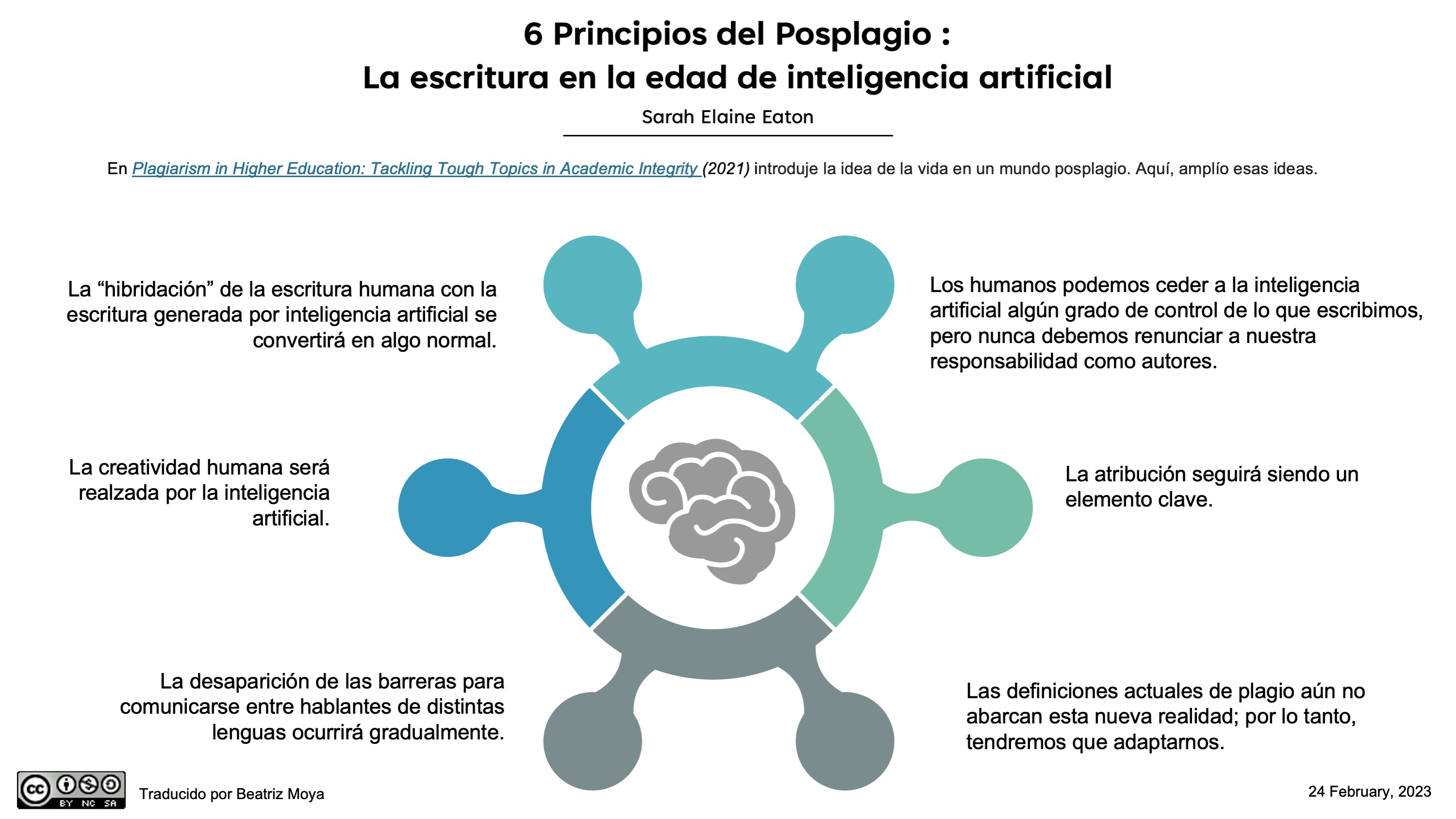
An infographic showing the 6 tenets of the post-plagiarism age. There is a circle with six points extending from it. There is an icon of a brain at the centre. These ideas were developed from the book, Plagiarism in Higher Education: Tackling Tough Topics in Academic Integrity (2021) by S. E. Eaton.

In the final chapter of Plagiarism in Higher Education: Tackling Tough Topics in Academic Integrity (2021) I contemplate the future of plagiarism and academic integrity. I introduced the idea of life in a postplagiarism world; thinking about the impact of artificial intelligence on writing. Here, I expand on those ideas. These 6 tenets characterize the post-plagiarism age:

Hybrid Human-AI Writing Will Become Normal

Hybrid writing, co-created by human and artificial intelligence together is becoming prevalent. Soon it will be the norm. Trying to determine where the human ends and where the artificial intelligence begins is pointless and futile.

Human Creativity is Enhanced

Human creativity is enhanced, not threatened by artificial intelligence. Humans can be inspired and inspire others. Humans may even be inspired by artificial intelligence, but our ability to imagine, inspire, and create remains boundless and inexhaustible.

Language Barriers Disappear

One’s first language will begin to matter less and less as tools become available for humans to understand each other in countless languages.

Humans can Relinquish Control, but not Responsibility

Humans can retain control over what they write, but they can also relinquish control to artificial intelligence tools if they choose. Although humans can relinquish control, they do not relinquish responsibility for what is written. Humans can – and must – remain accountable for fact-checking, verification procedures, and truth-telling. Humans are also responsible for how AI-tools are developed.

Attribution Remains Important

It always has been, and always will be, appropriate and desirable to appreciate, admire, and respect our teachers, mentors, and guides. Humans learn in community with one another, even when they are learning alone. Citing, referencing, and attribution remain important skills.

Historical Definitions of Plagiarism No Longer Apply

Historical definitions of plagiarism will not be rewritten because of artificial intelligence; they will be transcended. Policy definitions can – and must – adapt.

Translations of the Six Tenets of Postplagiarism

Since I first shared the Six Tenets of Postplagiarism, the infographic has been translated into French and Spanish. I am very grateful to the translators, who put in time and effort to go through the points in detail. Here are the translated versions:

Les 6 Principes du Postplagiat (French)

This translation was done by Dr. Elaine Beaulieu at the University of Ottawa, Canada.

Colleagues at the Université du Québec à Montréal (Canada), also wrote a web article in French. It is available here: https://collimateur.uqam.ca/collimateur/6-principes-de-lapres-plagiat-a-lere-de-lia/

6 Principios del Posplagio (Spanish)

The Spanish translation was done by Beatriz Moya, PhD candidate at the University of Calgary.

More Resources on PostPlagiarism

Check out my video on this topic on YouTube: https://youtu.be/NxFMMw1QZX0

Check out my article in University World News on this topic: “Artificial intelligence and academic integrity, post-plagiarism”

_________________________________

Share this:  6 Tenets of Postplagiarism: Writing in the Age of Artificial Intelligence https://drsaraheaton.wordpress.com/2023/02/25/6-tenets-of-postplagiarism-writing-in-the-age-of-artificial-intelligence/

This blog has had over 3 million views thanks to readers like you. If you enjoyed this post, please “like” it or share it on social media. Thanks!

Sarah Elaine Eaton, PhD, is a faculty member in the Werklund School of Education, and the Educational Leader in Residence, Academic Integrity, University of Calgary, Canada. Opinions are my own and do not represent those of the University of Calgary.


Fake Degrees and Fraudulent Credentials in Higher Education: A Synopsis of the Book

January 28, 2023

Fake Degrees and Fraudulent Credentials in Higher Education was published by Springer Nature in January, 2023. It features over a dozen chapters on various topics related the broad theme of credential fraud.

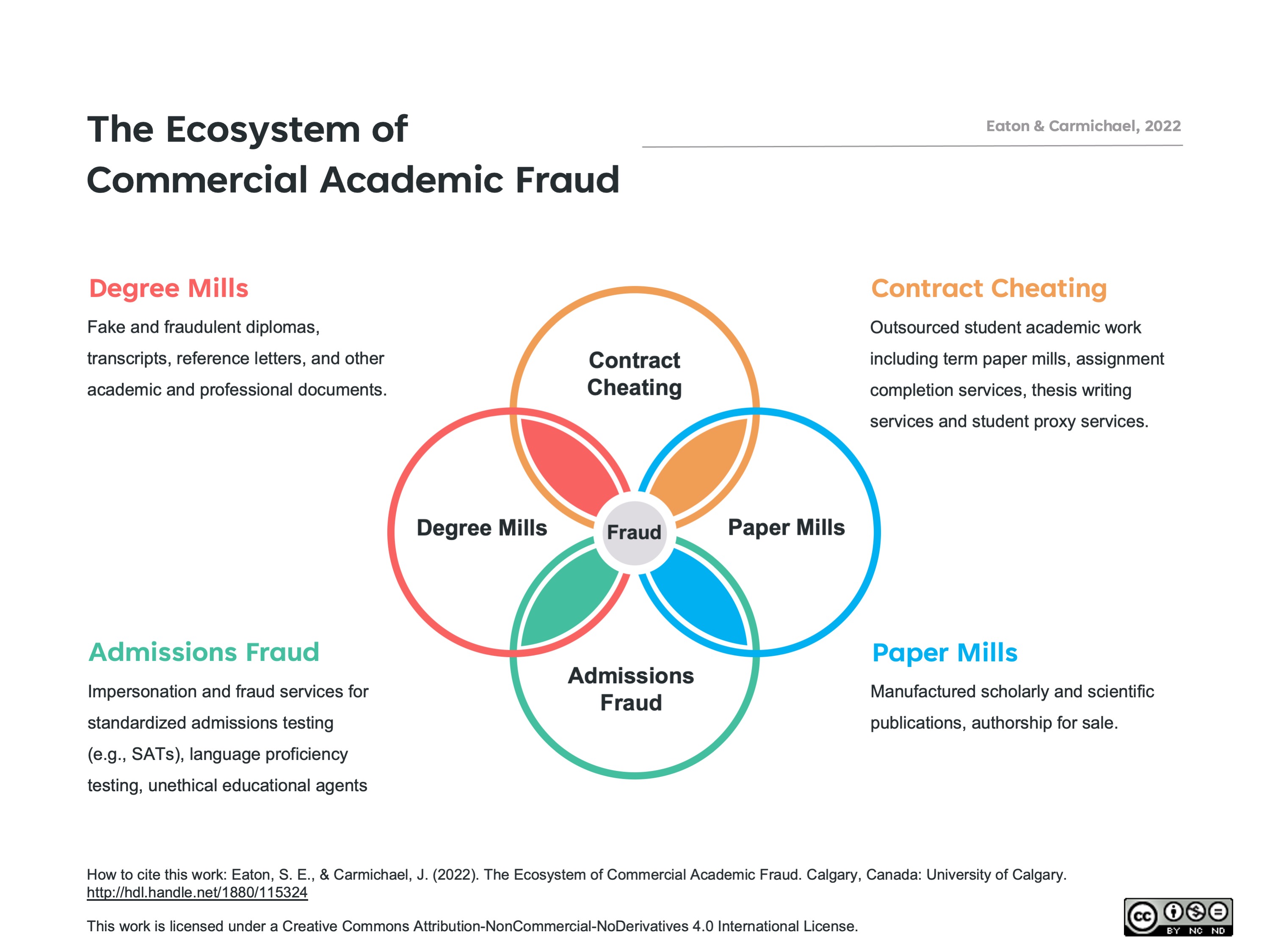
The introductory chapter includes an overview and historical perspectives of key issues. In this opening chapter, the authors connect the dots between the industries that supply fake degrees and fraudulent academic documents (including but not limited to bogus reference letters and tampered transcripts) to the contract cheating industries (e.g., term paper mills, student proxy services, and examination impersonators who take tests on behalf students) and to the admissions fraud industry. In addition, a connection is made to the scholarly paper mill industry which includes various violations of scientific publication ethics including fake data, fabricated scholarly articles and authorship for sale.

We present these connected industries through our Ecosystem of Commercial Academic Fraud model (Eaton & Carmichael, 2022). They synthesize what is known about the size and scope of the industry, estimating its valuation to be at least $21 Billion USD.

In Chapter Two, Jamie Carmichael and I (who are Canadian) argue that Canada is vulnerable to admission and credential fraud. This argument will be substantiated through (i) a survey that spanned coast-to-coast within Canada, (ii) media review that targeted the response to Operation Varsity Blues in Canadian newspapers, and (iii) a comparative analysis with another survey on this topic to gauge how Canada is fairing compared to others across the globe. This data triangulation resulted in an in-depth examination of admissions fraud in Canada, with 14 recommendations for practitioners, researchers, and those involved in policy reform.

In the third chapter, FBI Special Agent (retired), Allen Ezell, takes readers on a tour of “Axact, the world’s largest diploma mill”. Ezell has more than 40 years of experience investigating “fake high schools, colleges, universities, and counterfeiters” (p. 53). He writes that, “Axact is a classic example of a criminal enterprise. Even its own employees refer to it as the tower of frauds and house of lies.” (p. 49). This chapter is the longest in the book by far, spanning 49 pages, complete with concrete details, photos, and insider information not available anywhere else. Ezell explains that diploma mills, “are professional operations that take planning, preparation, and organization to run smoothly. Like legitimate businesses, they have business models, conduct market studies, have financial forecasts, perform cost analyses, set daily/ weekly/monthly sales goals, and offer sales incentives. They constantly survey their competition, and actions by law enforcement and regulators, to determine the direction the wind is blowing.” (p. 53)

Chapter Four, by Joanne Duklas, addresses how “digitization and technology have improved electronic exchange practices in the areas of document and data management and reduced occurrences of fraud thereby encouraging greater trust in the verification and assessment process for admission and transfer” (p. 95). Duklas discusses how background checks regularly show evidence of misrepresentation and fraud. Duklas’s in-depth exploration of  key issues related to electronic exchange processes. She provides details about Canada’s national document exchange network, MyCreds™ | MesCertif™, launched in 2020. She notes that, “Building solid bridges (technical infrastructure, standards, legislation, policies, and procedures) between issuers and receivers of official documents remains important for a trusted, quality assured ecosystem. Various technology solutions are solving credential fraud and creating greater trust in the chain of custody and bone fides of official documents.” (p. 110)

In Chapter 5, Kirsten Hextrum “considers how legal athletic admissions mirror the largest college admission conspiracy in US history: Operation Varsity Blues (OVB)” (p.  115). Hextrum analyzed 1487 college athletes’ demographic data; 47 life- history interviews with college athletes; and admission-related documents. Her results reveal how athletes invest to develop athletic talent, disputing college leaders’ claims that athletic admissions create diverse cohorts. She addresses important issues related to equity, diversity, and inclusion, as her findings show that “athletic investments create homogenous cohorts as White, middle-class youth are overrepresented as college athletes.” (p. 115). In addition, Hextrum discusses, “how colleges authenticate athletes’ credentials” (p. 115), finding that “universities use inconsistent and arbitrary measures—sometimes admitting athletes with little sport experience” (p. 115). Hextrum’s findings indicate that “athletic admissions misalign with the public’s interest because they are fixed to favour White, middle-class athletes and remain vulnerable to fraud” (p. 115).

In the next chapter, Stella-Maris Orim and Irene Glendinning, write about “Corruption in Admissions, Recruitment, Qualifications and Credentials” from the perspective of quality assurance. They draw on research conducted in 2017–2018 for the Council of Higher Education Accreditation’s International Quality Group (CIQG) “into how Accreditation and Quality Assurance Bodies (AQABs) respond to corruption” (p. 133). They address the question: Who is responsible for reducing corruption in education and research? (p. 133). They present findings from their empirical research, leading them to their evidence-informed conclusion that “higher education providers around the world are aware of corruption, fraud and malpractice in student assessment.”, but that “that much less attention has been given by institutions to the types of integrity breaches that we have looked at in this chapter, fraud in admissions and recruitment and in credentials and qualifications” (p. 145).

Chapter 7, by Özgür Çelik and Salim Razı, addresses favouritism and professorial recruitment practices in Turkish higher education institutions. They address the issue of fraud and corruption indirectly, through an analysis of 66 news stories that address favourtism in Turkish universities. They discuss how favouritism erodes public trust, noting that “the negative consequences of favouritism are far-reaching” (p. 154). Their findings showed that nepotism, cronyism, and patronage, were key areas of concern. They found that when specific individuals were identified for academic positions that customized job descriptions can be written so that only that particular individual could be deemed qualified. Although their chapter focuses specifically on Turkey, there are lessons that are transferrable to other countries with regards to corrupt hiring practices in higher education and other sectors.

The next two chapters address fraud in standardized English-language proficiency testing. Soroush Sabbaghan and Ismaeil Fazel’s chapter aims to “shed light on the complexities and the apparent disconnect between equity, integrity, fairness, and justice in standardized language proficiency tests and the integrity issues that can arise as a result” (p. 169). They point out that “at their core, standardized procedures imposed by testing centers ignore the fact that test-takers come from different socio-economic and sociocultural backgrounds with different interests, motivations and experiences of learning and using English” (p. 171). For those interested in exploring issues related to equity, diversity, and inclusion of international students, this chapter is a must read.

Angela Clark continues the discussion of fraud and corruption in English-language proficiency exams in her chapter that explores fraudulent test scores. Clark argues that “relying on a single language proficiency test score to determine an individual’s readiness is problematic, and also problematic is the lack of related academic research and data to help guide admissions decision-making” (p. 187). Clark presents concrete recommendations for “institutional stakeholders with ways to become better informed about these tests and their impact and approaches to help international NNES [non-native English-speaker] students succeed within their new academic disciplines and new academic culture” (p. 187) that include reconsidering admission criteria (p. 199) and instituting a post-entry language assessment (PELA) (p. 199).

In Chapter Ten, Brendan DeCoster uses systems theory to address admissions fraud. DeCoster explores the “culture of admissions fraud” in the United States. He proposes “a five-level framework for analyzing admissions fraud, noting how individuals, small groups and firms, larger firms, institutions, and political entities all play roles in establishing definitions of fraud, investigating fraud, prosecuting fraud, committing fraud, abetting fraud, and countering fraud” (p. 209). The five levels include micro, metaxy, meso, macro, and acro, and he provides examples for each level in his chapter.

Next, Jamie Carmichael leads a chapter on topic modelling, “an unsupervised machine learning technique commonly used in computer science as a research method” (p. 227). In this novel study, “data from 30 websites selling fake degrees were manually scraped, observations noted, and a topic model was built to identify risks within the dataset”, demonstrating that “that topic modeling can identify security risks by providing an environmental scan of the threat.” (p. 227). Twenty evidence-based recommendations are offered for higher education security professionals, senior leaders, and researchers.

In the penultimate chapter, together with Jamie Carmichael, I explore “what can happen when professor and educational leaders have fake or fraudulent degrees or other qualifications. We present four key issues: (a) the threat to institutional reputation; (b) the threat to the credentials awarded by the institutions; (c) the impact on students; and (d) material costs to the organization. Then, we propose seven recommendations to prevent or address academic qualification fraud: (a) verify applicant credentials; (b) develop or update internal risk assessment plans; (c) conduct an internal qualifications audit; (d) develop or update institutional codes of conduct; (e) develop an internal process to investigate allegations of credential fraud; (f) develop and follow internal quality assurance processes for courses, programs, and curricula; and (g) Develop or update crisis communications plans to include credential fakery or fraud. We conclude by emphasizing that moral outrage will not solve the problem of academic credential fraud.” (p. 251).

In our final chapter, we summarize key findings from the book, grouping them into “seven main categories: (a) historical perspectives and terminology; (b) a trend of global indifference; (c) criminal enterprises and security; (d) fraud in standardized language proficiency testing; (e) athletic credentialism; (f) the role of the institution; (g) hiring, and (h) technology. We discuss the significance and limitations of the book, concluding with calls to action for more research and resources to better understand and address the growing problem of the ecosystem of academic fraud that continues to grow” (p. 269).

This book was a passion project that we undertook during COVID-19. We hope it is useful to others who are dedicated to upholding academic integrity and raising awareness about the threats posed to higher education by fake degrees, fraud, corruption, and quackery.

Related posts

Just published! Fake Degrees and Fraudulent Credentials in Higher Education

Fake Degrees and Fraudulent Credentials: Research Project Update

Scholarships Without Scruples: 3 Signs of Bogus Scholarships and Scams

Why Universities and Colleges Need Clear Policies to Deal with Fake COVID-19 Vaccination Records and Test Results

Degrees of Deceit: A Webinar

_________________________________

Share or Tweet this: Fake Degrees and Fraudulent Credentials in Higher Education: A Synopsis of the Book https://drsaraheaton.wordpress.com/2023/01/28/fake-degrees-and-fraudulent-credentials-in-higher-education-a-synopsis-of-the-book/

This blog has had over 3 million views thanks to readers like you. If you enjoyed this post, please “like” it or share it on social media. Thanks!

Sarah Elaine Eaton, PhD, is a faculty member in the Werklund School of Education, and the Educational Leader in Residence, Academic Integrity, University of Calgary, Canada. Opinions are my own and do not represent those of the University of Calgary.