News story: Canadians can’t bribe their way into university

March 14, 2019

Jonathan Muma of City News Calgary stopped by campus today to talk with me about the college admissions scandal happening in the United States. The FBI investigation has led to 50 people being charged including celebrities Lori Loughlin and Felicity Huffman.

Many advocates of integrity and social justice have been actively discussing the scandal on social media. One key message is that parents, coaches and others in positions of authority are responsible for setting an example of integrity for young people to follow. Instead, in this case, parents and coaches have been exposed as frauds and conspirators. It begs the question: If young people can’t look up to their parents and their coaches, who can they look up to?

Not only it the entire situation a breach of institutional integrity and ethics in higher education, when we dig even deeper we can compare these stories to previous ones about African American mothers receiving jail time for trying to get their children an advantage.

This is not only a story about the corruption among the wealthy, it is also a story about white privilege and entitlement.

In the story I comment about how Canada and the US differ, but at the same time, I would add that Canada is not immune to social issues such as white privilege, entitlement or those with more money thinking they get to play by different rules. If there is one key takeaway from the college admissions scandal it is this: morality, integrity and ethics matter even before students enrol in university.

______________________________________________________

Share or Tweet this: News story: Canadians can’t bribe their way into university https://wp.me/pNAh3-2mW

This blog has had over 2 million views thanks to readers like you. If you enjoyed this post, please “like” it or share it on social media. Thanks!

Sarah Elaine Eaton is a faculty member in the Werklund School of Education, University of Calgary, Canada. Opinions are my own and do not represent those of the Werklund School of Education or the University of Calgary.


Academic Integrity (AI) Tutorials in Canadian Post-Secondary Institutions: A National Overview

March 11, 2019

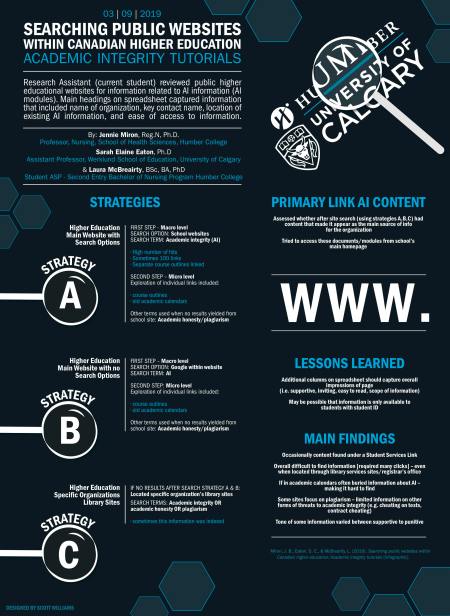
I’ve been working on a national research project with my colleagues, Jenny Miron and Laura McBrearity, at Humber College to look at what programming and supports Canadian post-secondary institutions provide to students to help them learn about academic integrity. We reviewed the websites of public higher education institutions across the country to better understand how academic integrity information is shared with students and faculty across campuses. We recently presented our findings at the conference of the International Center for Academic Integrity in New Orleans. Here’s a quick overview of our session:

Miron, J. B., Eaton, S. E., & McBrearity, L. (2019). Academic Integrity (AI) Tutorials in Canadian Post-Secondary Institutions: A National Overview. Paper presented at the International Center for Academic Integrity, New Orleans, LA.

The team at Humber College created this excellent visual infographic highlighting our methods (search strategies), lessons learned and key findings:

JPG (small) - Miron, Eaton & McBrearity - 2019 Final Infographic copy

We have not published the full findings yet, though we plan to do so soon. Because there is so little research available about what kind of support (e.g. education, tutorials, modules) offer on academic integrity to Canadian post-secondary students, we wanted to make these preliminary results available now.

You can download a high quality version of this infographic here:

Miron, J. B., Eaton, S. E., & McBrearity, L. (2019). Searching Public Websites within Canadian Higher Education: Academic Integrity Tutorials [Infographic]. Retrieved from http://hdl.handle.net/1880/109916

______________________________________________________

Share or Tweet this: Academic Integrity (AI) Tutorials in Canadian Post-Secondary Institutions: A National Overview

This blog has had over 2 million views thanks to readers like you. If you enjoyed this post, please “like” it or share it on social media. Thanks!

Sarah Elaine Eaton is a faculty member in the Werklund School of Education, University of Calgary, Canada. Opinions are my own and do not represent those of the Werklund School of Education or the University of Calgary.


Father Thomas Rosica: The Priest Who Plagiarized

February 26, 2019

There have been reports in the media recently about Father Thomas Rosica, the priest and Vatican spokesperson who has been plagiarizing material for years (Breen 2019a, 2019b). Just a few days after the story broke, Father Rosica resigned from his position on the governing body of the Collegium of the University of St. Michael’s College, University of Toronto.

Why is plagiarism by a priest so offensive? Well, for starters, the word “plagiarism” means “literary theft”. One of Ten Commandments that underpins Christian faith is “Thou Shalt Not Steal”.  Scholars of plagiarism have noted the act of plagiarism as being a transgression against Judeo-Christian values (Colon, 2001; Park, 2003).

According to the news reports (Brean, 2019a, 2019b), Father Rosica claimed that his plagiarism was unintentional, a result of having to meet demanding media deadlines. Being unable to cope with time pressure and deadlines is often one reason cited in the literature as to why students commit plagiarism.

But there’s a key difference. Father Rosica is not a student. He is a high-ranking Church official who presumably has the agency as an adult to manage his time.

And presumably, a highly educated priest should have known better. It is hard to believe this was a sin of ignorance.

According to news reports (Brean 2019a, 2019b), the optics worsened when Father Rosica allegedly cast blame towards junior staff who helped him prepare the content of his communications.

Let’s get one thing straight. It is wrong to plagiarize. It’s even worse to blame others when you are the one responsible for the communication. It seems that Father Rosica has confessed his sins and seeks forgiveness, which I have every confidence he will be granted. But forgiveness does not equate to the restoration of the public’s confidence. Nor can forgiveness fix an individual’s reputation.

Father Rosica is in a position of great moral authority and power. Plagiarism is a moral transgression, even when it isn’t a legal one. In certain professions (including priesthood), reputation is everything. I suspect that although Father Rosica may be granted the forgiveness he seeks, the damage to his reputation may be irreparable.

References:

Brean, J. (2019a, February 22). ‘It’s wrong’: Vatican media adviser admits to ‘cut and paste’ plagiarism for over a decade. National Post. Retrieved from https://nationalpost.com/news/its-wrong-vatican-media-advisor-admits-to-cut-and-paste-plagiarism-in-his-columns-and-essays

Brean, J. (2019b, February 25). After plagiarism apology, influential priest resigns from Toronto college board. National Post. Retrieved from https://nationalpost.com/news/canada/after-plagiarism-apology-influential-priest-resigns-from-toronto-college-board

Colon, A. (2001). Avoid the pitfalls of plagiarism. The Writer, 114(1), 8.

Park, C. (2003). In other (people’s) words: Plagiarism by university students – literature and lessons. Assessment and Evaluation in Higher Education, 28(5), 471-488. http://www.lancaster.ac.uk/staff/gyaccp/caeh_28_5_02lores.pdf doi:10.1080/0260293032000120352

______________________________________________________

Share or Tweet this: Father Thomas Rosica: The Priest Who Plagiarized https://wp.me/pNAh3-2mM

This blog has had over 2 million views thanks to readers like you. If you enjoyed this post, please “like” it or share it on social media. Thanks!

Sarah Elaine Eaton is a faculty member in the Werklund School of Education, University of Calgary, Canada.

Opinions are my own and do not represent those of the Werklund School of Education or the University of Calgary.


The ethics of outsourcing: Contract cheating in the health professions

February 15, 2019

This morning I had the pleasure of providing a continuing education session to the Orthopaedic Surgeons at their City Wide (Grand) Rounds. The session was offered live at the Foothills campus and participants from various hospitals around the city joined by video conference.

2019 02 15 Ortho CWR Poster[1]Learning Objectives:

  • Define and explain what contract cheating is
  • Explain how the global contract cheating industry works
  • Understand the impact of contract cheating among medical and health program students

Here’s a copy of the title slide:

Title slide - Orthopaedic surgery rounds

References:

Bagshaw, E. (2016, May 26). University of Sydney’s medical school in second cheating controversy. Sydney Morning Herald. Retrieved from https://www.smh.com.au/education/university-of-sydneys-medical-school-in-second-cheating-controversy-20160525-gp3g3h.html

Bretag, T. (2017). Tertiary Education Quality and Standards Agency, Good Practice Note: Addressing contract cheating to safeguard academic integrity  Retrieved from https://www.teqsa.gov.au/latest-news/publications/good-practice-note-addressing-contract-cheating-safeguard-academic

Clarke, R., & Lancaster, T. (2006). Eliminating the successor to plagiarism: Identifying the usage of contract cheating sites. Paper presented at the Second International Plagiarism Conference, Gateshead, UK.

Curtis, G. J., & Clare, J. (2017). How Prevalent is contract cheating and to what extent are students repeat offenders? Journal of Academic Ethics, 15(2), 115-124. doi:10.1007/s10805-017-9278-x

Eaton, S. E. (2018). Contract cheating: A Canadian perspective.  Retrieved from http://blogs.biomedcentral.com/bmcblog/2018/07/24/contract-cheating-a-canadian-perspective/

Eaton, S. E., & Edino, R. I. (2018). Strengthening the research agenda of educational integrity in Canada: A review of the research literature and call to action. Journal of Educational Integrity, 14(1). Retrieved from https://edintegrity.biomedcentral.com/articles/10.1007/s40979-018-0028-7 doi:https://doi.org/10.1007/s40979-018-0028-7

Hosney, M. I., & Fatima, S. (2014). Attitude of students towards cheating and plagiarism: University case study. Journal of Applied Sciences, 14(8), 748-757. doi:10.3923/jas.2014.748.757

International Center for Academic Integrity. (2016). Institutional toolkit to combat contract cheating  Retrieved from http://integrity.fiu.edu/pdfs/Contract%20Cheating.pdf

Lancaster, T. (2018). US in first place for essays orders (not surprising), with the UK and Canada in equal second place [Tweet].   Retrieved from https://twitter.com/DrLancaster/status/1029014675198013440

Lancaster, T., & Clarke, R. (2008). The phenomena of contract cheating. In T. S. Roberts (Ed.), Student plagiarism in an online world: Problems and solutions (pp. 144-158). Hershey, PA: Idea Group Inc.

Lancaster, T., & Clarke, R. (2015). Examining contract cheating, essay mill use and academic misconduct by students on health courses.  Retrieved from https://www.researchgate.net/publication/323425525_Examining_Contract_Cheating_Essay_Mill_Use_and_Academic_Misconduct_by_Students_on_Health_Courses

Newton, P. M., & Lang, C. (2016). Custom essay writers, freelancers, and other paid third parties. In T. Bretag (Ed.), Handbook of Academic Integrity (pp. 249-271). Singapore: Springer Singapore.

O’BRien, N., & Smith, A. (2015, June 6). Cheating scandal: Sydney university to review medical study unit. Sydney Morning Herald. Retrieved from https://www.smh.com.au/education/cheating-scandal-sydney-university-to-review-medical-study-unit-20150606-ghi5d2.html

Plagiarism.org. (2017). How big of a problem in contract cheating?   Retrieved from http://www.plagiarism.org/blog/2017/12/12/how-big-of-a-problem-is-contract-cheating

Quality Assurance Agency for Higher Education (UK) (QAA). (2017). Contracting to cheat in higher education: How to address contract cheating, the use of third-party services and essay mills  Retrieved from http://www.qaa.ac.uk/en/Publications/Documents/Contracting-to-cheat-in-higher-education.pdf

Rogerson, A. M. (2017). Detecting contract cheating in essay and report submissions: process, patterns, clues and conversations. International Journal for Educational Integrity, 13(1), 10. doi:10.1007/s40979-017-0021-6

Tonkin, A. L. (2015). “Lifting the carpet” on cheating in medical school exams. BMJ: British Medical Journal, 351(August), 22-29.

Turnitin. (2013). Paying for plagiarism (webinar). Retrieved from http://go.turnitin.com/webcast/paying-for-plagiarism

University of Alberta. (n.d.). Student Conduct and Accountability: Proving Misconduct.   Retrieved from https://www.ualberta.ca/provost/dean-of-students/student-conduct-and-accountability/proving-misconduct

Walker, M., & Townley, C. (2012). Contract cheating: A new challenge for academic honesty? Journal of Academic Ethics, 10(1), 27–44. https://doi.org/10.1007/s10805-012-9150-y

If you would like  a copy of this talk, please e-mail me at seaton (at) ucalgary (dot) ca

______________________________________________________

Share or Tweet this: The ethics of outsourcing: Contract cheating in the health professions https://wp.me/pNAh3-2mw

This blog has had over 2 million views thanks to readers like you. If you enjoyed this post, please “like” it or share it on social media. Thanks!

Sarah Elaine Eaton is a faculty member in the Werklund School of Education, University of Calgary, Canada.

Opinions are my own and do not represent those of the Werklund School of Education or the University of Calgary.


Exploring the Intersection Between Culturally Responsive Pedagogy and Academic Integrity Among EAL Students in Canadian Higher Education

February 12, 2019

JET 50(1)My colleague, Amy Burns, and I recently published this article in the Journal of Educational Thought.

Abstract

ABSTRACT: In this article, we examine selected literature on the implementation of culturally responsive pedagogy in higher education with regard to academic integrity among international students who speak English as an Additional Language (EAL). The question that guided this work was: How can Canadian post-secondary educators demonstrate culturally sensitive responses to plagiarism for international EAL students? Within this examination we used Sleeter’s (2011) critique of culturally responsive pedagogy as a framework to deepen our reflection of how to address plagiarism issues among the EAL population. We related each of Sleeter’s four observances of oversimplification to the notion of plagiarism and its prevention, to contextualize and connect the notion of culturally responsive pedagogy to academic integrity. Using the research literature to ground our recommendations, we conclude with strategies for instructors to support culturally responsive ways of addressing plagiarism with international EAL higher education students.

Keywords: culturally responsive pedagogy, higher education, English as an Additional Language, academic integrity, Canada, plagiarism

Please cite this article as: Eaton, S. E., & Burns, A. (2018). Exploring the intersection between culturally responsive pedagogy and academic integrity among EAL students in Canadian higher education. Journal of Educational Thought, 51(3), 339-359.

If you are interested in receiving a full copy of this article send me an email at:

seaton (at) ucalgary (dot) ca

______________________________________________________

Share or Tweet this: Exploring the Intersection Between Culturally Responsive Pedagogy and Academic Integrity Among EAL Students in Canadian Higher Education https://wp.me/pNAh3-2mr

This blog has had over 2 million views thanks to readers like you. If you enjoyed this post, please “like” it or share it on social media. Thanks!

Sarah Elaine Eaton is a faculty member in the Werklund School of Education, University of Calgary, Canada.

Opinions are my own and do not represent those of the Werklund School of Education or the University of Calgary.