Call for Proposals: Canadian Symposium on Academic Integrity

January 2, 2019

header-bg-date

We invite submissions for the Canadian Symposium on Academic Integrity. All submissions will undergo double-blind peer review. Successful proposals will be invited to submit full papers for peer-reviewed proceedings.

Submit your proposal here: https://ocs.ucalgary.ca/index.php/CSAI/2019CSAI/about/submissions#onlineSubmissions

Abstract

500 words, maximum. Summarize the scope, purpose, results and educational implication of your work. Indicate the value of your proposed submission to symposium participants.

Include 5-10 keywords. We encourage the use of  “Canada” as one of your keywords.

Types of submissions

Paper: We welcome a variety of formats including but not limited to: Empirical research, conceptual scholarship, policy analyses, evidence-informed position papers, community outreach and case studies. Submissions should be substantiated with high quality evidence (e.g. references). Time: 20 minutes, with and additional 5 minutes for Q & A

Poster: We welcome posters that showcase one of these particular kinds of contributions:

  • institutional initiatives (departmental, faculty or institutional)
  • student inquiry / research

All presenters are expected to register for the conference and pay the registration fee, even if only one presenter shares the work on behalf of a partnership or a group.

We regret that we are unable to accommodate virtual presentations. Presenters must attend in person to share their work.

Author Guidelines

We request that authors attend to these submission guidelines:

  • Submit in Word format.
  • English is the primary language of the conference.
  • Submissions should be approximately 500 words, including references.
  • 2-3 Key learning outcomes. “At the end of the session, participants will be able to…”
  • How to make your session interactive.
  • Include tables and figures within the body of your submission, labelled as per APA.
  • Use APA 6th edition for style, formatting, citations and references
  • Double-spaced
  • 12-point font
  • 1-inch margins on all sides
  • Title: Maximum 12 words
  • Use concise headings
  • Use up to three levels of headings.
  • Organize your submission with key elements such as: Introduction; Conceptual/Theoretical Framework; Methodology / Approach; Results / Findings; Significance/Implications; Conclusion; References. (These are just suggestions.)
  • Author bios – 50 words each.

Ensure all sources cited in the body of your submission are also listed in the References. Limit self-citations to a maximum of 3 sources.

Submissions should be blind, meaning that author information should not appear anywhere in the paper. Author information should also be stripped out of the metadata (i.e. document properties).

Ensure your submission clearly shows the value-add your submission would have for symposium participants.

The submitting author is responsible for ensuring that any and all co-authors have read and approved the final submission.

Check out the full symposium details here: . Registration fees apply.

Deadline to submit proposals: Extended to February 15, 2019!

Check out our Quick Guide with tips on how to submit your proposal – csai – proposal submission quick guide

______________________________________________________

Share or Tweet this:  Call for Proposals: Canadian Symposium on Academic Integrity https://wp.me/pNAh3-2m9

This blog has had over 2 million views thanks to readers like you. If you enjoyed this post, please “like” it or share it on social media. Thanks!

Sarah Elaine Eaton is a faculty member in the Werklund School of Education, University of Calgary, Canada.

Opinions are my own and do not represent those of the Werklund School of Education or the University of Calgary.


Research Assistant job posting – Canadian Symposium on Academic Integrity – April 2019

October 24, 2018

University of Calgary logoWe are planning a national symposium on academic integrity at the University of Calgary. I’ll be sharing more details about the symposium soon. Right now, we are looking for a Research Assistant to help us with the planning, organization and management of the Canadian Symposium on Academic Integrity – April 17-18, 2019.

A job description is below. We are expecting this role to have an increasing time commitment as we approach the actual event in April, so availability during March and April 2019 is critical.

This position is open to both undergraduate and graduate students, currently enrolled at the University of Calgary. Being currently enrolled as a student at the University of Calgary is a requirement for this position.

There is one position available and the person must be available to work in person on campus. A full job description follows.

Research Assistant – Job Description

Project: Canadian Symposium on Academic Integrity – April 17-18, 2019

Start date: Immediate

Maximum: 12 hours/week (3 hour shifts) – Scheduled as per project needs.

Work term: Fall 2018 and Winter 2019 terms

Work location: University of Calgary, main campus

Job Description:

The Research Assistant is responsible for working as part of the symposium planning team that supports the Canadian Symposium on Academic Integrity

Duties include:

  • Attend and actively participate in team meetings.
  • Assist with symposium planning and logistics.
  • Assist with symposium promotion, including social media.
  • Maintain detailed and organized project documentation, including reports, team meeting notes, etc.
  • Manage a team of student volunteers.
  • Assist with the preparation and publication of peer-reviewed conference proceedings.
  • Communicate with conference participants, as needed.
  • Assist with clerical work as needed.
  • Other duties as assigned.

Previous Experience/Qualifications:

  • Must be currently enrolled as a student at the University of Calgary.
  • Previous experience with event planning and/or volunteer coordination is an asset.
  • Independent and self-driven candidate is ideal.
  • Ability to function independently yet collaboratively within a team.
  • Attention to detail is critical.
  • Exceptional communication skills required to interact with other staff members, conference participants.
  • Excellent oral and written skills in English.
  • Commit to being fully available in person for conference preparations April 8—16, 2019.
  • Commit to attending the symposium in person for full-days on April 17-18, 2019.

Additional Information:

This is a part-time, casual position. We anticipate this role will include a maximum of 175 hours, distributed over shifts of not less than 3 hours and not more than 7 hours, with a maximum of 12 hours per week. There will be no hours scheduled on weekends or statutory holidays.

This is an on-campus position and the successful individual must be available in person for team meetings.

Application deadline: Friday, November 16, 2018

Please submit your cover letter and c.v. to the Symposium Co-Chairs:

Dr. Sarah Elaine EatonDr. Jennifer Lock, and  Dr. Meadow Schroeder

______________________________________________________

Share or Tweet this: Research Assistant job posting – Canadian Symposium on Academic Integrity – April 2019 https://wp.me/pNAh3-2m6

This blog has had over 2 million views thanks to readers like you. If you enjoyed this post, please “like” it or share it on social media. Thanks!

Sarah Elaine Eaton is a faculty member in the Werklund School of Education, University of Calgary, Canada.

Opinions are my own and do not represent those of the Werklund School of Education or the University of Calgary.


2018 International Day of Action Against Contract Cheating

October 4, 2018

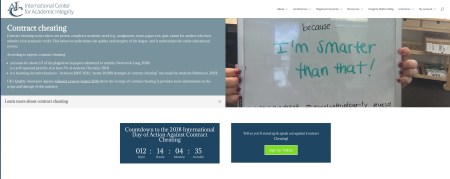
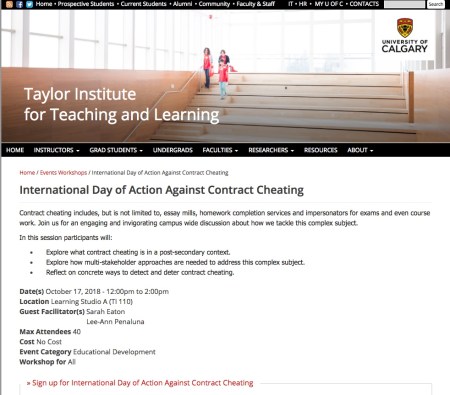
At the University of Calgary we will mark the International Day of Action Against Contract Cheating on October 17, 2018. We join with dozens of other institutions worldwide who have pledged their commitment to take action by registering their participate with the International Center for Academic Integrity.

ICAI Intl Day of Action 2018.jpeg

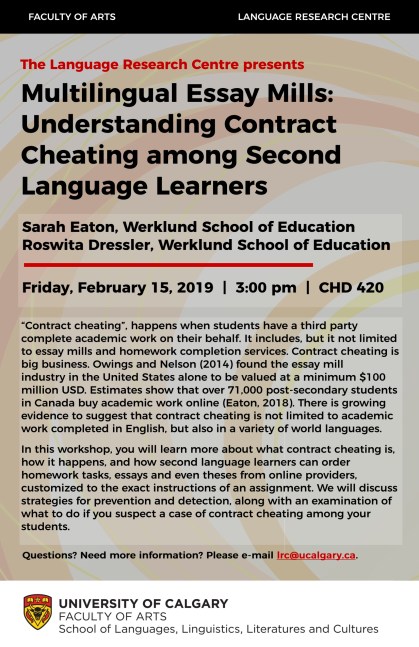
Contract cheating includes, but is not limited to, essay mills, homework completion services and impersonators for exams and even course work. Join us for an engaging and invigorating campus-wide discussion about how we tackle this complex subject.

At the University of Calgary, I’ll be co-hosting a campus-wide event with our our Academic Integrity Coordinator, Lee-Ann Penaluna, hosted by the Taylor Institute for Teaching and Learning.

In this session participants will:

  • Explore what contract cheating is in a post-secondary context.
  • Explore how multi-stakeholder approaches are needed to address this complex subject.
  • Reflect on concrete ways to detect and deter contract cheating.

We are excited to announce we’ll have a special guest presentation via Skype from Dr. Thomas Lancaster, from the UK, whose is one of the world’s leading experts on contract cheating.

We will also join in the social media white board campaign, using the hashtags #excelwithintegrity and #defeatthecheat.

2018 International Day of Action Against Contract Cheating

The event is open to everyone on campus, including students, faculty, staff and others. We also welcome members of the public to find out more about what contract cheating is and how to take action to promote integrity in education. Register to attend the University of Calgary event here.

______________________________________________________

Share or Tweet this:  2018 International Day of Action Against Contract Cheating

This blog has had over 2 million views thanks to readers like you. If you enjoyed this post, please “like” it or share it on social media. Thanks!

Sarah Elaine Eaton is a faculty member in the Werklund School of Education, University of Calgary, Canada.

Opinions are my own and do not represent those of the Werklund School of Education or the University of Calgary.


New article: Strengthening the research agenda of educational integrity in Canada

July 25, 2018

There’s been lots of research done about plagiarism, cheating and other topics related to academic integrity, but how much of it has actually been done in — or about — Canada? That’s the question my co-author, Rachael Ileh Edino, and I asked when we set out on a journey to review the published research literature about these topics, casting a specific lens on the Canadian context.

The results have been published by the International Journal for Educational Integrity.

Article screen shot.jpeg

Abstract

We present findings of a literature review on the topic of educational integrity in the Canadian context. Our search revealed 56 sources, published between 1992 and 2017. A historical overview showed a rise in the number of scholarly publications in recent years, but with an overall limited number of research contributions. We identified three major themes in the literature: (a) empirical research; (b) prevention and professional development; and (c) other (scholarly essay). Our analysis showed little evidence of sustained research programs in Canada over time or national funding to support integrity-related inquiry. We also found that graduate students who completed their theses on topics related to educational integrity often have not published further work in the field later in their careers. We provide five concrete recommendations to elevate and accelerate the research agenda on educational integrity in Canada on a national level. We conclude with a call to action for increased research to better understand the particular characteristics of educational integrity in Canada.

Check out the entire article: Strengthening the research agenda of educational integrity in Canada: a review of the research literature and call to action.

______________________________________________________

Share or Tweet this: New article: Strengthening the research agenda of educational integrity in Canada https://wp.me/pNAh3-2kC

This blog has had over 2 million views thanks to readers like you. If you enjoyed this post, please “like” it or share it on social media. Thanks!

Sarah Elaine Eaton is a faculty member in the Werklund School of Education, University of Calgary, Canada.

Opinions are my own and do not represent those of the Werklund School of Education or the University of Calgary.


Using video posts to promote engagement in online graduate learning

July 16, 2018

The first time I engaged with a group via e-learning was in 2005. I have been teaching graduate courses online since 2011. We often follow a standard learning design of having students read material and then write an online discussion post summarizing and/or reflecting on their readings. They repeat this format in just about every course they take. Students have anecdotally reported that they find this process tiresome, static and not very productive in terms of learning.

As a course instructor, I also find it somewhat unproductive. Don’t get me wrong. I firmly believe that written tasks have their place. At the same time, I also believe that we can provide students with challenging and engaging ways of learning that go beyond the traditional text post on a discussion board.

With that in mind, I have been playing around with using video to make online learning more engaging for my students. Since the course I am teaching right now is as Master’s level course called Language Learning and Technology, we are learning about how to incorporate technology into learning meaningful ways. I figured that if continue to engage through traditional text-posts, we are not really learning how to incorporate technology in new ways! So, I  have challenged the students to do video posts about their course readings, instead of their usual weekly write ups. Students are creating and sharing videos of 3 minutes or less that classmates and I can read and respond to. Students post their videos within our learning management system (D2L) that is associated with the course.

To lead by example, I have also been posting weekly videos welcoming students to each week of the course. In this week’s video post, I offer my own reflections on a recent article that I read, showing them how they can do their own reflections on a reading in their video posts.

Reflections on what I have learned from an instructional perspective

I realized after I posted my video that I could have conducted a more in-depth reflection in my post. This was good learning for me, because I had a lot more thoughts swirling around in my head about the reading I did, but I didn’t express them all in the video. In a written post, I would have taken the time to write, edit, revise and then maybe edit and revise some more. In the video post, I shared my reflections, but didn’t fuss over whether it was perfect. I will be mindful of this when I engage in my assessment of students’ learning using this format.

You can see that I start off with the date, and mentioning the weather for today in Calgary, where I live. I wanted to show students that I was not recycling material and that what I was creating for them was new and fresh.

I think showing that the material is new not only enhances learning and promotes principles of academic integrity, it shows we are not being lazy as instructors. I think that traditional text posts can be problematic in terms of academic integrity because students may be tempted, from time to time, to have someone else write posts on their behalf. This is a form of contract cheating (where a third party completes work on behalf of a student). Curtis and Clare (2017) reported that about 3.5% of students admitted to contract cheating. Even though that percentage is small, it is still important for instructors to offer students ways of demonstrating learning in ways that go beyond traditional writing tasks. It is important for instructors to changes the circumstances that might make it easier or more tempting for students to have someone else complete work on their behalf.

I mention this only because I research and write about topics related to academic integrity, so it’s always on my mind. By and large, I think our students are committed to their learning and act with integrity as professionals and as learners.

My intention with these activities is to offer students an opportunity to engage in ways other than text that is authentic and interesting. The process of reflecting on readings is different when we engage verbally than in writing. We are still using text-based elements of the course such as replies to weekly posts, but so far, video seems to providing a fun-yet-rigorous way for students to showcase their learning.

References:

Curtis, G. J., & Clare, J. (2017). How prevalent is contract cheating and to what extent are students repeat offenders? Journal of Academic Ethics, 15(2), 115-124. doi:10.1007/s10805-017-9278-x

Kumar Basak, S., Wotto, M., & Bélanger, P. (2018). E-learning, M-learning and D-learning: Conceptual definition and comparative analysis. E-Learning and Digital Media, 15(4), 191-216. doi:10.1177/204275301878518

______________________________________________________

Share or Tweet this: Using video posts to promote engagement in online graduate learning

This blog has had over 2 million views thanks to readers like you. If you enjoyed this post, please “like” it or share it on social media. Thanks!

Sarah Elaine Eaton is a faculty member in the Werklund School of Education, University of Calgary, Canada.

Opinions are my own and do not represent those of the Werklund School of Education or the University of Calgary.