New Journal: Canadian Perspectives on Academic Integrity

March 13, 2018

I’m so pleased to announce the launch of a new journal: Canadian Perspectives on Academic Integrity.

CPAI

We officially launched the journal on March 3, 2018 at the annual conference of the International Center for Academic Integrity, held in Richmond, Virginia.

Focus and Scope

The objectives of this online, open source journal is to provide Canadian practitioners working in the area of academic integrity with a venue to share experiences and insights about their work.

This journal is focused on the Canadian context. Submissions are accepted from those with an e-mail address from a Canadian educational institution. Independent scholars without a Canadian institutional address should contact the editor before submitting a manuscript.

Open Access Policy

This journal provides immediate open access to its content on the principle that making research freely available to the public supports a greater global exchange of knowledge.

Inaugural Issue

The inaugural issue features articles from some wonderful expert Canadian practitioners. The first, from Leeanne Morrow is, “Academic integrity outreach: Supporting high school students for success in higher education“. In this article, Morrow talks about the outreach she does with local secondary students to help them understand what academic integrity is and how knowing about it will benefit them once they are in university.

In the second article, Loie Gervias, talks about “Launching an institutional academic integrity campaign“. She offers practical tips on what works, what doesn’t and also shares some of the marketing materials her team used in their own campaign.

Brandy Usick and I also offer tips and advice in our “Writers’ guide for prospective contributors“. Our objective is to encourage those who work in the field of academic integrity as professional practitioners to share their knowledge, insights and wisdom.

We are looking forward to adding more contributors and articles as the journal continues to evolve.

______________________________________________________

Share or Tweet this: New Journal: Canadian Perspectives on Academic Integrity

This blog has had over 1.8 million views thanks to readers like you. If you enjoyed this post, please “like” it or share it on social media. Thanks!

Sarah Elaine Eaton is a faculty member in the Werklund School of Education, University of Calgary, Canada.

Opinions are my own and do not represent those of the Werklund School of Education or the University of Calgary.


How parents help their kids cheat in school

March 6, 2018

I recently heard an acquaintance complain about how tired they were at work one morning. The reason? “I was up all night working on my kid’s science project.”

The parent was adamant that their child had to “do well” on the science project. To that parent, “doing well” meant getting a good grade and receiving praise (and possibly a prize) from the judges. It wasn’t about if or how much their child learned during the process.

That got me thinking about the various ways I’ve observed parents helping their kids cheat in school. Here are a few:

Doing the work for them

When parents do their kids’ homework for them, students don’t learn.

Fixing all the mistakes

When parents fix all the mistakes so their child can hand in a perfect assignment, it doesn’t show the teacher how the student needs to improve.

Re-writing it

When parents re-write a student’s work to make it sound better, the end product does not reflect the student’s current writing ability.

Re-designing it

When parents re-work the slide deck or improve the design of a project, the end product shows what the parent can do, not the child.

Doing all the research

Parents are not helping their kids learn when they do all the background research for a project.

5 Ways parents help their kids cheat in school.jpg

Parents need to stop equating doing their children’s school work as an act of service that shows their children how much they love them. Doing a child’s school work does not send the message, “I love you!” Instead, it enables the child to avoid learning things for themselves.

When parents to school work on behalf of their children, it is a form of cheating. In fact, it is part of special kind of academic dishonesty called “contract cheating”. This is when a student has someone else do their work on their behalf. Contract cheating can happen when students buy their school work off the internet for money, or when they agree to have anyone else do their work for them, even if no money is exchanged. There is still an implicit contract in place: Someone else is doing the work on behalf of the student.

Parents can be active partners in their child’s success when they focus on learning as a process, not as an end product. That is why it is important for parents to help children learn skills like writing, designing and researching and to improve their skills over time. Learning isn’t about being perfect; it is a lifelong process that keeps going long after students leave school.

I am not saying this is easy. The temptation to “help” a child succeed can be strong. It is important for parents to understand that helping does not mean doing the student’s work for them.

______________________________________________________

Share or Tweet this: How parents help their kids cheat in school https://wp.me/pNAh3-2hd

This blog has had over 1.8 million views thanks to readers like you. If you enjoyed this post, please “like” it or share it on social media. Thanks!

Sarah Elaine Eaton is a faculty member in the Werklund School of Education, University of Calgary, Canada.

Opinions are my own and do not represent those of the Werklund School of Education or the University of Calgary.


Why you shouldn’t post your teaching dossier online

January 30, 2018

Students and colleagues sometimes ask me if they should post their teaching dossier or portfolio online. My answer is immediate: No!

Those who know me know that I am a big fan of developing a strong online professional presence. I encourage students and colleagues to keep their LinkedIn, Twitter, and other online professional profiles current. But there’s something about a teaching dossier that’s different. I couldn’t put my finger on it until I read an article by White & Conrod (2016) where they tell the story of how their teaching philosophies were plagiarized.

Your teaching philosophy is a key element of your dossier. Developing it is hard work. It involves some deep reflection, brain work and soul-searching. You dig deep into yourself to figure out who you are as an educator, what matters to you and why it matters. Honestly, articulating your teaching philosophy may be the single most difficult element of putting together your teaching dossier. When it’s done, it should be a reflection of who you are and what matters to you as an educator.

Other people may have similar philosophies, but in the end, your statement is about you and your values. It is yours and yours alone.

If you post it online, it becomes easy for others to cut-and-paste what you have shared. These may not be bad people. They may be too afraid or too intimidated to engage in the deep reflection required to develop a philosophy of their own. Who knows? My point is, don’t make it easy for others to steal your teaching philosophy.

Share your dossier selectively, with those who need it, such as employers or those evaluating your teaching. You might also choose to share your dossier with those who would benefit from it, such as students or junior colleagues. That does not mean you have to post it publicly online. You have other options:

Alternatives to posting your teaching dossier publicly online

  1. Share print copies of your work. This may sound old fashioned, but if someone does not require digital access to your dossier and a paper copy works just as well, why not? You might choose to add “Confidential” to the header or footer to make it clear you do not want it to be shared widely.
  2. Save a copy of your work in a digital format that is hard to copy. An protected .pdf isn’t foolproof, but it is an option. Another option is to save your work as a .jpg., but if you choose this route, be sure that the .jpg is high quality and easy to read.
  3. Save your work as a password protected or “read only” online document. Share the password or link with caution.

Again, share selectively and make it clear that your work is not for distribution.

I suspect that some people who are vehement believers in open access or the sharing culture may disagree with my stance on this issue. There are plenty of websites that offer tips about how to post your entire dossier online. Don’t get me wrong. I share lots of my work online, free of charge in an open access format. It may be OK to share parts of your teaching dossier publicly online, such as your previous teaching experience, but not all of it. The key is to think critically about what you want to share and how you choose to do that.

It is important to understand that the more publicly you share, the easier you make it for others to copy-and-paste your deep thoughts, rather than engaging in their own soul-searching journey. If you want to offer others a short-cut and do the hard work for them, that is an option. But if you’d rather not, think twice before posting your entire teaching dossier publicly online.

The point is for you to think critically about who you want to have access to your inner most values about teaching. In my view, your teaching philosophy is a key element of your identity as an educator. Don’t make it easy for others to steal your professional identity.

Reference:

White, M. A., & Conrod, J. D. (2016). Is nothing sacred? Our personal teaching philosophies have been plagiarized. University Affairs. Retrieved from https://www.universityaffairs.ca/opinion/in-my-opinion/is-nothing-sacred-our-personal-teaching-philosophies-have-been-plagiarized/

______________________________________________________

Share or Tweet this: Why you shouldn’t post your teaching dossier online https://wp.me/pNAh3-2gr

This blog has had over 1.8 million views thanks to readers like you. If you enjoyed this post, please “like” it or share it on social media. Thanks!

Sarah Elaine Eaton is a faculty member in the Werklund School of Education, University of Calgary, Canada.

Opinions are my own and do not represent those of the Werklund School of Education or the University of Calgary.


21st century definition of plagiarism

January 23, 2018

Not long after I started getting interested in academic integrity, I began wondering how different universities defined plagiarism in their official policy documents. That led me to do an analysis of policy documents from 20 Canadian higher education institutions, and the results were published in the peer-reviewed scholarly journal, Interchange. Basically, what I found was that there was no consistent definition of plagiarism across Canadian post-secondary institutions. In other words, we don’t agree about what actually constitutes plagiarism.

This makes it confusing for students and for professors, especially considering that students might attend one school to do their undergraduate degree and another for their graduate degree, or that professors sometimes change jobs, leaving one institution for another.

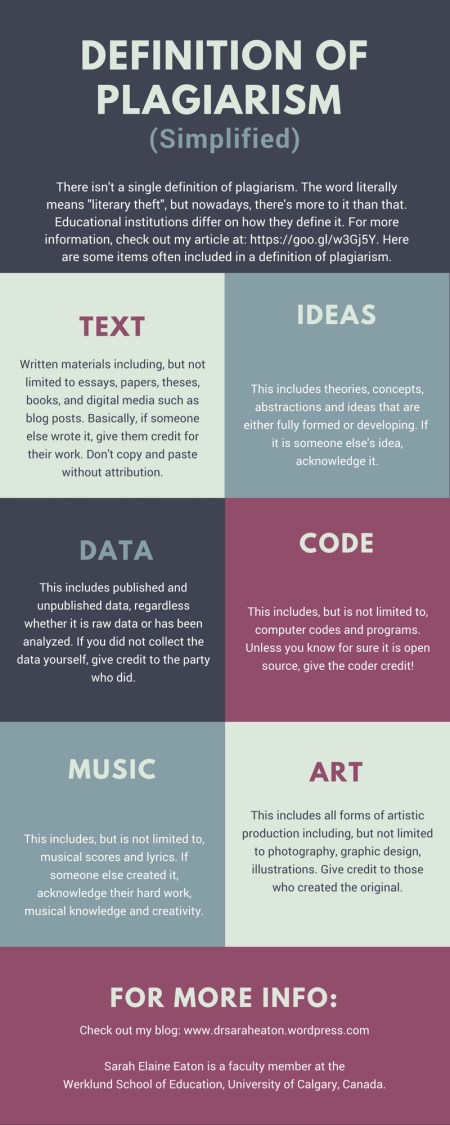
It used to be that the definition of plagiarism was simple: literary theft, but it is a lot more complicated than that in the 21st century, where digital outputs account for as much, if not more than, printed products. Students and professors have asked me, “So, how do you define plagiarism in plain and simple terms?” The answer is actually quite complex and a bit messy. But in the interest of demystifying the issue, here is a straight forward infographic that may help.

Let me say that this resource is simplified — perhaps overly so. My goal here isn’t to be reductionist and I fully acknowledge that not everyone may agree with these simplified explanations. But sometimes it can be easier to wrap your head around something simple to start and then tease out the complexities once you are more comfortable with the basic concepts.  I offer these not as the be-all-and-end-all definition, but rather as a starting point to help educators and students clarify and demystify basic concepts and also to engage in productive conversations about how to cultivate academic integrity and reduce plagiarism.

Definition of plagiarism (jpg)

Here is a free, downloadable .pdf of this infographic that you are welcome to use with your students for teaching purposes. Feel free to use it as a conversation starter to help students understand what plagiarism is and how to prevent it in their own work.

Related post:

Comparative Analysis of Institutional Policy Definitions of Plagiarism: A Pan-Canadian University Study https://wp.me/pNAh3-1LD

______________________________________________________

Share or Tweet this: 21st century definition of plagiarism https://wp.me/pNAh3-2eo

This blog has had over 1.8 million views thanks to readers like you. If you enjoyed this post, please “like” it or share it on social media. Thanks!

Sarah Elaine Eaton is a faculty member in the Werklund School of Education, University of Calgary, Canada.


New article: “Credit where credit is due”

December 19, 2017

Credit where credit is due - coverIn my latest article, “Credit where credit is due: How to prevent plagiarism in the 21st century classroom” I tackle the tricky question of what it means to plagiarize in the age of copy-and-paste. I also offer K-12 teachers five practical tips on how to prevent plagiarism among school-age children.

Most of my research and writing is focusing more and more on academic integrity and plagiarism prevention in higher education contexts. But it is important for K-12 teachers to be able to talk about these topics to their students, too. That’s what inspired me to write this article.

The full article was published by the EdCan Network and it is a web exclusive in their most recent edition. You can check it out here: https://www.edcan.ca/articles/credit-where-credit-is-due/

______________________________________________________

Share or Tweet this: New article: “Credit where credit is due”

This blog has had over 1.8 million views thanks to readers like you. If you enjoyed this post, please “like” it or share it on social media. Thanks!

Sarah Elaine Eaton is a faculty member in the Werklund School of Education, University of Calgary, Canada.