 Pretty excited to see that my upcoming book now has an official webpage on the publisher site! The manuscript has been officially approved by my editor, the wonderful Jessica Gribble. The next steps are for it to move into production. The scheduled release date is early 2021.
The book is not yet available for sale though. You’ll have to wait until closer to the publication date for that. In the meantime, you can send the book info to your friendly neighbourhood librarian, and ask them to put it in their ordering queue!
Plagiarism in Higher Education: Tackling Tough Topics in Academic Integrity
Libraries Unlimited
Pages: 230
The book will be available in paperback and e-book formats.
Description
Plagiarism is a complex issue that affects many stakeholders in higher education, but it isn’t always well understood. This text provides an in-depth, evidence-based understanding of plagiarism with the goal of engaging campus communities in informed conversations about proactive approaches to plagiarism.
Offering practical suggestions for addressing plagiarism campus-wide, this book tackles such messy topics as self-plagiarism, plagiarism among international students, essay mills, and contract cheating. It also answers such tough questions as:
- Why do students plagiarize, and why don’t faculty always report it?
- Why are plagiarism cases so hard to manage?
- What if researchers themselves plagiarize?
- How can we design better learning assessments to prevent plagiarism?
- When should we choose human detection versus text-matching software?
This book focuses on academic integrity from a teaching and learning perspective, offering comprehensive insights into various aspects of plagiarism with a particular lens on higher education to benefit the entire campus community.
_________________________________
Share or Tweet this: Coming in 2021! New book: Plagiarism in Higher Education: Tackling Tough Topics in Academic Integrity https://wp.me/pNAh3-2xI
This blog has had over 2 million views thanks to readers like you. If you enjoyed this post, please “like” it or share it on social media. Thanks!
Sarah Elaine Eaton, PhD, is a faculty member in the Werklund School of Education, and the Educational Leader in Residence, Academic Integrity, University of Calgary, Canada. Opinions are my own and do not represent those of the University of Calgary.
This blog has had over 2 million views thanks to readers like you. If you enjoyed this post, please “like” it or share it on social media. Thanks!
Sarah Elaine Eaton, PhD, is a faculty member in the Werklund School of Education, and the Educational Leader in Residence, Academic Integrity, University of Calgary, Canada. Opinions are my own and do not represent those of the University of Calgary.


 Posted by Sarah Elaine Eaton, Ph.D.
 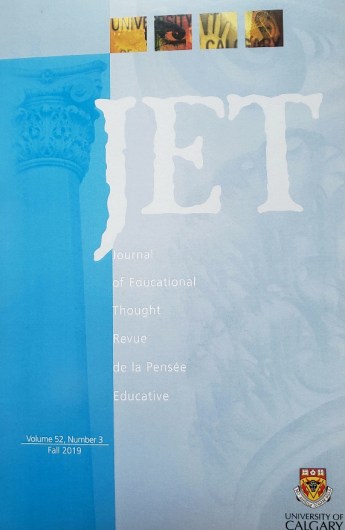 I am so pleased to share that the special issue of the Journal of Educational Thought dedicated to academic integrity and ethics is now out. I am excited about this work because it adds to the growing body of scholarly and research literature on these important topics, not only in Canada, but globally, too.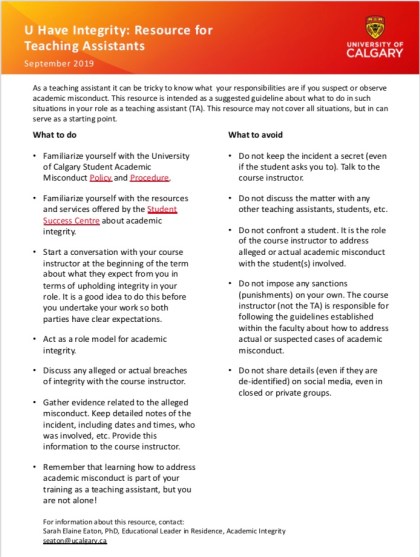
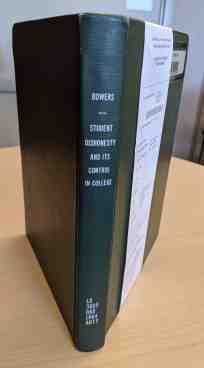 I am always telling my students to find and cite the original sources rather than relying on secondary sources. In the work I do on academic misconduct, the work of William Bowers is often cited as a seminal study in the field. The problem is that Bowers’s original work is hard to get your hands on. I was able to find a copy of his 1966 doctoral dissertation, but the original 1964 book seemed almost impossible to find. The two sources have exactly the same title. Although both texts are based on the same content, it is presented in different ways in both texts.


You must be logged in to post a comment.