9 Tips for Successfully Incorporating Virtual Presentations into Your Conference

February 16, 2012

Today I had the coolest experience. My colleagues at Idaho State University (ISU) Workforce Training were having an educational technology conference today in Pocatello. I teach for them online, but today’s conference was live — except for one presenter, me.

Here’s how we did it:

1. Brief your presenter on what to expect

Jeff Hough and the team at ISU gave me a thorough briefing about the conference a few weeks prior to the event. We negotiated the terms of the presentation and they gave me details on what to expect.

2. Tech-savvy conference organizers

These folks specialize in offering professional development webinars for educators. I’ve done dozens of webinars and used the same platform (in this case, Adobe Connect) that the conference organizers had on hand. They knew how to set up their system and had used their webinar platform hundreds of times before. They are adept at all kinds of technology and had significant experience successfully producing webinar presentations.

Sarah Elaine Eaton, virtual, presenter, webinar, education, professional development3. Experienced and energetic virtual presenter

Modesty aside, it is safe to say that I know how to give a virtual presentation. I have colleagues who flatline in a webinar environment because they “need the crowd to give them their energy”. At today’s conference, I never saw my audience. Well, not until after when one of my ISU colleagues, Paul Dickey, tweeted this photo (which I saw after the presentation).

Some of the worst virtual workshops or keynotes I have seen have been given by people who have no experience or webinar training. (In case you’re interested, here’s how you can get trained).

4. Previously presented material

Ensure the presentation has been tested. The conference organizers asked me to repeat a Twitter for Teachers workshop that I had taught for them previously. They had already seen the program delivered via webinar and liked it. The program had already proven to be a success.

Conference organizers want their attendees to have a stellar experience. Many things can go wrong with a virtual presentation. Make sure the presenter’s content is not one of them.

5. Do a connectivity test

Before the conference, we tested all the technology we were going to use – audio, video, slides and a real-time screen share. Hotels and conference centres are notorious for having poor wireless connections. The more people who tap into them, the slower they get. Virtual presentations chew up a lot of bandwidth. Even if your system works perfectly at the office, having a new venue changes the game. Every single piece of tech needs to get tested… and tested again.

As we prepared for today, we had some issues with the audio. We made some adjustments that helped significantly when the room was filled with a live audience.

6. Expect the unexpected

At one point during today’s session, we lost audio. Because we were all experienced working in a virtual environment and were aware of our audio problems during the connectivity test, it came as no surprise when the audio cut out. We were quickly able to work things through and I picked up where I had been cut off. Both the conference organizers and the presenter need to be able to keep their cool when “tech happens” in front of a room full of people.

Every person involved in today’s virtual program understood what aspects of the production we could control, such as our individual mics and computer settings and which we could not control, such as the venue’s wireless connection cutting out. Knowing what you can and can not control puts you in a better position to problem solve on the fly.

7. Include real-time interactivity

In my case, Jeff acted as a host for the session, introducing me and then fielding questions from the audience. At the beginning of the session, I said, “OK, let’s do a show of hands in the room. How many people use Twitter right now?”

Jeff acted as my eyes and ears and reported back to me, “There are crickets in the room, Sarah,” meaning that there was silence. He then added, “There are maybe four hands up.”

“O.K.,” I said. “That is less than 10% of the room. Let’s see if we can’t increase that by the end of the presentation…”

We stayed in constant contact throughout the session, talking back and forth, naturally and with a conversational tone.

8. Show, don’t tell

There is a certain amount of “telling” in an instructional program, but try to limit it as much as possible.

My presentation included a combination of static slides and a real-time screen share. I was showing folks how to use Twitter, so I demonstrated it live. Because Jeff also has a Twitter account, we were able to Tweet back and forth in real time and the participants could see it on screen.

The highlight for me as a presenter came when one participant signed for Twitter during the presentation and Tweeted “@DrSarahEaton“, as I had shown them how to do moments earlier.

I noticed it on my feed and said, “Hey, who’s that? Is that someone who’s in the conference room right now?”

Jeff asked the brand-new-baby-Tweeter to raise his or her hand. She did.

This was the single best moment for me as a virtual presenter. It was completely unrehearsed and unexpected. We had no idea anyone was going to sign up for Twitter right then and there and start putting the content into action at that very moment.

It caught the attention of every single person in the room and suddenly, it all made sense. What I had been saying about educators being able to connect in real time from all over the world, was no longer something I said, it was something we were able to actually show them. It was the coolest thing.

After that, a few other people joined in and sent Tweets, too.

Jimeny Cricket may have talked, but these crickets Tweeted! It was brilliant.

9. Give participants a valuable handout

Participants did not get a copy of my presentation slides. (Bor-ing!) Instead, every participant received a copy of the Twitter for Teachers manual that I did to accompany the course. It is a 25-page, step-by-step how to guide that steps them through the exact processes I showed during the presentation, in exactly the same order. Well, except for the spontaneous moments that made the session come alive.

The technical aspects of a virtual presentation increase your risk of failure significantly. Just about anything can go wrong. Even with all the preparation in the world, the potential for unexpected screw ups can still happen. Lots of preparation helps to mitigate that risk. Having an experienced team who have worked together before also helps tremendously.

You know when a virtual presentation has been truly successful because the webinar technology becomes “invisible”. When participants are so into the experience that they almost forget their presenter is hundreds, if not thousands of miles away and their sense of distance has melted away, you know you’ve just incorporated a great virtual presentation into your conference.

A personal thanks from me to all the folks at ISU Workforce Training. As any experienced virtual presenter knows, those work on the production team are the real stars of the show.

_____________

Share or Tweet this post: 9 Tips for Successfully Incorporating Virtual Presentations into Your Conference http://wp.me/pNAh3-1fm

Update – January 2018 – This blog has had over 1.8 million views thanks to readers like you. If you enjoyed this post, please “like” it or share it on social media. Thanks!

Sarah Elaine Eaton is a faculty member in the Werklund School of Education, University of Calgary, Canada.


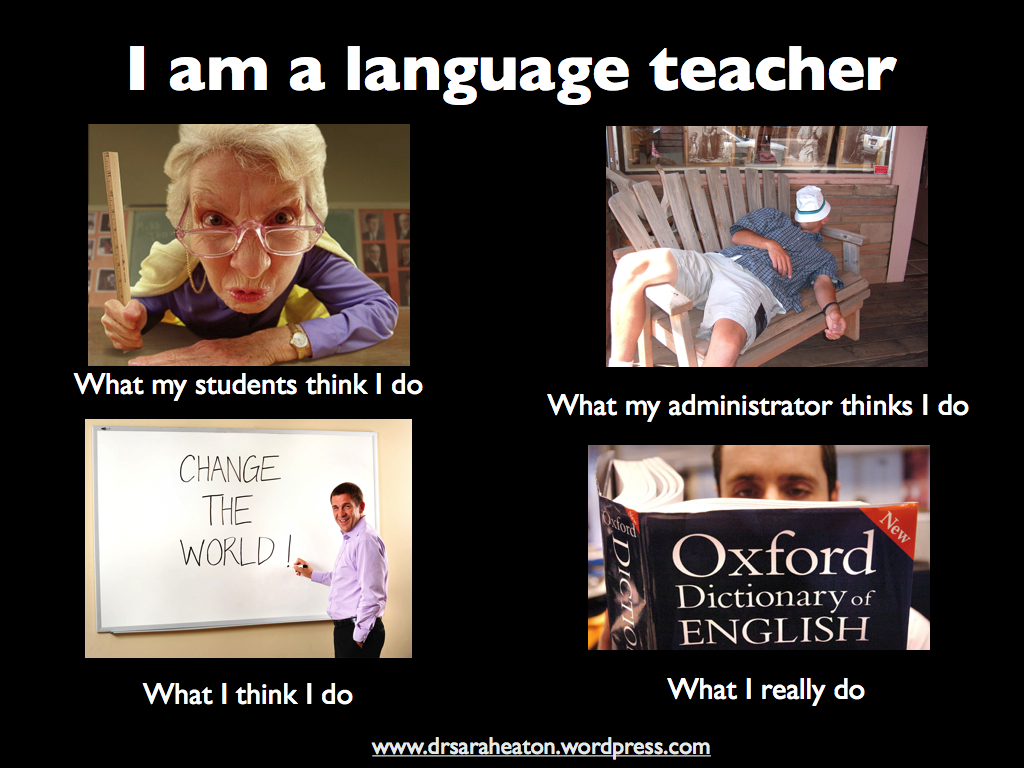
“I am a language teacher”: A picture says a thousand words

February 16, 2012

I’ve seen a few of these photo collections flying around the Internet recently. This is one I did up… just for fun.

Sarah Elaine Eaton I am a language teacher speaker presenter humor funny

You have my permission to share it… Just leave the blog link at the bottom, please. 😉

____________________________

Share this post: “I am a language teacher”: A picture says a thousand words  http://wp.me/pNAh3-1fb

Update – January 2018 – This blog has had over 1.8 million views thanks to readers like you. If you enjoyed this post, please “like” it or share it on social media. Thanks!

Sarah Elaine Eaton is a faculty member in the Werklund School of Education, University of Calgary, Canada.


Dr. Sarah’s favorite resources of the week (Feb. 6-12, 2012)

February 13, 2012

This past week, I was inundated with so many great articles and resources that to help you avoid getting overwhelmed, I’m dividing up my favorites of the past week into two posts: news and resources.

Here are my favorite resources of the week, curated from my Twitter account.

Ed tech resources

6 Sites to get kids excited about Google Maps – Fractus Learning

An app to create lesson plans – Tech & Learning

Web 2.0 Tools: Tools and Teacher Resources – 2Learn.ca

The Best Education Apps at FETC – by Stephen Noonoo, the Journal

Project-Based Learning for Digital Citizens – by Andrew Marcinek

Top 10 Free Online Tutoring Tools for 2012 – Edudemic

Literacy and languages resources

5 Keys to Snagging Reluctant Readers – Shelf Consumed

Open Source Language Education Resources – Yazik

ESL Literacy – Learning from Research: A Review of the Literature – Bow Valley College

General education resources

20 Must-Have Educational Resources For All Teachers – Edudemic

Social media resources

10 Tips for Creating a Social Media Policy for Your Business – by Jennifer Amanda Jones, Social Media Examiner

General resources that I thought were cool and useful

Starting and Managing a Small Business – Business Victoria (Note: Lots of great resources here for non-profits, too).

Step Outside Your Comfort Zone and Study Yourself Failing – by Joshua Foer

Pretty Good – poem by Charles Osgood

Related posts:

Dr. Sarah’s favorite news of the week (Feb. 6-12 2012)

Dr. Sarah’s favorite resources of the week (Jan. 30 – Feb. 5, 2012)

Dr. Sarah’s favorite resources of the week (Jan. 23-29, 2012)

Dr. Sarah’s favorite resources of the week (Jan. 16-22, 2012)

Dr. Sarah’s favorite resources of the week (Jan. 9-15, 2012)

Dr. Sarah’s favorite resources of the week (Jan. 2-8, 2012)

Dr. Sarah’s favorite resources of the week (Dec. 25, 2011 to January 1, 2012)

Dr. Sarah’s favorite resources of the week (Dec. 18-24, 2011)

Dr. Sarah’s favorite resources of the week (Dec. 11-17, 2011)

Dr. Sarah’s favorite resources of the week (Dec. 4-10, 2011)

____________________________

Update – January 2018 – This blog has had over 1.8 million views thanks to readers like you. If you enjoyed this post, please “like” it or share it on social media. Thanks!

Sarah Elaine Eaton is a faculty member in the Werklund School of Education, University of Calgary, Canada.


Dr. Sarah’s favorite news of the week (Feb. 6-12, 2012)

February 13, 2012

Sarah Eaton speaker education literacy keynote social media This past week, there were so many great articles and resources that came past my desk that I was almost overwhelmed. To help you avoid getting overwhelmed, I’m dividing up my favorites of the past week into two posts: news and resources.

Here are my favorite news stories of the week, curated from my Twitter account.

Social media news

German police use Facebook pictures to nab crooks – by Alice Baghdjian, Reuters

Employers, workers navigate pitfalls of social media – My Joy Online

Study: Why Do People Use Facebook? – ReadWriteWeb

Texting, social media prove problematic for teachers across the country – Laura Graff

What Schools are Really Blocking When They Block Social Media – by S. Craig Watkins

Literacy news

Caution: Not Embracing ‘Continuous Learning’ has become an Occupational Hazard – QELA

Newfoundland group wants literacy plan from the province – The Telegram

Wilsonville launches early childhood literacy program, putting free books in the hands of preschoolers– by Rachel Stark, The Oregonian

Language learning news

Hearing Bilingual: How Babies Sort Out Language – by Perri Klass, New York Times

Bilingual children gain better focus, literacy skills: York U study – Exchange magazine

Schools join forces to rescue languages – by Amanda Dunn, The Age

Finer points lost in Google translation – by Mark Abley, Montreal Gazette

Education news

The Future of Work for High School Grads – by Jordan Weissmann, The Atlantic

Why Pay for Intro Textbooks? Rice University Announces Open Source Textbooks – by Mitch Smith, Inside Higher Ed

Teacher retention a growing Alberta problem – by Jeremy Nolais, Metro

Technology news

How Computer Games Help Children Learn – MindShift

Study: U.S. gaming population has nearly tripled in three years – by Stephanie Fogel, GamesBeat

General interest

Speaking Up Is Hard to Do: Researchers Explain Why – by Elizabeth Bernstein, Wall Street Journal

Labour shortage becoming ‘desperate’ – by Barrie McKenna, Globe and Mail

Want People to Return Your Emails? Avoid These Words  – Mashable

The Business Savvy Behind Nonprofit Success – by David LePage, Canadian Centre for Nonprofit Renewal

Related posts:

Dr. Sarah’s favorite resources of the week (Jan. 30 – Feb. 5, 2012)

Dr. Sarah’s favorite resources of the week (Jan. 23-29, 2012)

Dr. Sarah’s favorite resources of the week (Jan. 16-22, 2012)

Dr. Sarah’s favorite resources of the week (Jan. 9-15, 2012)

Dr. Sarah’s favorite resources of the week (Jan. 2-8, 2012)

Dr. Sarah’s favorite resources of the week (Dec. 25, 2011 to January 1, 2012)

Dr. Sarah’s favorite resources of the week (Dec. 18-24, 2011)

Dr. Sarah’s favorite resources of the week (Dec. 11-17, 2011)

Dr. Sarah’s favorite resources of the week (Dec. 4-10, 2011)

____________________________

Share this post: Dr. Sarah’s favorite news of the week (Feb. 6-12, 2012) http://wp.me/pNAh3-1ev

Update – January 2018 – This blog has had over 1.8 million views thanks to readers like you. If you enjoyed this post, please “like” it or share it on social media. Thanks!

Sarah Elaine Eaton is a faculty member in the Werklund School of Education, University of Calgary, Canada.


A year of inspired insights #5: When reason falls on deaf ears

February 11, 2012

There comes a point in every teacher’s career where he or she is faced with a decision that could alter a student’s future.

Last week I shared a story about Zaina, the first deaf student I taught. A few years later, another deaf student showed up in my course. Kyle was a business student. Like Zaina, Kyle was focussed and determined, with exceptional people skills. Unlike Zaina, he was not multilingual. In fact, he did not know American Sign Language.

Kyle had been sent to an oral/aural school for the deaf. He explained to me that the type of education he had received had focussed on lip-reading, using contextual clues to understand spoken language, capitalizing on any residual hearing abilities and integrating students into mainstream education. Sign language is not used in this approach.

A fourth year business student, Kyle was not excited about the prospect of taking Spanish. It was a requirement of his program and he needed the course in order to graduate. This was not uncommon for students enrolled in certain programs outside the humanities. The difference was, of course, that Kyle was deaf.

He openly confessed that his English grammar knowledge was minimal and that he struggled with concepts around language such as grammar and syntax. He was also open about the fact that he didn’t spell well.

But you could tell, Kyle was sharp. He arrived to class every day dressed like a business student. He lived and breathed business. He had excellent interpersonal skills and a keen sense of how to manage his time and his priorities. He sat at the front of the class and despite his trepidation, he was determined to succeed.

Standing by as a student sinks

Every week he would visit my office during my posted office hours to review his homework and ask questions. He stayed after class to ask for clarification on points he did not understand. He arrived at class early every day, having made an honest, sincere attempt at his homework. Kyle was the epitome of an engaged, interested student. The reality was, he struggled. He struggled so desperately, it was pitiful to watch…

He found it almost impossible to form the sounds of Spanish words. His lack of knowledge about grammar made it hard for him to figure out the mechanics of language. His spelling was worse in Spanish than it was in English. His self-confidence plummeted. Yet, he persevered.

Kyle was a straight-A student whose performance on the first Spanish test of the semester was an undeniable failure. I asked him if he had an advisor in his program who might be able to make an exception for him in terms of the second language requirement of his program.

He shook his head, “I tried,” he said. “They said no. Every student has to meet all the requirements. I even asked if I could take sign language instead, because I thought it would be really useful to me to know it. But they refused that, too. Sign language is a continuing education course, not a credit course. They said that I could take it, but it would not count towards my degree. I still had to take another language that was part of the undergraduate program.”

I sighed and nodded my head. The university was strict about its rigorous program requirements. I thought to myself, “This is lunacy.” Here was a brilliant, engaged, focussed student who, despite his most sincere and eager efforts, was unlikely to pass my course.

If that happened, he would not graduate that year. He would need to repeat the course or try a new language in order to make the language requirement of his program. If that did not work, he would need to transfer into a program with no second language requirement.

It reminded me of the helpless feeling I had as I watched my mother die a few years earlier. Then, there was nothing I could do to prevent her passing. But Kyle was still struggling and still hanging on, if only barely. He still had a chance. I felt compelled to help.

I picked up the phone and made an appointment to speak with the head of program that Kyle was registered in.

When reason falls on deaf ears

Sarah Eaton literacy education keynote speaker Canada Calgary AlbertaAfter shaking hands with the program head, I said, “I’m here about Kyle Smith”.

“He’s one of our best students,” she replied. “… A shining example of what we wish every student would be.”

“I know,” I replied. “But this second language requirement is killing him.”

She nodded. “Yes, I remember that he came to us asking if he could take sign language instead, but there is no credit course in sign language.”

I advocated on his behalf. “It is not like he isn’t trying. This kid comes to class better prepared than any other student in the class. He does all his homework. He even pre-reads the entire chapter before we start it. It is not that he is incapable of learning. He’s smart. It is that the amount of time it would take him to get all this stuff is probably ten times longer than we have in our course. Is there anything we can do about this?”

She shook her head, “I am sorry. The program requirements are very strict. We can not make exceptions for a student just because he or she is disabled. This is a business program and it is our job to prepare students for the real world. The real world does not pander to people who can’t keep up. If he wants to graduate with a business degree, he needs a minimum of a C- in this course. End of story.”

The real world does not pander to people who can’t keep up?” I asked myself. Forcing a deaf student to take a second language when he has no background in languages and questionable affinity for the subject area is hardly a reliable benchmark for his overall success in life.

I thanked the program head for her time and left, angry. I realized that this was more about the program directors choosing to stick to their bureaucratic guns than it was about ensuring the success of their students. If there had been no other indicators of success, I might have agreed with her. But here was a straight-A student, with experience working in business, with great people skills, and that keen sense of determination and focus that is hard to actually teach anyone.

By that point, I had taught over 1000 students in my career. For me, there was no question in my mind that Kyle was going to be a success in life.

Paying it forward

I returned to my office and sat down to process what had just happened.

My mind was taken back a few years to my last semester of my undergraduate program, when I had been hit by a car. I missed the first month of the semester as I recovered from the accident. I returned to classes, determined to do whatever was necessary to graduate.

The words of my Spanish professor rang in my head, “You will get through this. I’ll do what I can to help you. Don’t worry about the grades. Just work hard,” she said.

She believed in me and my abilities at a time when my self-confidence was failing and my future was still uncertain. Her confidence in me lowered my anxiety and propelled me to work harder than I had worked before. At a time in my life when I needed it most, a teacher believed in me.

In that moment, I understood what she was really saying. The sub-text was, “You are safe here. Trust me. I am not leaving your side. You will succeed. I won’t let you fail.”

I sat back in my chair. Almost fifteen years had gone by since that conversation. I had never forgotten it. I knew that it was time to pay it forward.

Doing the right thing

I understood that the situation with Kyle was different from the situation when I was a student. This time would involve a bigger risk on my part. I did something that I had never done before, and have never done since. I adjusted the rules, in order to do the right thing.

Leadership and business guru, Peter F. Drucker said, “Management is doing things right; leadership is doing the right things.” Assigning grades is one of the management or leadership functions of a teacher. We assess, evaluate and ultimately assign a number or letter grade to each student that goes on his or her permanent record as an indicator of performance.

I already had permission from my own department head to make Kyle exempt from the listening exams. I had permission to re-organize the percentage of marks for the remainder of his work so that they would add up to 100% for his final mark. We reconfigured the percentage so that writing counted towards his final grade.

Since I already had permission to adjust the distribution of marks for the work he did, I made one other adjustment that I knew would ensure his success.

This was a subjective element of grading that allowed us as instructors to award marks based on class participation. It was our way of preventing students who were not really engaged from getting an A if they never came to class. If a student never showed up to class and only came to write the tests, got 100% on all the tests, but got a zero for participation in the course, the best grade he or she could end up with would be a B+.

The saying goes that 80% of success is showing up in life. So, if a student never showed up, it was impossible to get 100% in the course. It may seem sneaky, but that’s how it was.

Kyle demonstrated evidence of “showing up” in every possible manner. He had perfect attendance at class. He showed up having made a sincere stab at completing his homework. He stayed after class to ask intelligent clarifying questions. He came my office hours every week religious for extra help. At one point, he had hired a tutor to help him, but the tutor had no idea of how to help a deaf person learn a language and it didn’t work out.

Kyle did everything within his power to “show up”.

Since there were no grades awarded for discipline, focus or homework completion, I made a strategic decision to increase the percentage of his participation mark.

Risky business

There are rules and regulations in institutions for a reason. They set the standards that guide our professional behaviour. We are obliged to act in ethical ways that demonstrate an understanding and respect for the traditions and honour of our profession. Individual faculty members are required to abide by the rules established by the institution.

But what happens when the rules do not fit the situation? We have a choice. We can play by the rules or we can break them. (Yes, re-writing the rules can count as breaking them.) If you break the rules, you can be fired. That is part of “the real world” that my colleague in the business program was talking about.

Was I willing to risk it all for one student, whom I had known for a semester? The thought of it left a big knot in my stomach. I wanted to vomit. I could lose my career over this. It was like playing Russian roulette with my own future.

Inspired insight: Use deep reflection and analytical thinking to drive a tough decision

I reflected more deeply. Would I want to look myself in the mirror every day, knowing that I had upheld the bureaucratic rules, knowing that Kyle was all but doomed to fail my course and that was very likely to change the trajectory of his career? (Do things right, according to the rules).

Or did I want to take a chance on a student who was almost guaranteed to succeed in business and in life, but possibly risk my own career to do it? (Do the right thing).

I had a deep sense of not wanting to look in the mirror years later and ask “What if?”

I firmly believe that when we are faced with the impossible choice between doing things right, and doing the right thing that ultimately, it is more honorable to do the right thing. The price you might pay for doing so is ultimately less than the price you pay, in terms of your self-respect, ethics and integrity, for not doing so.

I had significant evidence that Kyle was going to make it. He had a solid track record of stellar grades, he showed up in every possible way and he had those intangible qualities such as people skills and determination, that never officially get factored into students’ grades. My own deep reflection, coupled with the evidence of success that this student had already demonstrated, ultimately led me to analyze the risk and decide that it was worth it.

Kyle received a passing grade in Spanish. And he worked harder than any other student in the class for what would turn out to be the only C- on his transcript. The grade broke his straight-A record, but we both knew how much it was really worth. He graduated from his program and has gone on to work for major multi-national companies.

Looking back, I could say that it wasn’t just Kyle who was deaf, it was also the institutional bureaucracy…. a system that did not care to listen to or take into account all the possible factors that contributes to a student’s success.

Peter F. Drucker also said, “The best way to predict your future is to create it”. As teachers, we have the opportunity to help our or hinder our students in the creation of their own futures. There are times though, when doing so is risky business.

When have you been faced with the choice between “doing things right” and “doing the right thing”? What struggles did you face? What did you ultimately decide, and more importantly, why?

Related posts:

A year of inspired insights #4: How teaching Spanish to a deaf multilingual student opened my eyes

A year of inspired insights #3: Servant leadership in the scullery

A year of inspired insights #2: Conversations change everything

A year of inspired insights #1: There’s a silver lining in every ambulance

My 2012 resolution project: A year of inspired insights

_____________

Share or Tweet this post: A year of inspired insights #5: When reason falls on deaf ears http://wp.me/pNAh3-1ei

Update – January 2018 – This blog has had over 1.8 million views thanks to readers like you. If you enjoyed this post, please “like” it or share it on social media. Thanks!

Sarah Elaine Eaton is a faculty member in the Werklund School of Education, University of Calgary, Canada.