3 Handy Checklists for APA Style and Formatting

November 27, 2012

As my students are getting ready to hand in their final research papers, they are struggling to learn APA (American Psychological Association) standards for formatting, citations and references. Here are three handy checklists I have shared with them. They find them very helpful:

APA Style Checklist – http://www2.indwes.edu/ocls/apa/apastylechecklist.pdf

Checklist for APA Style (from Elmhurst) – http://library.elmhurst.edu/files/2010/02/ChecklistAPA.pdf

APA Format Checklist (from SLU) – http://www.slu.edu/Documents/student_development/student_success_center/APA_Format_Checklist_Handout.pdf

______________

Share or Tweet this: 3 Handy Checklists for APA Style and Formatting  http://wp.me/pNAh3-1wD

Update – January 2018 – This blog has had over 1.8 million views thanks to readers like you. If you enjoyed this post, please “like” it or share it on social media. Thanks!

Sarah Elaine Eaton is a faculty member in the Werklund School of Education, University of Calgary, Canada.


What makes a good research question?

November 6, 2012

This week I posed a question to my students: What makes a good research question?

As Masters of Education students, they are learning about what it means to be a researcher and building a foundation of knowledge. They came up with some great resources this week. If you are looking for answers to this question, check out these great resources:

Sarah Eaton blog leadershipSonia Ospina’s entry in the Encyclopedia of Leadership on Qualitative Research

This is a 13-page document, available free in .pdf format. Published in 2004, this text shares some of the fundamentals of qualitative research, particularly as it pertains to leadership. It is also very useful for students and researchers working in education and other social sciences. It contains an extensive bibliography that serves as a great point of departure for more exploration. Link for this resource: http://ualr.edu/interdisciplinary/files/2010/03/Qualitative_Research.pdf

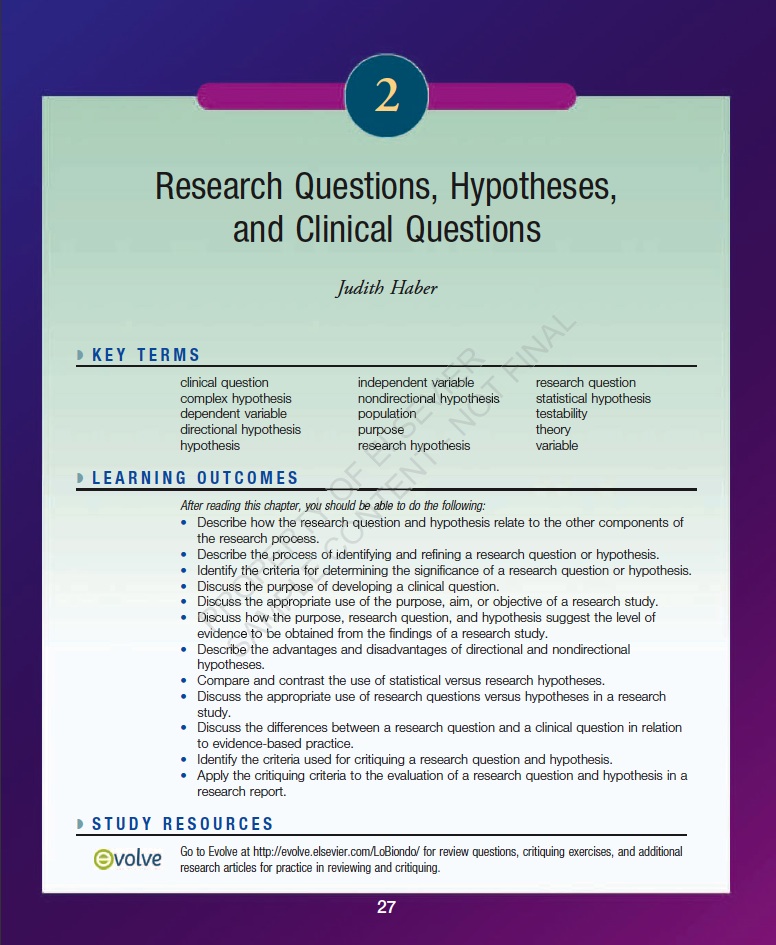
Sarah Eaton blogJudith Haber’s chapter called “Research Questions, Hypotheses and Clinical Questions”

Though marked as “Sample – Not final” with a watermark on the .pdf, this is an incredible 29-page resource that includes flow charts and tables of information. It is easy to understand and written in language that most novice researchers could understand. This one quickly became a favorite because it was colorful and concise. Even though it appears to be written for students and practitioners of health research, there are many elements that may be useful to educators and social science researchers, too. Link for this resource: http://www.us.elsevierhealth.com/media/us/samplechapters/9780323057431/Chapter%2002.pdf

Companion for Undergraduate Research

This is a website (http://www.socscidiss.bham.ac.uk/) that outlines the characteristics of a good research question. Then it talks about each characteristic in detail. It is written in clear language and is very well organized. The page also contains links to other helpful resources on research.

Figuring out how to craft a research question can be tricky. Resources like these help to demystify the process.

______________

Share or Tweet this: What makes a good research question? http://wp.me/pNAh3-1vL

Update – January 2018 – This blog has had over 1.8 million views thanks to readers like you. If you enjoyed this post, please “like” it or share it on social media. Thanks!

Sarah Elaine Eaton is a faculty member in the Werklund School of Education, University of Calgary, Canada.


Is your research biased? Answer: Yes. (Here’s why.)

October 29, 2012

Sarah Eaton blog technology researchThis semester I am teaching a course on Research Methodology in Education. One of the topics that has come up is bias.

Bias is present is bascially every research study. Even though we strive to be objective — and that is part of our work, we nevertheless start with a set of values, beliefs and philosophies that shape our opinions and world view.  It is important for reasearchers to understand the biases they bring to their work and to acknowledge them.

For example, one of my biases is that I hold is that everyone is capable of learning. Not everyone is capable of earning a Ph.D. (for any number of reasons), but everyone is capable of learning something. This is one of my values and beliefs that shapes my work. If I am an honest researcher, I must declare and acknowlege that bias when I do research. It is one thing to have and acknowledge bias. It is an entirely different matter to purposely bias our research in favor of a particular outcome or do research just to prove a point.

There are two ways to approach research:

Approach #1 – Conduct research in a manner that supports your argument

The first is to start with an argument or a position and conduct research and find literature that supports your point of view.

Though some scholars might disagree, I would submit that is an undesirable starting position. The reason is that you are likely to skew either your research or your results so they fit with your argument. Forcing results to fit to a pre-determined argument may be considered unethical. For example, pharmaceutical companies that conduct drug tests in order to prove the drug is safe and refuse to release research that may contradict that starting point are harshly criticized. Such research is not considered believable because it is skewed.

Approach #2 – Start with a research question, hypothesis or topic. Conduct your research in a manner that seeks to answer a question.

The second way to approach you research is to begin with a problem you want to solve or a question you want to answer. Then, you conduct your research in a manner that seeks to answer your research question. Once you have conducted your research, your argument emerges from your data.

The data is the information that you gather that allows you develop a cogent argument to persuade others. You can gather primary data (e.g. interviews) or secondary data (e.g. literature review).

Part of a research study almost always involves a review of previous literature written on the topic you are studying. In your literature review, it is valuable to cite opposing views. Once you have considered your question or problem from a variety of angles, then you can begin to develop an argument, based on your findings. Considering a variety of viewpoints is highly desirable as it demonstrates that you are not attempting to skew your results in favor of a pre-determined outcome.

Be aware that just because you start your research with a particular question or topic, it is unwise to assume that your starting position is the correct one. Be curious, rather than dogmatic. What themes emerge from the literature that you surveyed? What surprised you? What arguments can be made? What conclusions can be drawn?

In my own research, it has happened to me that I start with a research question, problem or hypothesis and as I surveyed the literature, my hypothesis was proven to be incorrect. Be prepared for that to happen. It does not mean you are a bad researcher. Quite the contrary, it means you have allowed your hypothesis or question to be challenged and your research is driven by the data you find.

We may come to our work with a bias. But ultimately, the research needs to speak for itself. That’s what makes it credible.

______________

Share or Tweet this: Is your research biased? Answer: Yes. (Here’s why.) http://wp.me/pNAh3-1vw

Update – January 2018 – This blog has had over 1.8 million views thanks to readers like you. If you enjoyed this post, please “like” it or share it on social media. Thanks!

Sarah Elaine Eaton is a faculty member in the Werklund School of Education, University of Calgary, Canada.


Maslow’s Hierarchy of Needs – Is the pyramid a hoax?

August 4, 2012
Maslow's hierarchy of needs

Did you know that this pyramid, that has become commonly known as “Maslow’s Hierarchy of Needs” never actually appears in Maslow’s original work? Source: http://en.wikipedia.org/wiki/File:Maslow%27s_Hierarchy_of_Needs.svg

I’m a big believer in going back to original sources, rather than relying on secondary sources.

Recently I was reading Maslow’s original 1943 article, “A theory of human motivation”. I was curious about his hierarchy of needs and wanted to learn more about it. When I began poking around on the Internet, I found that the pyramid was commonly cited as being from either his 1943 article or his 1954 book.

Wanting to find the original, I went to the oldest work first. I quickly flipped through the 27-page article from 1943, which was available on line through my university library. I looked for the pyramid figure. It was nowhere to be found. Maslow does talk about a hierarchy of needs, but there was no diagram of a pyramid.

I wondered if maybe it was in the 1954 book, Motivation and personality. I went to the University library and took out a copy of the book. The pyramid is not there either. In fact, there isn’t even one diagram or drawing in the entire book.

Maslow Motivation and Personality (1954)While the original ideas are Maslow’s, the pyramid is not. Someone, somewhere along the way, adapted his original work into the pyramid graphic. The pyramid is someone else’s interpretation of Maslow’s original work; and it has become an iconic representation of his ideas.

What Maslow does say about the hierarchy of needs is, “if I may assign arbitrary figures for the sake of illustration, it is as if the average citizen is satisfied perhaps 85% in his physiological needs, 70% in his safety needs, 50% in his love needs, 40% in his self-esteem needs and 10% in his self-actualization needs” (Maslow, 1943, pp. 388-389). So if we were to draw a diagram to represent Maslow’s hierarchy, the physiological needs would need to represent a much bigger piece of the pyramid.

The iconic pyramid of what has become known as “Maslow’s Hierarchy of Needs” is, arguably, a mutation or an interpretation of  the original work. (Some might even call it a bastardization, but that may be a little harsh…)

Recently in the class I was teaching on technology and inquiry-based learning, I posed a question to my grad students: “Where did Maslow’s pyramid come from?” Some of them thought it was a trick question. Others thought it was too easy. In their quest to answer the question I had posed for them, they embarked on their own inquiry-based learning. Some drew parallels between the mysterious origin of Maslow’s pyramid and the origin of the Egyptian pyramids. Others said they wanted to go to the library straight away and find the 1954 book. (An electronic copy of the book was not available, at least not through our library.) Other students began asking how they could have accepted the pyramid as a true representation of Maslow’s work, when in fact it is not.

Neither the students nor I were able to find the source of the pyramid representation. This surely means that we did not dig deep enough. What we were able to find out for certain though is that the pyramid never appears anywhere in any of Maslow’s work that we were able to access and read, including two of his major works.

What can we learn from this?

1. Original works are adapted by others. Some purists argue that mash-ups are an aberration; that they defile the original work. Well, people have been modifying and adapting original works for centuries.

2. Find the original sources whenever possible. In today’s world, it is easier than ever to find original source documents. Libraries have digitized versions of primary sources going back for decades. It is important for students and researchers to learn to “drill down” and find the original sources of information. If Maslow’s original article from 1943 has been digitized and is accessible through the local library, it is worth the effort to go and at least try to find the original source for your own research. It may be easier than you think to access it.

3. Don’t believe everything you see on the Internet. The pyramid figure that has come to represent Maslow’s work appears all over the Internet. Yet, it never appears anywhere in his original work. There is value in learning to discriminate between original research and was is presented on the Internet as “truth”.

4. Check others’ citations. Maslow’s pyramid has been cited in both academic and popular articles as originating from both his 1943 article and his 1954 book. Yet, the pyramid appears in neither original source. It is important for researchers, scholars and students to (respectfully) check other authors’ citations. Do not take it for granted that simply because a  reference appears in a bibliography that it means the citation is correct.

5. Learn to “drill deep” in your research. Often we take it for granted that others’ research is “the real deal”. Part of our professional practice means that we allow our curiosity to drive our search for knowledge. Learning to “drill deep” means that you take on the challenge of finding out for yourself, learning to analyze and think critically and not simply rely on what others say.

References:

Maslow, A. H. (1943). A theory of human motivation. Psychological Review, 50(4), 370-396.

Maslow, A. H. (1954). Motivation and personality. New York: Harper & Brothers Publishers.

__________________

Share or Tweet this post:  Maslow’s hierarchy of needs: Is the pyramid a hoax?  http://wp.me/pNAh3-1rU

Update – January 2018 – This blog has had over 1.8 million views thanks to readers like you. If you enjoyed this post, please “like” it or share it on social media. Thanks!

Sarah Elaine Eaton is a faculty member in the Werklund School of Education, University of Calgary, Canada.


Template for a 10-page graduate research paper in social sciences

July 11, 2012

Ever wondered how to structure a research paper? Maybe this will help.

There is no single “right” way to structure a research paper, but if you are new to writing research papers, or you go off on a tangent, or you just aren’t sure how to put it all together, this template may give you a place to start.

Click here to download a copy of this template.

_____

View this document on Scribd

______________

Related posts:

Readings for Writing Educational Research (EDER 603.23) http://wp.me/pNAh3-1OJ

12 Phrases to Avoid in Your Academic Research Papers http://wp.me/pNAh3-1JX

Active vs. passive voice — How to tell the difference http://wp.me/pNAh3-1HX

Why APA formatting matters http://wp.me/pNAh3-1Hc

How many sources do you need in a literature review?  http://wp.me/pNAh3-1Hu

What’s the difference between a citation and a reference? http://wp.me/pNAh3-1F9

Why “as cited in” should be avoided in academic writing  http://wp.me/pNAh3-1BH

10 Great writing resources for grad students – http://wp.me/pNAh3-1Bc

How to create a research paper outline: 5 great resources http://wp.me/pNAh3-1y6

_____________________________________

Share or Tweet this post:  Template for a 10-page graduate research paper in social sciences http://wp.me/pNAh3-1s2

Update – January 2018 – This blog has had over 1.8 million views thanks to readers like you. If you enjoyed this post, please “like” it or share it on social media. Thanks!

Sarah Elaine Eaton is a faculty member in the Werklund School of Education, University of Calgary, Canada.