Social Media Challenges in the Workplace – CIRA panel discussion

November 24, 2011
CIRA Dinner Calgary

(Left to Right) John Moreau, Tom Hesse, Sarah Eaton and Andy Robertson debating social media challenges in the workplace

Tonight I took place on a panel discussion in Calgary on the issue of social media challenges in Calgary. The dinner event was hosted by the Southern Alberta chapter of the Canadian Industrial Relations Association (CIRA), and organized by Dr. Kelly Williams-Whitt, who is a professor of Labour Relations at the University of Lethbridge (Calgary Campus) and serves in a leadership role with CIRA.

My fellow panelists were:

  • Andy Robertson, Partner, Macleod Dixon LLP
  • Tom Hesse, United Food and Commercial Workers Canada (UFCW) 401
  • John Moreau, Arbitrator

Dr. Whitt presented us with three Canadian labour cases including:

  1. A female employed in the health care sector who posted photos of patients without their permission on her blog, discussing their conditions and making disparaging remarks about her fellow employees, her workplace and her bosses. (She was later dismissed from her job.)
  2. A male employee with documented mental health issues who blogged about his Neo-Nazi beliefs, his hatred of certain racial groups, the desecration of animal remains that he took part in, the anti-depressants he was on and other assorted topics. He mentioned the name of his employer in his blog. (He was suspended from work and then reinstated.)
  3. A male employee who circulated pornography to his co-workers and was later found to have over 3000 pornographic images and some porn videos in his work e-mail account. (He was suspended from work and then reinstated).

Each panelist gave commentary on the cases, based on their respective experience. My point of view was mainly “pro” social media. My main arguments were:

  • Most companies do not train their employees adequately on how to use social media effectively and responsibly.
  • Organizations need to make their expectations about online behaviour very clear to employees.
  • Everyone who engages in social media leaves a “digital footprint”. Employees and employers need to be aware of what this is and what it can mean over the long term.
  • Digital citizenship is in an important skills to learn in the 21st century.
  • Online reputation management is becoming more important for both employees and employers.

Here’s a clip of my commentary:

It was a lively and invigorating discussion that touched on topics such as personal freedoms, organizational control, common sense and personal responsibility. My fellow panelists were articulate, well-informed and thoughtful in their responses. Being neither a lawyer, nor a union voice, I was honoured to take part in the discussion.

____________

Share this post: Social Media Challenges in the Workplace – CIRA panel discussion http://wp.me/pNAh3-129

Update – January 2018 – This blog has had over 1.8 million views thanks to readers like you. If you enjoyed this post, please “like” it or share it on social media. Thanks!

Sarah Elaine Eaton is a faculty member in the Werklund School of Education, University of Calgary, Canada.


30% of people under 30 say “social media freedom” more important than salary

November 20, 2011

While employers are struggling to crack down on employees’ social media behaviour, young professionals are saying “Don’t bother trying. We won’t be controlled”.

In a story called “Great Tech Expectations“, The Province reports some startling statistics about the Millennial generation (those under 30). The article draws on research presented in the 2011 Cisco Connected World Technology Report. The research surveyed 2800 students across 14 countries, all under the age of 30. The findings revealed that:

The study, which surveyed 2,800 college students and young professionals in 14 countries, found:

  • 56%of college students “said that if they encountered a company that banned access to social media, they would either not accept a job offer or would join and find a way to circumvent corporate policy.”
  • 1 in 3 respondents younger than 30 said social-media freedom and workplace mobility were more important than salary.
  • A quarter of college students said a prospective employer’s policy on social media usage would affect their decision in accepting or declining the job.
  • In India and China, more than 80% of respondents said their primary work device should be mobile.
  • More than 70% of college students said they didn’t want to differentiate between “personal” and work-related devices – “company-issued devices should be allowed for personal and business use because of the daily blending of work and personal communications.”
  • 70%  also say they want to be out of the office regularly, working remotely.

Read the whole article.

While employers are fighting to control what employees are doing on line, employees are fighting for their online freedom. This is especially true in education, where school boards argue that teachers are role models for children and often impose strict social media guidelines. It also applies to other industries where companies and non-profit organizations are desperately trying to figure what to do — and they want to do it quickly.

If you’re in Calgary, join me at an event hosted by the Canadian Industrial Relations Association this coming Thursday. I’ll be on a panel of experts debating with a lawyer and an arbitrator about how to deal with social media challenges at work.

How do you feel about employees using social media? Or employers trying to control your use of social media?

___________

Share this post: 30% of people under 30 say “social media freedom” more important than salary http://wp.me/pNAh3-11Z

Update – January 2018 – This blog has had over 1.8 million views thanks to readers like you. If you enjoyed this post, please “like” it or share it on social media. Thanks!

Sarah Elaine Eaton is a faculty member in the Werklund School of Education, University of Calgary, Canada.


Social Media Challenges at Work (CIRA Event)

November 10, 2011

If you’re in Calgary, join me on November 24 at the Village Park Inn for a dinner event hosted by the Southern Alberta Chapter of the Canadian Industrial Relations Association (CIRA):

“Social Media Challenges at Work”

Expert panelists: Sarah Eaton, John Moreau, Andy Robertson and Tom Hesse

An employee uses Facebook to malign her employer and harass co-workers. A manager regularly patrols the internet, “Googling” employees and monitoring their email. Where does the line get drawn between off-duty conduct, privacy, and the employer’s liability for the actions of its employees? What factors do adjudicators consider when analyzing social media cases? How can employers, unions and workers best protect themselves? Our panel of experts will address these and other thorny issues surrounding social media at work.

Join us for an enlightening conversation with Dr. Sarah Eaton, social media researcher and consultant; Arbitrator John Moreau; Andy Robertson, Partner, Macleod Dixon; and Tom Hesse, UFCW Negotiator and Executive Assistant to the President.

Cost: $40 for Non-CIRA members, $30 for members

To get your ticket, contact CIRA:

CIRA SOUTHERN ALBERTA CHAPTER

University of Lethbridge, Calgary Campus

Suite 1100 Rocky Mountain Plaza,

615 Macleod Trail SE, Calgary, Alberta T2G 4T8

Telephone: 571-3360 ext 4693 Fax: 403-261-2944

E-Mail: cira.alberta @ uleth.ca

View this document on Scribd

________________

Share this post: Social Media Challenges at Work (CIRA Event) http://wp.me/pNAh3-118

Update – January 2018 – This blog has had over 1.8 million views thanks to readers like you. If you enjoyed this post, please “like” it or share it on social media. Thanks!

Sarah Elaine Eaton is a faculty member in the Werklund School of Education, University of Calgary, Canada.


University’s Proposed Social Media Policy Results in Student Protests

October 27, 2011

The Chronicle of Higher Education recently released an article about an article about how a university’s proposed social media policy backfired on them. Reporter Alexandra Rice reports in “University’s Proposed Social-Media Policy Draws Cries of Censorship” that students at Sam Houston State University didn’t take kindly to the administration having access — and editing privileges — to their social media accounts.

The university released a new social media portal called Social Universe was deemed to be a one-stop portal for social media users at the university. The original policy draft indicated that any department or organization  that joined with a university e-mail account would be required to surrender their account passwords to the university, thus giving the university the right to oversee and edit activity on all accounts.

Essentially, this meant that any student, staff, faculty, department or student club with a Facebook, Twitter or any number of other online accounts that was registered with a university e-mail address could be monitored, edited, censored or even deleted by the university.

The students cried censorship. They staged a demonstration against the policy that included a “free speech wall”. That resulted in campus police citing students for creating a public disturbance… a situation which rolled itself into a second “free speech wall” later on.

In my humble opinion, if this university truly wanted to craft an effective social media policy, it would involve its users. By this I don’t just mean having reps from the student union sit on a committee, but I mean a large-scale public conversations over a period of time with all social media users at the institution.

Writing social media policies is tricky business. As this university found out, social media belongs to its users, not any one service or organization.

Policy makers are used to having all the authority when it comes to developing procedures, processes, and behaviour guidelines. Social media, social networking, flash mobs convened via Twitter and text and other forms of social interaction using technology have changed all that.

Power to the people has a whole new meaning in the era of social media. Policy-makers need to involve people, not tell them what to do. The old ways aren’t working any more, so find new ones that will.

Related article: Anatomy of a social media policy

___________

Share this post: University’s Proposed Social Media Policy Results in Student Protests https://wp.me/pNAh3-YT

Update – January 2018 – This blog has had over 1.8 million views thanks to readers like you. If you enjoyed this post, please “like” it or share it on social media. Thanks!

Sarah Elaine Eaton is a faculty member in the Werklund School of Education, University of Calgary, Canada.


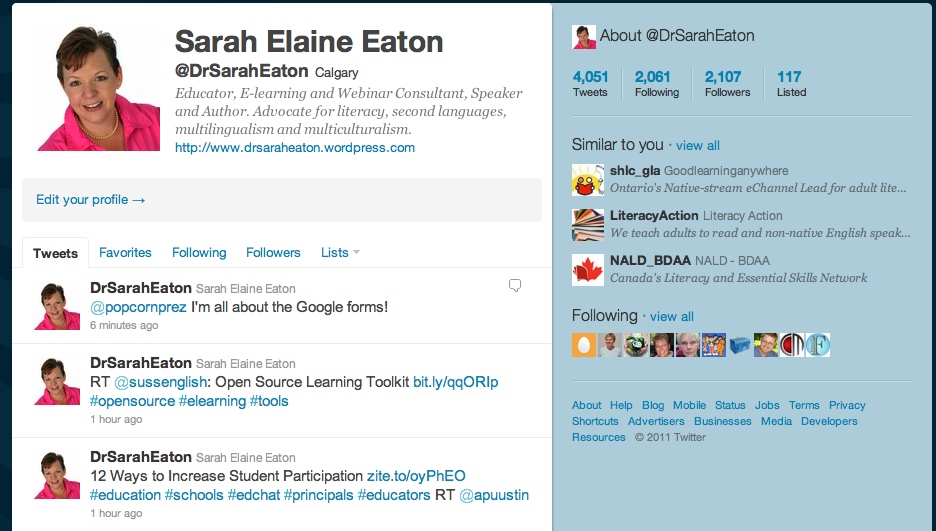
12 Things I Did to Build a Following of 2000 Engaged Twitter Followers

October 20, 2011

There’s a myth about Twitter followers. You don’t need more followers. You want more engaged followers.

I’ve been on Twitter since 2009. I spent probably 9 months figuring out what it was all about and how to use it. Then, I started looking at other people’s followings and wondering how they did it. That’s when I learned that some people literally buy followers, by paying into a service. Everyone who pays into the service follows each other. That inflates your following. But to me, those kinds of followers don’t mean anything. And I didn’t want them.

I wanted engaged followers: people who would have online conversations with me, retweet my Tweets, read my posts, make comments, offer suggestions. I wanted to interact with my followers.

I began making a conscious effort to increase my engagement levels and reciprocity.

Here’s how I did that:

  1. I used a service that allowed me to schedule my Tweets and included a dashboard so I could monitor conversations. I use Hootsuite, but there are other ones out there, too.
  2. Be consistent. I Tweet every day. Even if I’m in meetings all day, I still Tweet.
  3. Selective and strategic sharing. I make a point to share resources that I think others will enjoy and find useful.
  4. Regular retweeting. I repost interesting Tweets and give others credit for them.
  5. Original posts. I share my own material on a regular basis — but not too often.
  6. Watch your ratios. It can’t be a constant stream of output. You need to balance your output and asks with responses, acknowledgements and retrweets. Don’t expect others to share your stuff if you don’t share and acknowledge theirs.
  7. Have conversations. I engage with others in conversations about what is important to them.
  8. Block and report spammers. I nip these folks in the bud. I have no problem reporting spammers and neither should you.
  9. Follow back selectively. I don’t follow everyone who follows me. I follow people and organizations who seem to have legitimate profiles on topics I’m interested in.
  10. Vary the Tweet topics – within a selected range. I Tweet about a lot of stuff, mostly to do with education, training, literacy and social media.
  11. Acknowledge and appreciate your Tweeps. They don’t have to follow you, retweet your stuff or give you a shoutout, you know. Showing appreciation helps build good digital relationships.
  12. Random acts of kindness. Promote a good cause. Mention a friend’s business. Give someone you don’t know a public compliment or shoutout.

As a result of these strategies, here’s what has happened:

  1. I’ve connected with people in real life. We go for coffee. We share ideas and laugh.
  2. I get retweeted every day… sometimes up to 20 or 30 times per day. This leads me to new people. If I think they’re interesting. I follow them. Sometimes, they follow me back.
  3. I’ve been offered work. Tweeps have contacted me to ask me to present at conferences and take on projects. Never was I more surprised than when I was offered a contract to build an evaluation system for an educational organization via a connection that originated on Twitter.
  4. I’ve learned tons. I check out new resources and share them freely. In the process, I stay on top of what is happening in my field. I’m current and up to date. Must of it is thanks so Twitter and social media.
  5. My understanding of social media has deepened considerably. Social media changes quickly, but for those who are new to it or still working to really understand what it is and how it can work for them, it is important to know that there are some fundamentals. One of those is that building an engaged following is much more important than just building a following.

If you liked this post, you’d probably like my Tweets, too. Let’s connect on Twitter.

__________________________________________

Share this post: 12 Things I Did to Build a Following of 2000 Engaged Twitter Followerhttp://wp.me/pNAh3-XW

Update – January 2018 – This blog has had over 1.8 million views thanks to readers like you. If you enjoyed this post, please “like” it or share it on social media. Thanks!

Sarah Elaine Eaton is a faculty member in the Werklund School of Education, University of Calgary, Canada.