How curiosity spices up learning

January 20, 2011

While “curiosity may have killed the cat”, as the saying goes, it certainly livens up our learning. Ever thought of how anxiety blocks our desire to learn and curiosity heightens it?

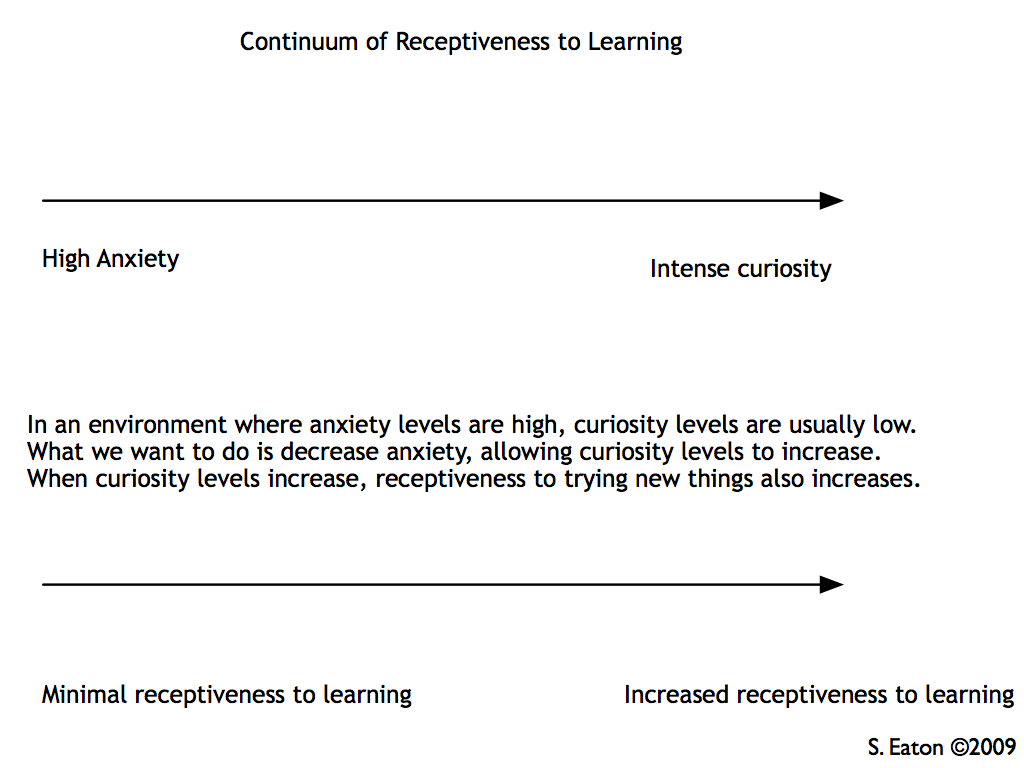
Think of anxiety and curiosity as being at two ends of a continuum.

When anxiety levels are high, our receptiveness to learning new things is low. We resist because we are full of panic and doubt.

At the other end of the spectrum from anxiety is intense curiosity. When curiosity levels are high, we are incredibly receptive to learning new things because we are motivated by our own hunger to learn.

Here’s a diagram to show what I mean.

Continuum of Receptiveness to Learning

This works whether you’re dealing with learners or members of your own staff. A student who is curious learns more. A staff member who is highly anxious when it comes to technology is unlikely to embrace Web 2.0 or mobile technologies for teaching.

Keep providing strategies to decrease anxiety. At the same time, encourage their natural curiosity and you’ll keep people learning. It’s that simple.

____________________

Share or Tweet this Post: How curiosity spices up learning http://wp.me/pNAh3-s4

Update – January 2018 – This blog has had over 1.8 million views thanks to readers like you. If you enjoyed this post, please “like” it or share it on social media. Thanks!

Sarah Elaine Eaton is a faculty member in the Werklund School of Education, University of Calgary, Canada.

Rubrics for Grading Student Presentations

December 20, 2010

This semester I developed some rubrics for grading student presentations in class. They include criteria such as preparation and presentation skills. The rubrics are designed so that they can be used either for native speakers or language learners.

There are 4 different rubrics. I used them with my university-age students. They could also be easily used with adult learners or high school students. For younger grades, you may want to adapt them to their level.

Feel free to use them, share them or let them inspire you to create your own.

Have a quick look here:

Rubric #1

View this document on Scribd

Rubric #2

View this document on Scribd

Rubric #3

View this document on Scribd

Rubric #4

View this document on Scribd

Sometimes the links disappear from Scribd and if that has happened, you can also download them directly from my blog:

Click the link to download –> Presentation Grading Rubric 1 

Click the link to download –> Presentation Grading Rubric 2 (Updated in 2013) 

Click the link to download –> Presentation Grading Rubric 3

Click the link to download –> Presentation Grading Rubric 4 (Updated in 2013)

Update : March 19, 2013 – If you are looking for these and the links do not work, please e-mail me at saraheaton2001 (at) yahoo (dot) ca. I’ll be happy to send them to you.

Update: March 27, 2017 – This is one of the more popular posts on my blog. As of this update, it has been viewed over 120,000 times. If you found this post useful, please like it and share it with others.

Related post: Teaching Public Speaking to Literacy or ESL Students http://wp.me/pNAh3-mZ

____________

Share or Tweet this post: Rubrics for Grading Student Presentations http://wp.me/pNAh3-pE

Update – January 2018 – This blog has had over 1.8 million views thanks to readers like you. If you enjoyed this post, please “like” it or share it on social media. Thanks!

Sarah Elaine Eaton is a faculty member in the Werklund School of Education, University of Calgary, Canada.


How and why my students wrote their own final exam

December 13, 2010

I teach a first-year university course called “Effective Learning”. This semester, topics included managing exam stress, how to prepare for exams and strategies to during a test including such things as reading over the exam before you start writing and answering the questions you know first. Most of the assessment I did for this class was strength-based evaluation such as group projects, evaluated presentations and portfolios. We did one test at the end of the semester.

I decided to engage the students in the exam development process. We spent time in class reviewing what types of exam questions were acceptable (e.g. multiple choice, short answer, essay) and what content would be covered. The questions were based on material from the two textbooks, as well as materials from in-class presentations and discussions. All the material covered from the first day of the semester was to be included in the final exam.

Earlier in the semester students had worked with a partner to present a presentation that was a synthesis of two readings each. For the development of the test questions, students worked with the same partner and prepared questions on each reading they had done their class presentations on some weeks earlier. Students were challenged to come up with at least 5 questions per chapter and to include more than one type of question (multiple choice, short answer, etc.)

Students prepared test questions and handed them in to me.  I compiled them into one document, noting which questions related to which chapters in the text or readings from the course pack. I also noted which students had contributed which questions. The questions were distributed to all students for study purposes. The result was a 10-page study guide comprised of potential test questions that they themselves had generated.

I let them know that I would be selecting from their contributed test questions and that I would also be adding some questions of my own that would not be shared before the exam.

The process of having students develop test questions proved to be a useful learning exercise for them. They got to experience what it is like to write exam questions and the thought-process that goes into it. Knowing that this was not simply an academic exercise but that some of these questions would actually appear on the final exam added a much-needed element of authenticity. Students took the exercise seriously when they knew that it would impact their peers.

Finally, they reported being more engaged with both the material and the study process when they had the opportunity to contribute questions. Suddenly it wasn’t an exam inflicted upon them, so much as a challenge they co-developed and were ready to take on.

Related post:

Course design: 7 ways I engaged my students in the process http://wp.me/pNAh3-nV

_____________

Share or Tweet this post: How and why my students wrote their own final exam http://wp.me/pNAh3-o2

Update – January 2018 – This blog has had over 1.8 million views thanks to readers like you. If you enjoyed this post, please “like” it or share it on social media. Thanks!

Sarah Elaine Eaton is a faculty member in the Werklund School of Education, University of Calgary, Canada.


My favorite sites to make your own crosswords

November 30, 2010

I love using crosswords in language classes. They’re an excellent way to get students thinking about the vocabulary they’re learning, to challenge them and to help them recall words from memory. Here are a few of my favorite online sites where teachers can make crosswords for free or very little cost:

Armored Penguin Crossword maker – Multilingual. Love this site!

Teach-nology Crossword maker – A site especially for teachers.

Variety Games.com – This site is a little more complex in how the words and clues are put together, but once you get the hang of it, it’s great.

Tools for Educators: Crossword maker

The Teachers’ Corner.Net – They ask for a linkback to their site.

ESL Galaxy Crosswords – This site has pre-made crosswords, available by themes. The pages have colorful backgrounds, too.

I’ve also heard about an $8 app for Mac Users: KrossWords (a shareware app written by Jerome Foucher), though I haven’t tried that one myself.

_________________

Share this post: My favorite sites to make your own crosswords http://wp.me/pNAh3-oC

Update – January 2018 – This blog has had over 1.8 million views thanks to readers like you. If you enjoyed this post, please “like” it or share it on social media. Thanks!

Sarah Elaine Eaton is a faculty member in the Werklund School of Education, University of Calgary, Canada.


Course design: 7 ways I engaged my students in the process

November 23, 2010

“Learner centered” is the new buzz phrase in education. Some recent research I did revealed that not only are learner-centered approaches to teaching part of 21st century teaching, but so is the practice of engaging learners in course design and outcomes. This seems to be a bit of a contentious issue. How do learners know what their outcomes should be? It’s a good question.

Rather than addressing the theoretical debate, I decided to try an experiment this semester. One of my courses this semester is on Effective Learning. It focuses on metacognition, making students aware of themselves as learners, their learning styles, improving study habits and ultimately, improving their performance. I thought this would be an optimal environment to test a learner centered approach.

The questions that guided my teaching experiment were:

  • How can I legitimately engage students in course design?
  • How can I do this without being accused of shirking my responsibilities as an instructor?
  • How do I ensure that the class doesn’t try to take over from me completely and hijack the entire course?

Here’s what I did:

  1. Set boundaries. Some aspects of the course design were negotiable and others were not. I decided what was going to be negotiated and set clear parameters.
  2. Engaged with the students in dialogue. In class we talked about what aspects of the course could be negotiated and which could not. I shared with them how they would be engaged in the process and what it would mean for them.
  3. Had the students engage in a dialogue with one another. After I talked with them, I gave them some time to talk amongst themselves without input from me. After they talked with each other, we would regroup and they would share what they talked about.
  4. Kept the process transparent. Students’ thoughts and input were all shared. Disagreements were addressed and points were negotiated.
  5. Voted. In cases where students disagreed on how they wanted to proceed, we voted. The majority ruled. This was effective in deciding, for example, what date the students would give their final presentations in class. Students votes reflected their desires to have the presentations on a date that was convenient for all of them. Since the presentations happen at the end of the semester, when everyone is busy, we were unable to achieve consensus on the date. So we voted by a show of hands. That way, students could see for themselves what the majority had decided.
  6. Focussed on developing relationships. I took advantage of the small class size by focussing on getting to know each student and also having them develop relationships with each other, as well as with me. 70% or more of class time was spent in group work or pair work. Students gave two presentations during the semester – one in pairs and another in small groups. Students were guided through a process where they exchanged contact information and were encouraged to connect with one another outside of class time. Within a few weeks, all the students knew each others names and began bonding. This built trust and cooperation.
  7. Increased the engagement as the course progressed. I began the course with a very traditional approach. The students received a course outline with specific information about what would be done and how it would be done. As the course progressed and relationships were developing, we were in a better position to negotiate on some aspects of the course.

Here are some of the ways I engaged my students in the course design process:

  • Course material. I decided what 90% of the course content would cover, including materials from the textbooks, as well as some outside sources. Students contributed videos and articles they found on line, using broad topics to guide them. The videos were posted on our Blackboard class site. Students reviewed the videos posted by their classmates and posted reflective comments about them. Both the posting of the videos and the reflective comments were assignments, each worth 1% of the final grade. As long as students contributed both their material and their personal feedback by the due date, they received credit for the assignment.
  • Due dates. Not all due dates were negotiable. Students chose the dates when they would present their final group project and have their final in-class test.
  • Exam content. Yup. You read that right. Students contributed some, but not all, of the questions for their final exam. I’ll talk about the process I used in a future blog post.

So far, the experiment seems to have been a success. I was pretty open with the students and let them know that the model of negotiated course design was new for me. Basically, I was learning as I went. Many times, I experienced some discomfort myself, not knowing how far we could or should go using a “distributed leadership” model. In some ways, I was still traditional. I teach in a traditional brick-and-mortar university, after all. In other ways, I think the amount of decision-making I allowed my students to engage in would boggle the minds of some of my colleagues, who might wonder if I let my students walk all over me.

The short answer is no. This was one of the few classes I’ve ever taught where students came to class on a regular basis, formed excellent relationships with one another, had a great deal of tolerance for one another. Did they try to hijack the course? Not at all. In fact – and this is purely subjective, of course – I would say that these students demonstrated more respect for me, as I muddled through this new way of teaching, than in courses where I have taken a authoritatively traditional stance. Interestingly, it’s one of the few university classes I’ve taught where I didn’t find students who tried to cheat, either. They were challenged to think beyond traditional learning roles, as they became collaborators in the learning process.

Would I try this again? Absolutely. It was a slightly unnerving experience and a very good challenge for me as an instructor. And I can honestly say that I’ve never had a more engaged, vibrant group of students.

Related post: How and why my students wrote their own final exam http://wp.me/pNAh3-o2

________________________

Share or Tweet this post: Course design: 7 ways I engaged my students in the process http://wp.me/pNAh3-nV

Update – January 2018 – This blog has had over 1.8 million views thanks to readers like you. If you enjoyed this post, please “like” it or share it on social media. Thanks!

Sarah Elaine Eaton is a faculty member in the Werklund School of Education, University of Calgary, Canada.