Literacy and Essential Skills: Why Digital Literacy is Crucial

December 6, 2011

The Guardian recently published an article called “No place in class for digital illiterates“. The article talks about how children who lack technology literacy skills are getting left behind. Writer Gavin Dudeney talks about changing definitions of literacy that now include “digital literacy”  or the ability to use the Internet and interact with digital texts.

As I was writing The Need For Increased Integration of Technology and Digital Skills in the Literacy Field in Canada I found research that suggests that Canada’s 9 Literacy and Essential Skills may be just the beginning. One of the 9 Essential Skills is “Computer Use”. Some researchers are suggesting that this term is too narrow. Today, it is not enough for a person to know how to turn on a computer, manipulate a mouse or use a track pad or write a resume on a word processing program. Digital skills are an important part of computer use.

People need to know how to search for everyday information such as bus schedules, tax information and other important information that is part of every day living. Job seekers need to know how to search for and apply for jobs posted on the Internet and submit their resume through an online application system. More and more job application sites require users to create an account and register with a company or a service. If adults do not know how to do these things, they will fall behind.

Children who do not know how to use touch screens or the Internet may find themselves disadvantaged later on, as they try to catch up with digitally savvy peers. There are some groups and individuals who are opposed to the increased use of technology in schools. Waldorf Schools, a system of private schools with an excellent reputation, reportedly does not use any technology in its elementary grades.

As an educator, I worry about such approaches. Clearly, it works for them because they are a hugely successful network of schools. But I openly confess that I have never worked with a Waldorf school, myself. I’d love to be invited to one to see how they teach and engage with their learners. As a bit of a “tech junkie”, I have to acknowledge my bias in favour of using more technology, rather than less. I worried whether children who do not learn how to use touch screens or the Internet in their school years may find themselves disadvantaged later on, as they try to catch up with digitally savvy peers?

Having said that, I do think it is important to incorporate technology in a meaningful way that shows why we are using it, what purpose it serves and ultimately, how it benefits the learner. It is critical to make these links so that we show how digital skills can help children develop cognitively and socially so that when they grow up, their lives as adults have meaning as they find work that makes them feel that they are making a meaningful contribution to their world. It is a world that we can only dream about right now. As an educator, I ask, how do we best prepare our learners for success in five, ten or twenty years’ time? And what will “literacy and essential skills” look like a decade from now?

________________

Like this post? Share or Tweet it: Literacy and Essential Skills: Why Digital Literacy is Crucial http://wp.me/pNAh3-13W

Update – January 2018 – This blog has had over 1.8 million views thanks to readers like you. If you enjoyed this post, please “like” it or share it on social media. Thanks!

Sarah Elaine Eaton is a faculty member in the Werklund School of Education, University of Calgary, Canada.


4 ways to engage learners without losing your mind

December 5, 2011

StudentsThere’s no doubt about it. Schools, universities and adult education training classrooms of today look very different than they did half a century ago.

Heck, they look different than they did 20 years ago. Twenty-first century learning is all about “engaging” the learner. What does that mean, exactly? There is not a single, concrete definition (at least as far as I have found). Here are a few common characteristics:

  • The teacher’s authoritative role is downplayed. Teachers are expected to be guides and collaborators, rather than the “ultimate authority” on a subject.
  • The “lecture” style of teaching is considered ineffective. Instead, group work and models that involve learners interacting with each other are preferred.
  • Students are encouraged to share their own ideas and opinions, not just regurgitate information. In an ideal situation, students also learn to back up their arguments with data and research.
  • Students discover meaning for themselves (often through a process guided by the teacher).
  • The one-way transmission of the teacher imparting knowledge and the students madly writing down everything the teacher says in order to absorb it all, is considered outdated and ineffective.

Let me be honest about my bias and say that I believe whole heartedly in engaging learners in this way. However, this way of teaching requires a substantial “re-wiring” of an instructor’s brain. If you were raised during a time or in a place where teachers could — and did — use the strap or a ruler to discipline students who misbehaved, you know what I am talking about. When I went to school, the strap had been outlawed, but rulers were still used.

Certain nuns in my school were particularly fond of whacking a ruler on a desk to grab the attention of a student who was daydreaming. Instantly, 25 students felt fear rush through them. I may be dating myself a bit here, but really, I am not as old as that statement might lead you to believe I am. My point is that education has changed dramatically in the past couple of decades.

The problem for many people like me is that we find it hard to reconcile 21st century ways of teaching and learning with the model that we know. Not only do we know it, it is all we knew growing up. Teaching in a way that supposedly “engages learners” seems “airy fairy” or “a waste of valuable classroom time” to some people. Some of those same people are very well educated. They have taken years to develop their expertise and they know their stuff darned well.

The problem is that no one really cares what teachers know any more. The whole concept of “teacher” has changed. Now, the person leading a class guides their students along a learning journey that neither begins, nor ends in their classroom. The model is unsettling and uncomfortable for educational professionals who feel that their worth and value as teachers is undermined unless they are imparting and actively transmitting their knowledge they carry within them.

So, what is the solution? Here are some easy ways to begin to transform your teaching practice, while still being true to who you are:

1. Start in the hallway. This may seem counterintuitive, but if the classroom is your sacred space where you teach and students learn, then acknowledge that bias and begin your exploration of new ways in a more neutral setting. Instead of rushing from your classroom to the teacher’s lounge or your office right away after a class, linger in the hallway. Ask students what they thought of the class today. Ask them how they might apply what they learned in the real world. Engaging students in these kinds of conversations gives you insights into your students’ abilities to engage in reflective thinking. It will also give you an idea of how they are making sense of what they learn.

2. Temporarily relinquish control of the chalkboard. Traditionally, the chalk board or white board is where the teacher writes down the information they want students’ to copy into their notebooks. It is part of the teacher’s “sacred space”. Traditionally, a teacher’s desk is located in front of the chalk board and there is an invisible field of authority around this space that includes the chalkboard or white board. Try this review activity in the last 20 minutes of class. Ask students to form teams of 4 or 5 students. Give the teams 2 minutes to write down the 10 most important aspects of the lesson. Draw vertical lines down your board so that the number of columns equals the number of teams (5 teams = 5 columns). Give each team a piece of chalk or a white board marker. Have them simultaneously go to the board and write down their 10 points. Then, have them find the common denominators among their lists. Talk about why those points rose to the top as being the most important. Then, review the points the teams did not agree on. Do all this while students are gathered at the front of the classroom in front of the board. At no point in this activity does the teacher write on the board. Let the students do the writing and circling of common denominators.

3. Include a group “discovery” or “creativity” project or activity. The project should not include going through a rote set of exercises and coming up with standardized answers. Instead, choose an activity that forces students to think “out of the box” and use their resourcefulness to create something new, using what they have learned. For example, in a foreign language class, group work might traditionally be done read through a dialogue. Each student would read the part of a different character. Together, students figure out the meaning of the conversation and answer standard questions. Instead of that traditional activity, an alternative would be to give students a list of key words or phrases in the chapter they are studying and have them create sentences using their new words. Groups trade copies of their work with each other and correct one another’s sentences. The teacher used to traditional classroom instruction needs to be aware that this type of activity will take much longer than a traditional group activity. A brief verbal survey after the activity is over will let you know which type of activity the students prefer more. Encourage them to articulate why they prefer one over the other.

4. Incorporate metacognitive activities. One aspect of creating “engaged” learning is challenging students to become more self-aware about their own learning process and increase their levels of personal responsibility. In order for this to happen, learners must become aware of the processes involved in acquiring new knowledge. Then, they can determine which methods are most effective for them. An example of how to do this in a language classroom would be to give pairs or small groups of students an assignment asking them to determine what is the most effective method to learn new verb conjugations. This activity begins with the assumption that there is more than one method. Students then embark on a journey of discovery to determine what those methods are. Part of the assignment might include testing a variety of different methods to determine which they feel works best. Then, they must use analytical thinking and research skills to determine which method is most effective. This not only helps them learn their verbs while focussing on the effectiveness of their method, it also increases their awareness of themselves as learners.

Evangelists of 21st century learning will tell you that traditional ways of teaching are bad and that your methods are arcane and do nothing to help students learn.

There may be some truth in that, but if you have been raised and trained to think and teach a certain way, becoming a 21st century teacher is not something that happens overnight. If you are interested in learning what will keep your students engaged, incorporating small, incremental changes to your teaching practice might be the most effective way to go. You don’t have to throw away everything that has worked for you over the past ten, fifteen or more years. Take stock of what you do very well and take pride in it. Incorporate new strategies slowly, in a way that makes sense for you. Observe how your students react and most importantly, if they are learning and absorbing new material in an effective manner.

Personally, I believe that most teaching methods have some merit. Certain methods work better with certain students. There is no absolute right way. Having said that, the teaching profession has changed… and continues to change. Our students and our world have changed. If we are to be not just teachers, but also role models, it is up to us to challenge ourselves to try new ways of doing things, too.

____________________________

Share this post: How to engage learners without losing your mind http://wp.me/pNAh3-13p

Update – January 2018 – This blog has had over 1.8 million views thanks to readers like you. If you enjoyed this post, please “like” it or share it on social media. Thanks!

Sarah Elaine Eaton is a faculty member in the Werklund School of Education, University of Calgary, Canada.


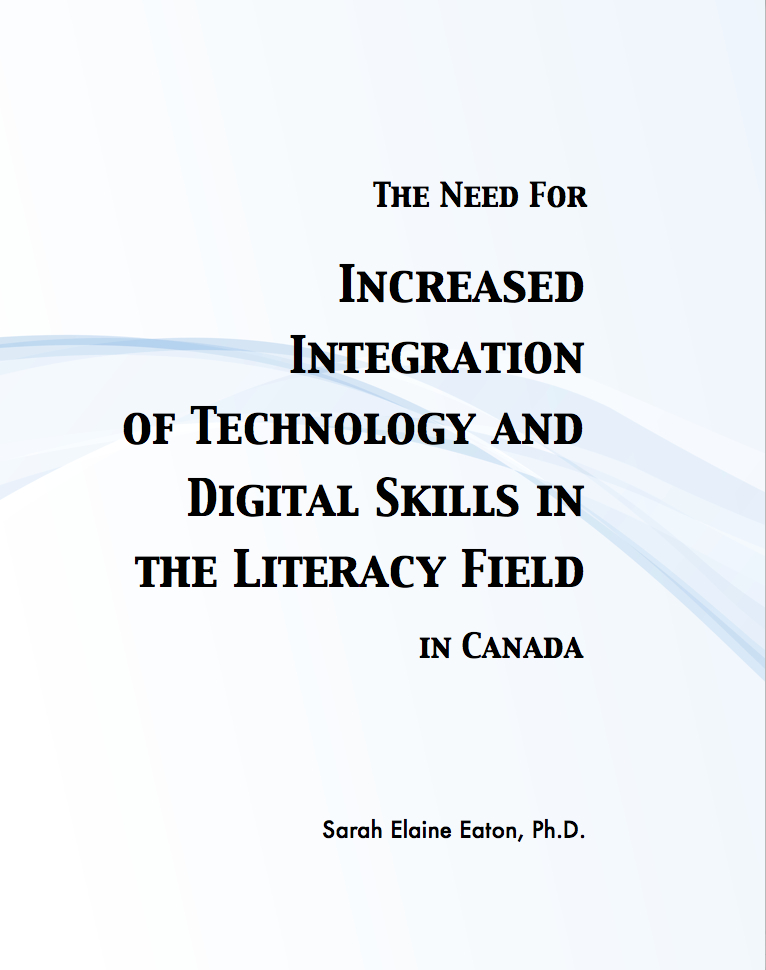
The Need For Increased Integration of Technology and Digital Skills in the Literacy Field in Canada

December 2, 2011

Need for Increased Tech in Literacy by Sarah Elaine Eaton, Calgary, CanadaIt’s here! The Need For Increased Integration of Technology and Digital Skills in the Literacy Field in Canada has just been released.

Technology does not need to be adopted because it is fashionable, but because the face of learning worldwide has changed dramatically over the past several decades at all levels, from early childhood education to workforce training. When literacy professionals integrate technology in meaningful ways, they ultimately help learners prepare for long-term success.

This report highlights the changing landscape of Canadian education and training (though the findings may relate to other regions, too). It offers recommendations for literacy organizations, managers, coordinators, staff, volunteer tutors and other practitioners to incorporate technology into professional practice in an easily accessible manner that focuses on building professional competencies.

Topics covered include:

  • The changing nature of education and training.
  • The current state of literacy instruction.
  • Emerging models of technology integration in the literacy field.
  • The need for continuing professional development.
  • Recommendations.

Bibliography contains 36 references. Get your copy here: http://www.onatepress.com/titles/the-need-for-technology-in-literacy/

This publication is also available through the ERIC database: http://www.eric.ed.gov/PDFS/ED526087.pdf

______________

Like this post? Share or Tweet it: The Need For Increased Integration of Technology and Digital Skills in the Literacy Field in Canada  http://wp.me/pNAh3-12r

Update – January 2018 – This blog has had over 1.8 million views thanks to readers like you. If you enjoyed this post, please “like” it or share it on social media. Thanks!

Sarah Elaine Eaton is a faculty member in the Werklund School of Education, University of Calgary, Canada.


Everything I needed to know about relationships, I learned from a hotel maid

November 29, 2011

There I was, rushing out of my hotel room to head down to the conference when I suddenly realized I hadn’t left a tip for the maid. I’m one of those people who leaves a tip every day for the hotel maid, rather than leaving it all at the end. The cleaning staff have different schedules and throughout my years of travelling, I have noticed, sometimes, that there can be different maids on different days. I figure that if I leave the entire tip at the end, then one person can clean up and any others might go without.

Leaving smaller tips every day has its drawbacks. It means that you can’t be carrying all $20 bills in your purse (unless, of course, you leave the maid a $20 every day.)

Although I haven’t seen her (or him, or them), I suspect that it has been the same person cleaning my room during the three days of my conference. Here’s why:

After the first day, I left a reasonable tip. I had mostly $20s with me, but I cobbled together enough of a tip that it wasn’t an insult. I came back to the room at the end of the day, and my room was clean and nicely arranged. There were a couple of extra drinking glasses in the bathroom. I always stick my toothbrush in one to dry out during the day, leaving only one other glass. The housekeeping staff had added a couple of extra so I wouldn’t run out. Nice touch. (When your job involves enough travelling, you notice the little details in hotels.)

On the second day, I realized that I’d forgotten to get change. All I had were larger bills. “Oh well,” I thought. “I don’t like to do it, but I’ll leave double tomorrow.” I knew in my head what my plan was, but it never occurred to me to leave a note for the housekeeping staff. I went on my way, with a small twinge of guilt in my gut — and a plan to correct my wrong the next day.

When I came back to my room that night, the bare minimum had been done… and the extra bed pillows I’d tossed onto the  arm chair before bed the night before remained there. Again, when you spend enough time in hotels, you notice.

During the day, I had made a point to get some smaller denominations. So, at the beginning of the third day, I did as I had intended and left a double tip.

What happened? I came back to an immaculate and sparkling room. The pillows were arranged perfectly, my personal toiletries were neatly organized on the bathroom counter and there were even extra towels that I had not asked for. Oh yeah, and there were extra bars of soap and bottles of shampoo and conditioner, too.

Of course, we don’t know for sure if it has been the same maid for the last three days. But let’s say, for the sake of argument, that it was. If I reflect on this possibility, then it occurs to me that there is much to learn from this. Here are 7 things I learned from this exchange:

1. Show appreciation. A little acknowledgement goes a long way in letting others know that you are thinking about them.

2. Non-verbal communication speaks volumes. I have never spoken with the hotel maid. I don’t even know what he or she looks like. But over the last three days, we have communicated with each other in non-verbal ways. Sometimes, it isn’t what you say, it is what you do not say that speaks the loudest.

3. Notice what is going on. Non-verbal communication may say a great deal, but if you are not listening, you will not hear the message. Take the time to notice what is going on around you, what is communicated silently and perhaps, deliberately.

4. Say what needs to be said. I just didn’t have any cash on me yesterday to leave a tip. It wasn’t a sign that I was dissatisfied or that I was being cheap. I could have left a note to say, “No cash with me today. Promise a double tip tomorrow.” I didn’t. In fact, it didn’t occur to me until much later.

5. Consistency creates security. The first day I left a tip and the next day I did not. I was inconsistent in that unspoken language of between a customer and a service worker. If I had been consistent I would have been sending the message that I was consistently pleased with how things were going. In relationships, it is helpful to act in a consistent way.

6. If you screw up, fix it — and fast. I understood from the minimum services that were performed on the second day (the day I didn’t leave a tip) that my house keeper was not happy. In the unspoken rituals of being a hotel guest, I screwed up. I corrected the situation the next day by leaving a double tip. In other words, I fixed the faux pas as soon as it was appropriate.

7. What matters is reality, not theory. Really, it shouldn’t matter if I leave a tip or not. The maid gets paid to do a job and certain duties are expected. That’s the theory. The reality is that to people in the service industry, tips matter. Whether or not you agree with reality is a different issue entirely from the fact that reality itself matters very much.

I’ve learned a great deal over the course of this three-day, silent exchange with this hotel housekeeper whose face I have never seen. I silently salute her (or him) and say, “Thank you for this lesson in human relationships.”

What relationships do you have where non-verbal communication speaks louder than any words between you? How are you listening? How do you address what is real in a relationship, rather than the way you think things “should” be?

______________

Like this post? Share or Tweet it: Everything I needed to know about relationships I learned from a hotel maid http://wp.me/pNAh3-12k 

Update – January 2018 – This blog has had over 1.8 million views thanks to readers like you. If you enjoyed this post, please “like” it or share it on social media. Thanks!

Sarah Elaine Eaton is a faculty member in the Werklund School of Education, University of Calgary, Canada.


Social Media Challenges at Work (CIRA Event)

November 10, 2011

If you’re in Calgary, join me on November 24 at the Village Park Inn for a dinner event hosted by the Southern Alberta Chapter of the Canadian Industrial Relations Association (CIRA):

“Social Media Challenges at Work”

Expert panelists: Sarah Eaton, John Moreau, Andy Robertson and Tom Hesse

An employee uses Facebook to malign her employer and harass co-workers. A manager regularly patrols the internet, “Googling” employees and monitoring their email. Where does the line get drawn between off-duty conduct, privacy, and the employer’s liability for the actions of its employees? What factors do adjudicators consider when analyzing social media cases? How can employers, unions and workers best protect themselves? Our panel of experts will address these and other thorny issues surrounding social media at work.

Join us for an enlightening conversation with Dr. Sarah Eaton, social media researcher and consultant; Arbitrator John Moreau; Andy Robertson, Partner, Macleod Dixon; and Tom Hesse, UFCW Negotiator and Executive Assistant to the President.

Cost: $40 for Non-CIRA members, $30 for members

To get your ticket, contact CIRA:

CIRA SOUTHERN ALBERTA CHAPTER

University of Lethbridge, Calgary Campus

Suite 1100 Rocky Mountain Plaza,

615 Macleod Trail SE, Calgary, Alberta T2G 4T8

Telephone: 571-3360 ext 4693 Fax: 403-261-2944

E-Mail: cira.alberta @ uleth.ca

View this document on Scribd

________________

Share this post: Social Media Challenges at Work (CIRA Event) http://wp.me/pNAh3-118

Update – January 2018 – This blog has had over 1.8 million views thanks to readers like you. If you enjoyed this post, please “like” it or share it on social media. Thanks!

Sarah Elaine Eaton is a faculty member in the Werklund School of Education, University of Calgary, Canada.