In Quebec, kippahs are out, but swastikas are OK

September 11, 2013

There have been very few times I have been ashamed to be Canadian, but today is one of them.

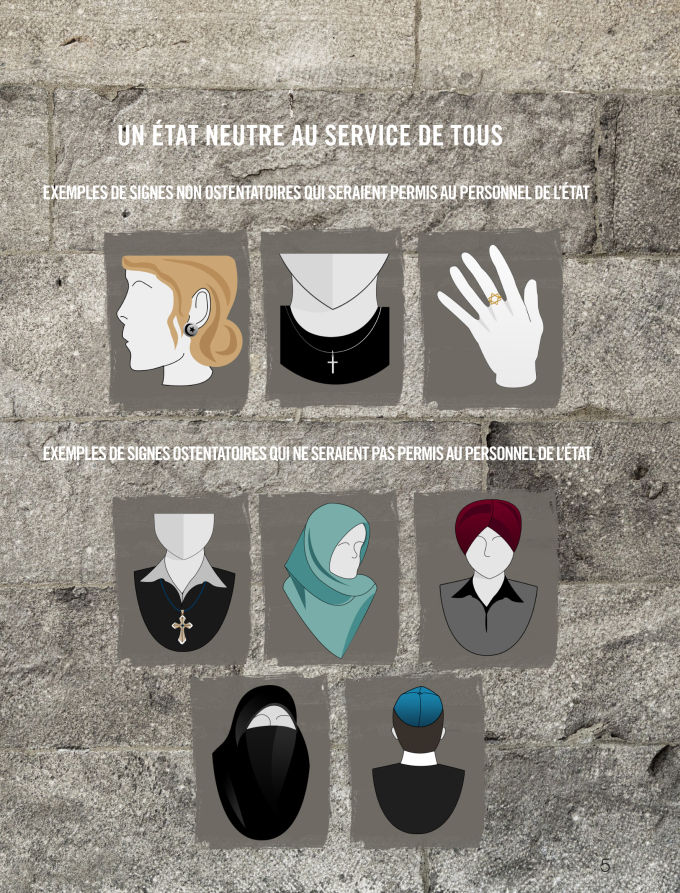
The provincial government of Quebec is institutionalized its vision of a secular society and “state neutrality”. It has produced its own “Charter of Values” that prohibits all public servants from wearing religious symbols or dress while at work. For example, female Muslim teachers can no longer a hijab to work. Jewish men who work as public servants may no longer wear a kippah. This poster shows what is and is not acceptable in Quebec workplaces:
Valeurs_depliant_version_longue-7.jpg

On the top row you can see the approved “non-ostentatious” symbols that recognize “Quebec heritage”, including a small cross or a discreet Star of David. So, Christian and Jewish symbols are OK, as long as they are not too obvious.

But clothing is out. Turbans, hijabs and kipphas all have to go.

Note the distinct lack of the swastika in the poster. The Quebec government might say those are OK, because they are not a religious symbol. The message seems pretty clear: Fanaticism might be tolerated, but showing that you believe in a non-human supreme being is not. Of course, the Quebec government has not explicitly said, “Yes, please wear a swastika to work”, but by not adding it to its list of “unacceptable symbols” the permission seems implicit, no?

This new “Charter of Values” has made international news and has Canadians up in arms. This CBC news article says that support for the Quebec government’s new policy is growing, however.

Journalists such as Steve Murray have parodied the new policy, suggesting that perhaps hockey jerseys should also be outlawed. After all, we would not want fans of the Montreal Canadiens offending those who believe strongly in the Toronto Maple Leafs. Can you imagine the riots that might break out at the local Tim Hortons if people went after one another for wearing a jersey from the wrong team? You might spill your double-double. (For my non-Canadian readers, that is Canadian-speak for a cup of coffee with two lumps of sugar and two helpings of cream).

Another, Canadian-born journalist, Fariha Naqvi-Mohamed offers a brilliant response to the Parti Quebecois in her Huffington Post Op/Ed.

What gets me is that this dress code does not seem to have been thought through. We have a national Charter of Rights and Freedoms that trumps (or should trump) what happens on a provincial level.

It’s not that I don’t think there should be a dress code at work. Safety and social decorum are two sensible reasons to have a dress code. People who work in an environment where the risk of injury might increase if your hair gets in the way, well, they should have to tie it back or tuck it under a cap, for example. That’s just  common sense.  Likewise, there’s no need for public servants to wear bathing suits, hot pants or pasties to work.  That sort of attire is more suited for work outside the public sector. That’s also common sense.

But banning religious symbols and particular pieces of clothing in the hopes of creating a secular society? Really? Didn’t the former Soviet Union try that and fail? Miserably?

As I mentioned earlier, people holds lots of beliefs that have nothing to do with religion… Those are still OK, though? You can believe in aliens or racial supremacy or child labor and that’s all OK?

Mind you… Quebec is the same  province that was able to pass a law banning businesses from posting any signage in English, in order to promote the French language. (Equally silly, in my humble opinion.) They seem to have carte blanche to do whatever they please and we’ll let them do it because, well… they’re Quebec.

Hopefully, Quebecers will remember that we still live in a democracy and they get to elect their leaders.

Practice tolerance

__________________________________

If you enjoyed this post, please “like” it or share it on social media. Thanks!

Share or Tweet this: In Quebec, kippahs are out, but swastikas are OK http://wp.me/pNAh3-1EE

Update – January 2018 – This blog has had over 1.8 million views thanks to readers like you. If you enjoyed this post, please “like” it or share it on social media. Thanks!

Sarah Elaine Eaton is a faculty member in the Werklund School of Education, University of Calgary, Canada.


How to use Scribd to publish your own documents online: A free, downloadable, step-by-step guide

September 2, 2013

With a new school year about to start, a great online tool for teachers and students to know about is Scribd. This online service lets you publish all kinds of documents, including:

  • Resources (like the guide I am sharing with you in this post)
  • Slide presentations
  • Digitally created books
  • Basically any document you can save in Word or .pdf format.

Here’s a preview, step-by-step, “how to” guide for you:

View this document on Scribd

To download a free copy, click on the download icon next to the word “Scribd” at the bottom of the frame. (It looks like an arrow pointing downwards.)

__________________________________

If you enjoyed this post, please “like” it or share it on social media. Thanks!

Share or Tweet this: How to use Scribd to publish your own documents online: A free, downloadable, step-by-step guide  http://wp.me/pNAh3-1Em

Update – January 2018 – This blog has had over 1.8 million views thanks to readers like you. If you enjoyed this post, please “like” it or share it on social media. Thanks!

Sarah Elaine Eaton is a faculty member in the Werklund School of Education, University of Calgary, Canada.


How to Access an ElluminateLive! Recording

August 30, 2013

Here’s a handy, downloadable two-page, step-by-step guide with screen shots to help you figure out how to access a recording of an ElluminateLive! e-learning session in Blackboard:

View this document on Scribd

Here’s a link to the downloadable file in .pdf format: How to access an ElluminateLive recording

__________________________________

If you enjoyed this post, please “like” it or share it on social media. Thanks!

Share or Tweet this:  How to Access an ElluminateLive! Recording http://wp.me/pNAh3-1Eh

Update – January 2018 – This blog has had over 1.8 million views thanks to readers like you. If you enjoyed this post, please “like” it or share it on social media. Thanks!

Sarah Elaine Eaton is a faculty member in the Werklund School of Education, University of Calgary, Canada.


Investment club for teachers: Circle or Dead End?

August 29, 2013

The first time I heard about Gifting Cirlces, I was sitting in the dentist’s chair getting my teeth cleaned. My dental hygienist was telling me about the one she was in.

I was her captive audience, as I sat wide-mouthed in the chair. She told me that the circles started during the Second World War, as a way for women to help each other when their husbands were off fighting overseas.

The concept sounds simple:

  • One woman in the middle.
  • Two women in the next outer circle.
  • Four women in a third circle.
  • Eight women in the outer circle.

Here’s a visual:

When you join a circle, you “gift” $5000 in cash to the woman in the centre. Upon receiving her gift, the woman leaves the circle. Then the group splits in half. Each of the other two then becomes the centre of her own circle. When eight more women are added, she accepts a cash gift of $5000 from each of them, for a total gift of $40,000. She then leaves the group and the circle splits again.

The idea is that everyone who joins the circle, ultimately leaves the circle with a cash gift of $40,000.

You can buy in again after you have left, but you have to move to the outer circle and contribute another $5000 each time you re-join.

I listened to the dental hygienist for almost a solid hour as she performed regular maintenance on my pearly whites. As she was finishing up, she said that if I was ever interested in investing,  I could let her know and she’d get me an invitation.

I was intrigued. (I questioned whether the dentist knew that her hygienist was informally recruiting patients to this gifting circle. I suspect she didn’t, as she was busy in another area, filling teeth…)

Nevertheless, I was very, very curious. I loved the idea of women helping women. Having been raised by a single mother, I know how hard it can be for women to make ends meet from month to month.

There were elements of this that didn’t sit quite right with me…

  •  We were not supposed to tell the men closest to us about the circle. It is just for women.
  • It had an element of mystery that I found as captivating as I did suspicious… No last names, no cheques. Cash only.
  • There was an almost cult-like feeling… You must be “chosen” to take part in a gifting circle. This seemed to be a blatant appeal to my ego… I was suddenly special. I was “chosen”.

I didn’t join… but remained curious.

I’ve recently been invited to another “Gifting Circle”. They are also called “investment circles”, “gift clouds” or “gifting clouds”. This one is primarily targeted towards teachers.

“We are under paid, you know…” The person inviting me said. “The system won’t really help us get ahead… not financially, anyway. We have to help each other. This helps us build our financial literacy and become empowered as women. We teach our students how to shine their brightest, but we don’t always do the same for ourselves. The Gifting Circle helps us do just that… be the very best you can be.”

For me, these words are seductive. Phrases such as “build our financial literacy” and “become empowered” speak to my heart. They invoke a deep and visceral response of wanting to help my fellow woman, as much as myself.

But at heart, I am a skeptic. Before I put my $5000 in an unmarked envelope and headed to a meeting, my head took over and I began doing some research. Sadly, all I found was bad news:

The article from the Calgary Herald was particularly poignant, as it talked about how these Gifting Circles can ruin friendships and professional relationships.

I am all about women building their financial literacy and learning how to develop personal leadership for themselves and their money. I am no longer convinced that joining a Gifting Circle is a way to help my fellow teachers… or that it will build my financial literacy.

Besides… who would want to risk losing a friend over an investment that might just constitute illegal activity? My teacher-friends are among those nearest and dearest to my heart. We often have lots in common when it comes not only to work, but also to our values, ethics and who we are as people. We are almost compulsively supportive of one another… in a really great way.

I wont’ be joining a gifting club or investment circle (or pyramid) any time soon. I will find other ways to support my fellow teachers this year.

What do you think? Have you ever heard of a “gifting circle”? Or an investment club for teachers? What was your experience?

__________________________________

If you enjoyed this post, please “like” it or share it on social media. Thanks!

Share or Tweet this: Investment club for teachers: Circle or Dead End? http://wp.me/pNAh3-1DY

Update – January 2018 – This blog has had over 1.8 million views thanks to readers like you. If you enjoyed this post, please “like” it or share it on social media. Thanks!

Sarah Elaine Eaton is a faculty member in the Werklund School of Education, University of Calgary, Canada.


50 years after “I have a dream” U.S. college residences implement “self-segregation” based on religion

August 28, 2013

On the day of the 50th Anniversary of the March on Washington and Martin Luther King Jr.’s now famous “I have a dream” speech, Inside Higher Ed. published an article on self-segregation at U.S. college residences.

The article is titled “Residence Halls Get Religion” and talks specifically about residences that favour Roman Catholic and Christian students. Students of other faiths are allegedly permitted “if there is space”.

Should institutions that promote higher thinking also promote this new form of self-segregation?

Is this a sign that young people really prefer not to live in harmony with others, but rather “stick with their own kind”?

Is segregation any better if it is done through self-selection?

Canada is usually not terribly far behind the United States in terms of trends. I wonder if this phenomenon will hit Canadian campuses, too? (Let me re-phrase that… I worry that it might.) Does the sad irony of this make you shake your head, too?

I cannot help but wonder, on this very important anniversary, how far we have really come?

I think we still have some work to do when it comes to putting tolerance, understanding and peace first.

What do you think? Is it a good idea to have college residences segregated by religion?

__________________________________

If you enjoyed this post, please “like” it or share it on social media. Thanks!

Share or Tweet this: 50 years after “I have a dream” U.S. college residences implement “self-segregation” based on religion http://wp.me/pNAh3-1DP

Update – January 2018 – This blog has had over 1.8 million views thanks to readers like you. If you enjoyed this post, please “like” it or share it on social media. Thanks!

Sarah Elaine Eaton is a faculty member in the Werklund School of Education, University of Calgary, Canada.