Academic Integrity: Resource for Teaching Assistants

September 16, 2019
Academic Integrity resource for teaching assistants

Academic Integrity resource for teaching assistants

As a Teaching Assistant (TA) it can be tricky to know what your responsibilities are if you suspect or observe academic misconduct. This resource is intended to help both TAs and course instructors about the roles and responsibilities teaching assistants play in upholding academic integrity at the University of Calgary.

Teaching assistants are responsible for acting with integrity, maintaining the privacy of all parties involved and reporting any suspected or actual cases of academic misconduct to the course instructor. TAs are not responsible for confronting student(s) who may be allegedly responsible for academic misconduct and nor are they responsible for imposing sanctions (discipline). It is the responsibility of the course instructor to follow the guidelines established by their faculty for responding to allegations of academic misconduct.

Open communication between course instructors and teaching assistants is key. Establishing expectations early in the term, before issues might arise can be very helpful for teaching assistants.

It is important for teaching assistants to know they are not alone when it comes to upholding academic integrity.

This one-page tip sheet is intended as a suggested guideline to help teaching assistants figure out what to do if they encounter or suspect a breach of academic integrity. This handout is not exhaustive and it may not cover all situations. This resource was developed specifically for teaching assistants at the University of Calgary and may not apply to TAs at other institutions.

Here is a link to this free and downloadable .pdf resource: U Have Integrity: Resource for Teaching Assistants.

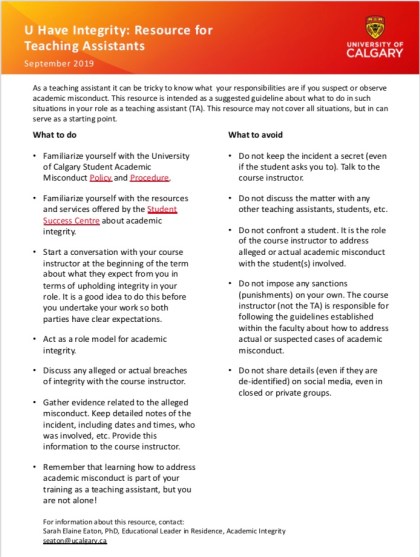
Here is the text of the .pdf for anyone wanting a quick read:

As a teaching assistant it can be tricky to know what your responsibilities are if you suspect or observe academic misconduct. This resource is intended as a suggested guideline about what to do in such situations in your role as a teaching assistant (TA). This resource may not cover all situations, but in can serve as a starting point. 

What to do 

  • Familiarize yourself with the University of Calgary Student Academic Misconduct Policy and Procedure. 
  • Familiarize yourself with the resources and services offered by the Student Success Centre about academic integrity. 
  • Start a conversation with your course instructor at the beginning of the term about what they expect from you in terms of upholding integrity in your role. It is a good idea to do this before you undertake your work so both parties have clear expectations. 
  • Act as a role model for academic integrity. 
  • Discuss any alleged or actual breaches of integrity with the course instructor. 
  • Gather evidence related to the alleged misconduct. Keep detailed notes of the incident, including dates and times, who was involved, etc. Provide this information to the course instructor. 
  • Remember that learning how to address academic misconduct is part of your training as a teaching assistant, but you are not alone! 

What to avoid 

  • Do not keep the incident a secret (even if the student asks you to). Talk to the course instructor. 
  • Do not discuss the matter with any other teaching assistants, students, etc. 
  • Do not confront a student. It is the role of the course instructor to address alleged or actual academic misconduct with the student(s) involved. 
  • Do not impose any sanctions (punishments) on your own. The course instructor (not the TA) is responsible for following the guidelines established within the faculty about how to address actual or suspected cases of academic misconduct. 
  • Do not share details (even if they are de-identified) on social media, even in closed or private groups.

Related posts:

______________________________________________________

Share or Tweet this: Academic Integrity: Resource for Teaching Assistants https://wp.me/pNAh3-2oQ

This blog has had over 2 million views thanks to readers like you. If you enjoyed this post, please “like” it or share it on social media. Thanks!

Sarah Elaine Eaton is a faculty member in the Werklund School of Education, and the Educational Leader in Residence, Academic Integrity, University of Calgary, Canada. Opinions are my own and do not represent those of the University of Calgary.


The foundations of scholarship: Original sources

September 3, 2019

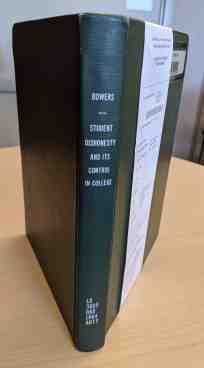
Bowers 1964-sm.jpgI am always telling my students to find and cite the original sources rather than relying on secondary sources. In the work I do on academic misconduct, the work of William Bowers is often cited as a seminal study in the field. The problem is that Bowers’s original work is hard to get your hands on. I was able to find a copy of his 1966 doctoral dissertation, but the original 1964 book seemed almost impossible to find. The two sources have exactly the same title. Although both texts are based on the same content, it is presented in different ways in both texts.

I can say this because I’ve now read both sources in their entirety.

Thanks to our amazing librarians at the University of Calgary, who were able to track down a copy of Bowers’s original 1964 work. Through the inter-library loan system, they were able to request the book from another library (thanks, University of Waterloo!) and have it sent to the university where I work so I could read it.

It is a beautiful volume, obviously produced on a typewriter with painstaking detail. This work was a true labour of love. I so appreciate having the opportunity to read it for myself. I now understand Bowers’s work much better. (I purposely do not offer a synopsis of his work in this blog post, so as to encourage others to go read the original works themselves, rather than relying on someone else’s summary!) Although more updated studies have been published since then, this nevertheless remains an important foundational book in my field. I am delighted to have had the privilege to read it.

I encourage anyone who wants to undertake deep scholarship in a particular field to find the original works upon which the field was built. If you can’t find the books, ask your friendly neighbourhood librarian for help. You might be surprised how they can help you be a better scholar.

References:

Bowers, W. J. (1964). Student dishonesty and its control in college. New York: NY: Bureau of Applied Social Research, Columbia University.

Bowers, W. J. (1966). Student dishonesty and its control in college. (Doctor of Philosophy). Columbia University, New York.

______________________________________________________

Share or Tweet this: The foundations of scholarship: Original sources https://wp.me/pNAh3-2ol

This blog has had over 2 million views thanks to readers like you. If you enjoyed this post, please “like” it or share it on social media. Thanks!

Sarah Elaine Eaton is a faculty member in the Werklund School of Education, University of Calgary, Canada. Opinions are my own and do not represent those of the Werklund School of Education or the University of Calgary.


Multilingual essay mills – New article

August 6, 2019

Notos coverMy colleague, Roswita Dressler and I have just had a new paper published. It all started when I was at an academic integrity conference a couple of years back. I was sitting next to a colleague who works in a language other than English (LOTE). The colleague suggested that contract cheating (e.g. essay mills and other forms of outsourced academic work) was a problem of the English-speaking world, asserting that there simply wouldn’t be enough of a market in other languages.
I thought to myself, “Challenge accepted!” I recruited Roswita Dressler to help me undertake a small-scale pilot study. We both have a background in language teaching and between us, we have some level of proficiency in about four languages. We were also curious about the market for academic outsourcing for younger audiences, in elementary, middle and high school.


The questions that guided our project were:

  1. What evidence exists that online providers offer academic work in languages other than English?
  2. To what degree are K-12 students targeted by these online providers?

We framed our study specifically within the Canadian context.

Our results showed that not only do commercial contract cheating companies market to specifically to students in Canada, they target children as young as Grade six (approximately 11-12 years old). And yes, we found strong evidence that contract cheating happens in languages other than English (ten of them, in fact).

To the best of our knowledge, this is the first study on contract cheating published in Canada.

The Alberta Teachers Association is the publisher and copyright holder of this article. They have given us permission to post the article in our university’s digital repository. You can access a copy of it free of charge from here:

Eaton, S. E., & Dressler, R. (2019). Multilingual essay mills: Implications for second language teaching and learning. Notos, 14(2), 4-14. Retrieved from http://hdl.handle.net/1880/110695

______________________________________________________

Share or Tweet this: Multilingual essay mills – New article

This blog has had over 2 million views thanks to readers like you. If you enjoyed this post, please “like” it or share it on social media. Thanks!

Sarah Elaine Eaton is a faculty member in the Werklund School of Education, University of Calgary, Canada. Opinions are my own and do not represent those of the Werklund School of Education or the University of Calgary.


Academic Integrity (AI) Tutorials in Canadian Post-Secondary Institutions: A National Overview

March 11, 2019

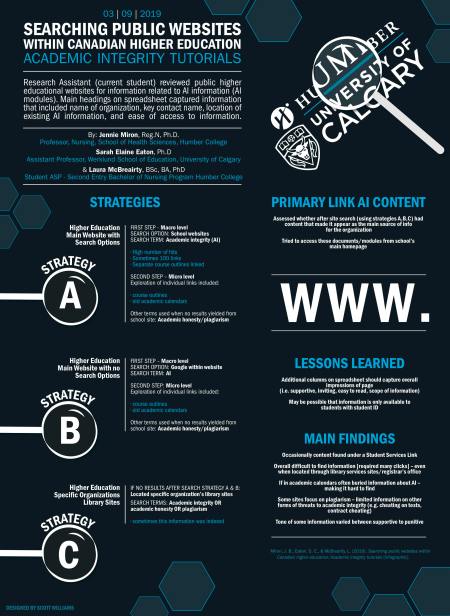
I’ve been working on a national research project with my colleagues, Jenny Miron and Laura McBrearity, at Humber College to look at what programming and supports Canadian post-secondary institutions provide to students to help them learn about academic integrity. We reviewed the websites of public higher education institutions across the country to better understand how academic integrity information is shared with students and faculty across campuses. We recently presented our findings at the conference of the International Center for Academic Integrity in New Orleans. Here’s a quick overview of our session:

Miron, J. B., Eaton, S. E., & McBrearity, L. (2019). Academic Integrity (AI) Tutorials in Canadian Post-Secondary Institutions: A National Overview. Paper presented at the International Center for Academic Integrity, New Orleans, LA.

The team at Humber College created this excellent visual infographic highlighting our methods (search strategies), lessons learned and key findings:

JPG (small) - Miron, Eaton & McBrearity - 2019 Final Infographic copy

We have not published the full findings yet, though we plan to do so soon. Because there is so little research available about what kind of support (e.g. education, tutorials, modules) offer on academic integrity to Canadian post-secondary students, we wanted to make these preliminary results available now.

You can download a high quality version of this infographic here:

Miron, J. B., Eaton, S. E., & McBrearity, L. (2019). Searching Public Websites within Canadian Higher Education: Academic Integrity Tutorials [Infographic]. Retrieved from http://hdl.handle.net/1880/109916

______________________________________________________

Share or Tweet this: Academic Integrity (AI) Tutorials in Canadian Post-Secondary Institutions: A National Overview

This blog has had over 2 million views thanks to readers like you. If you enjoyed this post, please “like” it or share it on social media. Thanks!

Sarah Elaine Eaton is a faculty member in the Werklund School of Education, University of Calgary, Canada. Opinions are my own and do not represent those of the Werklund School of Education or the University of Calgary.


The ethics of outsourcing: Contract cheating in the health professions

February 15, 2019

This morning I had the pleasure of providing a continuing education session to the Orthopaedic Surgeons at their City Wide (Grand) Rounds. The session was offered live at the Foothills campus and participants from various hospitals around the city joined by video conference.

2019 02 15 Ortho CWR Poster[1]Learning Objectives:

  • Define and explain what contract cheating is
  • Explain how the global contract cheating industry works
  • Understand the impact of contract cheating among medical and health program students

Here’s a copy of the title slide:

Title slide - Orthopaedic surgery rounds

References:

Bagshaw, E. (2016, May 26). University of Sydney’s medical school in second cheating controversy. Sydney Morning Herald. Retrieved from https://www.smh.com.au/education/university-of-sydneys-medical-school-in-second-cheating-controversy-20160525-gp3g3h.html

Bretag, T. (2017). Tertiary Education Quality and Standards Agency, Good Practice Note: Addressing contract cheating to safeguard academic integrity  Retrieved from https://www.teqsa.gov.au/latest-news/publications/good-practice-note-addressing-contract-cheating-safeguard-academic

Clarke, R., & Lancaster, T. (2006). Eliminating the successor to plagiarism: Identifying the usage of contract cheating sites. Paper presented at the Second International Plagiarism Conference, Gateshead, UK.

Curtis, G. J., & Clare, J. (2017). How Prevalent is contract cheating and to what extent are students repeat offenders? Journal of Academic Ethics, 15(2), 115-124. doi:10.1007/s10805-017-9278-x

Eaton, S. E. (2018). Contract cheating: A Canadian perspective.  Retrieved from http://blogs.biomedcentral.com/bmcblog/2018/07/24/contract-cheating-a-canadian-perspective/

Eaton, S. E., & Edino, R. I. (2018). Strengthening the research agenda of educational integrity in Canada: A review of the research literature and call to action. Journal of Educational Integrity, 14(1). Retrieved from https://edintegrity.biomedcentral.com/articles/10.1007/s40979-018-0028-7 doi:https://doi.org/10.1007/s40979-018-0028-7

Hosney, M. I., & Fatima, S. (2014). Attitude of students towards cheating and plagiarism: University case study. Journal of Applied Sciences, 14(8), 748-757. doi:10.3923/jas.2014.748.757

International Center for Academic Integrity. (2016). Institutional toolkit to combat contract cheating  Retrieved from http://integrity.fiu.edu/pdfs/Contract%20Cheating.pdf

Lancaster, T. (2018). US in first place for essays orders (not surprising), with the UK and Canada in equal second place [Tweet].   Retrieved from https://twitter.com/DrLancaster/status/1029014675198013440

Lancaster, T., & Clarke, R. (2008). The phenomena of contract cheating. In T. S. Roberts (Ed.), Student plagiarism in an online world: Problems and solutions (pp. 144-158). Hershey, PA: Idea Group Inc.

Lancaster, T., & Clarke, R. (2015). Examining contract cheating, essay mill use and academic misconduct by students on health courses.  Retrieved from https://www.researchgate.net/publication/323425525_Examining_Contract_Cheating_Essay_Mill_Use_and_Academic_Misconduct_by_Students_on_Health_Courses

Newton, P. M., & Lang, C. (2016). Custom essay writers, freelancers, and other paid third parties. In T. Bretag (Ed.), Handbook of Academic Integrity (pp. 249-271). Singapore: Springer Singapore.

O’BRien, N., & Smith, A. (2015, June 6). Cheating scandal: Sydney university to review medical study unit. Sydney Morning Herald. Retrieved from https://www.smh.com.au/education/cheating-scandal-sydney-university-to-review-medical-study-unit-20150606-ghi5d2.html

Plagiarism.org. (2017). How big of a problem in contract cheating?   Retrieved from http://www.plagiarism.org/blog/2017/12/12/how-big-of-a-problem-is-contract-cheating

Quality Assurance Agency for Higher Education (UK) (QAA). (2017). Contracting to cheat in higher education: How to address contract cheating, the use of third-party services and essay mills  Retrieved from http://www.qaa.ac.uk/en/Publications/Documents/Contracting-to-cheat-in-higher-education.pdf

Rogerson, A. M. (2017). Detecting contract cheating in essay and report submissions: process, patterns, clues and conversations. International Journal for Educational Integrity, 13(1), 10. doi:10.1007/s40979-017-0021-6

Tonkin, A. L. (2015). “Lifting the carpet” on cheating in medical school exams. BMJ: British Medical Journal, 351(August), 22-29.

Turnitin. (2013). Paying for plagiarism (webinar). Retrieved from http://go.turnitin.com/webcast/paying-for-plagiarism

University of Alberta. (n.d.). Student Conduct and Accountability: Proving Misconduct.   Retrieved from https://www.ualberta.ca/provost/dean-of-students/student-conduct-and-accountability/proving-misconduct

Walker, M., & Townley, C. (2012). Contract cheating: A new challenge for academic honesty? Journal of Academic Ethics, 10(1), 27–44. https://doi.org/10.1007/s10805-012-9150-y

If you would like  a copy of this talk, please e-mail me at seaton (at) ucalgary (dot) ca

______________________________________________________

Share or Tweet this: The ethics of outsourcing: Contract cheating in the health professions https://wp.me/pNAh3-2mw

This blog has had over 2 million views thanks to readers like you. If you enjoyed this post, please “like” it or share it on social media. Thanks!

Sarah Elaine Eaton is a faculty member in the Werklund School of Education, University of Calgary, Canada.

Opinions are my own and do not represent those of the Werklund School of Education or the University of Calgary.