#ICAI2021 Re-cap: My Reflections on International Collaborations

March 5, 2021

I was delighted to take part in three sessions for the International Center for Academic Integrity (ICAI) conference, which was held online this week. With over 1200 registrants, this was the largest ICAI conference ever.

In terms of my own contributions to the conference, this year I focused on collaborative work with others. For me, this means that the work is conceptualized and developed jointly, every step of the way. The end result is stronger, more interesting, and more dynamic than if it had been created by any one individual alone. In an article I co-authored with Rachael Edino a few years ago, we showed that academic integrity research in Canada has mostly been small scale and has lacked collaboration across institutions and across countries. Ever since, I have been on a mission to actively engage in and promote research collaborations that not only include researchers from multiple institutions, but extend to international partnerships, too. I am super excited to say that goal was certainly achieved through collaborative presentations at this year’s ICAI conference, as I had the opportunity to showcase work with 6 colleagues and 1 PhD student, spread out across 7 countries. Here’s a recap:

Student Perspectives on the Impact of Race in Educational Surveillance and Proctoring Technologies

Parnther & Eaton #ICAI2021 Slide 1

Ceceilia Parnther, St. John’s University, USA

Sarah Elaine Eaton, University of Calgary, Canada

Presentation date: March 1, 2021

# of registered session participants: 349

Parnther & Eaton #ICAI2021 Slide 2

Session re-cap: We brought a critical race perspective to electronic and remote proctoring technologies that have become prevalent during COVID-19. E-proctoring is a rapidly growing technology for higher-education institutions. Although this technology is promoted as a method to promote academic integrity by offering faculty control over the remote testing environment, students have expressed concern and anxiety about these monitoring tools. Specifically, students note anxiety and discomfort resulting from the use of these tools. These feelings may be exacerbated for students of colour due to the algorithmic biases that position whiteness as normative. We interrogate the ethical complexities of e-proctoring and other academic integrity technologies through the lens of equity and diversity.

A Chilean Perspective on Academic Integrity During COVID-19: Analyzing Possible Benefits and Challenges of Online Learning Communities

Moya & Eaton #ICAI2021 - Slide 1

Beatriz Moya Figueroa, University of Calgary, Canada

Sarah Elaine Eaton, University of Calgary, Canada

Presentation date: March 1, 2021

# of registered session participants: 78

Overview: Beatriz is a new PhD student studying with me at the University of Calgary. This session marked Beatriz’s debut into the international academic integrity community. Due to COVID-19, Beatriz has remained in her home country of Chile throughout the pandemic and has not yet been able to physically come to Canada. She has been getting to know members of the Canadian academic integrity community by joining into our weekly Integrity Hour. This experience of working virtually across several months during Beatriz’s first year as a PhD students served as the basis for this collaborative session.

Session description: The COVID-19 pandemic pushed Chilean universities towards a quick transition into emergency remote teaching. Moreover, faculty identified a rapid increase in academic misconduct cases and the need to promote an academic integrity culture in their institutions. This new scenario called for new strategies to exchange academic integrity practices to help face the pandemic’s obstacles. In this presentation, we analyze the possible benefits and challenges of online learning communities for Chilean higher education institutions inspired by the experience of the Canadian “Integrity hour” online learning community. We also discuss new opportunities as the effects of COVID-19.

You can check out the video recording of our session here.

Publishing Your Academic Integrity Research: Advice From the Editorial Board of the International Journal for Educational Integrity
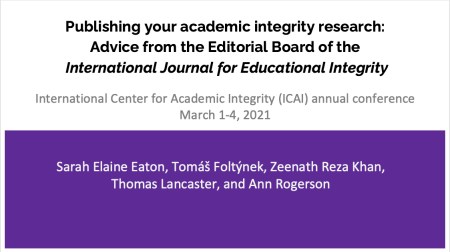
IJEI Presentation #ICAI2021

Sarah Elaine Eaton, University of Calgary, Canada

Tomáš Foltýnek, Mendel University in Brno, Czech Republic

Zeenath Reza Khan, University of Wollongong in Dubai (UOWD), UAE

Thomas Lancaster, Imperial College London, UK

Ann Rogerson, University of Wollongong, Australia

Presentation date: March 4, 2021

# of registered session participants: 77
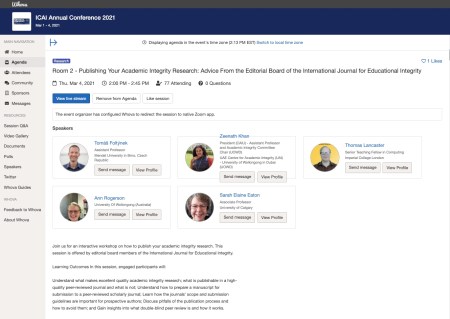
Whova - Screen Shot 2021-03-05 at 12.13.28 PM - IJEI

Session recap: We offered an interactive workshop on how to publish your academic integrity research. This session is offered by editorial board members of the International Journal for Educational Integrity.

Learning Outcomes:
Understand what makes excellent quality academic integrity research; what is publishable in a high-quality peer-reviewed journal and what is not; Understand how to prepare a manuscript for submission to a peer-reviewed scholarly journal; Learn how the journals’ scope and submission guidelines are important for prospective authors; Discuss pitfalls of the publication process and how to avoid them; and Gain insights into what double-blind peer review is and how it works. Check out an abbreviated session recording here.

Reflections: This session was the most logistically complex, by far. We had 5 presenters co-presenting in real time from 5 countries across 5 very different time zones. The session was held at 14:00 Eastern, which meant that Ann Rogerson was just rolling out of bed at 06:00 the next day in Wollongong. Needless to say, she arrived with coffee in hand. Meanwhile, Zeenath Reza Khan was looking forward to going to bed after the workshop, as the session was starting at 11:00 p.m. for her over in Dubai. It was noon for me in Calgary, 19:00 for Thomas Lancaster in the UK, and 20:00 for Tomáš Foltýnek in Brno.

This was the first time the five of us had ever co-presented together and our preparations for this session happened entirely asynchronously, using Google slides and also corresponding via e-mail to prepare the entire presentation. We each had slides assigned to us to speak to, but due to the time zones, we did not do a practice run for the session. For me, this was the most incredible presentation as it was truly a privilege to collaborate with so many dedicated colleagues from so many corners of the world. I can’t say for sure, but I think we might have been the most internationally diverse presentation team at this year’s conference.

Concluding Reflections

The conference organizers did a tremendous job of planning and delivering an excellent online event. None of the sessions I took part in either as a co-presenter or as a participant had any technical issues, which really speaks to how much preparation went into this conference prior to the event and “in the background” during the conference itself.

As others with expertise in educational technology will attest, the technology works best when it is invisible. That is to say, when there are technology problems, everyone turns their focus to the tech issues, often at the expense of developing human connections. In this case, the technology itself was very much invisible and the opportunity to connect with fellow collaborators in a very human sense was a highlight of the conference for me.

I think the most remarkable part of co-presenting all of these sessions is that the virtual environment facilitated and provided opportunities to collaborate across countries and time zones. Although I have had the pleasure of meeting Ann Rogerson and Thomas Lancaster in person at previous events, I have yet to meet any of my other fellow collaborators “in real life”. I very much look forward to the day when that happens.

In expect that by the time we get the meet face to face, it will be like meeting old friends and we will slip into conversations and laughter easily. To be able to collaborate with so many international colleagues from across continents was a special and remarkable aspect to this virtual conference.

_____

Share or Tweet this: #ICAI2021 Re-cap: My Reflections on International Collaborations – https://drsaraheaton.wordpress.com/2021/03/05/icai21-re-cap-my-reflections-on-international-collaborations/

This blog has had over 2 million views thanks to readers like you. If you enjoyed this post, please “like” it or share it on social media. Thanks!

Sarah Elaine Eaton, PhD, is a faculty member in the Werklund School of Education, and the Educational Leader in Residence, Academic Integrity, University of Calgary, Canada.

Opinions are my own and do not represent those of the University of Calgary or anyone else.


Why schools need “safe sharing sites” for students: Promoting academic integrity with ethical approaches to file-sharing

March 3, 2021

#ICAI2021 - Eaton quoteCommercial file-sharing and homework help sites have proliferated during the COVID-10 pandemic. One recent news report states that Chegg is now worth $12 Billion USD. And that’s just one company.

During the 2021 International Center for Academic Integrity conference, there were a few sessions dedicated to how to deal with companies such as Chegg, CourseHero and other commercial entities. One answer might be for schools themselves to create “safe sharing sites” for students.

The idea is similar to that of safe consumption sites for those who use drugs to do so in a monitored and safe environment. The purpose of a supervised or safe consumption site is to support harm reduction for users.

To transfer the analogy to academic file sharing, if students are going to share files anyway, it is incumbent upon schools provide them with safe and supported ways for them to do so. Safe sharing sites can promote ethical decision-making, minimize academic misconduct, and foster a sense of school community where profs, administrators, and students are working together to uphold integrity.

The onus is on educational institutions to support students’ learning. When schools invest in student learning through institutionally-supported tools and platforms, they support the student experience. Developing safe sharing sites is one viable way to address the problem of unethical file-sharing.

Putting resources into trying to combat global corporate entities whose primary purpose is to make a profit from our students is a losing battle. Putting effort into submitting requests to take down materials from corporate third party sites is like a game of whack-a-mole we can never win. As I commented in one of the conference presentations during the ICAI conference: Schools paying for a commercial file-sharing site account in order to find out what is on their website is like paying a drug dealer to find out what is in their pills. When schools pay for an account on corporate 3rd party sites, we help to finance the industry we are advocating against.

As educational institutions, we must find ways to work with our students, not against them. File-sharing is a normal online behaviour, so let’s provide students with the tools to do what they are going to do any way in safe and supported ways that help them – and us – uphold integrity on our campuses.

_____

Share or Tweet this: Why schools need “safe sharing sites” for students: Promoting academic integrity with ethical approaches to file-sharing – https://drsaraheaton.wordpress.com/2021/03/03/why-schools-need-safe-sharing-sites-for-students-promoting-academic-integrity-with-ethical-approaches-to-file-sharing/

This blog has had over 2 million views thanks to readers like you. If you enjoyed this post, please “like” it or share it on social media. Thanks!

Sarah Elaine Eaton, PhD, is a faculty member in the Werklund School of Education, and the Educational Leader in Residence, Academic Integrity, University of Calgary, Canada.

Opinions are my own and do not represent those of the University of Calgary or anyone else.


Research update: Highlights from some current projects

February 9, 2021

It seems I have a lot of academic Integrity research projects on the go these days, so I thought I’d do a post about some of this exciting work and the amazing people I’ve been collaborating with.

Academic Integrity and Mental Well-Being

As part of my Educational Leader in Residence, Academic Integrity role, I wanted to connect some of my research to the University of Calgary’s Campus Mental Health Strategy.

I’ve been working on with two terrific graduate students, Helen Pethrick and Kristal Turner on a new project, Academic Integrity and Mental Well-Being.

So far, we have one publication from this project. Exploring academic integrity and mental health during COVID-19: Rapid review was published in the Journal of Contemporary Education Theory & Research in December 2020.

Our second paper is under peer review, so stay tuned for details on that later.

Academic Integrity: Faculty Development Needs for Canadian Higher Education

This is the inaugural project associated with the D2L Innovation Guild. This project is the first of its kind in Canada. There has never before been a multi-institutional project, with representation from across multiple provinces, that has also partnered with industry in pursuit of a common unified goal with regards to academic integrity.

This collaborative, multi-institutional project included researchers from four Canadian provinces:

  • Sarah Elaine Eaton, PhD, Principal Investigator, University of Calgary
  • Katherine (Katie) Crossman, PhD, Co-Investigator and Study Coordinator, University of Calgary
  • Brenda M. Stoesz, PhD, Co-Investigator, University of Manitoba
  • Kim Garwood, PhD, Co-Investigator, University of Guelph
  • Amanda McKenzie, MA, Co-Investigator, University of Waterloo

We have publicly registered our project on the Open Science Framework. You can check out details about our project here.

You can check out our project brief, which is available as an open access report (Crossman et al., 2019). This project is now complete and we submitted our final reports to the D2L Innovation Guild Board on February 8, 2021.

Contract Cheating in Canada: National Policy Analysis

 This is an exciting project that I began developing in 2018. I wanted to create opportunities for Canadian researchers to do scholarly inquiry into contract cheating. I received mentorship from Dr. Tracey Bretag in the early stages of this project. She had led a team in Australia to conduct academic integrity policy research there. She coached me on how to conduct a similar project in Canada. As a result, I launched Contract Cheating in Canada: National Policy Analysis.

The specific objectives of this project are to:

  • Identify existing components of academic integrity policies and procedures related to contract cheating;
  • Identify gaps in existing academic integrity policies and procedures related to contract cheating;
  • Evaluate the policies and procedures against existing standards for post-secondary education policy (i.e., Australian Government: Tertiary Education Quality and Standards Agency (TEQSA), 2017; Higher Education Academy [HEA], 2011) with a focus on supports that have been developed for students and other campus stakeholders (Bretag et al., 2011);
  • Compare supports available for undergraduate students and graduate students; and
  • Develop and communicate recommendations for policy reform.

This national project is sub-divided according to regions of Canada and types of post-secondary institutions (e.g., colleges and universities). Different teams have been involved with each of the smaller sub-projects, with individuals from a particular region studying the policies from their own regions.

We’ve already had some great publications out of this project, the most recent of which was published in Educational Policy.

Degrees of Deceit: A Study of Fake Degrees, Diploma Fraud and Counterfeit Credentials

I am working with Jamie Carmichael at Carleton University in Ottawa, Canada, on a project to better understand fake degrees and fraudulent credentials in Canadian higher education.

Check out our webinar recording about this work. Some very cool resources we have already produced out of this work include:

A slide deck from our webinar session.

Counterfeit Credentials: Top 13 Recommendations for Higher Education Professionals (Infographic)

Scholarships without Scruples (Infographic)

We are also working on an edited book on this topic. More details on that will be coming soon…

These aren’t all the projects I have on the go, just a few I wanted to highlight here. Feel free to get in touch about any of these projects. You know where to find me!

_____

Share or Tweet this: Research update: Highlights from some current projects

This blog has had over 2 million views thanks to readers like you. If you enjoyed this post, please “like” it or share it on social media. Thanks!

Sarah Elaine Eaton, PhD, is a faculty member in the Werklund School of Education, and the Educational Leader in Residence, Academic Integrity, University of Calgary, Canada.

Opinions are my own and do not represent those of the University of Calgary or anyone else.


New book Series: Ethics and Integrity in Educational Contexts

February 1, 2021

A97796_EIEC_Series_Banner_P2

I am pleased to announce a new book series, Ethics and Integrity in Educational Contexts by Springer.

About this series

The aim of this series is to provide an authoritative series of books on topics relating to ethics and integrity in educational contexts. Its scope includes ethics and integrity, defined in broad and inclusive terms, in educational contexts. It focuses on higher education, but also welcomes contributions that address ethics and integrity in primary and secondary education, non-formal educational contexts, professional education, etc. We welcome books that address traditional academic integrity topics such as plagiarism, exam cheating, and collusion.

In addition, we are particularly interested in topics that extend beyond questions of student conduct, such as

  • Quality assurance in education;
  • Research ethics and integrity;
  • Admissions fraud;
  • Fake and fraudulent credentials;
  • Publication ethics;
  • Educational technology ethics (e.g., surveillance tech, machine learning, and artificial intelligence, as they are used in education);
  • Biomedical ethics in educational contexts;
  • Ethics in varsity and school sports.

This series extends beyond traditional and narrow concepts of academic integrity to broader interpretations of applied ethics in education, including corruption and ethical questions relating to instruction, assessment, and educational leadership. It also seeks to promote social justice, diversity, equity, and inclusion.

The series provides a forum to address emerging, urgent, and even provocative topics related to ethics and integrity at all levels of education, from a variety of disciplinary and geographical perspectives.

Editorial Board

I am delighted to work with an international group scholars and experts as members of the Editorial Board:

Tomáš Foltýnek, Department of Informatics, Faculty of Business and Economics, Mendel University, Brno, Czechia

Irene Glendinning, Coventry University, Coventry, UK

Zeenath Reza Khan, University of Wollongong, Dubai, United Arab Emirates

Rebecca Moore Howard, Syracuse University, New York, USA

Mark Israel, Australasian Human Research Ethics Consultancy Services, Perth, Australia

Ceceilia Parnther, St. Johns’ University, New York, USA

Brenda M. Stoesz, The Center for Advancement of Teaching and Learning, University of Manitoba, Winnipeg, Manitoba, Canada

Forthcoming and New Books

The first book to launch the series will be Academic Integrity in Canada (Eaton & Christensen Hughes, eds., forthcoming). I will share more details about this first book when we are closer to publication, which should be in mid to late 2021.

Proposals for a number of other books to join the series are underway, with authors and editors from a variety of countries.

If you have an idea for a book to be included as part of this series, please contact me.

_____

Share or Tweet this: New book Series: Ethics and Integrity in Educational Contexts https://drsaraheaton.wordpress.com/2021/02/01/new-book-series-ethics-and-integrity-in-educational-contexts/

This blog has had over 2 million views thanks to readers like you. If you enjoyed this post, please “like” it or share it on social media. Thanks!

Sarah Elaine Eaton, PhD, is a faculty member in the Werklund School of Education, and the Educational Leader in Residence, Academic Integrity, University of Calgary, Canada.

Opinions are my own and do not represent those of the University of Calgary or anyone else.


Plagiarism in Engineering Programs: An Annotated Bibliography

January 13, 2021

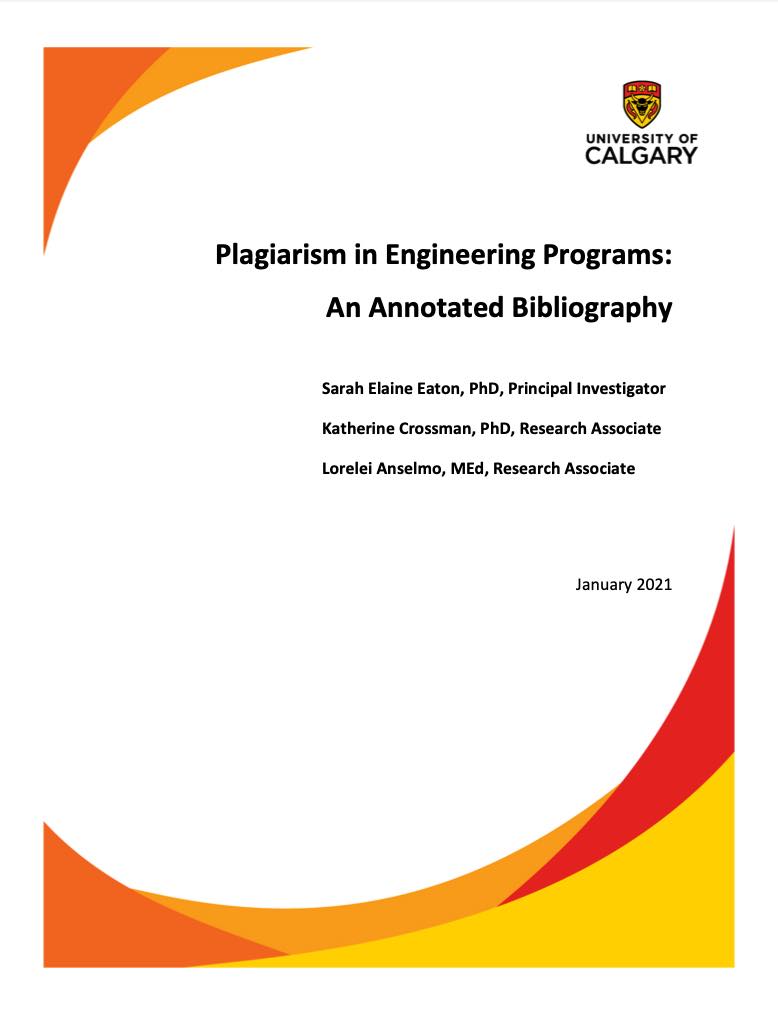
Engineering Annotated Bib coverExcited to share this long-overdue annotated bibliography. We started working on this one a while ago and then COVID hit. We are excited to have completed this and be able to share this with you. We hope it will be particularly helpful for those studying academic integrity in STEM fields.

Eaton, S.E., Crossman, K., & Anselmo, L. (2021). Plagiarism in Engineering Programs: An Annotated Bibliography. Calgary, University of Calgary. http://hdl.handle.net/1880/112969

Purpose

This report documents research and related materials concerning plagiarism in STEM and engineering programs to inform and guide future work in the field. It provides an overview of the literature up to and including 2019 related to plagiarism in STEM and engineering programs.

Methods

Two research questions guided this literature review: 1. What scholarly, research, and professional literature explores and examines plagiarism in STEM and engineering programs? 2. What major themes emerge from scholarly and research literature about plagiarism in engineering? To this end, a methodical research of databases was undertaken, relevant research was compiled, and articles were summarized and categorized.

Results

Our review and search of the literature resulted in more than 30 sources, which we organized into 7 categories: (a) Background: AI in engineering; (b) student perceptions and attitudes; (c) faculty perceptions and attitudes; (d) cheating and collusion; (e) text-matching software and plagiarism detection; (f) international students and (g) interventions and reparations.

We found that plagiarism in STEM and engineering, as in other fields, is widespread among students and faculty, while policies and their implementation are often inconsistent. Calls for clearer guidelines and greater support for students and faculty resound as a consistent theme in the literature.

Implications

Plagiarism in STEM and engineering research has been slow to develop, but is a continuing field of growth. As more stakeholders become aware of the scope and complexities of plagiarism, many researchers are making recommendations for policy, policy implementation, and support through technology, education, and intervention programs.

Additional materials: 36 References

Keywords: Academic integrity, academic dishonesty, academic misconduct, plagiarism, cheating, engineering

_____

Share or Tweet this: Plagiarism in Engineering Programs: An Annotated Bibliography – https://drsaraheaton.wordpress.com/2021/01/13/plagiarism-in-engineering-programs-an-annotated-bibliography/

This blog has had over 2 million views thanks to readers like you. If you enjoyed this post, please “like” it or share it on social media. Thanks!

Sarah Elaine Eaton, PhD, is a faculty member in the Werklund School of Education, and the Educational Leader in Residence, Academic Integrity, University of Calgary, Canada. Opinions are my own and do not represent those of the University of Calgary.