Fake Degrees and Fraudulent Credentials: Research Project Update

February 3, 2022
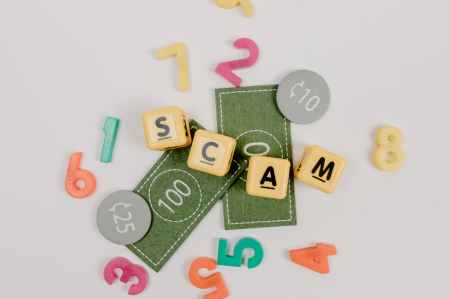
close up shot of paper money and numbers on a gray surface

Photo by Tara Winstead on Pexels.com

Since 2020, Jamie Carmichael (Carleton University, Ottawa, Canada) and I have been partnering on research related to fake degrees and fraudulent credentials in Canada. We presented our preliminary findings last year at the 2021 European Conference on Academic Integrity and Plagiarism. Later in 2021, I contributed an invited article on fake degrees and credential fraud to a special issue of the Career Planning & Adult Development Journal focusing on the future of work.

Now Jamie and I are working on an edited book to be published by Springer Nature later this year.

We have noticed more and more discussions of qualification fraud and impersonation in the news, such as this article that talks about a situation in which the person who showed up for an interview and was hired was not the same person who showed up for the job after the hiring process was complete.

Since starting this project almost two years ago our eyes have been opened to the massive global market that exists for fake and fraudulent degrees, diplomas, and other credentials. We’ll keep you updated as our research evolves, but for now we just wanted to let you know we are still working on this and learning more every day.

Related posts:

_________________________________

Share or Tweet this: Fake Degrees and Fraudulent Credentials: Research Project Update –  https://drsaraheaton.wordpress.com/2022/02/03/fake-degrees-and-fraudulent-credentials-research-project-update/

This blog has had over 3 million views thanks to readers like you. If you enjoyed this post, please “like” it or share it on social media. Thanks!

Sarah Elaine Eaton, PhD, is a faculty member in the Werklund School of Education, and the Educational Leader in Residence, Academic Integrity, University of Calgary, Canada. Opinions are my own and do not represent those of the University of Calgary.

Alberta’s Proposed “Student First Act”: Analysis from an Academic Integrity Perspective

November 15, 2021

Last week the Hon. Adrianna LaGrange, Minister of Education in Alberta, published a commentary in the Edmonton Journal about a proposed new legislation she intended to bring forward called the “Student First Act”.

In this blog post I offer my perspective on this editorial through the lens of someone who studies educational integrity, including misconduct. I have pointed out my qualifications to comment on matters related academic misconduct in a previous blog post, so I won’t repeat them here. Suffice to say that I have some expertise related to academic integrity. Those familiar with my work will know that I advocate for a multi-stakeholder approach to academic integrity in which students, educators, and administrators are all held accountable for their behaviours. Academic integrity is about more than student conduct and examining educator and administrator misconduct remains an understudied area, but an important one.

In my analysis of LaGrange’s commentary (which was effectively an announcement about the new proposed legislation), I will examine both the positive and negative aspects of this announcement.

Lack of Transparency

LaGrange opened by stating that, “Fourteen years ago, as a newly elected school board trustee in Red Deer, I began hearing concerns about the lack of transparency in teacher disciplinary process. Now, as Alberta’s minister of education, I hear these same concerns from students and parents across the province.”

It’s a good thing that Minister LaGrange heard these concerns. There shouldn’t be any surprise with regards to misconduct occurring. Misconduct happens in almost every profession and teaching is no exception. Here LaGrange is signalling that she first became aware that there was a “lack of transparency in teacher disciplinary process”.

“Lack of transparency” is a trigger phrase. It is almost a guarantee that readers and members of the public will become offended when they hear about “lack of transparency”, especially from a government. As I have written about in my book, misconduct among educators is usually addressed by human resources. There are strict laws in Canada, including in Alberta, about what a human resources manager or department is legally permitted to disclose regarding an employee misconduct. I am not a labour relations lawyer, but I am confident saying that this “lack of transparency” is a function of existing labour laws, not a flaw in government policy.

Every large organization in Alberta and in Canada has policies and procedures in place to address employee misconduct. There are thresholds in place so that if a misconduct crosses over from an internal disciplinary matter to a criminal one, that these must be reported to police for investigation.

There is an assumption in the LaGrange editorial that school boards lack processes to investigate employee misconduct or that the existing processes are flawed. I suspect that if she dug a little deeper she would find that the existing policies and procedures conform to the labour laws already in place.

Praise… but…

LaGrange goes on to say, “While the overwhelming majority of teachers in the province are dedicated and caring professionals, we know that cases of inappropriate or even dangerous conduct do happen — and sometimes those cases involve a student.”

It’s good to see that the Minister of Education is acknowledging that “the majority of teachers in the province are dedicated and caring professionals”. This is a truism and there’s nothing really new here. In her book, Cheating: Ethics in Everyday Life, author Deborah Rhode guides us to think about cheating and other misconduct behaviours as a bell curve. At one end you have a small minority of people who rarely or never commit misconduct. At the other end, you have another small percentage of people who do bad stuff repeatedly and often. In the middle, there’s about 80% or so who are basically good most of the time, but can be influenced by circumstances on occasion.

One concerning aspect of LaGrange’s statement is that she seems to be focusing on the moral character of the teachers, rather than their behaviour. As someone who studies misconduct, I can say that in Canada, we treat misconduct cases as bad behaviour, not as a moral failing. This is an important distinction because these are drastically different philosophical positions. Bad behaviour can be corrected, but moral failings? That’s an entirely different matter. I am guessing that political scientists might agree that it would be a fool’s errand for any politician to comment on the moral failings of others…

“An extremely concerning case…”

LaGrange goes on to explain that in 2019 an “extremely concerning case” crossed her desk. Wow, that’s got to be bad, right? I mean… an extremely concerning case. We’d better pay attention here, folks.

Let’s unpack that though… A few paragraphs previously, LaGrange commented that she’s been hearing about misconduct cases for fourteen years. It took 14 years for an “extremely concerning case” to cross her desk? As someone who studies misconduct, I am genuinely surprised by this. For those of us who deal with misconduct on a regular basis as part of our jobs, it probably a matter of weeks or months — not years — before we come face to face with an egregious or complicated case. That’s like saying the Minister of Justice didn’t hear about a horrible criminal case until after a decade of being on the job. Really? How remarkably lucky for the minister that she has been in an educational leadership role and has not encountered an extremely concerning case for 14 years.

Of course, we do not know what the details of the case were and nor should we. What we do need to know is that if the case was so concerning that it crossed over into criminal behaviour, it should have been reported to the police. When the minister described that the teacher was “found guilty of inappropriately touching five young students and only a two-year suspension was recommended”. This makes me wonder if the case was reported to the police? Minister LaGrange does not comment on this in her article, but it really is a question worth asking.

Minister LaGrange that she found the recommended penalty for the teacher, “unacceptable” and that she “overturned the recommendation and handed down a lifetime teaching ban”.

Bravo for taking a stand, but the question remains, why was this case not reported to the police? There is no mention that law enforcement was involved. Surely the minister could have insisted that a case of alleged sexual violence against not one but five students be referred to the police immediately?

A Review of the Discipline Process for Educators

LaGrange goes on to say that this incident triggered “a review of the discipline processes for educators”. Periodic reviews of misconduct policies are a good thing. My colleagues and I have recommended such reviews for universities and colleges, for example. If regular reviews of misconduct policies are not already part of the educational policy governance process, then they should be. A review should not be a one-time effort, but a regular part of policy work.

LaGrange states, “cases are dealt with away from the public’s view”. Well, that’s pretty typical in an employee misconduct case, in part due to labour and privacy laws. It would be very unusual for any employer Canada to investigate and address employee misconduct cases in the public view. Employee misconduct cases are dealt with internally in almost every organization, unless the matter is criminal. If a case is criminal it might be prosecuted in court with case-related information being a matter of public record. I reiterate – why are allegations of sexual violence against students not reported to police?

LaGrange also goes on to say that cases “often take years to be settled after a complaint is made”. The timelines for addressing misconduct cases can — and should — be laid out in policy. This is easily fixed through a policy revision that outlines the number of business days permitted to address a case.

In large educational organizations, it is pretty typical for in-house counsel (i.e., the lawyers) to get involved to ensure that procedures are followed and to offer advice. One of the aspects of policy that lawyers provide guidance on is how much time to allow to ensure that a case can be dealt with fairly and in a timely manner.

The Current Legislation

Minister LaGrange states, “current legislation prohibits the government and myself from informing the public”. That’s because when it comes to employee misconduct there are laws in place to protect people’s privacy. This goes back to misconduct being a matter of bad behaviour not a moral failing. I know of no employer anywhere in Canada – including educational institutions – who engage in the practice of publicly naming and shaming every employee (or student) under review for or found responsible of misconduct.

Status of teaching certificates

LaGrange states, “Alberta’s current legislation is lagging behind. British Columbia, Ontario and Saskatchewan all have public registries where parents can easily check the status of their child’s teacher’s certificate”. Well, that’s also an easy fix. But let’s be clear that a public registry of valid teaching certificates should not be conflated with a registry of individuals who have or have not committed misconduct. Teaching certificates can lapse due to illness or any other reason. Besides, every school board in Alberta will ensure its teachers have a valid teaching certificate. Again, this is the job of the HR department.

Others have already commented on the misinformation in LaGrange’s commentary about the need for teachers to undergo police checks, so I’ll refrain from further analysis on that point. Suffice to say that, this point was poorly presented in the editorial.

LaGrange concludes by saying that she will be introducing the “Students First Act” in the legislature next week. I am curious to know what the proposed legislation will say and I’ll be watching carefully. Some key points to keep in mind are:

  • What are some easy ways to update current policies (e.g., the time allowed to address a misconduct case) without having to enact legislation? In other words, what’s the low hanging fruit here? What are some ways to tighten up existing policies and procedures quickly while still ensuring they are fair and comprehensive?
  • How do we keep the focus on identifying and correcting poor behaviour, as opposed to handing down moral judgement?
  • How do we ensure that addressing employee misconduct is not confused with a witch hunt designed to name and shame individuals?
  • And perhaps most importantly… how do we ensure that egregious instances of teacher misconduct that cross into criminal behaviour are reported to the police so the Minister herself does not have to serve as judge and jury in such cases?

We all agree that we want to “keep our students safe, parents informed and teachers accountable”, as LaGrange says. It’s how we do it that matters.

Related posts:

_________________________________________

Share or Tweet this: Alberta’s Proposed “Student First Act”: Analysis from an Academic Integrity Perspective – https://drsaraheaton.wordpress.com/2021/11/15/albertas-proposed-student-first-act-analysis-from-an-academic-integrity-perspective/

This blog has had over 2 million views thanks to readers like you. If you enjoyed this post, please “like” it or share it on social media. Thanks!

Sarah Elaine Eaton, PhD, is a faculty member in the Werklund School of Education, and the Educational Leader in Residence, Academic Integrity, University of Calgary, Canada. Opinions are my own and do not represent those of the University of Calgary.


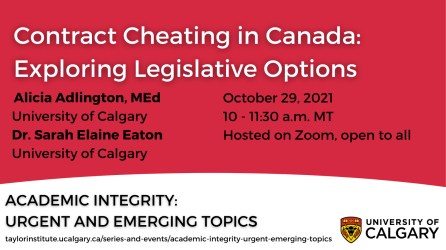
Contract Cheating in Canada: Exploring Legislative Options

November 1, 2021

Contract cheating report coverLast week Alicia Adlington and I presented our work on possible legislative options to address contract cheating in Canada. We did our presentation via webinar with 70+ registrants and launched our report, which is publicly available online:

Adlington, A., & Eaton, S. E. (2021). Contract Cheating in Canada: Exploring Legislative Options. Calgary, Canada: University of Calgary. http://hdl.handle.net/1880/114088

Webinar description

An introductory discussion about the commercial contract cheating industry (e.g., term paper mills, homework completion services, and paid imposters who take exams on behalf of students). One question people often ask is, “Why aren’t these services illegal?” The short answer is: Academic cheating services are not currently illegal in Canada, but they are in other countries. In this session we’ll provide an overview of which countries have successfully enacted legislation against predatory industry that profits from academic misconduct. We will provide an overview of the legal structures in Canada that might facilitate or present barriers to such legislation being enacted in this country. We do not promise answers or solutions to the complex issue of contract cheating, but instead provide an evidence-base for deeper discussion.

The intended audience for this session is primarily for those in Canada interested in contract cheating from the Canadian legal context. Participants from other regions are also welcome.

By the end of this session engaged participants will be able to: 

  • Describe what contract cheating is
  • Understand how legislation against contract cheating has been enacted in other countries
  • Discover legal aspects of contract cheating in Canada and beyond

We are grateful to the Taylor Institute for Teaching and Learning at the University of Calgary for hosting the webinar and supporting this work.

You can check out the slides from our webinar here:

I’ll update this blog post with the link to the recording when it is available.

_________________________________________

Share or Tweet this: Contract Cheating in Canada: Exploring Legislative Options https://drsaraheaton.wordpress.com/2021/11/01/contract-cheating-in-canada-exploring-legislative-options/

This blog has had over 2 million views thanks to readers like you. If you enjoyed this post, please “like” it or share it on social media. Thanks!

Sarah Elaine Eaton, PhD, is a faculty member in the Werklund School of Education, and the Educational Leader in Residence, Academic Integrity, University of Calgary, Canada. Opinions are my own and do not represent those of the University of Calgary.


Webinar: Contract Cheating in Canada: Exploring Legislative Options

October 4, 2021

ACADEMIC INTEGRITY: URGENT AND EMERGING TOPICSJoin us for an introductory discussion about the commercial contract cheating industry (e.g., term paper mills, homework completion services, and paid imposters who take exams on behalf of students). One question people often ask is, “Why aren’t these services illegal?” The short answer is: Academic cheating services are not currently illegal in Canada, but they are in other countries. In this session we’ll provide an overview of which countries have successfully enacted legislation against predatory industry that profits from academic misconduct. We will provide an overview of the legal structures in Canada that might facilitate or present barriers to such legislation being enacted in this country. We do not promise answers or solutions to the complex issue of contract cheating, but instead provide an evidence-base for deeper discussion.

The intended audience for this session is primarily for those in Canada interested in contract cheating from the Canadian legal context. Participants from other regions are also welcome.

By the end of this session engaged participants will be able to: 

  • Describe what contract cheating is
  • Understand how legislation against contract cheating has been enacted in other countries
  • Discover legal aspects of contract cheating in Canada and beyond

Facilitators: Alicia Adlington &  Sarah Elaine Eaton, University of Calgary
Date: Friday, October 29, 2021
Time: 10:00 – 11:30 a.m. (Note: This is Mountain Time. Please convert to your local time zone)
Location: Online via Zoom

Please note: Registration will close on Wednesday, October 27, 2021, at 11:59 p.m. (MT) and a Zoom link for the webinar will be sent the morning of the workshop.

Register now

For more information, visit the website: https://taylorinstitute.ucalgary.ca/series-and-events/academic-integrity-urgent-emerging-topics

______________________

Share or Tweet this: Webinar: Contract Cheating in Canada: Exploring Legislative Options https://drsaraheaton.wordpress.com/2021/10/04/webinar-contract-cheating-in-canada-exploring-legislative-options/

This blog has had over 2 million views thanks to readers like you. If you enjoyed this post, please “like” it or share it on social media. Thanks!

Sarah Elaine Eaton, PhD, is a faculty member in the Werklund School of Education, and the Educational Leader in Residence, Academic Integrity, University of Calgary, Canada.

Opinions are my own and do not represent those of the University of Calgary or anyone else.


Indigenous Academic Integrity: A Post in Honour of the National Day for Truth and Reconciliation

September 30, 2021

21-TAY-Orange-Shirt-DayToday marks the first National Day for Truth and Reconciliation in Canada. The purpose of the day is to honour Survivors of residential schools and those who died in them.

Keeta Gladue Headshot (web size)A few days ago Keeta Gladue, Indigenous Student Advisor and Team Lead at the Writing Symbols Lodge at the University of Calgary reached out to me and asked me to consider writing a blog post today about Indigenous ways of citing and referencing. Keeta led the Indigenous Academic Integrity project, which has not only benefitted our university, but has been shared further at other institutions across the country including Ryerson University (Ontario) and Red River College (Manitoba), among others. Keeta has also presented this project nationally and internationally. Check out the recorded version of one of her presentations on this project here.

Keeta is not alone in her efforts to bring awareness to the ways in which academic integrity is embedded in Indigenous ways of knowing, being, teaching, and learning. Iehnhotonkwas B.J. Maracle from the University of Toronto developed “Seven Grandfathers in Academic Integrity”, a fantastic resource that is publicly available as a .pdf.

The impact of residential schools on Indigenous children, in terms ethical and moral violations, not to mention outright abuse and crime, could fill volumes. When Keeta asked me to think about a blog specifically about Indigenous citing and referencing, that resonated with me. This post is not intended to trivialize, diminish, or dismiss the importance of broader conversations about residential schools, decolonization, or reconciliation. Instead, it is intended to honour the Indigenous scholars, educators, and knowledge keepers I have learned from, directly and indirectly, with respect to my work as an academic integrity scholar and advocate, including Keeta Gladue, Yvonne Poitras Pratt, Gabrielle Lindstrom, among others. It is also intended to generate broader conversations about the need to question systems of oppression that get labelled as “integrity” when do little or nothing to promote integrity at all.

Truth

Before we get to reconciliation, we start with truth. Here are some truths about citing and referencing:

  1. Citing and referencing styles are established, by and large, by organizations (e.g., APA, MLA) that profit from the sale of manuals and guidebooks that prescribe conventions for how citing and referencing should be done in a particular discipline.
  2. The organizations that set up citing and referencing systems are generally academic in nature, and their boards of directors are often populated by white scholars, many of whom are male. Indigenous scholars (as well as Black and other scholars of colour) are rarely, if ever, elected or appointed to the boards that govern these organizations.
  3. Citing and referencing manuals universally ignore or diminish the value of Indigenous knowledge by failing to provide adequate guidance about how to cite and reference Indigenous knowledge. (See this article by Lorisia MacLeod for a discussion of how citing oral knowledge as personal communication is simply not enough.)
  4. Too often, when students fail to follow the conventions of a particular citing and referencing style, they are punished or reported for plagiarism. Research has shown over, and over, and over again that many cases of student plagiarism are not intentional or deceitful, but instead they are due to a lack of skills and knowledge.
  5. The minutiae of citing and referencing standards are weaponized against students (and everyone else who uses them, for that matter). Those who know how to wield the finer details of citing and referencing are lauded as erudite scholars. Those who do not are mocked, dismissed, or accused of misconduct. (Honestly, who gives a flying leap about sentence case versus title case capitalization? Can we do away with these nonsensical details, once and for all, please?!)

These are just a few of the truths about citing and referencing that we need to confront. As an academic integrity scholar and advocate, part of my job involves not only upholding the rules, but questioning the systems that created them. The deeper I dive into this world, the more I realize that much of what gets labelled as “academic integrity” actually has little to do with ethics, and more to do with behaviour control, oppression, and even corporate profit. There’s a lot of work we need to do to put the integrity back into “academic integrity”.

Reconciliation

Once we have told the truth, we can start to work on reconciliation. Here are a few things we can think about as we move along the path to reconciliation:

  1. Learn from (and cite) Indigenous authors and knowledge keepers. As part of my own journey towards reconciliation, I am making a point to educate myself about Indigenous ways of knowing, being, teaching, and learning. I have a lot to learn, and the journey is worthwhile. In addition to learning, I make an effort to give attribution to those from whom I have learned.
  2. Educate ourselves about how to give attribution to Indigenous Elders and Knowledge Keepers. A great place to start is by reading Elements of Indigenous Style by Gregory Younging. From there, check out MacLeod’s Templates for Citing Indigenous Elders and Knowledge Keepers.
  3. Stop weaponizing citation and referencing. These systems should be used to give attribution to the creators and keepers of knowledge, not to punish people for failing to comply with rules. Focus on giving attribution as a way to honour and show respect, not as a means to inflict punishment. Giving attribution to others should be a joy, not an afterthought, a drudgery, or a cause for punishment or anxiety.
  4. Re-consider citing and referencing systems in general. These systems embody colonialism in education and scholarship, focusing on rule compliance, rather than actual learning. It is time to have deep and provocative conversations about the ways citing and referencing systems propagate colonialism, oppression, and elitism in education and publishing. Elsewhere I have called for a universal citation system that is easy and free to use and that is accepted by educational institutions and publishers.
  5. Take an educative and supportive approach, rather than punitive to academic integrity. The “Gotcha!” approach doesn’t help students learn.
  6. Think about attribution in relational ways. As I have discussed in my book on plagiarism, my own PhD supervisor taught me to think about the people who write books and articles, situating myself in relation to their work and words. He taught me to pay attention to who was writing as much as what they were writing.

There are many conversations we need to have about decolonizing education. Recognizing the harms inflicted by colonial education systems is essential. Oppressive systems have become a pervasive hallmark of education. We need to recognize the ways in which vestiges of colonialism permeate all aspects of our educational systems, including academic integrity, citing, and referencing. As part of our work to decolonize education, let’s not forget about how to decolonize our approaches to academic and research integrity (and misconduct). It’s time to ditch the “crime and punishment” approach to misconduct and instead focus on relational, reconciliatory, and restorative approaches to building integrity with one another and the systems in which we live and work.

References and further reading from Indigenous authors

Gladue, K. (2021). Indigenous Academic Integrity. Retrieved from https://taylorinstitute.ucalgary.ca/resources/indigenous-academic-integrity

MacLeod, L. (2021). More than personal communication: Templates For citing Indigenous Elders and Knowledge Keepers. KULA, 5(1), 1-5. https://doi.org/10.18357/kula.135

Poitras Pratt, Y., & Gladue, K. (forthcoming). Re-defining academic integrity: Embracing Indigenous truths. In S. E. Eaton & J. Christensen Hughes (Eds.), Academic integrity in Canada: An enduring and essential challenge: Springer.

Lindstrom, G. (forthcoming). Accountability, relationality and Indigenous epistemology: Advancing an Indigenous perspective on academic integrity. In S. E. Eaton & J. Christensen Hughes (Eds.), Academic integrity in Canada: An enduring and essential challenge: Springer.

Younging, G. (2018). Elements of Indigenous style: A guide for writing by and about Indigenous Peoples. Edmonton, AB: Brush Education Inc.

References and further reading from non-Indigenous authors

Eaton, S. E. (2021). Plagiarism in higher education: Tackling tough topics in academic integrity. Santa Barbara, CA: Libraries Unlimited.

Howard, R. M. (2001). Forget about policing plagiarism. Just teach. The Chronicle of Higher Education, B24. Retrieved from http://chronicle.com/article/Forget-About-Policing/2792

McGowan, U. (2005). Academic integrity: An awareness and development issue for students. Journal of University Teaching and Learning Practice, 2(3a), 48-57. Retrieved from http://jutlp.uow.edu.au/2005_v02_i03a/pdf/mcgowan_005.pdf

Schwabl, K., Rossiter, M. J., & Abbott, M. L. (2013). University students’ and instructors’ paraphrasing and citation knowledge and practices. Alberta Journal of Educational Research, 59(3). Retrieved from https://journalhosting.ucalgary.ca/index.php/ajer/article/view/55730

______________________

Share or Tweet this: Indigenous Academic Integrity: A Post in Honour of the National Day for Truth and Reconciliation – https://drsaraheaton.wordpress.com/2021/09/30/indigenous-academic-integrity-a-post-in-honour-of-the-national-day-for-truth-and-reconciliation/

This blog has had over 2 million views thanks to readers like you. If you enjoyed this post, please “like” it or share it on social media. Thanks!

Sarah Elaine Eaton, PhD, is a faculty member in the Werklund School of Education, and the Educational Leader in Residence, Academic Integrity, University of Calgary, Canada.

Opinions are my own and do not represent those of the University of Calgary or anyone else.