New article: Plagiarism: A Canadian Higher Education Case Study of Policy and Practice Gaps

January 8, 2021

AJER Screen ShotWe are excited to share this new article:

Eaton, S. E., Fernández Conde, C., Rothschuh, S., Guglielmin, M., & Otoo, B. K. (2020). Plagiarism: A Canadian higher education case study of policy and practice gaps. Alberta Journal of Educational Research, 66(4), 471-488. Retrieved from https://journalhosting.ucalgary.ca/index.php/ajer/article/view/69204

This was a project that I undertook with some of our excellent graduate students at the Werklund School of Education. Our findings corroborated other studies that found faculty do not report academic misconduct, and adds to the body of evidence from Canada. Our findings showed that although pre-service teachers engage in academic misconduct, sometimes their instructors choose not to report them for it. Instead, faculty deal with such instances privately, as a “teachable moment”, without following institutional policy. This was a fascinating study to conduct and I am hoping it will be useful to other Canadian researchers, as well as others studying academic misconduct in teacher training programs.

Abstract

This mixed methods case study investigated faculty perspectives and practice around plagiarism in a Western Canadian faculty of education. Data sources included interviews, focus groups, and a survey. Findings showed that participants (N = 36) were disinclined to follow established procedures. Instead, they tended to deal with plagiarism in informal ways without reporting cases to administration, which resulted in a disconnect between policy and practice. The emotional impact of reporting plagiarism included frustration with the time required to document a case, and fear that reporting could have a negative effect on one’s employment. Recommendations include approaches that bridge the gap between policy and practice.

Key words: Academic integrity, plagiarism, Canada, higher education, faculty

Cette étude de cas à méthodes mixtes s’est penchée sur les perspectives et les pratiques du corps professoral relatives au plagiat dans une faculté d’éducation dans l’ouest du Canada. Les sources de données ont inclus les entrevues, les groupes de discussion et un sondage. Les résultats indiquent que les participants (N=36) étaient peu portés à suivre les procédures établies. Ils avaient plutôt tendance à employer des moyens informels pour traiter le plagiat, sans signaler les cas à l’administration, ce qui entrainait un écart entre la politique et la pratique. L’impact émotionnel découlant du signalement du plagiat comprenait le temps nécessaire à documenter un cas et la peur que le signalement puisse avoir une incidence négative sur son emploi. Les recommandations proposées incluent des approches visant à combler l’écart entre la politique et la pratique.

Mots clés : intégrité académique, plagiat, Canada, enseignement supérieur, faculté

Authors:

  • Sarah Elaine Eaton, University of Calgary
  • Cristina Fernández Conde, University of Calgary
  • Stefan Rothschuh, University of Calgary
  • Melanie Guglielmin, University of Calgary
  • Benedict Kojo Otoo, University of Calgary

Check out the entire issue here: https://journalhosting.ucalgary.ca/index.php/ajer/issue/view/5241

For more information about this article please contact me directly.

_____

Share or Tweet this: New article: Plagiarism: A Canadian Higher Education Case Study of Policy and Practice Gaps – https://drsaraheaton.wordpress.com/2021/01/08/new-article-plagiarism-a-canadian-higher-education-case-study-of-policy-and-practice-gaps/

This blog has had over 2 million views thanks to readers like you. If you enjoyed this post, please “like” it or share it on social media. Thanks!

Sarah Elaine Eaton, PhD, is a faculty member in the Werklund School of Education, and the Educational Leader in Residence, Academic Integrity, University of Calgary, Canada. Opinions are my own and do not represent those of the University of Calgary.


Upcoming Webinar: None of the above: Integrity concerns of standardized English proficiency tests with Soroush Sabbaghan and Ismaeil Fazel

January 4, 2021

Sabbaghan Fazel webinarThis session will bring to fore (or highlight) the oft-neglected discord between equity and integrity in high-stakes standardized language tests. The equity issues surrounding these so-called standardized language tests can potentially precipitate and predispose academic dishonesty. This presentation will discuss the ramifications of inherent inequities in high stakes language proficiency tests for academic integrity and will call for a more critical consideration of commercialized high stakes language tests. Redressing equity issues in language assessment can serve to promote academic integrity and reduce academic dishonesty.

Learning outcomes

  • Learn more about challenges to equity in high stakes language testing.
  • Recognize discords between equity and integrity in commercial standardized language tests
  • Review principles and best practices for equitable language assessment

About the presenters

Ismaeil Fazel - web sizeIsmaeil Fazel is a Lecturer at the Faculty of Education of Simon Fraser University. He has a PhD in TESL and a sub-specialization in Measurement and Evaluation from the University of British Columbia. His main research interests include English for Academic and Professional Purposes, academic discourse socialization, and language assessment. His publications have appeared in the Journal of English for Academic Purposes, English for Specific Purposes Journal, and TESL Canada Journal, among others.

Soroush Sabbaghan - web sizeSoroush Sabbaghan is a Senior Instructor at the Werklund School of Education at the University of Calgary. He holds two PhDs, one in TESL and the other in Curriculum and Learning with a focus in Mathematics Education. His main research interests include language and mathematics education of bilingual and multilinguals, Language Learning and Technology, and ecological complexity discourses. He has publications in both Language and mathematics education journals and books.

Friday, 08 January 2021

10:00 a.m. – 11:30 a.m. Calgary (Mountain) time

This session is open to the public and everyone is welcome. Registration required. Deadline to register is 07 Jan 2021.

More information and registration:

https://taylorinstitute.ucalgary.ca/series-and-events/academic-integrity-urgent-emerging-topics

This webinar is part of our series, Academic Integrity: Urgent and Emerging Topics. This series addresses timely and emergent topics that are cutting edge, provocative or high profile in nature. The series is hosted by the Taylor Institute for Teaching and Learning, University of Calgary.

_____

Share or Tweet this: Upcoming Webinar: None of the above: Integrity concerns of standardized English proficiency tests with Soroush Sabbaghan and Ismaeil Fazel

This blog has had over 2 million views thanks to readers like you. If you enjoyed this post, please “like” it or share it on social media. Thanks!

Sarah Elaine Eaton, PhD, is a faculty member in the Werklund School of Education, and the Educational Leader in Residence, Academic Integrity, University of Calgary, Canada. Opinions are my own and do not represent those of the University of Calgary.


New article: Understanding the academic integrity policies of publicly funded universities in western Canada

December 23, 2020

Educational PolicyThe latest article in our project, Contract Cheating in Canada: National Policy Analysis has just been published!

Stoesz, B., & Eaton, S. E. (2020). Understanding the academic integrity policies of publicly funded universities in western Canada. Educational Policy. https://doi.org/10.1177/0895904820983032

Abstract

We examined 45 academic integrity policy documents from 24 publicly-funded universities in Canada’s four western provinces using a qualitative research design. We extracted data related to 5 core elements of exemplary academic integrity policy (i.e., access, detail, responsibility, approach, support). Most documents pointed to punitive approaches for academic misconduct and were based on the notion that academic misconduct results from a lack of morals. One university used the term “contract cheating,” although nearly all categorized the outsourcing of academic work as plagiarism. Details about educational resources and supports to increase student and staff understanding of academic integrity and prevention of academic misconduct were sparse. This study signals the continuing punitive nature of academic integrity policies in western Canadian universities, the reluctance to address contract cheating directly, and the need to revise policies with deeper consideration of educative approaches to academic integrity that support students and academic staff.

Keywords: academic integrity, Canada, contract cheating, educational supports, higher education, policy

This is an open access article and is free to read and download.

For more information about this article, or the national project, please contact me directly.

_____

Share or Tweet this: New article: Understanding the academic integrity policies of publicly funded universities in western Canada – https://drsaraheaton.wordpress.com/2020/12/23/new-article-understanding-the-academic-integrity-policies-of-publicly-funded-universities-in-western-canada/

This blog has had over 2 million views thanks to readers like you. If you enjoyed this post, please “like” it or share it on social media. Thanks!

Sarah Elaine Eaton, PhD, is a faculty member in the Werklund School of Education, and the Educational Leader in Residence, Academic Integrity, University of Calgary, Canada. Opinions are my own and do not represent those of the University of Calgary.


Comparing E-Proctoring Software to Hydroxychloroquine: An Apt Analogy

November 4, 2020
Image courtesy of patrisyu at FreeDigitalPhotos.net

Image courtesy of patrisyu at FreeDigitalPhotos.net

To help educators and administrators understand why I urge caution, and even skepticism about the use of e-proctoring software and other surveillance technologies such as those that lockdown students’ Internet browsers, here’s an analogy I have been using that seems to resonate:

In my opinion, e-proctoring software is to higher education what Hydroxycloroquine has been to the COVID-19 virus.

It’s not that e-proctoring software is bad, it is that it was never designed to be used under the current conditions. There are colleagues who would disagree with me about this kind of software being bad in principle. I accept their position. Let’s look at this through the eyes of scholar who is trained to reserve judgement on an issue without evidence to back it up. If we assume the software was designed for a specific purpose – to invigilate exams taken via a computer, then it fulfills that purpose. So, in that sense, it does what it is supposed to do. However, that is not the whole story.

We can turn to Hydroxychloroquine as an analogy to help us understand why we should be skeptical.

Hydroxychloroquine is an anti-malaria drug, also used to treat arthritis. It was never designed to be used against the SARS-CoV-2 (COVID-19) virus. Hasty attempts to do research on the coronavirus, including studies on Hydroxychloroquine, have resulted in numerous papers now being retracted from scientific journals. People ran to this drug as a possible antidote the coronavirus, just as schools are running to e-proctoring software as an antidote for exam cheating. Neither e-proctoring software nor Hydroxychloroquine were designed to be used during the current pandemic. People flocked to them both as if they were some kind of magic pill that would solve a massively complex problem, without sufficient evidence that either would actually do what they so desperately wanted it to do.

The reality is that there is scant scientific data to show that e-proctoring actually works in the way that people want it to, that is, to provide a way of addressing academic misconduct during the pandemic. By “scientific data” I do not mean sales pitches. I am talking about independent scholarly studies undertaken by qualified academic researchers employed at reputable universities. By “independent scholarly studies” I mean research that has not been funded in any way by the companies that produce the products. That kind of research is terrifyingly lacking.

We need to back up for a minute and look about why we invigilate exams in the first place. To invigilate means “to keep watch over”. Keeping watch over students while they write an exam is part of ensuring that testing conditions are fair and objective.

The point of a test, in scientific terms, involves controlling all variables except one. In traditional testing, all other factors are controlled, including the conditions under which the test was administered such as the exam hall with desks separated, same lighting and environment for all test-takers, length of time permitted to take the test, how it is invigilated, and so on. All variables are presumably controlled except one: the student’s knowledge of the subject matter. That’s what’s being tested, the student’s knowledge.

Exams are administered in what could be termed, academically sterile environments. In an ideal situation, academic hygiene is the starting point for administering a test. Invigilation is just one aspect of ensuring academic hygiene during testing, but it is not the only factor that contributes to this kind of educational hygiene that we need to ensure testing conditions control for all possible variables except a student’s knowledge of the subject matter.

During the pandemic, with the shift to remote learning, we cannot control all the variables. We simply cannot assure an academically hygienic environment for testing. Students may have absolutely no control over who else is present in their living/studying quarters. They may have no control over a family member (including their own children) who might enter a room unannounced during a test. The conditions under which students are being tested during the pandemic are not academically hygienic. And that’s not their fault.

E-proctoring may address one aspect of exam administration: invigilation. It cannot, however, ensure that all variables are controlled.

As an academic integrity scholar, I am distressed by the lack of objective, peer-reviewed data about e-proctoring software. Schools have turned to e-proctoring software as if it were some kind of magic pill that will make academic cheating go away. We have insufficient evidence to substantiate that e-proctoring software, or any technology for that matter, can serve as a substitute for an in-person academically hygienic testing environment.

Schools that were using e-proctoring before the pandemic, such as Thompson Rivers University or Athabasca University in Canada, offered students a choice about whether students preferred to take their exams online, at home, using an e-proctoring service, or whether they preferred to drive to an in-person exam centre. During the pandemic, students’ choice has been taken away.

We all want an antidote to academic misconduct during remote learning, but I urge you educators and administrators to think like scholars and scientists. In other words, approach this “solution” with caution, and even skepticism. At present, we lack sufficient evidence to make informed decisions. Educators need to be just as skeptical about this technology and how it works during pandemic conditions as physicians and the FDA have been about using Hydroxychloroquine as a treatment for the coronavirus. Its use as being effective against the coronavirus is a myth. The use of e-proctoring software as being an effective replacement for in-person exams is also a myth, one perpetuated by the companies that sell the product.

Forcing surveillance technology on students against their will during a pandemic is tantamount to forcing an untested treatment on a patient; it is unethical to the extreme.

______

Share or Tweet this: Comparing E-Proctoring Software to Hydroxychloroquine: An Apt Analogy – https://drsaraheaton.wordpress.com/2020/11/04/comparing-e-proctoring-software-to-hydroxychloroquine-an-apt-analogy/(opens in a new tab)

This blog has had over 2 million views thanks to readers like you. If you enjoyed this post, please “like” it or share it on social media. Thanks!

Sarah Elaine Eaton, PhD, is a faculty member in the Werklund School of Education, and the Educational Leader in Residence, Academic Integrity, University of Calgary, Canada. Opinions are my own and do not represent those of the University of Calgary.


New Report: Contract Academic Work and Contract Cheating: Policy Brief

October 19, 2020

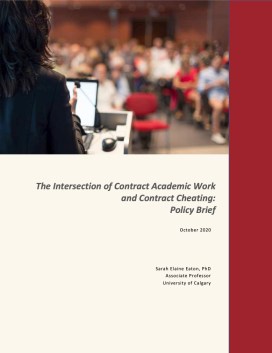
Cover - Contract academic work contract cheatingThe week of October 18-23, 2020 marks Fair Employment Week, hosted by the Canadian Association of University Teachers (CAUT). In many countries, it also marks Integrity Week, built around the International Day of Action Against Contract Cheating. These weeks have coincided for the past several years. A few years ago, I began to study the intersection of contract academic work and contract cheating (e.g., essay mills, term paper mills, etc.)

This report offers a preliminary discussion of the intersection between precarious academic employment and the commercial contract cheating industry. I have written it with the Canadian context in mind, though it may be relevant in other jurisdiction as well. The entire report is available for free download here.

Abstract

Purpose: The goal of this report is to provide substance for an evidence-informed discussion about the intersection of precarious academic employment and the contract cheating industry.

Methods: This is a qualitative report informed by the extant literature. It synthesizes available source material relating to academic staff who also supply services (e.g., essay writing, assignment completion, etc.) to the commercial contract cheating industry.

Results: A summary and synthesis are provided of issues relating to precariously employed academic staff and the contract cheating industry. A key outcome of this work is to highlight how the commercial cheating industry preys on underemployed academic staff. Predatory practices of the contract cheating industry are highlighted including false promises of high pay and meaningful work. Consequences such as disciplinary action and dismissal of academic staff who moonlight as suppliers to the industry are discussed, along with possible counter-measures to raise awareness and protect academic staff.

Implications: This guide is intended to provide guidance on methods used by the commercial contract cheating industry to exploit contract academic staff. Recommendations are provided on how to build awareness about the issue and also consider protections for the precariously employed.

Additional materials: 1 table; 46 references

Document type: Report, 26 pages

Keywords: academic integrity, higher education, academic labour, contingent faculty, precarious employment, cheating economy, sessional, adjunct, faculty

________

Share or Tweet this: New Report: Contract Academic Work and Contract Cheating: Policy Brief https://drsaraheaton.wordpress.com/2020/10/19/contract-academic-work-and-contract-cheating-policy-brief/

This blog has had over 2 million views thanks to readers like you. If you enjoyed this post, please “like” it or share it on social media. Thanks!

Sarah Elaine Eaton, PhD, is an Associate Professor the Werklund School of Education, and the Educational Leader in Residence, Academic Integrity, University of Calgary, Canada. Opinions are my own and do not represent those of the University of Calgary.