Webinar: Exploring the Impacts of Text Generating Technologies on Academic Integrity

March 12, 2021

Academic Integrity webinar series

Join us for our final webinar in our Academic Integrity: Urgent and Emerging Topics series hosted by the Taylor Institute for Teaching and Learning at the University of Calgary. I’ll be hosting two incredible presenters who are experts in Generative Pre-Trained Transformer (GPT-3) technology. Ryan Morrison and Michael Mindzak will wrap up our series with a truly emerging topic that #academicintegrity advocates, scholars, and practitioners will want to know about.

Session Description

Natural language processing (NLP) has advanced rapidly in recent years, to the point where algorithms can now generate focused texts that are increasingly indistinguishable from human writing. OpenAI’s Generative Pre-Trained Transformer (GPT-3) has been at the forefront of these developments, with major implications for language-based assessment from Kindergarten to postgraduate levels.

With this technology becoming publicly available in January 2021, educators will have to readily confront some difficult realities regarding the assessment and evaluation of critical writing and the nature of both plagiarism and authorship.

Beyond GPT-3, there are other text and research generating technologies on the horizon which embolden the impetus for educators and researchers to reconsider the definition of academic integrity.

In this webinar, attendees will explore a short history of text generators, examples of GPT-3 generated texts, and possible ideas and approaches to addressing these technologies practice.

Learning outcomes

  • Understand the current state of algorithmic writing
  • Interpret the impact that text generating technology will have on academic integrity
  • Generate ideas and approaches to addressing the problematic impacts through curriculum design

Facilitators: Ryan Morrison and Dr. Michael Mindzak, PhD
Date: Friday, April 9, 2021
Time: 10:00 – 11:30 a.m. Mountain time (Please convert to your local time zone)
Location: Online via Zoom

Space is limited and registration is required. Register here.

Please note: This workshop will be recorded, registration will close on Thursday, April 8, 2021 at 1:00 p.m. (Mountain Time) and a Zoom link for the webinar will be sent to you the morning of the workshop.

Presenters

Ryan Morrison (M. Ed. (IT), TESL) is an English language and Communications professor with the Centre of Preparatory and Liberal Studies at George Brown College in Toronto, Ontario, Canada. Fulfilling the role of an educational technologist within the school, outside of the classroom, he investigates trends like AI and digital tools for 21st century education.

Michael Mindzak (PhD) is an educator and educational researcher interested in the intersections of work, schooling and society. More specifically, his research focuses on educational policy issues, the sociology of work, as well as technology in the contemporary period. He works in the Faculty of Education, Brock University, Canada.

_____

Share or Tweet this: Exploring the Impacts of Text Generating Technologies on Academic Integrity – https://drsaraheaton.wordpress.com/2021/03/12/webinar-exploring-the-impacts-of-text-generating-technologies-on-academic-integrity/

This blog has had over 2 million views thanks to readers like you. If you enjoyed this post, please “like” it or share it on social media. Thanks!

Sarah Elaine Eaton, PhD, is a faculty member in the Werklund School of Education, and the Educational Leader in Residence, Academic Integrity, University of Calgary, Canada.

Opinions are my own and do not represent those of the University of Calgary or anyone else.


Why schools need “safe sharing sites” for students: Promoting academic integrity with ethical approaches to file-sharing

March 3, 2021

#ICAI2021 - Eaton quoteCommercial file-sharing and homework help sites have proliferated during the COVID-10 pandemic. One recent news report states that Chegg is now worth $12 Billion USD. And that’s just one company.

During the 2021 International Center for Academic Integrity conference, there were a few sessions dedicated to how to deal with companies such as Chegg, CourseHero and other commercial entities. One answer might be for schools themselves to create “safe sharing sites” for students.

The idea is similar to that of safe consumption sites for those who use drugs to do so in a monitored and safe environment. The purpose of a supervised or safe consumption site is to support harm reduction for users.

To transfer the analogy to academic file sharing, if students are going to share files anyway, it is incumbent upon schools provide them with safe and supported ways for them to do so. Safe sharing sites can promote ethical decision-making, minimize academic misconduct, and foster a sense of school community where profs, administrators, and students are working together to uphold integrity.

The onus is on educational institutions to support students’ learning. When schools invest in student learning through institutionally-supported tools and platforms, they support the student experience. Developing safe sharing sites is one viable way to address the problem of unethical file-sharing.

Putting resources into trying to combat global corporate entities whose primary purpose is to make a profit from our students is a losing battle. Putting effort into submitting requests to take down materials from corporate third party sites is like a game of whack-a-mole we can never win. As I commented in one of the conference presentations during the ICAI conference: Schools paying for a commercial file-sharing site account in order to find out what is on their website is like paying a drug dealer to find out what is in their pills. When schools pay for an account on corporate 3rd party sites, we help to finance the industry we are advocating against.

As educational institutions, we must find ways to work with our students, not against them. File-sharing is a normal online behaviour, so let’s provide students with the tools to do what they are going to do any way in safe and supported ways that help them – and us – uphold integrity on our campuses.

_____

Share or Tweet this: Why schools need “safe sharing sites” for students: Promoting academic integrity with ethical approaches to file-sharing – https://drsaraheaton.wordpress.com/2021/03/03/why-schools-need-safe-sharing-sites-for-students-promoting-academic-integrity-with-ethical-approaches-to-file-sharing/

This blog has had over 2 million views thanks to readers like you. If you enjoyed this post, please “like” it or share it on social media. Thanks!

Sarah Elaine Eaton, PhD, is a faculty member in the Werklund School of Education, and the Educational Leader in Residence, Academic Integrity, University of Calgary, Canada.

Opinions are my own and do not represent those of the University of Calgary or anyone else.


New book Series: Ethics and Integrity in Educational Contexts

February 1, 2021

A97796_EIEC_Series_Banner_P2

I am pleased to announce a new book series, Ethics and Integrity in Educational Contexts by Springer.

About this series

The aim of this series is to provide an authoritative series of books on topics relating to ethics and integrity in educational contexts. Its scope includes ethics and integrity, defined in broad and inclusive terms, in educational contexts. It focuses on higher education, but also welcomes contributions that address ethics and integrity in primary and secondary education, non-formal educational contexts, professional education, etc. We welcome books that address traditional academic integrity topics such as plagiarism, exam cheating, and collusion.

In addition, we are particularly interested in topics that extend beyond questions of student conduct, such as

  • Quality assurance in education;
  • Research ethics and integrity;
  • Admissions fraud;
  • Fake and fraudulent credentials;
  • Publication ethics;
  • Educational technology ethics (e.g., surveillance tech, machine learning, and artificial intelligence, as they are used in education);
  • Biomedical ethics in educational contexts;
  • Ethics in varsity and school sports.

This series extends beyond traditional and narrow concepts of academic integrity to broader interpretations of applied ethics in education, including corruption and ethical questions relating to instruction, assessment, and educational leadership. It also seeks to promote social justice, diversity, equity, and inclusion.

The series provides a forum to address emerging, urgent, and even provocative topics related to ethics and integrity at all levels of education, from a variety of disciplinary and geographical perspectives.

Editorial Board

I am delighted to work with an international group scholars and experts as members of the Editorial Board:

Tomáš Foltýnek, Department of Informatics, Faculty of Business and Economics, Mendel University, Brno, Czechia

Irene Glendinning, Coventry University, Coventry, UK

Zeenath Reza Khan, University of Wollongong, Dubai, United Arab Emirates

Rebecca Moore Howard, Syracuse University, New York, USA

Mark Israel, Australasian Human Research Ethics Consultancy Services, Perth, Australia

Ceceilia Parnther, St. Johns’ University, New York, USA

Brenda M. Stoesz, The Center for Advancement of Teaching and Learning, University of Manitoba, Winnipeg, Manitoba, Canada

Forthcoming and New Books

The first book to launch the series will be Academic Integrity in Canada (Eaton & Christensen Hughes, eds., forthcoming). I will share more details about this first book when we are closer to publication, which should be in mid to late 2021.

Proposals for a number of other books to join the series are underway, with authors and editors from a variety of countries.

If you have an idea for a book to be included as part of this series, please contact me.

_____

Share or Tweet this: New book Series: Ethics and Integrity in Educational Contexts https://drsaraheaton.wordpress.com/2021/02/01/new-book-series-ethics-and-integrity-in-educational-contexts/

This blog has had over 2 million views thanks to readers like you. If you enjoyed this post, please “like” it or share it on social media. Thanks!

Sarah Elaine Eaton, PhD, is a faculty member in the Werklund School of Education, and the Educational Leader in Residence, Academic Integrity, University of Calgary, Canada.

Opinions are my own and do not represent those of the University of Calgary or anyone else.


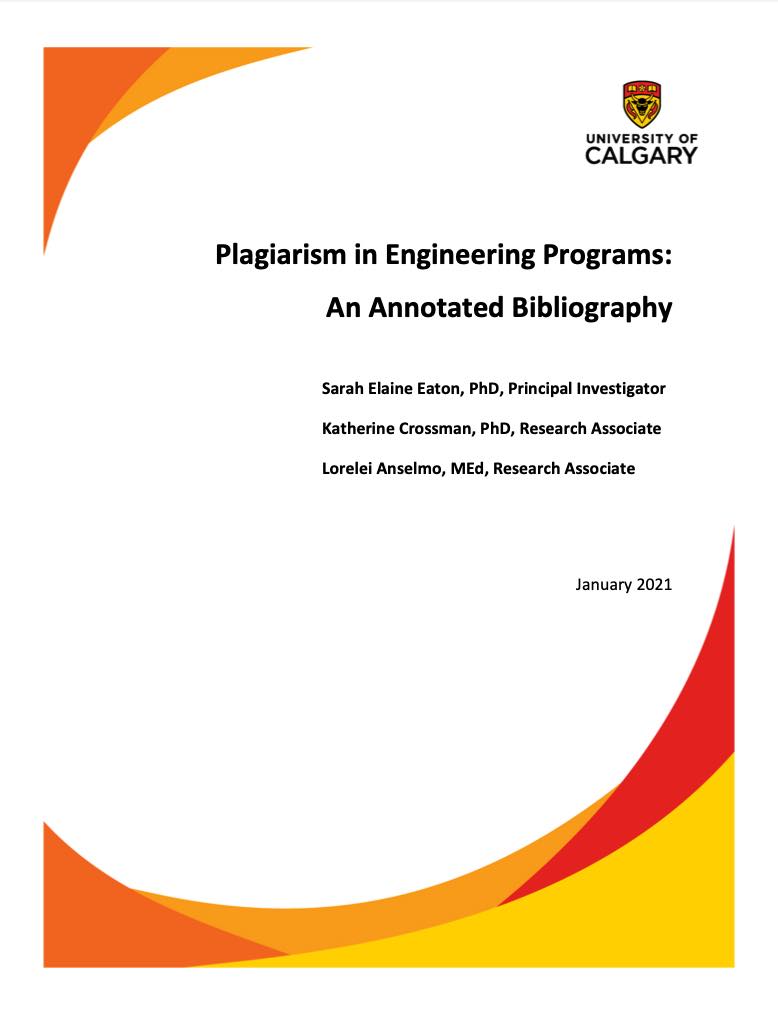
Plagiarism in Engineering Programs: An Annotated Bibliography

January 13, 2021

Engineering Annotated Bib coverExcited to share this long-overdue annotated bibliography. We started working on this one a while ago and then COVID hit. We are excited to have completed this and be able to share this with you. We hope it will be particularly helpful for those studying academic integrity in STEM fields.

Eaton, S.E., Crossman, K., & Anselmo, L. (2021). Plagiarism in Engineering Programs: An Annotated Bibliography. Calgary, University of Calgary. http://hdl.handle.net/1880/112969

Purpose

This report documents research and related materials concerning plagiarism in STEM and engineering programs to inform and guide future work in the field. It provides an overview of the literature up to and including 2019 related to plagiarism in STEM and engineering programs.

Methods

Two research questions guided this literature review: 1. What scholarly, research, and professional literature explores and examines plagiarism in STEM and engineering programs? 2. What major themes emerge from scholarly and research literature about plagiarism in engineering? To this end, a methodical research of databases was undertaken, relevant research was compiled, and articles were summarized and categorized.

Results

Our review and search of the literature resulted in more than 30 sources, which we organized into 7 categories: (a) Background: AI in engineering; (b) student perceptions and attitudes; (c) faculty perceptions and attitudes; (d) cheating and collusion; (e) text-matching software and plagiarism detection; (f) international students and (g) interventions and reparations.

We found that plagiarism in STEM and engineering, as in other fields, is widespread among students and faculty, while policies and their implementation are often inconsistent. Calls for clearer guidelines and greater support for students and faculty resound as a consistent theme in the literature.

Implications

Plagiarism in STEM and engineering research has been slow to develop, but is a continuing field of growth. As more stakeholders become aware of the scope and complexities of plagiarism, many researchers are making recommendations for policy, policy implementation, and support through technology, education, and intervention programs.

Additional materials: 36 References

Keywords: Academic integrity, academic dishonesty, academic misconduct, plagiarism, cheating, engineering

_____

Share or Tweet this: Plagiarism in Engineering Programs: An Annotated Bibliography – https://drsaraheaton.wordpress.com/2021/01/13/plagiarism-in-engineering-programs-an-annotated-bibliography/

This blog has had over 2 million views thanks to readers like you. If you enjoyed this post, please “like” it or share it on social media. Thanks!

Sarah Elaine Eaton, PhD, is a faculty member in the Werklund School of Education, and the Educational Leader in Residence, Academic Integrity, University of Calgary, Canada. Opinions are my own and do not represent those of the University of Calgary.


New article: Plagiarism: A Canadian Higher Education Case Study of Policy and Practice Gaps

January 8, 2021

AJER Screen ShotWe are excited to share this new article:

Eaton, S. E., Fernández Conde, C., Rothschuh, S., Guglielmin, M., & Otoo, B. K. (2020). Plagiarism: A Canadian higher education case study of policy and practice gaps. Alberta Journal of Educational Research, 66(4), 471-488. Retrieved from https://journalhosting.ucalgary.ca/index.php/ajer/article/view/69204

This was a project that I undertook with some of our excellent graduate students at the Werklund School of Education. Our findings corroborated other studies that found faculty do not report academic misconduct, and adds to the body of evidence from Canada. Our findings showed that although pre-service teachers engage in academic misconduct, sometimes their instructors choose not to report them for it. Instead, faculty deal with such instances privately, as a “teachable moment”, without following institutional policy. This was a fascinating study to conduct and I am hoping it will be useful to other Canadian researchers, as well as others studying academic misconduct in teacher training programs.

Abstract

This mixed methods case study investigated faculty perspectives and practice around plagiarism in a Western Canadian faculty of education. Data sources included interviews, focus groups, and a survey. Findings showed that participants (N = 36) were disinclined to follow established procedures. Instead, they tended to deal with plagiarism in informal ways without reporting cases to administration, which resulted in a disconnect between policy and practice. The emotional impact of reporting plagiarism included frustration with the time required to document a case, and fear that reporting could have a negative effect on one’s employment. Recommendations include approaches that bridge the gap between policy and practice.

Key words: Academic integrity, plagiarism, Canada, higher education, faculty

Cette étude de cas à méthodes mixtes s’est penchée sur les perspectives et les pratiques du corps professoral relatives au plagiat dans une faculté d’éducation dans l’ouest du Canada. Les sources de données ont inclus les entrevues, les groupes de discussion et un sondage. Les résultats indiquent que les participants (N=36) étaient peu portés à suivre les procédures établies. Ils avaient plutôt tendance à employer des moyens informels pour traiter le plagiat, sans signaler les cas à l’administration, ce qui entrainait un écart entre la politique et la pratique. L’impact émotionnel découlant du signalement du plagiat comprenait le temps nécessaire à documenter un cas et la peur que le signalement puisse avoir une incidence négative sur son emploi. Les recommandations proposées incluent des approches visant à combler l’écart entre la politique et la pratique.

Mots clés : intégrité académique, plagiat, Canada, enseignement supérieur, faculté

Authors:

  • Sarah Elaine Eaton, University of Calgary
  • Cristina Fernández Conde, University of Calgary
  • Stefan Rothschuh, University of Calgary
  • Melanie Guglielmin, University of Calgary
  • Benedict Kojo Otoo, University of Calgary

Check out the entire issue here: https://journalhosting.ucalgary.ca/index.php/ajer/issue/view/5241

For more information about this article please contact me directly.

_____

Share or Tweet this: New article: Plagiarism: A Canadian Higher Education Case Study of Policy and Practice Gaps – https://drsaraheaton.wordpress.com/2021/01/08/new-article-plagiarism-a-canadian-higher-education-case-study-of-policy-and-practice-gaps/

This blog has had over 2 million views thanks to readers like you. If you enjoyed this post, please “like” it or share it on social media. Thanks!

Sarah Elaine Eaton, PhD, is a faculty member in the Werklund School of Education, and the Educational Leader in Residence, Academic Integrity, University of Calgary, Canada. Opinions are my own and do not represent those of the University of Calgary.