What Happened to the “Public” in Public Education?

March 12, 2013

Today I received an e-mail about this event. Since it is a public event and they have asked folks to help them get the word out, I am sharing it with you:

Invitation to Participate

Public Education Focus Groups – What Happened to the “Public” in Public Education?

The Sheldon Chumir Foundation for Ethics in Leadership invites you to contribute to our research on the state of public education in Alberta.

The Foundation is conducting focus groups in Alberta cities and towns to gather information about the opinions, experiences and values of Albertans regarding public education as a public institution in the province. Discussion topics will include the purpose of public education and the type of community and democracy public education should encourage.

The Foundation is holding a focus group in Calgary on March 19, 2013 from 5:00-7:00 pm. Participants will receive a $20 honorarium and dinner will be served.

They welcome input from all Albertans, with and without connections to the public education system.

Please pass this invitation along to any friends or family you think may be interested in participating in a focus group about public education.

To attend this focus group, please RSVP to Jasmine Ing at

jing @ chumir.ca or 403-244-6666 by March 15, 2013.

When you RSVP, please include your name, phone number, and city or town.

The Sheldon Chumir Foundation for Ethics in Leadership is a non-profit organization based in Calgary which conducts activities across Canada.

———–

I am not personally involved in this event or the Foundation, but I do think it sounds like a pretty interesting conversation to be part of.

____________________________

If you enjoyed this post, please “like” it or leave a comment. Thanks!

Share or Tweet this: What Happened to the “Public” in Public Education? http://wp.me/pNAh3-1zK

Update – January 2018 – This blog has had over 1.8 million views thanks to readers like you. If you enjoyed this post, please “like” it or share it on social media. Thanks!

Sarah Elaine Eaton is a faculty member in the Werklund School of Education, University of Calgary, Canada.


How will Alberta’s second language students ever achieve proficiency?

March 11, 2013

SLIC logoLate last year I had an article published in the peer-reviewed journal, Notos, which is published by the Second Language and Intercultural Council (SLIC) of the Alberta Teachers’ Association. With permission of the publisher, I am sharing the abstract and article with you:

Abstract

Students of second and international languages in Alberta do not receive sufficient hours of instruction through formal classroom time alone to achieve distinguished levels of proficiency (Archibald, J., Roy, S., Harmel, S., Jesney, K., Dewey, E., Moisik, S., et al., 2006). This research study uses a constructivist approach (Guba & Lincoln, 1994; Twomey Fosnot, 2005) to explore what is meant by proficiency and expertise in terms of language learning, by applying what has commonly become known as “the 10,000-hour rule” of expertise (Ericsson, K. A., Krampe, R., & Tesch-Romer, C.,1993; Ericsson, K. A., Prietula, M. J., & Cokely, E. T., 2007; Gladwell, 2008).

Alberta’s French as a second language: Nine-year program of studies (Grade 4 to 12) is considered as an example. This paper argues that dedicated, self-regulated informal learning is necessary to supplement classroom learning in order to achieve 10,000 hours of dedicated practice necessary to develop high levels of proficiency or expertise, according to the definitions offered by American Council on the Teaching of Foreign Languages (ACTFL) and the Common European Framework of Reference for Languages (CEFR). Recommendations are offered to help learners and parents understand critical role of self-regulated, informal learning in achieving language proficiency.

Keywords

second language, international languages, Canada, Alberta, 10,000-hour rule, expertise, proficiency, ACTFL, Common European Framework of Reference, CEFR, expert, self-regulation, formal learning, non-formal learning, informal learning.

Citation

Eaton, S. E. (2012). How will Alberta’s second language students ever achieve proficiency? ACTFL Proficiency Guidelines, the CEFR and the “10,000-hour rule” in relation to the Alberta K-12 language-learning context. Notos, 12(2), 2-12.

If you are interested in a copy of the full article, please contact me.

_________________

If you enjoyed this post, please “like” it or leave a comment. Thanks!

Share or Tweet this: How will Alberta’s second language students ever achieve proficiency? http://wp.me/pNAh3-1zA

Update – January 2018 – This blog has had over 1.8 million views thanks to readers like you. If you enjoyed this post, please “like” it or share it on social media. Thanks!

Sarah Elaine Eaton is a faculty member in the Werklund School of Education, University of Calgary, Canada.


How Community Conversations Create Powerful Possibilities

February 23, 2013

The other night we held a “community conversation” as part of our “Creating Space for Strength” project. Together with my two colleagues, Lee Tunstall and Vilma Dawson, the three of us were thrilled to facilitate the evening for this amazing group of Calgarians.

Representatives from Calgary’s North Central Communities

Over 40 people attended the event, including local elected representatives, Hon. Teresa Woo-Paw, MLA for Calgary Northern Hills and Calgary Alderman, Jim Stevenson.

Creating Space for Strength - Panorama shot

Citizens from a number of Calgary communities attended:

  • Harvest Hills
  • Panorama Hills
  • Coventry Hills
  • Country Hills
  • Hidden Valley
  • MacEwan Glen
  • Sandstone Valley

World Café format

We used a “world café” style of conversation. We started off by explaining that the purpose of the meeting was to find out what mattered to community residents. Then, to take the first steps towards envisioning what the community could look like in the not-too-distant future.

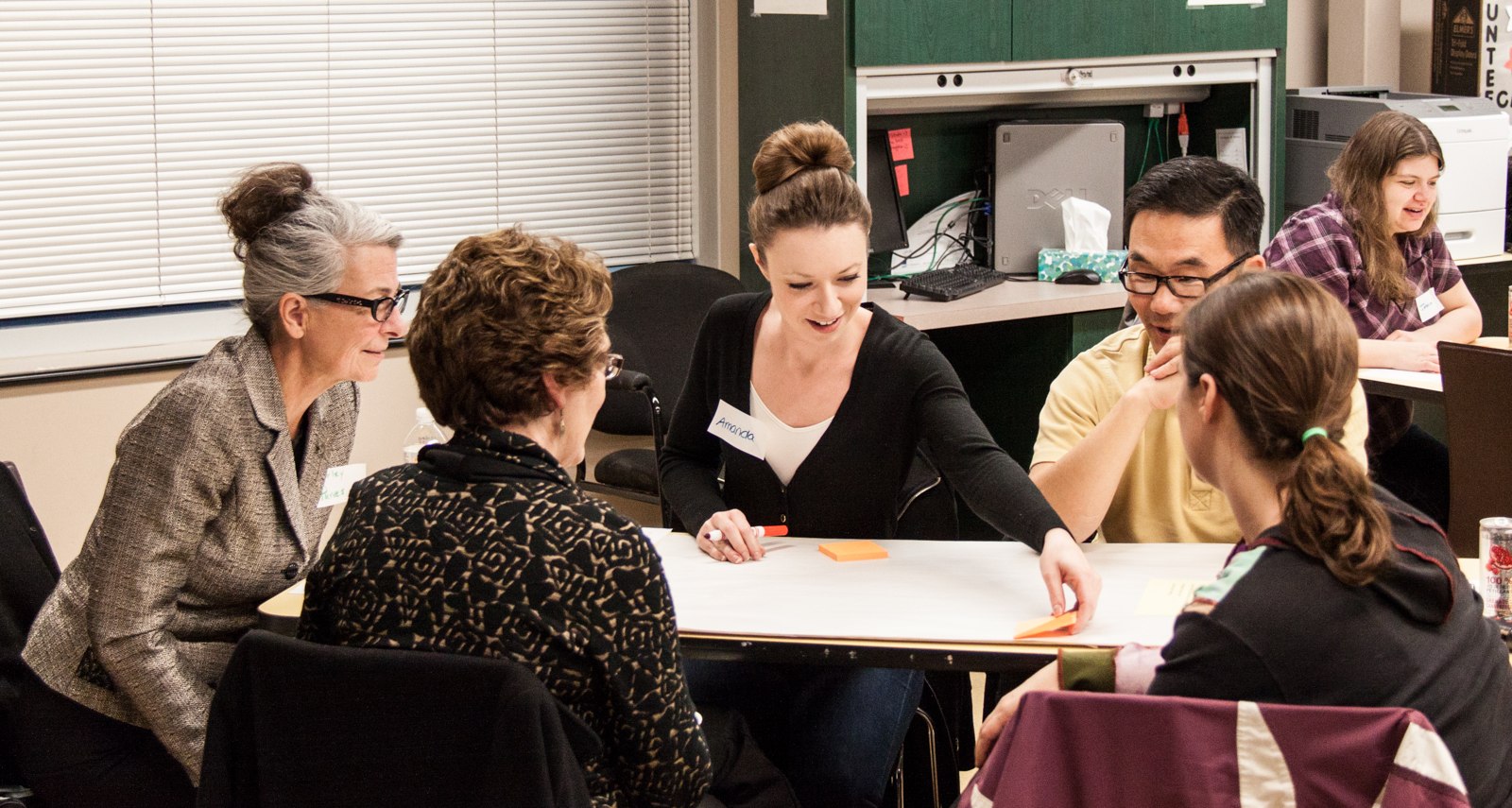
People worked in groups of 5 or 6 at small tables, using key questions to guide their conversations. We asked them to jot down their key ideas and points on sticky notes. Later, volunteers collected the sticky notes from all the tables and grouped them into common themes.

We asked four key questions, framed in asset-based community development (ABCD) way:

  • What is good and strong about our community?
  • What could be better?
  • What would you like to see the community achieve in the next 5 years?
  • How do we get there?

Creating space for Strength - community conversation 1

Community-driven

Even though a team of 3 of us consultants facilitated the evening, the whole event was planned, organized and promoted mostly by Northern Hills Community Association.

This picture shows two volunteers from the community association grouping the sticky notes from each question into themes.Creating Space for Strength (Moraig and Paul)

The community association booked the space for the event (a meeting room in a local grocery store) and arranged for food and beverages. They ordered wraps, veggie and fruit trays, cheese and crackers and sweets.

They kept in mind that the population living in their communities is culturally diverse, so they were careful to pay attention to dietary restrictions such as having beef and pork products separated from other foods, and offering completely vegetarian options. The provided a variety of water, juice and soft drinks, too. There is something that brings people together over food and so this was an important element of our evening.

The community association also took the responsibility of buying all the supplies for the evening, including hundreds of sticky notes and enough markers so that everyone could have one to use.

Results

We have yet to formally analyze the data from the event, but informally I can say that by the end of the meeting, the room was buzzing with energy. Residents stayed for a long while after the event wrapped up. They wanted to talk more about their community and how to improve it.

A number of attendees took the initiative to exchange contact information and ask how they could get involved.

Overall, it was a great night that ended on an energetic and inspired note.

As always, we want to acknowledge the organizations that are making this work possible:

Project Origins – Northern Hills Constituency

Project Funders – Government of Alberta (CFEP Grant); United Way of Calgary and Area; Aspen Family and Community Network Society; Northern Hills Community Association

Project Supporters – Northern Hills Constituency; City of Calgary; Aspen Family and Community Network Society; Northern Hills Community Association; United Way of Calgary and Area

_________________

If you enjoyed this post, please “like” it or leave a comment. Thanks!

Share or Tweet this: How Community Conversations Create Powerful Possibilities http://wp.me/pNAh3-1z7

Update – January 2018 – This blog has had over 1.8 million views thanks to readers like you. If you enjoyed this post, please “like” it or share it on social media. Thanks!

Sarah Elaine Eaton is a faculty member in the Werklund School of Education, University of Calgary, Canada.


Twitter for Teachers at the Central Alberta Teachers’ Convention (CATCA) 2013

February 22, 2013

Twitter for Teachers (cover - jpg)I am super excited to be presenting my workshop, Twitter for Teachers, today at the Central Alberta Teachers’ Convention at Red Deer College.

Here’s what I’ll be sharing:

  1. Twitter overview. We will briefly review what Twitter is and how it is used in business. This course is designed for people who already have had some exposure to Twitter and want to learn how to use Twitter in a meaningful and strategic way. There is no point in having a Twitter account “just because”.
  2. Develop your personal Twitter strategy. You will learn how to develop your own personal vision about what Twitter means to you and why.
  3. Twitter time management. You will learn how to manage your time on Twitter effectively. There is no question that social media can be time consuming. In this session, we will talk about ways to minimize the time you spend on Twitter,  while still using it to its fullest potential.
  4. Twitter followers.  We will bust the myth that you need more followers. What you really need is more engaged followers. You will learn what it means to have an engaged following and how to develop one.

If you can’t attend the conference, but you are interested in the content, you can download my free .pdf guide with step-by-step, “how to” instructions. Click here to get your copy of the guide.

_________________

If you enjoyed this post, please “like” it or leave a comment. Thanks!

Share or Tweet this: Twitter for Teachers at the Central Alberta Teachers’ Convention (CATCA) 2013 http://wp.me/pNAh3-1yM

Update – January 2018 – This blog has had over 1.8 million views thanks to readers like you. If you enjoyed this post, please “like” it or share it on social media. Thanks!

Sarah Elaine Eaton is a faculty member in the Werklund School of Education, University of Calgary, Canada.


Spanish for Dentists: 6 Great (and Free!) Resources

February 13, 2013

Teeth - smile - smallI unexpectedly had to go to the dentist this week when a filling broke in half and part of it fell out. During my visit, my dentist was telling me about her plans to take her entire team to Guatemala next year to do some pro bono work in poor communities there.

She asked me if I had any resources on Spanish for dentists. I set off on a bit of a quest. Here are six wonderful, free online resources that I found to help English-speaking dentists and dental hygienists learn the basics so they can communicate with Spanish-speaking patients:

  1. English to Spanish Phrase Guide for Dentists – http://www.deltadentalins.com/dentists/guidance/english-spanish-phrase-guide.html
  2. PracticingSpanish.Com – Spanish for Dentists – http://www.practicingspanish.com/dental-exam.html
  3. Spanish for the Dental Office  – https://www.aetnadental.com/AD/ihtAD/r.WSIHW000/st.35410/t.706081.html
  4.  Spanish Words and Phrases for Dentists – http://www.artofteeth.com/files/Spanish_for_Dentists.pdf
  5. Spanish Guide of Dental Terminology – http://lrc.wfu.edu/community_interpreting/extras/editeddental.pdf
  6. English-Spanish Dictionary of Health Related Terms – http://www.cdpr.ca.gov/docs/dept/spanish/engspdict.pdf

_________________

Share or Tweet this: Spanish for Dentists: 6 Great (and Free!) Resources http://wp.me/pNAh3-1yE

Update – January 2018 – This blog has had over 1.8 million views thanks to readers like you. If you enjoyed this post, please “like” it or share it on social media. Thanks!

Sarah Elaine Eaton is a faculty member in the Werklund School of Education, University of Calgary, Canada.