Webinar recording: Creating Space for Strength

November 30, 2012

Our research team is thrilled to share the recording of our webinar “An Introduction to Creating Space for Strength: An Asset-Based Community Development and Research Project Focused on Calgary’s North Central Communities”.

We had over 40 people sign up for the webinar. The program lasted approximately 45 minutes and included chat dialogue from many community participants.

Thank you to everyone who attended and contributed. As promised, here is the recording. Feel free to share it with others.

5 Great resources on asset-based community development (ABCD) http://wp.me/pNAh3-1xJ
______________

Share or Tweet this: Webinar recording: Creating Space for Strength http://wp.me/pNAh3-1wI

Update – January 2018 – This blog has had over 1.8 million views thanks to readers like you. If you enjoyed this post, please “like” it or share it on social media. Thanks!

Sarah Elaine Eaton is a faculty member in the Werklund School of Education, University of Calgary, Canada.


3 Handy Checklists for APA Style and Formatting

November 27, 2012

As my students are getting ready to hand in their final research papers, they are struggling to learn APA (American Psychological Association) standards for formatting, citations and references. Here are three handy checklists I have shared with them. They find them very helpful:

APA Style Checklist – http://www2.indwes.edu/ocls/apa/apastylechecklist.pdf

Checklist for APA Style (from Elmhurst) – http://library.elmhurst.edu/files/2010/02/ChecklistAPA.pdf

APA Format Checklist (from SLU) – http://www.slu.edu/Documents/student_development/student_success_center/APA_Format_Checklist_Handout.pdf

______________

Share or Tweet this: 3 Handy Checklists for APA Style and Formatting  http://wp.me/pNAh3-1wD

Update – January 2018 – This blog has had over 1.8 million views thanks to readers like you. If you enjoyed this post, please “like” it or share it on social media. Thanks!

Sarah Elaine Eaton is a faculty member in the Werklund School of Education, University of Calgary, Canada.


How to tell if your child is being cyber-bullied

November 19, 2012

In 2012, in British Columbia, Canada, a 15-year old girl named Amanda Todd killed herself. The reason: cyberbullying.

The case has brought to light the devastating effects that cyberbullying can have on a person. Todd’s death has affected Canadians immediately and deeply. Parents are suddenly asking themselves: Is my child being cyber-bullied? How would I know?

Sarah Eaton's education blogStopBullying.gov (a U.S. website) says warning signs that your child may be the victim of face-to-face or any type bullying include:

  • Unexplainable injuries
  • Lost or destroyed clothing, books, electronics, or jewelry.
  • Frequent headaches or stomach aches, feeling sick or faking illness.
  • Changes in eating habits, like suddenly skipping meals or binge eating. Kids may come home from school hungry because they did not eat lunch.
  • Difficulty sleeping or frequent nightmares.
  • Declining grades, loss of interest in schoolwork, or not wanting to go to school.
  • Sudden loss of friends or avoidance of social situations.
  • Feelings of helplessness or decreased self esteem.
  • Self-destructive behaviors such as running away from home, harming themselves, or talking about suicide.

The Cyberbullying Research Centre says that 1o% to 40% of youth may be the victim of cyberbullying. They add to the list of warning signs by zooming in on key indicators that make cyberbullying different from other kinds of bullying:

Signs your child is the victim of cyberbullying

Your child may be the victim of cyberbullying if he or she:

  • unexpectedly stops using their computer or cell phone.
  • appears nervous or jumpy when an instant message or email appears.
  • appears uneasy about going to school or outside in general.
  • appears to be angry, depressed, or frustrated after using the computer or cell phone.
  • avoids discussions about what they are doing on the computer or cell phone.
  • or becomes abnormally withdrawn from usual friends and family members.

The Cyberbullying Research Centre offers numerous free resources for parents, children and teachers to help you stay safe online, including this awesome cyberbullying prevention tip sheet for teens.

Cyberbulling is a real phenomenon that affects tens of thousands of children (and adults) around the world on a daily basis. I am not an expert in this area, but I firmly believe that every person deserves love, respect and safety. Deepest condolences to the family of Amanda Todd.

References

Amercian Humane Association. (n.d.). Cyber Bullying Prevention and Intervention.   Retrieved November 19, 2012, from http://www.americanhumane.org/children/stop-child-abuse/fact-sheets/cyber-bullying-prevention-and-intervention.html

Hinduja, S., & Patchin, J. W. (n.d.). Cyberbulling: Indentification, prevention and response. Retrieved from http://www.cyberbullying.us/Cyberbullying_Identification_Prevention_Response_Fact_Sheet.pdf

StopBullying.gov. (n.d.). Warning signs.   Retrieved 2012, 2012, from http://www.stopbullying.gov/at-risk/warning-signs/index.html#bullying

_______________

This is the first in a series of posts on cyberbulling. Check out these related posts:

5 Signs your child is a cyberbully http://wp.me/pNAh3-1AM

______________

Share or Tweet this: How to tell if your child is being cyber-bullied http://wp.me/pNAh3-1w4

Update – January 2018 – This blog has had over 1.8 million views thanks to readers like you. If you enjoyed this post, please “like” it or share it on social media. Thanks!

Sarah Elaine Eaton is a faculty member in the Werklund School of Education, University of Calgary, Canada.


What makes a good research question?

November 6, 2012

This week I posed a question to my students: What makes a good research question?

As Masters of Education students, they are learning about what it means to be a researcher and building a foundation of knowledge. They came up with some great resources this week. If you are looking for answers to this question, check out these great resources:

Sarah Eaton blog leadershipSonia Ospina’s entry in the Encyclopedia of Leadership on Qualitative Research

This is a 13-page document, available free in .pdf format. Published in 2004, this text shares some of the fundamentals of qualitative research, particularly as it pertains to leadership. It is also very useful for students and researchers working in education and other social sciences. It contains an extensive bibliography that serves as a great point of departure for more exploration. Link for this resource: http://ualr.edu/interdisciplinary/files/2010/03/Qualitative_Research.pdf

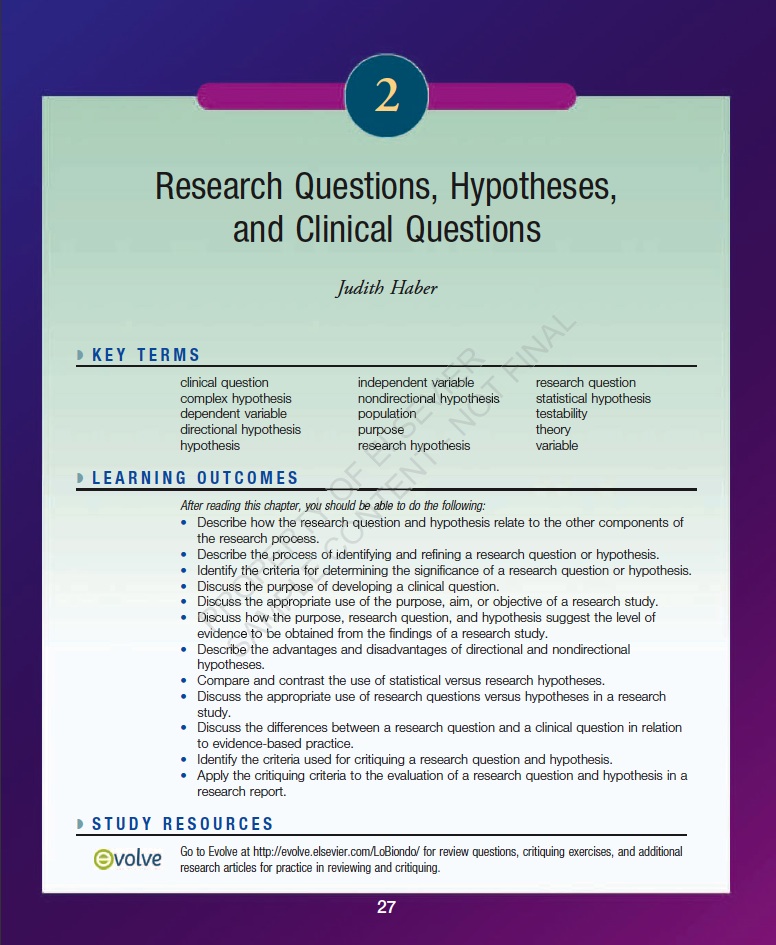
Sarah Eaton blogJudith Haber’s chapter called “Research Questions, Hypotheses and Clinical Questions”

Though marked as “Sample – Not final” with a watermark on the .pdf, this is an incredible 29-page resource that includes flow charts and tables of information. It is easy to understand and written in language that most novice researchers could understand. This one quickly became a favorite because it was colorful and concise. Even though it appears to be written for students and practitioners of health research, there are many elements that may be useful to educators and social science researchers, too. Link for this resource: http://www.us.elsevierhealth.com/media/us/samplechapters/9780323057431/Chapter%2002.pdf

Companion for Undergraduate Research

This is a website (http://www.socscidiss.bham.ac.uk/) that outlines the characteristics of a good research question. Then it talks about each characteristic in detail. It is written in clear language and is very well organized. The page also contains links to other helpful resources on research.

Figuring out how to craft a research question can be tricky. Resources like these help to demystify the process.

______________

Share or Tweet this: What makes a good research question? http://wp.me/pNAh3-1vL

Update – January 2018 – This blog has had over 1.8 million views thanks to readers like you. If you enjoyed this post, please “like” it or share it on social media. Thanks!

Sarah Elaine Eaton is a faculty member in the Werklund School of Education, University of Calgary, Canada.


German sign language – Resources and tips

August 29, 2012

Did you know that not all countries in the world share a universal sign language? Today’s post is in honour of my friend, Meike Thomesen, who is the Assistant Principal at Bowcroft Elementary, Calgary’s only German bilingual school. Meike just came back from an intensive training program for in-service German teachers. The course was held in Germany. Part of their training involved PD to teach the German language to children by complementing the spoken language with sign language. What a super idea!

If you teach German, here are some resources to help you learn about German sign language:

DGS Korpus – A corpus of German sign language texts. This is a long-term project of the Academy of Sciences in Hamburg for documenting and researching the German Sign Language (DGS).

Basic German sign language – You Tube video with English sub-titles

German Sign Language Numbers – YouTube video

AlphaDictionary – A very cool, multilingual sign language resource site

__________________

Share or Tweet this post:  German sign language – Resources and tips http://wp.me/pNAh3-1uf

Update – January 2018 – This blog has had over 1.8 million views thanks to readers like you. If you enjoyed this post, please “like” it or share it on social media. Thanks!

Sarah Elaine Eaton is a faculty member in the Werklund School of Education, University of Calgary, Canada.