21st century definition of plagiarism

January 23, 2018

Not long after I started getting interested in academic integrity, I began wondering how different universities defined plagiarism in their official policy documents. That led me to do an analysis of policy documents from 20 Canadian higher education institutions, and the results were published in the peer-reviewed scholarly journal, Interchange. Basically, what I found was that there was no consistent definition of plagiarism across Canadian post-secondary institutions. In other words, we don’t agree about what actually constitutes plagiarism.

This makes it confusing for students and for professors, especially considering that students might attend one school to do their undergraduate degree and another for their graduate degree, or that professors sometimes change jobs, leaving one institution for another.

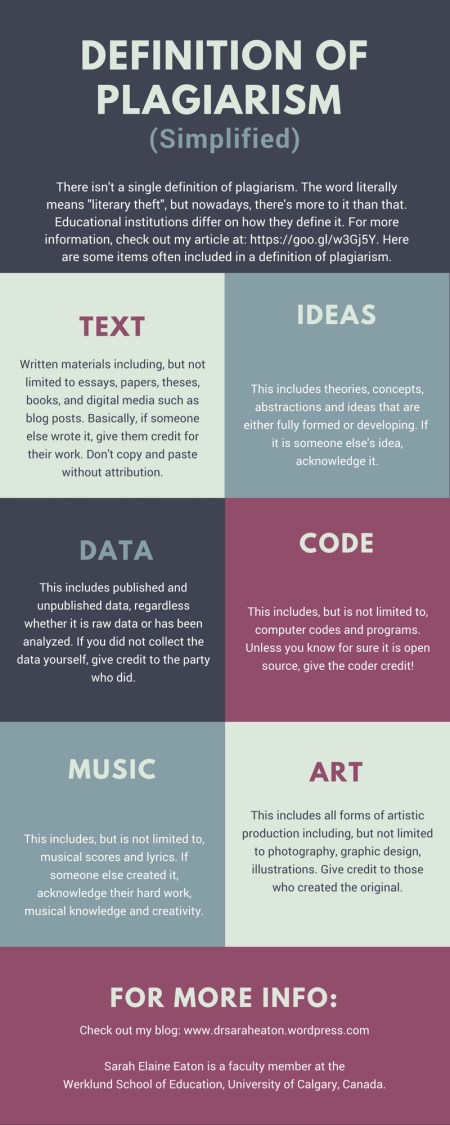
It used to be that the definition of plagiarism was simple: literary theft, but it is a lot more complicated than that in the 21st century, where digital outputs account for as much, if not more than, printed products. Students and professors have asked me, “So, how do you define plagiarism in plain and simple terms?” The answer is actually quite complex and a bit messy. But in the interest of demystifying the issue, here is a straight forward infographic that may help.

Let me say that this resource is simplified — perhaps overly so. My goal here isn’t to be reductionist and I fully acknowledge that not everyone may agree with these simplified explanations. But sometimes it can be easier to wrap your head around something simple to start and then tease out the complexities once you are more comfortable with the basic concepts.  I offer these not as the be-all-and-end-all definition, but rather as a starting point to help educators and students clarify and demystify basic concepts and also to engage in productive conversations about how to cultivate academic integrity and reduce plagiarism.
Definition of plagiarism (jpg)

Here is a free, downloadable .pdf of this infographic that you are welcome to use with your students for teaching purposes. Feel free to use it as a conversation starter to help students understand what plagiarism is and how to prevent it in their own work.

Related post:

Comparative Analysis of Institutional Policy Definitions of Plagiarism: A Pan-Canadian University Study https://wp.me/pNAh3-1LD

______________________________________________________

Share or Tweet this: 21st century definition of plagiarism https://wp.me/pNAh3-2eo

This blog has had over 1.8 million views thanks to readers like you. If you enjoyed this post, please “like” it or share it on social media. Thanks!

Sarah Elaine Eaton is a faculty member in the Werklund School of Education, University of Calgary, Canada.


New article: “Credit where credit is due”

December 19, 2017

Credit where credit is due - coverIn my latest article, “Credit where credit is due: How to prevent plagiarism in the 21st century classroom” I tackle the tricky question of what it means to plagiarize in the age of copy-and-paste. I also offer K-12 teachers five practical tips on how to prevent plagiarism among school-age children.

Most of my research and writing is focusing more and more on academic integrity and plagiarism prevention in higher education contexts. But it is important for K-12 teachers to be able to talk about these topics to their students, too. That’s what inspired me to write this article.

The full article was published by the EdCan Network and it is a web exclusive in their most recent edition. You can check it out here: https://www.edcan.ca/articles/credit-where-credit-is-due/

______________________________________________________

Share or Tweet this: New article: “Credit where credit is due”

This blog has had over 1.8 million views thanks to readers like you. If you enjoyed this post, please “like” it or share it on social media. Thanks!

Sarah Elaine Eaton is a faculty member in the Werklund School of Education, University of Calgary, Canada.


Workshop for Educators: Academic Integrity – Opening Up the Conversation Around Plagiarism

March 15, 2017

Today my research assistants, Jenny and Ian, collaborated with me to facilitate a workshop to faculty members and grad students in the Werklund School of Education, University of Calgary, on plagiarism. This workshop is part of the knowledge sharing and mobilization for a research project on plagiarism in our school of education.

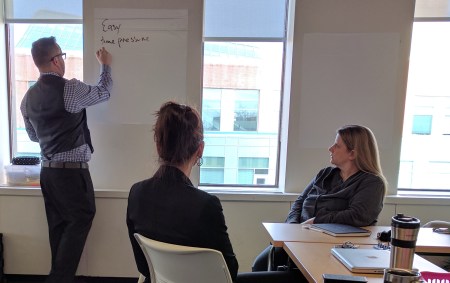
Here’s a photo of the group discussing their experiences with plagiarism in their professional practice in higher education contexts.

2017-03-15 - Worshop photo 1

We brainstormed ideas about why students plagiarize:

2017-03-15 - Workshop photo 2

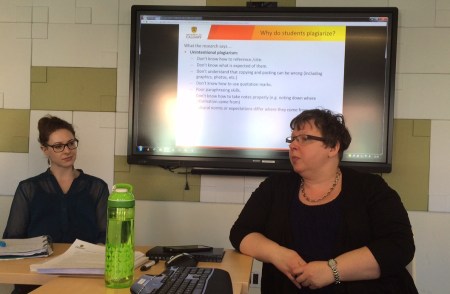
Then, we talked about the reasons why students plagiarize, as informed by the research literature, and compared participants’ responses to what is evident in the literature. There were numerous parallels between participants’ experiences and what we found in the literature.

2017-03-15 - Workshop photo 3

Finally, we shared strategies about how to prevent plagiarism and also how to address it if you encounter it in a student’s work.

You can find a copy of our slides from the workshop here:

You can download a copy of the supplementary materials guide that we gave out to participants here: http://hdl.handle.net/1880/51859

Funding for this study was provided by  the University of Calgary Werklund School of Education Scholarship of Teaching and Learning Grant.

Here are some other posts related to this research project:

____________________________________________________

Share this post: Plagiarism workshop for faculty http://wp.me/pNAh3-1NS

This blog has had over 1.8 million views thanks to readers like you. If you enjoyed this post, please “like” it or share it on social media. Thanks!

Sarah Elaine Eaton is a faculty member in the Werklund School of Education, University of Calgary, Canada.


Designing Synchronous Online Interactions and Discussions

May 17, 2016

IDEAS 2016: Designing for InnovationA few weeks ago I co-presented a session at the University of Calgary’s IDEAS 2016 conference. This year the theme was “Designing for Innovation”. My colleagues, Barb Brown and Meadow Schroeder and I presented on how to effectively design synchronous sessions for e-learning.

The three of us are all award-winning educators, and each has her own approach to how we design and deliver real-time sessions via Adobe Connect in our classes. We offered ideas and tips on what we do and how we do it. Our paper has been included in the conference proceedings, which have just been released. Here’s a link to our paper:

Brown, B., Schroeder, M., & Eaton, S.E. (2016, May). Designing Synchronous Online Interactions and Discussions. In M. Takeuchi, A.P. Preciado Babb, & J. Lock. IDEAS 2016: Designing for Innovation Selected Proceedings. Paper presented at IDEAS 2016: Designing for Innovation, Calgary, Canada (pg 51-60). Calgary, Canada: Werklund School of Education, University of Calgary. Available from: http://hdl.handle.net/1880/51209

___________________________

Share this post: Designing Synchronous Online Interactions and Discussions http://wp.me/pNAh3-1Ks

This blog has had over 1.8 million views thanks to readers like you. If you enjoyed this post, please “like” it or share it on social media. Thanks!

Sarah Elaine Eaton is a faculty member in the Werklund School of Education, University of Calgary, Canada.


A Review of the Literature on Rural and Remote Pre-Service Teacher Preparation With a Focus on Blended and E-Learning Models

June 29, 2015

U of C logo - 2015Over the past several months I have been working with a team in the Werklund School of Education at the University of Calgary to investigate the benefits and challenges of a blended pre-service teacher education program. We did an extensive survey of recent literature and our work has been archived on the U of C’s digital space.

We are excited to share the results of our work. You can check it out here:

Eaton, S. E., Dressler, R., Gereluk, D. & Becker, S. (2015). A review of the literature on rural and remote pre-service teacher preparation with a focus on blended and e-learning models. Calgary: University of Calgary. Retrieved from http://hdl.handle.net/1880/50497

____________________________________________________

If you enjoyed this post, please “like” it or share it on social media. Thanks!

This blog has had over 1.8 million views thanks to readers like you. If you enjoyed this post, please “like” it or share it on social media. Thanks!

Sarah Elaine Eaton is a faculty member in the Werklund School of Education, University of Calgary, Canada.