How checking things off your “to do” list is different than solving problems

December 7, 2012

I am in the middle of a small war with the management company of our condo complex. As the board president, I constantly liaise with our property manager about problems that need to be solved on the property. A recent issue is an excellent example of the difference between management and leadership.

There are 110 town homes in our condo complex that are approaching 40 years old. Structural wear and tear is starting to be a problem. This year, one unit had a major ant infestation. We got an exterminator to deal with the problem immediately. He said that the ants were entering through small holes under the kitchen window and in addition to his extermination services, he recommended that we fix the exterior by plugging up the holes that the ants use as entry points to the house.

Since the beginning of August I have been sending in requests to get the holes around the exterior of the windows fixed. I am not an expert in windows or building envelopes or exterior structures, but it was pretty clear where the holes were. I sent in a request to have the caulking around the outside of the window

The property manager has a construction company that they send out on a regular basis to do jobs on the property. I have met them and they are actually great guys. They know what they are doing. They arrive on time, they do a good job, they clean up after themselves, and they are pleasant to all the residents who live here. It doesn’t really get much better than that.

But this ant issue has recently turned into an all out war.

Last month I said, “I have been asking for this to be done for 3 months. Please have the work done.”

His reply, “I have talked to the contractor. He says the work has been done.”

Yesterday I looked at the unit. The entry points for the ants are still visible.

I wrote again, saying “Four months have now passed since I sent in this work request. This work has not yet been completed. Please have the work done.”

The reply came back, “The contractor assures me that he has caulked around the window. Can I give the contractor your phone number and you can deal with him directly?”

I went outside and looked. Indeed, the area around the metal frame had been caulked, but the entry points for the ants were still wide open. I took some pictures. I highlighted the areas where ants were entering:
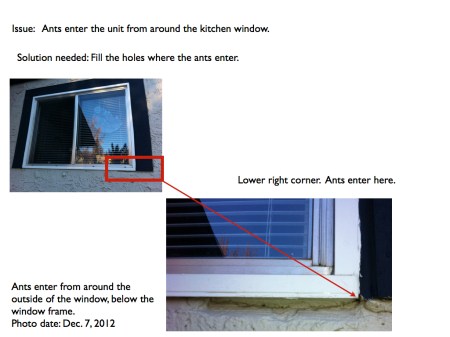
Ant photos.001

Here is the second photo:

Ant photos.002

I sent the photos together with this letter:

Dear John:

I’ve been thinking about this. If you say to a guy, “Go caulk around the window.” He’s going to come over and caulk around the window. The job is done because the job was “to caulk around the window”.

 If you say to the guy, “This place has an ant problem. The kitchen wall is covered with thousands of ants. The exterminator says they are coming in from outside, specifically from around the kitchen window. Go over there and have a look at the outside of the kitchen window. Figure out every possible entry point for the ants to get in around that window. Plug each and every last one of those holes up, so the little buggers can’t get in.”

The job is done when the window is turned into an ant version of Fort Knox. No one — not one little ant — gets in.

That is an entirely different job than, “Go caulk around this window.”

The job we need to have done is the second one — plug up every possible entry point for ants from around that kitchen window.

If you need to give the contractor my number to explain that, then go ahead, but I’m pretty sure you get the idea about what we are after here, which is a solution to the problem of blocking how the ants get into the unit.

Every time you send a guy — or a couple of guys — to our property to do a job, they are not just checking off items from a “to do” list. They are solving problems for the people who live here. In doing that, they are making their life better.

I’m not trying to be melodramatic here, but every time one of your guys comes to our property to fix a problem for a resident, they get a chance to be somebody’s hero. They do that by solving a problem that the owner can not solve by themselves, because they either do not know how or they do not have the skills, expertise, materials, or maybe just the time. That’s one reason people live in condos.

I guarantee you that the single lady who lives in that unit does not have the skills or materials to fix this problem herself — or she would have already.

Your guys have all that — skills, talent, expertise and materials. We rely on you to hire smart guys and you do that. We see it time and time again. They’re smart, they’re capable and they can solve problems. In a small way, they can be somebody’s hero.

So tell your guy that this is his chance to be a hero for Marilyn, the lady who lives there.

Thanks,

Sarah

When it comes to leadership, it is important to give people all the information they need to solve a problem. If you hire smart people, then do not simply give them items to check off their “to do” list. Engage people’s skills, expertise and problem-solving abilities to make them part of the solution. In doing so, you are likely to make their work more meaningful… and both they — and their work — will have a greater impact on those they are helping.

I believe deeply in people’s capacity to solve problems, help others and do meaningful work.

Checking items off a “to do” list does very little to connect the work to the people who may benefit from it. Besides, work that only involves checking items off a “to do” list often lacks meaning, especially when that list is assigned to you by someone else.

Engaging smart people to develop sustainable solutions helps everyone over the long term.

_________________

Share or Tweet this: How checking things off your “to do” list is different than solving problems http://wp.me/pNAh3-1×6

Update – January 2018 – This blog has had over 1.8 million views thanks to readers like you. If you enjoyed this post, please “like” it or share it on social media. Thanks!

Sarah Elaine Eaton is a faculty member in the Werklund School of Education, University of Calgary, Canada.


Webinar recording: Creating Space for Strength

November 30, 2012

Our research team is thrilled to share the recording of our webinar “An Introduction to Creating Space for Strength: An Asset-Based Community Development and Research Project Focused on Calgary’s North Central Communities”.

We had over 40 people sign up for the webinar. The program lasted approximately 45 minutes and included chat dialogue from many community participants.

Thank you to everyone who attended and contributed. As promised, here is the recording. Feel free to share it with others.

5 Great resources on asset-based community development (ABCD) http://wp.me/pNAh3-1xJ
______________

Share or Tweet this: Webinar recording: Creating Space for Strength http://wp.me/pNAh3-1wI

Update – January 2018 – This blog has had over 1.8 million views thanks to readers like you. If you enjoyed this post, please “like” it or share it on social media. Thanks!

Sarah Elaine Eaton is a faculty member in the Werklund School of Education, University of Calgary, Canada.


3 Handy Checklists for APA Style and Formatting

November 27, 2012

As my students are getting ready to hand in their final research papers, they are struggling to learn APA (American Psychological Association) standards for formatting, citations and references. Here are three handy checklists I have shared with them. They find them very helpful:

APA Style Checklist – http://www2.indwes.edu/ocls/apa/apastylechecklist.pdf

Checklist for APA Style (from Elmhurst) – http://library.elmhurst.edu/files/2010/02/ChecklistAPA.pdf

APA Format Checklist (from SLU) – http://www.slu.edu/Documents/student_development/student_success_center/APA_Format_Checklist_Handout.pdf

______________

Share or Tweet this: 3 Handy Checklists for APA Style and Formatting  http://wp.me/pNAh3-1wD

Update – January 2018 – This blog has had over 1.8 million views thanks to readers like you. If you enjoyed this post, please “like” it or share it on social media. Thanks!

Sarah Elaine Eaton is a faculty member in the Werklund School of Education, University of Calgary, Canada.


How to tell if your child is being cyber-bullied

November 19, 2012

In 2012, in British Columbia, Canada, a 15-year old girl named Amanda Todd killed herself. The reason: cyberbullying.

The case has brought to light the devastating effects that cyberbullying can have on a person. Todd’s death has affected Canadians immediately and deeply. Parents are suddenly asking themselves: Is my child being cyber-bullied? How would I know?

Sarah Eaton's education blogStopBullying.gov (a U.S. website) says warning signs that your child may be the victim of face-to-face or any type bullying include:

  • Unexplainable injuries
  • Lost or destroyed clothing, books, electronics, or jewelry.
  • Frequent headaches or stomach aches, feeling sick or faking illness.
  • Changes in eating habits, like suddenly skipping meals or binge eating. Kids may come home from school hungry because they did not eat lunch.
  • Difficulty sleeping or frequent nightmares.
  • Declining grades, loss of interest in schoolwork, or not wanting to go to school.
  • Sudden loss of friends or avoidance of social situations.
  • Feelings of helplessness or decreased self esteem.
  • Self-destructive behaviors such as running away from home, harming themselves, or talking about suicide.

The Cyberbullying Research Centre says that 1o% to 40% of youth may be the victim of cyberbullying. They add to the list of warning signs by zooming in on key indicators that make cyberbullying different from other kinds of bullying:

Signs your child is the victim of cyberbullying

Your child may be the victim of cyberbullying if he or she:

  • unexpectedly stops using their computer or cell phone.
  • appears nervous or jumpy when an instant message or email appears.
  • appears uneasy about going to school or outside in general.
  • appears to be angry, depressed, or frustrated after using the computer or cell phone.
  • avoids discussions about what they are doing on the computer or cell phone.
  • or becomes abnormally withdrawn from usual friends and family members.

The Cyberbullying Research Centre offers numerous free resources for parents, children and teachers to help you stay safe online, including this awesome cyberbullying prevention tip sheet for teens.

Cyberbulling is a real phenomenon that affects tens of thousands of children (and adults) around the world on a daily basis. I am not an expert in this area, but I firmly believe that every person deserves love, respect and safety. Deepest condolences to the family of Amanda Todd.

References

Amercian Humane Association. (n.d.). Cyber Bullying Prevention and Intervention.   Retrieved November 19, 2012, from http://www.americanhumane.org/children/stop-child-abuse/fact-sheets/cyber-bullying-prevention-and-intervention.html

Hinduja, S., & Patchin, J. W. (n.d.). Cyberbulling: Indentification, prevention and response. Retrieved from http://www.cyberbullying.us/Cyberbullying_Identification_Prevention_Response_Fact_Sheet.pdf

StopBullying.gov. (n.d.). Warning signs.   Retrieved 2012, 2012, from http://www.stopbullying.gov/at-risk/warning-signs/index.html#bullying

_______________

This is the first in a series of posts on cyberbulling. Check out these related posts:

5 Signs your child is a cyberbully http://wp.me/pNAh3-1AM

______________

Share or Tweet this: How to tell if your child is being cyber-bullied http://wp.me/pNAh3-1w4

Update – January 2018 – This blog has had over 1.8 million views thanks to readers like you. If you enjoyed this post, please “like” it or share it on social media. Thanks!

Sarah Elaine Eaton is a faculty member in the Werklund School of Education, University of Calgary, Canada.


CILC Pinnacle Award Honorable Mention

November 8, 2012

Sarah Elaine Eaton CILC Pinnacle Award 2011-2012The Center for Interactive Learning and Collaboration (CILC) is a national U.S. service that offers virtual learning programs and professional development programs for educators.

I have been offering professional development programs via webinar for teachers and other professionals for a few years now. My programs include:

Every year, CILC confers awards on those who have top scores in their program evaluations — in other words, based on how participants evaluate our programs.

Each school year, the scores of ALL program evaluations for each professional development provider are averaged based on 7 questions which are:

The presenter:

  • was knowledgeable about the content.
  • was engaging.

The program:

  • was engaging.
  • was applicable to professional growth.
  • aligned to presenter’s stated objectives.
  • contained strategies that will impact student learning.
  • will impact my teaching.

Each question has a numerical value and drives the CILC Pinnacle Award.

This year, I was thrilled to receive an honorable mention for high quality virtual programming and PD webinars. This is the second time I have received an honorable mention in the Pinnacle Awards. The first time was in 2009-2010. Check out the list of all the professional development award recipients. Mine is listed under my company, Eaton International Consulting Inc.

I love working with CILC. They create amazing opportunities for students, teachers, administrators, leaders and others to engage in collaborative or innovative programs with presenters from across the globe.

They also create opportunities for people like me, who love to do offer programs virtually, the chance to connect with new people from across the United States.

Thank you to the clients who took the time to evaluate my programs and give them high marks. I love working with you.

____________________________

Update – January 2018 – This blog has had over 1.8 million views thanks to readers like you. If you enjoyed this post, please “like” it or share it on social media. Thanks!

Sarah Elaine Eaton is a faculty member in the Werklund School of Education, University of Calgary, Canada.