This morning I had the pleasure of providing a continuing education session to the Orthopaedic Surgeons at their City Wide (Grand) Rounds. The session was offered live at the Foothills campus and participants from various hospitals around the city joined by video conference.
![2019 02 15 Ortho CWR Poster[1]](https://drsaraheaton.com/wp-content/uploads/2019/02/2019-02-15-ortho-cwr-poster1.jpg?w=450) Learning Objectives:
Learning Objectives:
- Define and explain what contract cheating is
- Explain how the global contract cheating industry works
- Understand the impact of contract cheating among medical and health program students
Here’s a copy of the title slide:

References:
Bagshaw, E. (2016, May 26). University of Sydney’s medical school in second cheating controversy. Sydney Morning Herald. Retrieved from https://www.smh.com.au/education/university-of-sydneys-medical-school-in-second-cheating-controversy-20160525-gp3g3h.html
Bretag, T. (2017). Tertiary Education Quality and Standards Agency, Good Practice Note: Addressing contract cheating to safeguard academic integrity Retrieved from https://www.teqsa.gov.au/latest-news/publications/good-practice-note-addressing-contract-cheating-safeguard-academic
Clarke, R., & Lancaster, T. (2006). Eliminating the successor to plagiarism: Identifying the usage of contract cheating sites. Paper presented at the Second International Plagiarism Conference, Gateshead, UK.
Curtis, G. J., & Clare, J. (2017). How Prevalent is contract cheating and to what extent are students repeat offenders? Journal of Academic Ethics, 15(2), 115-124. doi:10.1007/s10805-017-9278-x
Eaton, S. E. (2018). Contract cheating: A Canadian perspective. Retrieved from http://blogs.biomedcentral.com/bmcblog/2018/07/24/contract-cheating-a-canadian-perspective/
Eaton, S. E., & Edino, R. I. (2018). Strengthening the research agenda of educational integrity in Canada: A review of the research literature and call to action. Journal of Educational Integrity, 14(1). Retrieved from https://edintegrity.biomedcentral.com/articles/10.1007/s40979-018-0028-7 doi:https://doi.org/10.1007/s40979-018-0028-7
Hosney, M. I., & Fatima, S. (2014). Attitude of students towards cheating and plagiarism: University case study. Journal of Applied Sciences, 14(8), 748-757. doi:10.3923/jas.2014.748.757
International Center for Academic Integrity. (2016). Institutional toolkit to combat contract cheating Retrieved from http://integrity.fiu.edu/pdfs/Contract%20Cheating.pdf
Lancaster, T. (2018). US in first place for essays orders (not surprising), with the UK and Canada in equal second place [Tweet]. Retrieved from https://twitter.com/DrLancaster/status/1029014675198013440
Lancaster, T., & Clarke, R. (2008). The phenomena of contract cheating. In T. S. Roberts (Ed.), Student plagiarism in an online world: Problems and solutions (pp. 144-158). Hershey, PA: Idea Group Inc.
Lancaster, T., & Clarke, R. (2015). Examining contract cheating, essay mill use and academic misconduct by students on health courses. Retrieved from https://www.researchgate.net/publication/323425525_Examining_Contract_Cheating_Essay_Mill_Use_and_Academic_Misconduct_by_Students_on_Health_Courses
Newton, P. M., & Lang, C. (2016). Custom essay writers, freelancers, and other paid third parties. In T. Bretag (Ed.), Handbook of Academic Integrity (pp. 249-271). Singapore: Springer Singapore.
O’BRien, N., & Smith, A. (2015, June 6). Cheating scandal: Sydney university to review medical study unit. Sydney Morning Herald. Retrieved from https://www.smh.com.au/education/cheating-scandal-sydney-university-to-review-medical-study-unit-20150606-ghi5d2.html
Plagiarism.org. (2017). How big of a problem in contract cheating? Retrieved from http://www.plagiarism.org/blog/2017/12/12/how-big-of-a-problem-is-contract-cheating
Quality Assurance Agency for Higher Education (UK) (QAA). (2017). Contracting to cheat in higher education: How to address contract cheating, the use of third-party services and essay mills Retrieved from http://www.qaa.ac.uk/en/Publications/Documents/Contracting-to-cheat-in-higher-education.pdf
Rogerson, A. M. (2017). Detecting contract cheating in essay and report submissions: process, patterns, clues and conversations. International Journal for Educational Integrity, 13(1), 10. doi:10.1007/s40979-017-0021-6
Tonkin, A. L. (2015). “Lifting the carpet” on cheating in medical school exams. BMJ: British Medical Journal, 351(August), 22-29.
Turnitin. (2013). Paying for plagiarism (webinar). Retrieved from http://go.turnitin.com/webcast/paying-for-plagiarism
University of Alberta. (n.d.). Student Conduct and Accountability: Proving Misconduct. Retrieved from https://www.ualberta.ca/provost/dean-of-students/student-conduct-and-accountability/proving-misconduct
Walker, M., & Townley, C. (2012). Contract cheating: A new challenge for academic honesty? Journal of Academic Ethics, 10(1), 27–44. https://doi.org/10.1007/s10805-012-9150-y
If you would like a copy of this talk, please e-mail me at seaton (at) ucalgary (dot) ca
______________________________________________________
Share or Tweet this: The ethics of outsourcing: Contract cheating in the health professions https://wp.me/pNAh3-2mw
This blog has had over 2 million views thanks to readers like you. If you enjoyed this post, please “like” it or share it on social media. Thanks!
Sarah Elaine Eaton is a faculty member in the Werklund School of Education, University of Calgary, Canada.
Opinions are my own and do not represent those of the Werklund School of Education or the University of Calgary.
 My colleague, Roswita Dressler and I have just had a new paper published. It all started when I was at an academic integrity conference a couple of years back. I was sitting next to a colleague who works in a language other than English (LOTE). The colleague suggested that contract cheating (e.g. essay mills and other forms of outsourced academic work) was a problem of the English-speaking world, asserting that there simply wouldn’t be enough of a market in other languages.


 Posted by Sarah Elaine Eaton, Ph.D.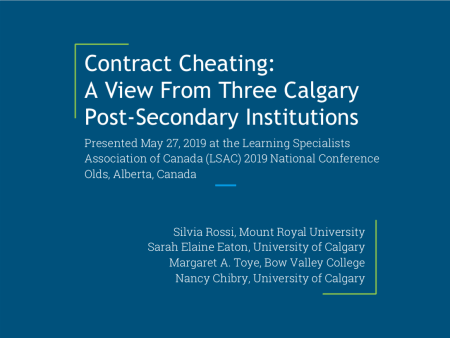
 As many of you know, I’ve been developing a research program on academic integrity over the past few years. Last year I began collaborating with my friend and colleague,
 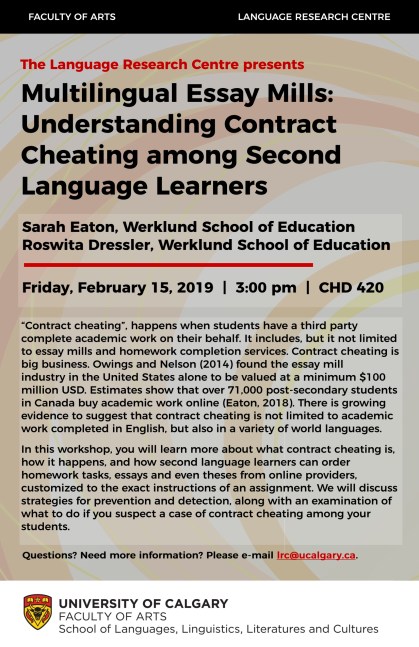 Contract cheating happens when students have a third party complete academic work on their behalf. The term was coined by UK researchers Clarke and Lancaster (2006). It includes, but it not limited to essay mills and homework completion services. Suppliers of this form of “black market” academic work exist mainly online. Students can simply upload a digital copy of their assignment instructions to a website, insert a delivery date and pay for the work by credit card. Contract cheating is big business. Owings and Nelson (2014) found the essay mill industry in the United States alone to be valued at a minimum $100 million USD. Estimates show that over 71,000 post-secondary students in Canada buy academic work online (Eaton, 2018). There is growing evidence to suggest that contract cheating is not limited to academic work completed in English, but also in a variety of world languages.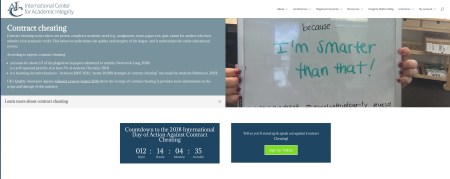

 Learning, Teaching and Leadership
You must be logged in to post a comment.