This year, the Univeristy of Calgary has activities planned for students, faculty, staff, teaching assistants and other members of the university community. We have activities being led by students all over campus including:
- Student’s Union, Mac Hall – Lunch time awareness event and game.
- Taylor Family Digital Library – Interactive prize wheel game.
- Health Research Innovation Centre (HRIC) Atrium – Foothills Campus – Interactive prize wheel game.
- Roaming Whiteboards – Social media campaign – Students Union representatives.
I will document the student-focused initiatives in another post after the Day of Action.
We have also launched the University of Calgary’s own social media campaign called #UHaveIntegrity. Here’s a photo of our shiny new laptop stickers that we’ll be giving out starting tomorrow:

In this post, I highlight two workshops, designed specifically to help academic staff and teaching assistants better understand what contract cheating is and how to address it.
Workshop #1: Contract Cheating: What professors and teaching assistants need to know
Wednesday, October 16, 2019 – 10:30 a.m. – 11:30 a.m.
How do you know if your students are buying their academic work from the Internet? How prevalent is this practice, anyway? How do you talk to your students about the issue of contract cheating? Get answers to these questions and more in this interactive workshop. Find out the latest research about academic outsourcing and get resources to help.
Participants will:
Gain insights into how the contract cheating industry really works
Learn what the latest research says
Learn practical ways to detect contract cheating and how to talk to students about it.
Facilitator: Sarah Elaine Eaton, PhD. is the Educational Leader in Residence, Academic Integrity, at the University of Calgary. Her research focuses on academic integrity, misconduct and contract cheating.
Workshop #2: Pay-to-Pass: Knowledge as a commodity
Wednesday, October 16, 2019 – 12:00 p.m. – 1:00 p.m.
With the aid of social media, companies offering study ‘help’ and better grades have proliferated the post-secondary sector at an alarming rate. Students are deliberately or inadvertently breaching academic integrity regulations in the search of an easier solution to improve academic performance. This interactive workshop examines how some of these companies have created the ease and (sometimes) anonymity of online uploads and downloads.
Participants will:
Learn the scope of the pay-to-pass phenomenon
Share and discuss their experiences with pay-to-pass companies
Brainstorm solutions to this rising crisis.
Facilitators: Ebba Kurz, PhD., Associate Dean, Undergraduate Health and Science Education and Director, O’Brien Centre for the Bachelor of Health Sciences Program, Cumming School of Medicine
Nancy Chibry, Associate Dean, Undergraduate Programs and Student Affairs, Faculty of Science
These workshops are free of charge and open to all members of the campus community.
______________________________________________________
Share or Tweet this: University of Calgary activities planned for 2019 International Day of Action Against Contract Cheating #defeatthecheat #excelwithintegrity #uhaveintegrity
This blog has had over 2 million views thanks to readers like you. If you enjoyed this post, please “like” it or share it on social media. Thanks!
Sarah Elaine Eaton is a faculty member in the Werklund School of Education, and the Educational Leader in Residence, Academic Integrity, University of Calgary, Canada. Opinions are my own and do not represent those of the University of Calgary.


 Posted by Sarah Elaine Eaton, Ph.D.
  My colleague, Roswita Dressler and I have just had a new paper published. It all started when I was at an academic integrity conference a couple of years back. I was sitting next to a colleague who works in a language other than English (LOTE). The colleague suggested that contract cheating (e.g. essay mills and other forms of outsourced academic work) was a problem of the English-speaking world, asserting that there simply wouldn’t be enough of a market in other languages.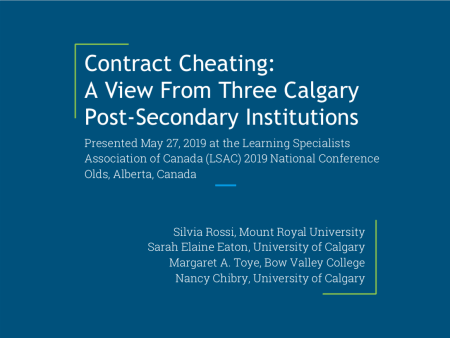
![2019 02 15 Ortho CWR Poster[1]](https://drsaraheaton.com/wp-content/uploads/2019/02/2019-02-15-ortho-cwr-poster1.jpg?w=450) Learning Objectives:
Learning Objectives:
 As many of you know, I’ve been developing a research program on academic integrity over the past few years. Last year I began collaborating with my friend and colleague,
 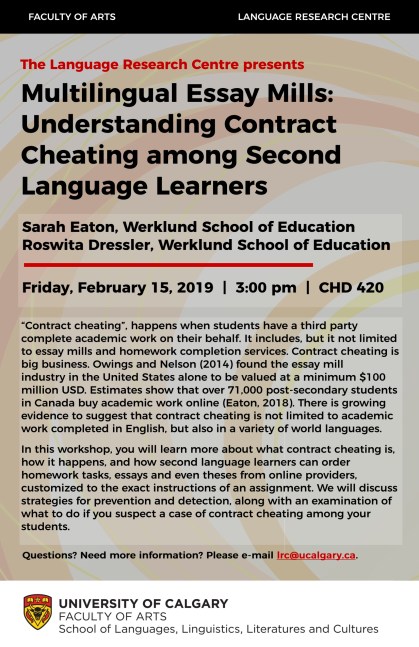 Contract cheating happens when students have a third party complete academic work on their behalf. The term was coined by UK researchers Clarke and Lancaster (2006). It includes, but it not limited to essay mills and homework completion services. Suppliers of this form of “black market” academic work exist mainly online. Students can simply upload a digital copy of their assignment instructions to a website, insert a delivery date and pay for the work by credit card. Contract cheating is big business. Owings and Nelson (2014) found the essay mill industry in the United States alone to be valued at a minimum $100 million USD. Estimates show that over 71,000 post-secondary students in Canada buy academic work online (Eaton, 2018). There is growing evidence to suggest that contract cheating is not limited to academic work completed in English, but also in a variety of world languages.


You must be logged in to post a comment.