A question I am often asked is: Is it considered self-plagiarism to publish an article or some other output from one’s thesis?
I will start with a disclaimer: The contents of this post may not represent the views of my employer, an editor, or a publisher. There is no singular or universally accepted definition of self-plagiarism (or even plagiarism, for that matter). This post is based on my expertise as a scholar of plagiarism and academic misconduct. I have written about self-plagiarism in this peer-reviewed article and I dedicate an entire chapter to the topic my book, Plagiarism in Higher Education: Tackling Tough Topics in Academic Integrity.
In this post, I use the word ‘thesis’ to include any kind of student final summative written work including dissertations or other forms of final projects. A thesis can refer to undergraduate (often honours) work or graduate work, which is also called post-graduate work in some countries. In this post, I am talking specifically about student academic work that is supervised by a professor and receives approval and validation through formal evaluation such as a written appraisal of the work, an examination, and/or an oral defence.
In this post I am talking more about a thesis with a traditional format (e.g., five or six chapters) than about a manuscript-based thesis (also called ‘thesis by publication’ or ‘PhD by publication’). The queries I get about self-plagiarism are almost always about theses that follow a historically dominant structure with chapters, which is the kind of thesis that remains prevalent in the humanities and social sciences.
With these details covered, let’s get to the good stuff. Firstly, it is both expected and encouraged that students will publish from their thesis. After the oral defence or final thesis evaluation, a student’s work can be further refined and developed in order for it to be ready for publication. In many cases, student work may require substantive revisions (or even a complete overhaul) before it is suitable for publication in a journal or a book. It is foolhardy to assume that just because a student thesis has passed that it is automatically suitable for publication elsewhere. In some cases, there is still a lot of work to be done.
Here are the few things to think about after the thesis has been approved by the university authorities:
Archiving the Thesis in a Digital Repository
Our friendly institutional librarians at the University of Calgary have clarified for me on a previous occasion that theses are considered ‘unpublished’. Adding a thesis to a digital repository means it is archived, but not published. Learning that distinction was helpful for me.
Request an embargo on the release of the thesis into the public domain
Students can ask for an embargo on the release of the thesis until the results are published (e.g., journal article, book chapter or any other format). There seems to be a distressing but growing predatory practice around graduate student theses (or the data therein) being misappropriated, repackaged, and published under someone else’s name. I have heard of two such instances recently and, anecdotally, it seems this practice is growing internationally, though I have no data to substantiate this assertion.
This recommendation stems not from protecting oneself from self-plagiarism, but rather from predatory bad actors who have the intention of harvesting your work before you yourself have published it.
An embargo on a thesis should be requested for a reasonable and finite period of time, with the goal of making the research publicly accessible at some point within a couple of years of graduation, unless there is a compelling reason to extend the embargo longer than that.
Advice About How to Avoid Allegations of Self-plagiarism
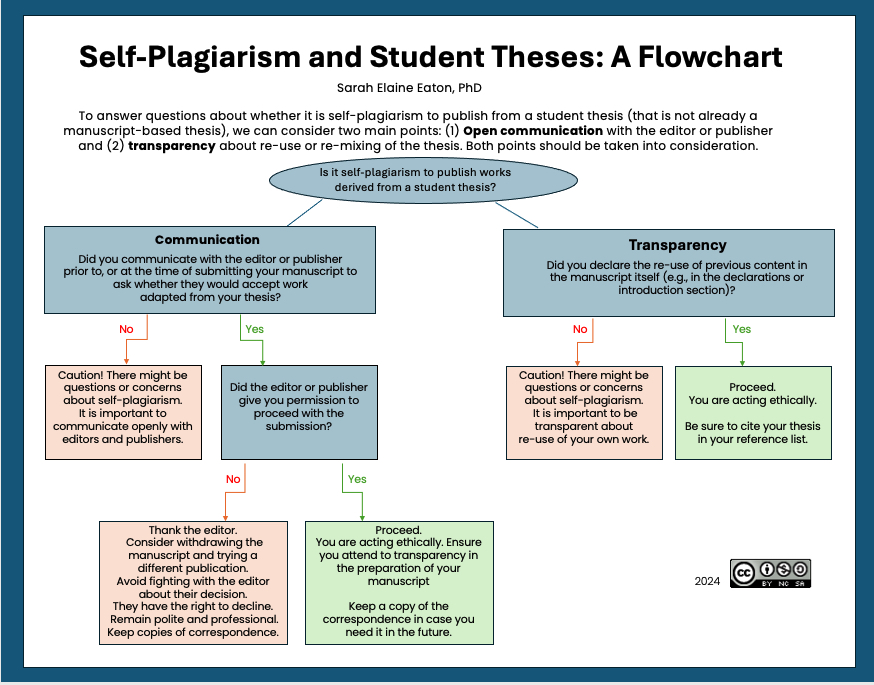
To avoid questions about academic or research misconduct, and specifically self-plagiarism, that can emerge when a student publish works derived from their thesis, there are two points to consider: communication and transparency. Both points should be taken into consideration.
Communication: Correspond with the Editor Prior to Submission
I recommend that students/graduates correspond with the journal editors prior to, or at the time of manuscript submission, in writing, to ensure full transparency. State clearly that the manuscript is drawn from the thesis and parts of it may be replicated exactly (e.g., methods section). Other parts of the manuscript may be derived (and/or significantly revised) from the thesis and if that is the case, offer some details, but avoid going overboard. Ask directly if such a submission would be considered by the journal / publisher. There is no harm is being clear and transparent with journal editors in this regard.
If the journal editor says no, then consider withdrawing the manuscript and trying a different publication. It is important to recognize that editors have the authority to make such judgements, so don’t be rude or try to convince the editor that their decision is wrong. Maintain a polite and professional tone at all times. Thank them for considering your request and move on.
If the editor says yes, then you are ready to proceed. Ensure you are attending to the matter of transparency during the preparation of your manuscript.
If you communicate with an editor orally (e.g., a face-to-face conversation or a video call), follow up in writing to document the conversation. Ask for confirmation that you have understood the agreement correctly.
I recommend keeping a record of your written correspondence in case you ever need it again in the future.
Transparency: Declare the re-use of previous content in the manuscript itself
As you prepare your manuscript for submission, ensure you are being transparent about the re-use of content derived from your thesis. This can be done in a couple of ways:
Explicit transparency statement: Add a declaration to the article/chapter/knowledge output stating that it is derived from your thesis. This way, you are declaring there may be some duplication helps to mitigate concerns about self-plagiarizing. You do not need be excessive with your statement. You can keep it short and simple. Here is some sample text that you are welcome to use, re-use, or adapt (as in, I am openly giving anyone permission to use or adapt this statement):
“This work is derived from my doctoral dissertation. Portions of the text resemble or may replicate the original text from my unpublished PhD thesis and have been reproduced as such with the permission of the editors”.
Note that if you use this statement verbatim, it may (ironically) be picked up by text-matching software used by publishers (i.e., flagged for possible plagiarism). I won’t take responsibility for that, so use some judgement in how you prepare your transparency statement.
Attribution: Self-citation is a contested issue in academic publication and it is prudent to avoid over-citing oneself. There are some circumstances in which self-citation is appropriate and this is one of them. When you are deriving work from your thesis, it is appropriate to cite your thesis in the list of references of your publication.
Be careful and attentive when it comes to attribution in publications derived from your thesis. You still need to cite any original works that your thesis drew from. I once saw a manuscript derived from a student thesis and the only work listed in the references was the student thesis! This is disrespectful to the authors of any original works the student thesis was drawn from, so be sure to give credit where it is due. Ensure you give attribution to the authors whose work informed your thesis and any subsequent publications.
This does not mean that you need to replicate the entire bibliography from your thesis in subsequent publications, unless, of course, you are specifically citing every single source in the publication. Instead, be meticulous and mindful to ensure that the specific sources that inform subsequent publications are cited appropriately. Details matter, and if you are going to publish from your thesis, it is worth it to focus on producing the highest quality publication possible.
Finally, assuming that you have a good relationship with your supervisor, I recommend that you keep them informed. In some cases, co-publication with the supervisor may be appropriate, but not in all cases. Co-publishing with one’s supervisor is a topic for another blog post, so I won’t delve deep into those complexities here. Suffice to say that staying in touch with your supervisor about the publication of your work may be beneficial to you, depending on the circumstances.
The bottom line is that concerns about self-plagiarism might be solved with open communication and transparency.
Bibliography and Further Reading
- Eaton, S. E., & Crossman, K. (2018). Self-plagiarism research literature in the social sciences: A scoping review. Interchange: A Quarterly Review of Education, 49(3), 285-311. https://rdcu.be/YR5u
- Roig, M. (2005). Re-using text from one’s own previously published papers: An exploratory study of potential self-plagiarism. Psychological Reports, 2005(97), 43-49. https://doi.org/10.2466/pr0.97.1.43-49
- Roig, M. (2008). The debate on self-plagiarism: Inquisitional science or high standards of scholarship? Journal of Cognitive & Behavioral Psychotherapies, 8(2), 245-258.
- Roig, M. (2010). Plagiarism and self-plagiarism: What every author should know. Biochemia Medica, 20(3), 295-300. https://www.biochemia-medica.com/en/journal/20/3/10.11613/BM.2010.037
- Roig, M. (2024). On Recycling Our Own Work in the Digital Age. In S. E. Eaton (Ed.), Second Handbook of Academic Integrity (pp. 361-380). Springer Nature Switzerland. https://doi.org/10.1007/978-3-031-54144-5_15
Related posts
How to Get Your Academic Article Published in a High Quality Journal https://drsaraheaton.wordpress.com/2024/01/02/how-to-get-your-academic-article-published-in-a-high-quality-journal/
What is the difference between a thesis, a dissertation and a capstone project? https://drsaraheaton.wordpress.com/2018/02/06/what-is-the-difference-between-a-dissertation-a-thesis-and-a-capstone-project/
What’s the difference between a citation and a reference? https://drsaraheaton.wordpress.com/2013/10/18/whats-the-difference-between-a-citation-and-a-reference/
What’s the difference between a manuscript and an article?https://drsaraheaton.wordpress.com/2017/05/08/whats-the-difference-between-a-manuscript-and-an-article
____________________________
Share this post: Self-Plagiarism: Publishing Works Based on a Thesis or Dissertation – https://drsaraheaton.wordpress.com/2024/01/28/self-plagiarism-publishing-works-based-on-a-thesis-or-dissertation/
This blog has had over 3.7 million views thanks to readers like you. If you enjoyed this post, please “like” it or share it on social media. Thanks!
Sarah Elaine Eaton, PhD, is a faculty member in the Werklund School of Education at the University of Calgary, Canada. Opinions are my own and do not represent those of my employer.
Sarah Elaine Eaton, PhD, Editor-in-Chief, International Journal for Educational Integrity


 Posted by Sarah Elaine Eaton, Ph.D.


You must be logged in to post a comment.