Invitation to Participate: Research Study on Artificial Intelligence and Academic Integrity: 

April 19, 2023

The Ethics of Teaching and Learning with Algorithmic Writing Technologies 

On the right there is a black robotic hand and forearm. On the left there is a human hand and forearm. The forearm is tatooed. One finger from each hand is touching the other.
Photo by cottonbro studio on Pexels.com

Academic misconduct has taken various forms in present-day educational systems. One method that is on the rise is the use of artificially generated software compositions. The capabilities and sophistication of these new technologies are improving steadily. We are conducting a study to gauge the sophistication of the current artificial intelligence (AI) software-generated text. To that end, we are recruiting participants to evaluate the level of writing level of small compositions (260 words in length at most).

Your participation in this study would be to evaluate two small pieces of text presented in a survey and optionally make comments on your observation. We appreciate your consideration in this matter. This research provides an opportunity for the participants to contribute to the state of AI software used for various educational purposes. Participation in this study is voluntary, and you are free to terminate the survey and withdraw at any time and for any reason without censor. There are no known physical, psychological, or social risks associated with participation in the study.

All demographic data collected will be kept strictly confidential. Only the researchers listed in this letter will have access to the raw data. The data (in electronic format) will be retained indefinitely. Participation in the study will be asked for some basic demographic information and then presented with a 260- word length composition. After reading, the participants will be asked to evaluate the level, assign a mark to the composition, and note any pertinent observations. The second piece of composition, also of the same length, will be followed by the same set of questions. The total anticipated time for completing the survey is about 9-12 minutes, but it can vary based on reading speed and consideration afforded to the assigned grade.

If you have any questions or concerns about your participation in this study, you can contact the Principal Investigator, Dr. Sarah Elaine Eaton, seaton (at) ucalgary.ca

This study is funded by a University of Calgary Teaching and Learning Grant. This study has been approved by the Conjoint Faculties Research Ethics Board at the University of Calgary: REB22-0137.

To take the survey, click here.

_________________________________

Share this post: Invitation to Participate: Research Study on Artificial Intelligence and Academic Integrity: The Ethics of Teaching and Learning with Algorithmic Writing Technologies – https://wp.me/pNAh3-2U3

This blog has had over 3 million views thanks to readers like you. If you enjoyed this post, please “like” it or share it on social media. Thanks! Sarah Elaine Eaton, PhD, is a faculty member in the Werklund School of Education, and the Educational Leader in Residence, Academic Integrity, University of Calgary, Canada. Opinions are my own and do not represent those of the University of Calgary.



Book launch: Fake Degrees and Fraudulent Credentials in Higher Education

March 7, 2023

Carleton University Innovation Hub is pleased to host this public event.

Fake Degrees and Fraudulent Credentials in Higher Education

Join editors/authors Sarah Elaine Eaton, Jamie J. Carmichael, and Helen Pethrick in the Innovation Hub on Friday March 24, 2023 for the launch of their new book Fake Degrees and Fraudulent Credentials in Higher Education. This hybrid event will feature reading from the book and continue an important conversation facing many people in the world today.

Event Date: March 24th, 11:00 am – 12:00 (Eastern Standard Time)  

Event Location: Innovation Hub, 2020 Nicol Building, Carleton University or online

Hybrid Option:  A zoom Link will be provided via email to event registrants.

For more information or to register – https://carleton.ca/innovationhub/book-launch/

Related posts

_________________________________

Share or Tweet this: Book launch: Fake Degrees and Fraudulent Credentials in Higher Education https://wp.me/pNAh3-2SD

This blog has had over 3 million views thanks to readers like you. If you enjoyed this post, please “like” it or share it on social media. Thanks!

Sarah Elaine Eaton, PhD, is a faculty member in the Werklund School of Education, and the Educational Leader in Residence, Academic Integrity, University of Calgary, Canada. Opinions are my own and do not represent those of the University of Calgary.


Fake Degrees and Fraudulent Credentials in Higher Education: A Synopsis of the Book

January 28, 2023

Fake Degrees and Fraudulent Credentials in Higher Education was published by Springer Nature in January, 2023. It features over a dozen chapters on various topics related the broad theme of credential fraud.

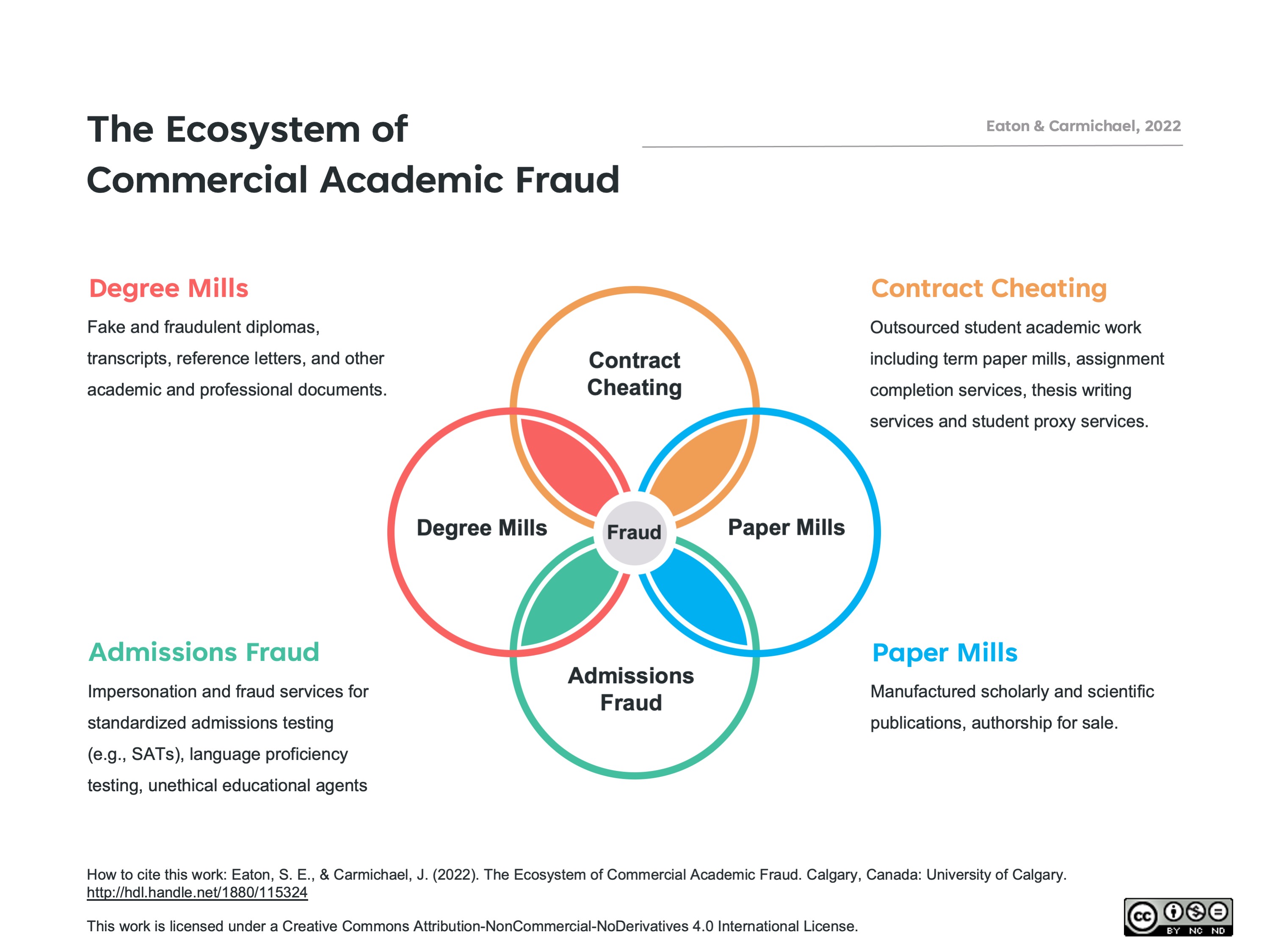
The introductory chapter includes an overview and historical perspectives of key issues. In this opening chapter, the authors connect the dots between the industries that supply fake degrees and fraudulent academic documents (including but not limited to bogus reference letters and tampered transcripts) to the contract cheating industries (e.g., term paper mills, student proxy services, and examination impersonators who take tests on behalf students) and to the admissions fraud industry. In addition, a connection is made to the scholarly paper mill industry which includes various violations of scientific publication ethics including fake data, fabricated scholarly articles and authorship for sale.

We present these connected industries through our Ecosystem of Commercial Academic Fraud model (Eaton & Carmichael, 2022). They synthesize what is known about the size and scope of the industry, estimating its valuation to be at least $21 Billion USD.

In Chapter Two, Jamie Carmichael and I (who are Canadian) argue that Canada is vulnerable to admission and credential fraud. This argument will be substantiated through (i) a survey that spanned coast-to-coast within Canada, (ii) media review that targeted the response to Operation Varsity Blues in Canadian newspapers, and (iii) a comparative analysis with another survey on this topic to gauge how Canada is fairing compared to others across the globe. This data triangulation resulted in an in-depth examination of admissions fraud in Canada, with 14 recommendations for practitioners, researchers, and those involved in policy reform.

In the third chapter, FBI Special Agent (retired), Allen Ezell, takes readers on a tour of “Axact, the world’s largest diploma mill”. Ezell has more than 40 years of experience investigating “fake high schools, colleges, universities, and counterfeiters” (p. 53). He writes that, “Axact is a classic example of a criminal enterprise. Even its own employees refer to it as the tower of frauds and house of lies.” (p. 49). This chapter is the longest in the book by far, spanning 49 pages, complete with concrete details, photos, and insider information not available anywhere else. Ezell explains that diploma mills, “are professional operations that take planning, preparation, and organization to run smoothly. Like legitimate businesses, they have business models, conduct market studies, have financial forecasts, perform cost analyses, set daily/ weekly/monthly sales goals, and offer sales incentives. They constantly survey their competition, and actions by law enforcement and regulators, to determine the direction the wind is blowing.” (p. 53)

Chapter Four, by Joanne Duklas, addresses how “digitization and technology have improved electronic exchange practices in the areas of document and data management and reduced occurrences of fraud thereby encouraging greater trust in the verification and assessment process for admission and transfer” (p. 95). Duklas discusses how background checks regularly show evidence of misrepresentation and fraud. Duklas’s in-depth exploration of  key issues related to electronic exchange processes. She provides details about Canada’s national document exchange network, MyCreds™ | MesCertif™, launched in 2020. She notes that, “Building solid bridges (technical infrastructure, standards, legislation, policies, and procedures) between issuers and receivers of official documents remains important for a trusted, quality assured ecosystem. Various technology solutions are solving credential fraud and creating greater trust in the chain of custody and bone fides of official documents.” (p. 110)

In Chapter 5, Kirsten Hextrum “considers how legal athletic admissions mirror the largest college admission conspiracy in US history: Operation Varsity Blues (OVB)” (p.  115). Hextrum analyzed 1487 college athletes’ demographic data; 47 life- history interviews with college athletes; and admission-related documents. Her results reveal how athletes invest to develop athletic talent, disputing college leaders’ claims that athletic admissions create diverse cohorts. She addresses important issues related to equity, diversity, and inclusion, as her findings show that “athletic investments create homogenous cohorts as White, middle-class youth are overrepresented as college athletes.” (p. 115). In addition, Hextrum discusses, “how colleges authenticate athletes’ credentials” (p. 115), finding that “universities use inconsistent and arbitrary measures—sometimes admitting athletes with little sport experience” (p. 115). Hextrum’s findings indicate that “athletic admissions misalign with the public’s interest because they are fixed to favour White, middle-class athletes and remain vulnerable to fraud” (p. 115).

In the next chapter, Stella-Maris Orim and Irene Glendinning, write about “Corruption in Admissions, Recruitment, Qualifications and Credentials” from the perspective of quality assurance. They draw on research conducted in 2017–2018 for the Council of Higher Education Accreditation’s International Quality Group (CIQG) “into how Accreditation and Quality Assurance Bodies (AQABs) respond to corruption” (p. 133). They address the question: Who is responsible for reducing corruption in education and research? (p. 133). They present findings from their empirical research, leading them to their evidence-informed conclusion that “higher education providers around the world are aware of corruption, fraud and malpractice in student assessment.”, but that “that much less attention has been given by institutions to the types of integrity breaches that we have looked at in this chapter, fraud in admissions and recruitment and in credentials and qualifications” (p. 145).

Chapter 7, by Özgür Çelik and Salim Razı, addresses favouritism and professorial recruitment practices in Turkish higher education institutions. They address the issue of fraud and corruption indirectly, through an analysis of 66 news stories that address favourtism in Turkish universities. They discuss how favouritism erodes public trust, noting that “the negative consequences of favouritism are far-reaching” (p. 154). Their findings showed that nepotism, cronyism, and patronage, were key areas of concern. They found that when specific individuals were identified for academic positions that customized job descriptions can be written so that only that particular individual could be deemed qualified. Although their chapter focuses specifically on Turkey, there are lessons that are transferrable to other countries with regards to corrupt hiring practices in higher education and other sectors.

The next two chapters address fraud in standardized English-language proficiency testing. Soroush Sabbaghan and Ismaeil Fazel’s chapter aims to “shed light on the complexities and the apparent disconnect between equity, integrity, fairness, and justice in standardized language proficiency tests and the integrity issues that can arise as a result” (p. 169). They point out that “at their core, standardized procedures imposed by testing centers ignore the fact that test-takers come from different socio-economic and sociocultural backgrounds with different interests, motivations and experiences of learning and using English” (p. 171). For those interested in exploring issues related to equity, diversity, and inclusion of international students, this chapter is a must read.

Angela Clark continues the discussion of fraud and corruption in English-language proficiency exams in her chapter that explores fraudulent test scores. Clark argues that “relying on a single language proficiency test score to determine an individual’s readiness is problematic, and also problematic is the lack of related academic research and data to help guide admissions decision-making” (p. 187). Clark presents concrete recommendations for “institutional stakeholders with ways to become better informed about these tests and their impact and approaches to help international NNES [non-native English-speaker] students succeed within their new academic disciplines and new academic culture” (p. 187) that include reconsidering admission criteria (p. 199) and instituting a post-entry language assessment (PELA) (p. 199).

In Chapter Ten, Brendan DeCoster uses systems theory to address admissions fraud. DeCoster explores the “culture of admissions fraud” in the United States. He proposes “a five-level framework for analyzing admissions fraud, noting how individuals, small groups and firms, larger firms, institutions, and political entities all play roles in establishing definitions of fraud, investigating fraud, prosecuting fraud, committing fraud, abetting fraud, and countering fraud” (p. 209). The five levels include micro, metaxy, meso, macro, and acro, and he provides examples for each level in his chapter.

Next, Jamie Carmichael leads a chapter on topic modelling, “an unsupervised machine learning technique commonly used in computer science as a research method” (p. 227). In this novel study, “data from 30 websites selling fake degrees were manually scraped, observations noted, and a topic model was built to identify risks within the dataset”, demonstrating that “that topic modeling can identify security risks by providing an environmental scan of the threat.” (p. 227). Twenty evidence-based recommendations are offered for higher education security professionals, senior leaders, and researchers.

In the penultimate chapter, together with Jamie Carmichael, I explore “what can happen when professor and educational leaders have fake or fraudulent degrees or other qualifications. We present four key issues: (a) the threat to institutional reputation; (b) the threat to the credentials awarded by the institutions; (c) the impact on students; and (d) material costs to the organization. Then, we propose seven recommendations to prevent or address academic qualification fraud: (a) verify applicant credentials; (b) develop or update internal risk assessment plans; (c) conduct an internal qualifications audit; (d) develop or update institutional codes of conduct; (e) develop an internal process to investigate allegations of credential fraud; (f) develop and follow internal quality assurance processes for courses, programs, and curricula; and (g) Develop or update crisis communications plans to include credential fakery or fraud. We conclude by emphasizing that moral outrage will not solve the problem of academic credential fraud.” (p. 251).

In our final chapter, we summarize key findings from the book, grouping them into “seven main categories: (a) historical perspectives and terminology; (b) a trend of global indifference; (c) criminal enterprises and security; (d) fraud in standardized language proficiency testing; (e) athletic credentialism; (f) the role of the institution; (g) hiring, and (h) technology. We discuss the significance and limitations of the book, concluding with calls to action for more research and resources to better understand and address the growing problem of the ecosystem of academic fraud that continues to grow” (p. 269).

This book was a passion project that we undertook during COVID-19. We hope it is useful to others who are dedicated to upholding academic integrity and raising awareness about the threats posed to higher education by fake degrees, fraud, corruption, and quackery.

Related posts

Just published! Fake Degrees and Fraudulent Credentials in Higher Education

Fake Degrees and Fraudulent Credentials: Research Project Update

Scholarships Without Scruples: 3 Signs of Bogus Scholarships and Scams

Why Universities and Colleges Need Clear Policies to Deal with Fake COVID-19 Vaccination Records and Test Results

Degrees of Deceit: A Webinar

_________________________________

Share or Tweet this: Fake Degrees and Fraudulent Credentials in Higher Education: A Synopsis of the Book https://drsaraheaton.wordpress.com/2023/01/28/fake-degrees-and-fraudulent-credentials-in-higher-education-a-synopsis-of-the-book/

This blog has had over 3 million views thanks to readers like you. If you enjoyed this post, please “like” it or share it on social media. Thanks!

Sarah Elaine Eaton, PhD, is a faculty member in the Werklund School of Education, and the Educational Leader in Residence, Academic Integrity, University of Calgary, Canada. Opinions are my own and do not represent those of the University of Calgary.


Alberta’s Proposed “Student First Act”: Analysis from an Academic Integrity Perspective

November 15, 2021

Last week the Hon. Adrianna LaGrange, Minister of Education in Alberta, published a commentary in the Edmonton Journal about a proposed new legislation she intended to bring forward called the “Student First Act”.

In this blog post I offer my perspective on this editorial through the lens of someone who studies educational integrity, including misconduct. I have pointed out my qualifications to comment on matters related academic misconduct in a previous blog post, so I won’t repeat them here. Suffice to say that I have some expertise related to academic integrity. Those familiar with my work will know that I advocate for a multi-stakeholder approach to academic integrity in which students, educators, and administrators are all held accountable for their behaviours. Academic integrity is about more than student conduct and examining educator and administrator misconduct remains an understudied area, but an important one.

In my analysis of LaGrange’s commentary (which was effectively an announcement about the new proposed legislation), I will examine both the positive and negative aspects of this announcement.

Lack of Transparency

LaGrange opened by stating that, “Fourteen years ago, as a newly elected school board trustee in Red Deer, I began hearing concerns about the lack of transparency in teacher disciplinary process. Now, as Alberta’s minister of education, I hear these same concerns from students and parents across the province.”

It’s a good thing that Minister LaGrange heard these concerns. There shouldn’t be any surprise with regards to misconduct occurring. Misconduct happens in almost every profession and teaching is no exception. Here LaGrange is signalling that she first became aware that there was a “lack of transparency in teacher disciplinary process”.

“Lack of transparency” is a trigger phrase. It is almost a guarantee that readers and members of the public will become offended when they hear about “lack of transparency”, especially from a government. As I have written about in my book, misconduct among educators is usually addressed by human resources. There are strict laws in Canada, including in Alberta, about what a human resources manager or department is legally permitted to disclose regarding an employee misconduct. I am not a labour relations lawyer, but I am confident saying that this “lack of transparency” is a function of existing labour laws, not a flaw in government policy.

Every large organization in Alberta and in Canada has policies and procedures in place to address employee misconduct. There are thresholds in place so that if a misconduct crosses over from an internal disciplinary matter to a criminal one, that these must be reported to police for investigation.

There is an assumption in the LaGrange editorial that school boards lack processes to investigate employee misconduct or that the existing processes are flawed. I suspect that if she dug a little deeper she would find that the existing policies and procedures conform to the labour laws already in place.

Praise… but…

LaGrange goes on to say, “While the overwhelming majority of teachers in the province are dedicated and caring professionals, we know that cases of inappropriate or even dangerous conduct do happen — and sometimes those cases involve a student.”

It’s good to see that the Minister of Education is acknowledging that “the majority of teachers in the province are dedicated and caring professionals”. This is a truism and there’s nothing really new here. In her book, Cheating: Ethics in Everyday Life, author Deborah Rhode guides us to think about cheating and other misconduct behaviours as a bell curve. At one end you have a small minority of people who rarely or never commit misconduct. At the other end, you have another small percentage of people who do bad stuff repeatedly and often. In the middle, there’s about 80% or so who are basically good most of the time, but can be influenced by circumstances on occasion.

One concerning aspect of LaGrange’s statement is that she seems to be focusing on the moral character of the teachers, rather than their behaviour. As someone who studies misconduct, I can say that in Canada, we treat misconduct cases as bad behaviour, not as a moral failing. This is an important distinction because these are drastically different philosophical positions. Bad behaviour can be corrected, but moral failings? That’s an entirely different matter. I am guessing that political scientists might agree that it would be a fool’s errand for any politician to comment on the moral failings of others…

“An extremely concerning case…”

LaGrange goes on to explain that in 2019 an “extremely concerning case” crossed her desk. Wow, that’s got to be bad, right? I mean… an extremely concerning case. We’d better pay attention here, folks.

Let’s unpack that though… A few paragraphs previously, LaGrange commented that she’s been hearing about misconduct cases for fourteen years. It took 14 years for an “extremely concerning case” to cross her desk? As someone who studies misconduct, I am genuinely surprised by this. For those of us who deal with misconduct on a regular basis as part of our jobs, it probably a matter of weeks or months — not years — before we come face to face with an egregious or complicated case. That’s like saying the Minister of Justice didn’t hear about a horrible criminal case until after a decade of being on the job. Really? How remarkably lucky for the minister that she has been in an educational leadership role and has not encountered an extremely concerning case for 14 years.

Of course, we do not know what the details of the case were and nor should we. What we do need to know is that if the case was so concerning that it crossed over into criminal behaviour, it should have been reported to the police. When the minister described that the teacher was “found guilty of inappropriately touching five young students and only a two-year suspension was recommended”. This makes me wonder if the case was reported to the police? Minister LaGrange does not comment on this in her article, but it really is a question worth asking.

Minister LaGrange that she found the recommended penalty for the teacher, “unacceptable” and that she “overturned the recommendation and handed down a lifetime teaching ban”.

Bravo for taking a stand, but the question remains, why was this case not reported to the police? There is no mention that law enforcement was involved. Surely the minister could have insisted that a case of alleged sexual violence against not one but five students be referred to the police immediately?

A Review of the Discipline Process for Educators

LaGrange goes on to say that this incident triggered “a review of the discipline processes for educators”. Periodic reviews of misconduct policies are a good thing. My colleagues and I have recommended such reviews for universities and colleges, for example. If regular reviews of misconduct policies are not already part of the educational policy governance process, then they should be. A review should not be a one-time effort, but a regular part of policy work.

LaGrange states, “cases are dealt with away from the public’s view”. Well, that’s pretty typical in an employee misconduct case, in part due to labour and privacy laws. It would be very unusual for any employer Canada to investigate and address employee misconduct cases in the public view. Employee misconduct cases are dealt with internally in almost every organization, unless the matter is criminal. If a case is criminal it might be prosecuted in court with case-related information being a matter of public record. I reiterate – why are allegations of sexual violence against students not reported to police?

LaGrange also goes on to say that cases “often take years to be settled after a complaint is made”. The timelines for addressing misconduct cases can — and should — be laid out in policy. This is easily fixed through a policy revision that outlines the number of business days permitted to address a case.

In large educational organizations, it is pretty typical for in-house counsel (i.e., the lawyers) to get involved to ensure that procedures are followed and to offer advice. One of the aspects of policy that lawyers provide guidance on is how much time to allow to ensure that a case can be dealt with fairly and in a timely manner.

The Current Legislation

Minister LaGrange states, “current legislation prohibits the government and myself from informing the public”. That’s because when it comes to employee misconduct there are laws in place to protect people’s privacy. This goes back to misconduct being a matter of bad behaviour not a moral failing. I know of no employer anywhere in Canada – including educational institutions – who engage in the practice of publicly naming and shaming every employee (or student) under review for or found responsible of misconduct.

Status of teaching certificates

LaGrange states, “Alberta’s current legislation is lagging behind. British Columbia, Ontario and Saskatchewan all have public registries where parents can easily check the status of their child’s teacher’s certificate”. Well, that’s also an easy fix. But let’s be clear that a public registry of valid teaching certificates should not be conflated with a registry of individuals who have or have not committed misconduct. Teaching certificates can lapse due to illness or any other reason. Besides, every school board in Alberta will ensure its teachers have a valid teaching certificate. Again, this is the job of the HR department.

Others have already commented on the misinformation in LaGrange’s commentary about the need for teachers to undergo police checks, so I’ll refrain from further analysis on that point. Suffice to say that, this point was poorly presented in the editorial.

LaGrange concludes by saying that she will be introducing the “Students First Act” in the legislature next week. I am curious to know what the proposed legislation will say and I’ll be watching carefully. Some key points to keep in mind are:

  • What are some easy ways to update current policies (e.g., the time allowed to address a misconduct case) without having to enact legislation? In other words, what’s the low hanging fruit here? What are some ways to tighten up existing policies and procedures quickly while still ensuring they are fair and comprehensive?
  • How do we keep the focus on identifying and correcting poor behaviour, as opposed to handing down moral judgement?
  • How do we ensure that addressing employee misconduct is not confused with a witch hunt designed to name and shame individuals?
  • And perhaps most importantly… how do we ensure that egregious instances of teacher misconduct that cross into criminal behaviour are reported to the police so the Minister herself does not have to serve as judge and jury in such cases?

We all agree that we want to “keep our students safe, parents informed and teachers accountable”, as LaGrange says. It’s how we do it that matters.

Related posts:

_________________________________________

Share or Tweet this: Alberta’s Proposed “Student First Act”: Analysis from an Academic Integrity Perspective – https://drsaraheaton.wordpress.com/2021/11/15/albertas-proposed-student-first-act-analysis-from-an-academic-integrity-perspective/

This blog has had over 2 million views thanks to readers like you. If you enjoyed this post, please “like” it or share it on social media. Thanks!

Sarah Elaine Eaton, PhD, is a faculty member in the Werklund School of Education, and the Educational Leader in Residence, Academic Integrity, University of Calgary, Canada. Opinions are my own and do not represent those of the University of Calgary.


New book Series: Ethics and Integrity in Educational Contexts

February 1, 2021

A97796_EIEC_Series_Banner_P2

I am pleased to announce a new book series, Ethics and Integrity in Educational Contexts by Springer.

About this series

The aim of this series is to provide an authoritative series of books on topics relating to ethics and integrity in educational contexts. Its scope includes ethics and integrity, defined in broad and inclusive terms, in educational contexts. It focuses on higher education, but also welcomes contributions that address ethics and integrity in primary and secondary education, non-formal educational contexts, professional education, etc. We welcome books that address traditional academic integrity topics such as plagiarism, exam cheating, and collusion.

In addition, we are particularly interested in topics that extend beyond questions of student conduct, such as

  • Quality assurance in education;
  • Research ethics and integrity;
  • Admissions fraud;
  • Fake and fraudulent credentials;
  • Publication ethics;
  • Educational technology ethics (e.g., surveillance tech, machine learning, and artificial intelligence, as they are used in education);
  • Biomedical ethics in educational contexts;
  • Ethics in varsity and school sports.

This series extends beyond traditional and narrow concepts of academic integrity to broader interpretations of applied ethics in education, including corruption and ethical questions relating to instruction, assessment, and educational leadership. It also seeks to promote social justice, diversity, equity, and inclusion.

The series provides a forum to address emerging, urgent, and even provocative topics related to ethics and integrity at all levels of education, from a variety of disciplinary and geographical perspectives.

Editorial Board

I am delighted to work with an international group scholars and experts as members of the Editorial Board:

Tomáš Foltýnek, Department of Informatics, Faculty of Business and Economics, Mendel University, Brno, Czechia

Irene Glendinning, Coventry University, Coventry, UK

Zeenath Reza Khan, University of Wollongong, Dubai, United Arab Emirates

Rebecca Moore Howard, Syracuse University, New York, USA

Mark Israel, Australasian Human Research Ethics Consultancy Services, Perth, Australia

Ceceilia Parnther, St. Johns’ University, New York, USA

Brenda M. Stoesz, The Center for Advancement of Teaching and Learning, University of Manitoba, Winnipeg, Manitoba, Canada

Forthcoming and New Books

The first book to launch the series will be Academic Integrity in Canada (Eaton & Christensen Hughes, eds., forthcoming). I will share more details about this first book when we are closer to publication, which should be in mid to late 2021.

Proposals for a number of other books to join the series are underway, with authors and editors from a variety of countries.

If you have an idea for a book to be included as part of this series, please contact me.

_____

Share or Tweet this: New book Series: Ethics and Integrity in Educational Contexts https://drsaraheaton.wordpress.com/2021/02/01/new-book-series-ethics-and-integrity-in-educational-contexts/

This blog has had over 2 million views thanks to readers like you. If you enjoyed this post, please “like” it or share it on social media. Thanks!

Sarah Elaine Eaton, PhD, is a faculty member in the Werklund School of Education, and the Educational Leader in Residence, Academic Integrity, University of Calgary, Canada.

Opinions are my own and do not represent those of the University of Calgary or anyone else.