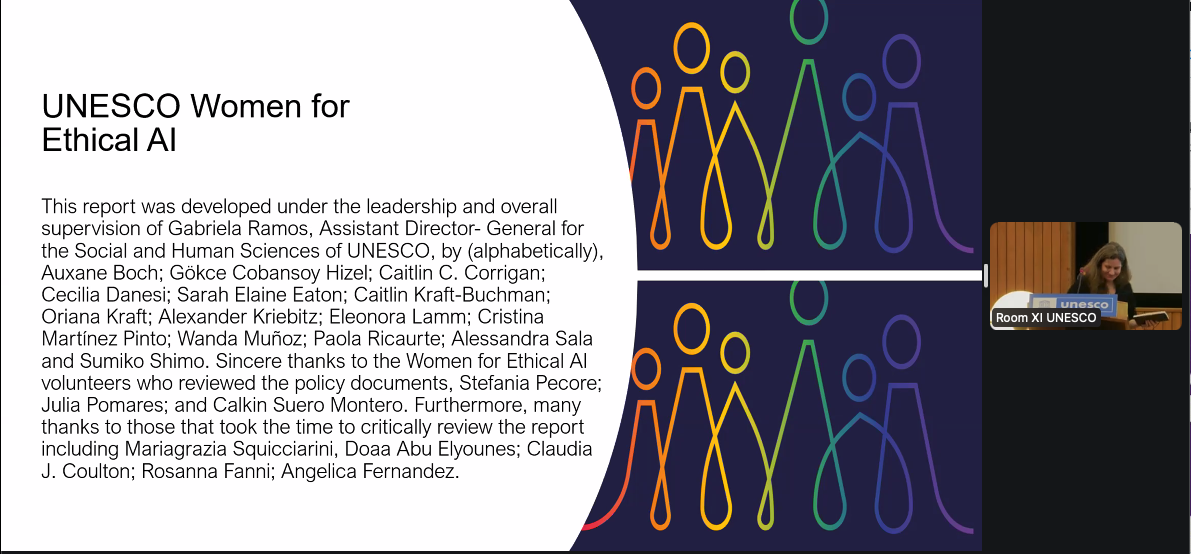
Over the past few months I have had the tremendous opportunity to work with an incredible group of women under the direction of Assistant Director-General (ADG) for Social and Human Sciences of UNESCO. Our collective produced this report that was launched today at a special conference in Paris:
UNESCO Women for Ethical AI: outlook study on artificial intelligence and gender
This blog has had over 3 million views thanks to readers like you. If you enjoyed this post, please “like” it or share it on social media. Thanks!
Sarah Elaine Eaton, PhD, is a Professor and Research Chair in the Werklund School of Education at the University of Calgary, Canada. Opinions are my own and do not represent those of my employer.
Next week is Academic Integrity Week at the Univeristy of Calgary. This year, I have the honour of moderating a fireside chat with one of my very own Werklund School of Education Doctor of Education (EdD) students, Colleen Fleming.
Join us for a thought-provoking discussion during Academic Integrity Week 2024!
Discover the crucial link between academic integrity and inclusion in higher education with our distinguished speaker, Colleen Fleming, EdD student, Werklund School of Education.
Moderated by Dr. Sarah Elaine Eaton, this conversation will explore:
Defining academic integrity in an inclusive context
Challenges in maintaining integrity across diverse student populations
Practical strategies for educators to promote both integrity and inclusion
Don’t miss this opportunity to gain insights from Colleen’s extensive experience as a K-12 practitioner and her cutting-edge doctoral research. Engage in a live Q&A session and contribute to this important conversation.
A bit about Colleen…
Colleen Fleming (she/her/hers) is a K-12 practitioner at a designated special education school in Calgary. She has a keen interest in developing a culture of integrity among learners through the promotion of equity, diversity, and inclusion. As a Doctor of Education student at Werklund, her research involves proactively educating students about academic integrity in preparation for higher education.
Event details
Date: October 16, 2024
Time: 12:00 – 1:00 p.m.
Location: University of Calgary, Taylor Family Digital Library, Gallery Hall
This blog has had over 3 million views thanks to readers like you. If you enjoyed this post, please “like” it or share it on social media. Thanks!
Sarah Elaine Eaton, PhD, is a Professor and Research Chair in the Werklund School of Education at the University of Calgary, Canada. Opinions are my own and do not represent those of my employer.
This weekend I have been playing around with Google’s NotebookLM. This is a brand new, completely free service that can help users learn content in a variety of ways. It is powered by Gemini 1.5 Pro and it’s worth checking out.
Postplagiarism: Navigating Ethics and Integrity in the Age of AI: Study Guide
Screenshot from Google’s NotebookLM, taken 22-SEP-2024
Summary
This article introduces the concept of “postplagiarism,” an era defined by the seamless integration of artificial intelligence (AI) and neurotechnology into everyday life, including education. Eaton explores the implications of this integration for academic integrity, arguing that traditional definitions of plagiarism may become obsolete as AI blurs the lines of authorship.
The author posits six key tenets of postplagiarism:
Hybrid human-AI writing will become the norm: Co-created content will make distinguishing human and AI input increasingly difficult.
Human creativity is enhanced: AI serves as a tool to augment human creativity, not replace it.
Language barriers disappear: AI translation tools have the potential to facilitate cross-cultural communication.
Humans can relinquish control, but not responsibility: While AI can assist in content creation, individuals remain accountable for accuracy and ethical use.
Attribution remains important: Acknowledging sources and intellectual contributions remains crucial, with evolving considerations for Indigenous knowledge systems.
Historical definitions of plagiarism no longer apply: Shifting technological landscapes necessitate new frameworks for ethical engagement with information and knowledge creation.
Eaton challenges Chomsky’s view of AI as “high-tech plagiarism,” arguing instead that it demands a reevaluation of existing definitions of plagiarism within the context of rapidly evolving technological capabilities. She advocates for pre-emptive research into the ethical implications of AI and neurotechnology, particularly commercially available brain-computer interfaces (BCIs), highlighting the need for transdisciplinary collaboration to address these complex issues.
The article concludes with a call to action, urging educators to prepare students for a future characterized by ubiquitous AI and neurotechnology, emphasizing ethical considerations and societal impact.
Quiz
Instructions: Answer the following questions in 2-3 sentences.
What does Eaton mean by “postplagiarism”?
Why does Eaton believe that AI will make traditional definitions of plagiarism obsolete?
What is Eaton’s stance on Chomsky’s characterization of AI as “high-tech plagiarism”?
Explain the concept of “hybrid human-AI writing” and its implications.
According to Eaton, how does the emergence of AI impact human creativity?
Why does Eaton believe that attribution remains important in the age of AI?
What ethical concerns does Eaton raise regarding the use of neurotechnology in education?
Why does Eaton believe that educators were caught off guard by both the COVID-19 pandemic and the emergence of AI like ChatGPT?
What type of research does Eaton advocate for in relation to AI and neurotechnology in education?
What is Eaton’s primary call to action for educators in light of the emerging postplagiarism era?
Quiz Answer Key
“Postplagiarism” refers to an era where advanced technologies like AI and neurotechnology are fully integrated into everyday life, including education. This integration significantly impacts how we teach, learn, communicate, and engage with knowledge.
Eaton argues that traditional definitions of plagiarism, often focused on verbatim copying, become inadequate in the face of AI. This is because AI tools enable the creation of sophisticated, original content, blurring the lines between human and machine authorship and challenging the notion of plagiarism as we know it.
Eaton disagrees with Chomsky’s view, arguing that AI should not be simply dismissed as “high-tech plagiarism.” Instead, she calls for a nuanced understanding of AI’s capabilities and a re-evaluation of existing plagiarism definitions within the context of evolving technology.
“Hybrid human-AI writing” refers to the collaborative process where humans and AI tools work together to create content. This collaboration makes it difficult to discern human input from AI-generated content, challenging traditional authorship and plagiarism detection methods.
Eaton argues that AI enhances, rather than threatens, human creativity. She sees AI tools as resources that can augment human imagination and inspire new forms of creative expression, rather than replacing human ingenuity.
Eaton stresses the continued importance of attribution in acknowledging intellectual debts and recognizing the contributions of others. In the age of AI, this includes responsibly crediting both human and AI sources, acknowledging the collaborative nature of knowledge creation.
Eaton raises ethical concerns related to privacy, consent, and equitable access when it comes to neurotechnology in education. She particularly highlights concerns regarding commercially available brain-computer interfaces (BCIs) and their potential for misuse or exacerbating existing inequalities.
Eaton suggests that educators were caught off guard by both the rapid shift to online learning during the COVID-19 pandemic and the sudden rise of AI tools like ChatGPT. She attributes this to a lack of preparedness for large-scale disruptions and the exponential pace of technological advancement.
Eaton advocates for pre-emptive, transdisciplinary research on the ethical implications of AI and neurotechnology in education. This research would involve collaboration between academics, policymakers, and industry experts to address complex questions surrounding equitable access, privacy, and the impact on learning and teaching practices.
Eaton calls on educators to proactively prepare students for a future deeply integrated with AI and neurotechnology. This preparation involves fostering critical thinking skills, ethical awareness regarding technology use, and adaptability in the face of evolving technological landscapes.
Essay Questions
Analyse Eaton’s argument that traditional definitions of plagiarism are no longer applicable in the age of AI. How does AI challenge existing notions of authorship and originality?
Discuss the ethical implications of commercially available neurotechnology in education. What are the potential benefits and risks associated with using such technologies in learning environments?
How should educational institutions adapt their policies and practices to address the challenges and opportunities presented by postplagiarism?
In what ways can AI be used to enhance, rather than replace, human creativity and critical thinking skills in educational settings? Provide specific examples to support your arguments.
Discuss the potential impact of AI-driven translation tools on language learning and cross-cultural communication in education. How can we ensure equitable access to these tools and address concerns related to language diversity and cultural representation?
Glossary of Key Terms
Postplagiarism: An era characterized by the seamless integration of advanced technologies like AI and neurotechnology into everyday life, impacting how we learn, communicate, and create knowledge.
Artificial Intelligence (AI): The ability of a computer or a robot controlled by a computer to perform tasks that are usually done by humans because they require human intelligence and discernment.
Neurotechnology: Technology that interacts directly with the brain or nervous system, encompassing tools for monitoring, recording, or modulating neural activity.
Brain-Computer Interface (BCI): A device that establishes a direct communication pathway between the brain and an external device, often a computer, enabling the control of the device using brain signals.
Hybrid Human-AI Writing: Collaborative content creation involving both human input and AI-generated text, blurring the lines of authorship.
Large Language Model (LLM): A type of AI trained on a massive dataset of text and code to generate human-quality text, translate languages, write different kinds of creative content, and answer your questions in an informative way.
Decolonization: The process of undoing the harmful effects of colonialism, particularly in educational contexts, challenging Eurocentric perspectives and promoting Indigenous knowledge systems.
Knowledge Caretaker: An individual or community responsible for preserving, transmitting, and respectfully engaging with knowledge, particularly within Indigenous cultures.
This study guide provides a comprehensive overview of the article, aiding in your understanding of the key concepts and arguments presented. Remember to utilize the quiz and essay questions to test your knowledge and delve deeper into the complexities of postplagiarism.
Postplagiarism FAQ
1. What is postplagiarism?
Postplagiarism refers to an era where advanced technologies, such as artificial intelligence (AI) and neurotechnology like brain-computer interfaces (BCIs), are deeply integrated into our daily lives, including education. This integration will significantly impact how we teach, learn, and interact.
2. How will AI impact academic writing?
AI writing tools are becoming increasingly sophisticated, making it difficult to distinguish between human and AI-generated text. This rise of hybrid human-AI writing presents challenges to traditional notions of plagiarism. While AI can enhance creativity by assisting with writing tasks, it also raises concerns about authenticity and the need to uphold ethical writing practices.
3. Will AI make learning languages irrelevant?
While AI translation tools are becoming more powerful, they won’t render language learning obsolete. Although AI can facilitate communication across language barriers, it cannot replace the cultural understanding and nuanced communication that comes with learning a language.
4. Can I use AI to complete my assignments?
Even with AI assistance, students are ultimately responsible for their academic work. Using AI to complete assignments without proper attribution or understanding can be considered a form of academic misconduct. Educators have a responsibility to adapt assessment methods to ensure students demonstrate genuine learning.
5. How does postplagiarism affect attribution practices?
While traditional citation methods remain important, postplagiarism challenges us to rethink how we acknowledge and value knowledge sources, particularly Indigenous knowledge systems often overlooked in standard academic practices. Respectful attribution in the postplagiarism era requires moving beyond technical citations to engage deeply with the works and ideas of others.
6. Are current academic integrity policies equipped to handle AI?
Existing definitions and policies related to plagiarism may need to be reevaluated in the age of postplagiarism. The lines are becoming blurred, demanding a more nuanced understanding of academic integrity that goes beyond simply detecting copied text.
7. What about neurotechnology? How will it impact education?
The emergence of neurotechnology, particularly BCIs, brings both opportunities and challenges. While it has the potential to revolutionize learning and assist individuals with disabilities, it also raises ethical concerns regarding privacy, autonomy, and potential misuse for academic cheating.
8. What can educators do to prepare for the postplagiarism era?
Educators should actively engage in discussions surrounding AI and neurotechnology in education. This includes researching ethical implications, promoting responsible AI use, adapting teaching practices, and fostering critical thinking skills in students to navigate this evolving landscape. Collaboration between educators, policymakers, and researchers is crucial to address these challenges proactively.
Sarah’s Reflections on NotebookLM
Notebook LM is a game-changer for teaching and learning. Students can upload any material to the app and generate content in plain language in both text and audio format.
NotebookLM is a game-changer for teaching and learning. Students can upload any material to the app and generate content in plain language in both text and audio format. There are benefits and drawbacks to any technology and here are some that come to mind for NotebookLM:
Benefits
Personalized Learning: NotebookLM can tailor learning experiences to individual students’ needs, pace, and preferences. It can provide personalized explanations, examples, and practice test questions. I like this aspect of NotebookLM because it allows learners to personalize their own learning experience, rather than having a teacher do it for them.
Enhanced Engagement: By offering interactive and engaging content, NotebookLM can increase student interest and motivation by situating the locus of control for the learning with the student. I like this because the app can help to promote learner autonomy and agency. It can also facilitate collaborative learning through features like group discussions and shared notes.
Accessibility and UDL: The tool can make learning more accessible to students with disabilities, learning difficulties or really, just any learner. It does this by providing the content in a variety of formats such as text-based summaries or the audio pod-cast style conversation.
24/7 Support: NotebookLM can be available to students at any time, providing a resource for independent learning and practice. No matter when a student prefers to do their learning,”just-in-time” tools like this meet learners where they are at, on their timeline, not the teacher’s timeline.
Drawbacks
Lack of Human Interaction: Although NotebookLM can provide valuable support, it cannot fully replace the human connection and guidance that educators offer. The affective aspects of teaching and learning and the social connections, remain important.
Dependency on Technology: Overreliance on NotebookLM could lead to technological issues and disruptions in learning. For example, students who are overly dependent on technology may struggle to adapt to situations where the tool is not available or appropriate. Tools like this may — or may not — help students to develop metacognitve skills and evaluative judgement. (For more info on assessment in the age of generative AI, check out this article by Margaret Bearman and Rosemary Luckin.)
Perpetuation of Inequities: Students from disadvantaged backgrounds may have limited access to technology or to Internet connectivity, creating a digital divide and exacerbating educational inequalities. So, just as tools like this can enhance accessibility, they may simultaneously erode equity in different ways.
Data Privacy Concerns: The collection and use of student data raise privacy concerns and require careful consideration of data protection measures. There are also questions about copyright and what happens when students upload work to which others hold the copyright.
Potential for Misuse: NotebookLM could be misused by students to cheat or generate inaccurate content, requiring educators to implement appropriate safeguards. So, like any other technology, it can be used ethically, or unethically. Students may or may not know what is allowed or expected and so having conversations with students about expectations remains important.
Thank you to my friend and colleague, Dr. Soroush Sabbaghan, Associate Professor (Teaching) at the University of Calgary, for introducing me to NotebookLM a few days ago. I am keen to hear what learners and educators think of this tool.
References
Eaton, S. E. (2023). Postplagiarism: Transdisciplinary ethics and integrity in the age of artificial intelligence and neurotechnology. International Journal for Educational Integrity, 19(1), 1-10. https://doi.org/10.1007/s40979-023-00144-1
This blog has had over 3 million views thanks to readers like you. If you enjoyed this post, please “like” it or share it on social media. Thanks!
Sarah Elaine Eaton, PhD, is a faculty member in the Werklund School of Education, and the Educational Leader in Residence, Academic Integrity, University of Calgary, Canada. Opinions are my own and do not represent those of the University of Calgary.
It’s the start of a new school year here in North America. We are into the second week of classes and already I am hearing from administrators in both K-12 and higher education institutions who are frustrated with educators who have turned to ChatGPT and other publicly-available Gen AI apps to help them assess student learning.
Although customized AI apps designed specifically to assist with the assessment of student learning already exist, many educators do not yet have access to such tools. Instead, I am hearing about educators turning to large language models (LLMs) like ChatGPT to help them provide formative or summative assessment of students’ work. There are some good reasons not to avoid using ChatGPT or other LLMs to assess student learning.
I expect that not everyone will agree with these points, please take them with the spirit in which they are intended, which to provide guidance on ethical ways to teach, learn, and assess students’ work.
8 Tips on Why Educators Should Avoid Using AI Apps to Help with Assessment of Student Learning
Intellectual Property
In Canada at least, a student’s work is their intellectual property. Unless you have permission to use it outside of class, then avoid doing so. The bottom line here is that student’s intellectual work is not yours to share to a large-language model (LLM) or any other third party application, with out their knowledge and consent.
Privacy
A student’s personal data, including their name, ID number and other details should never be uploaded to an external app without consent. One reason for this blog post is to respond to stories I am hearing about educators uploading entire student essays or assignments, including the cover page with all the identifying information, to a third-party GenAI app.
Data security
Content uploaded to an AI tool may be added to its database and used to train the tool. Uploading student assignments to GenAI apps for feedback poses several data security risks. These include potential breaches of data storage systems, privacy violations through sharing sensitive student information, and intellectual property concerns. Inadequate access controls or encryption could allow unauthorized access to student work.
AI model vulnerabilities might enable data extraction, while unintended leakage could occur through the AI app’s responses. If the educator’s account is compromised, it could expose all of the uploaded assignments. The app’s policies may permit third-party data sharing, and long-term data persistence in backups or training sets could extend the risk timeline. Also, there may be legal and regulatory issues around sharing student data, especially for minors, without proper consent.
Bias
AI apps are known to be biased. Feedback generated by an AI app can be biased, unfair, and even racist. To learn more check out this article published in Nature. AI models can perpetuate existing biases present in their training data, which may not represent diverse student populations adequately. Apps might favour certain writing styles (e.g., standard American English), cultural references, or modes of expression, disadvantaging students from different backgrounds.
Furthermore, the AI’s feedback could be inconsistent across similar submissions or fail to account for individual student progress and needs. Additionally, the app may not fully grasp nuanced or creative approaches, leading to standardized feedback that discourages unique thinking.
Lack of context
An AI app does not know your student like you do. Although GenAI tools can offer quick assessments and feedback, they often lack the nuanced understanding of a student’s unique context, learning style, and emotional or physical well-being. Overreliance on AI-generated feedback might lead to generic responses, diminishing the personal connection and meaningful interaction that educators provide, which are vital for effective learning.
Impersonal
AI apps can provide generic feedback, but as an educator, you can personalize feedback to help the student grow. AI apps can provide generic feedback but may not help to scaffold a student’s learning. Personalized feedback is crucial, as it fosters individual student growth, enhances understanding, and encourages engagement with the material. Tailoring feedback to specific strengths and weaknesses helps students recognize their progress and areas needing improvement. In turn, this helps to build their confidence and motivation.
Academic Integrity
Educators model ethical behaviour, this includes transparent and fair assessment. If you are using tech tools to assess student learning, it is important to be transparent about it. In this post, I write more about how and why deceptive and covert assessment tactics are unacceptable.
Your Employee Responsibilities
If your job description includes assessing student work , you may be violating your employment contract if you offload assessment to an AI app.
Concluding Thoughts
Unless your employer has explicitly given you permission to use AI apps for assessing student work then, at least for now, consider providing feedback and assessment in the ways expected by your employer. If we do not want students to use AI apps to take shortcuts, then it is up to us as educators to model the behavior we expect from students.
I understand that educators have excessive and exhausting workloads. I appreciate that we have more items on our To Do Lists than is reasonable. I totally get it that we may look for shortcuts and ways to reduce our workload. The reality is that although Gen AI may have the capability to help with certain tasks, not all employers have endorsed their use in same way.
Not all institutions or schools have artificial intelligence policies or guideline, so when in doubt, ask your supervisor if you are not sure about the expectations. Again, there is a parallel here with student conduct. If we expect students to avoid using AI apps unless we make it explicit that it is OK, then the same goes for educators. Avoid using unauthorized tech tools for assessment without the boss knowing about it.
I am not suggesting that Gen AI apps don’t have the capability to assist with AI, but I am suggesting that many educational institutions have not yet approved the use of such apps for use in the workplace. Trust me, when there are Gen AI apps to help with the heaviest aspects of our workload as educators, I’ll be at the front of the line to use them. In the meantime, there’s a balance to be struck between what AI can do and what one’s employer may permit us to use AI for. It’s important to know the difference — and to protect your livelihood.
This blog has had over 3.6 million views thanks to readers like you. If you enjoyed this post, please “like” it or share it on social media. Thanks!
Sarah Elaine Eaton, PhD, is a faculty member in the Werklund School of Education at the University of Calgary, Canada. Opinions are my own and do not represent those of my employer.
Sarah Elaine Eaton, PhD, Editor-in-Chief, International Journal for Educational Integrity
In this post, I’d like to give a shoutout to Beatriz Moya, who led a rapid review on academic integrity and artificial intelligence.
Title page of “Academic Integrity and artificial intelligence in higher education (HE) contexts: A rapid scoping review”.
Here is the reference:
Moya, B. A., Eaton, S. E., Pethrick, H., Hayden, A. K., Brennan, R., Wiens, J., & McDermott, B. (2024). Academic integrity and artificial intelligence in higher education (HE) contexts: A rapid scoping review. Canadian Perspectives on Academic Integrity, 7(3). https://doi.org/10.55016/ojs/cpai.v7i3
Abstract
Artificial intelligence (AI) developments challenge higher education institutions’ teaching, learning, assessment, and research practices. To contribute evidence-based recommendations for upholding academic integrity, we conducted a rapid scoping review focusing on what is known about academic integrity and AI in higher education before the emergence of ChatGPT. We followed the Updated Reviewer Manual for Scoping Reviews from the Joanna Briggs Institute (JBI) and the Preferred Reporting Items for Systematic reviews Meta-Analysis for Scoping Reviews (PRISMA-ScR) reporting standards. Five databases were searched, and the eligibility criteria included higher education stakeholders of any age and gender engaged with AI in the context of academic integrity from 2007 through November 2022 and available in English. The search retrieved 2,223 records, of which 14 publications with mixed methods, qualitative, quantitative, randomized controlled trials, and text and opinion studies met the inclusion criteria. The results showed bounded and unbounded ethical implications of AI. Perspectives included: AI for cheating; AI as legitimate support; an equity, diversity, and inclusion lens into AI; and emerging recommendations to tackle AI implications in higher education. The evidence from the sources provides guidance that can inform educational stakeholders in decision-making processes for AI integration, in the analysis of misconduct cases involving AI, and in the exploration of AI as legitimate assistance. Likewise, this rapid scoping review signals possibilities for future research, which we explore in our discussion.
Keywords
academic integrity, artificial intelligence, academic misconduct, higher education, rapid scoping review, large language models (LLM)
This blog has had over 3.6 million views thanks to readers like you. If you enjoyed this post, please “like” it or share it on social media. Thanks!
Sarah Elaine Eaton, PhD, is a faculty member in the Werklund School of Education at the University of Calgary, Canada. Opinions are my own and do not represent those of my employer.
Sarah Elaine Eaton, PhD, Editor-in-Chief, International Journal for Educational Integrity




 Posted by Sarah Elaine Eaton, Ph.D.



You must be logged in to post a comment.