How to tell if your child is being cyber-bullied

November 19, 2012

In 2012, in British Columbia, Canada, a 15-year old girl named Amanda Todd killed herself. The reason: cyberbullying.

The case has brought to light the devastating effects that cyberbullying can have on a person. Todd’s death has affected Canadians immediately and deeply. Parents are suddenly asking themselves: Is my child being cyber-bullied? How would I know?

Sarah Eaton's education blogStopBullying.gov (a U.S. website) says warning signs that your child may be the victim of face-to-face or any type bullying include:

  • Unexplainable injuries
  • Lost or destroyed clothing, books, electronics, or jewelry.
  • Frequent headaches or stomach aches, feeling sick or faking illness.
  • Changes in eating habits, like suddenly skipping meals or binge eating. Kids may come home from school hungry because they did not eat lunch.
  • Difficulty sleeping or frequent nightmares.
  • Declining grades, loss of interest in schoolwork, or not wanting to go to school.
  • Sudden loss of friends or avoidance of social situations.
  • Feelings of helplessness or decreased self esteem.
  • Self-destructive behaviors such as running away from home, harming themselves, or talking about suicide.

The Cyberbullying Research Centre says that 1o% to 40% of youth may be the victim of cyberbullying. They add to the list of warning signs by zooming in on key indicators that make cyberbullying different from other kinds of bullying:

Signs your child is the victim of cyberbullying

Your child may be the victim of cyberbullying if he or she:

  • unexpectedly stops using their computer or cell phone.
  • appears nervous or jumpy when an instant message or email appears.
  • appears uneasy about going to school or outside in general.
  • appears to be angry, depressed, or frustrated after using the computer or cell phone.
  • avoids discussions about what they are doing on the computer or cell phone.
  • or becomes abnormally withdrawn from usual friends and family members.

The Cyberbullying Research Centre offers numerous free resources for parents, children and teachers to help you stay safe online, including this awesome cyberbullying prevention tip sheet for teens.

Cyberbulling is a real phenomenon that affects tens of thousands of children (and adults) around the world on a daily basis. I am not an expert in this area, but I firmly believe that every person deserves love, respect and safety. Deepest condolences to the family of Amanda Todd.

References

Amercian Humane Association. (n.d.). Cyber Bullying Prevention and Intervention.   Retrieved November 19, 2012, from http://www.americanhumane.org/children/stop-child-abuse/fact-sheets/cyber-bullying-prevention-and-intervention.html

Hinduja, S., & Patchin, J. W. (n.d.). Cyberbulling: Indentification, prevention and response. Retrieved from http://www.cyberbullying.us/Cyberbullying_Identification_Prevention_Response_Fact_Sheet.pdf

StopBullying.gov. (n.d.). Warning signs.   Retrieved 2012, 2012, from http://www.stopbullying.gov/at-risk/warning-signs/index.html#bullying

_______________

This is the first in a series of posts on cyberbulling. Check out these related posts:

5 Signs your child is a cyberbully http://wp.me/pNAh3-1AM

______________

Share or Tweet this: How to tell if your child is being cyber-bullied http://wp.me/pNAh3-1w4

Update – January 2018 – This blog has had over 1.8 million views thanks to readers like you. If you enjoyed this post, please “like” it or share it on social media. Thanks!

Sarah Elaine Eaton is a faculty member in the Werklund School of Education, University of Calgary, Canada.


What makes a good research question?

November 6, 2012

This week I posed a question to my students: What makes a good research question?

As Masters of Education students, they are learning about what it means to be a researcher and building a foundation of knowledge. They came up with some great resources this week. If you are looking for answers to this question, check out these great resources:

Sarah Eaton blog leadershipSonia Ospina’s entry in the Encyclopedia of Leadership on Qualitative Research

This is a 13-page document, available free in .pdf format. Published in 2004, this text shares some of the fundamentals of qualitative research, particularly as it pertains to leadership. It is also very useful for students and researchers working in education and other social sciences. It contains an extensive bibliography that serves as a great point of departure for more exploration. Link for this resource: http://ualr.edu/interdisciplinary/files/2010/03/Qualitative_Research.pdf

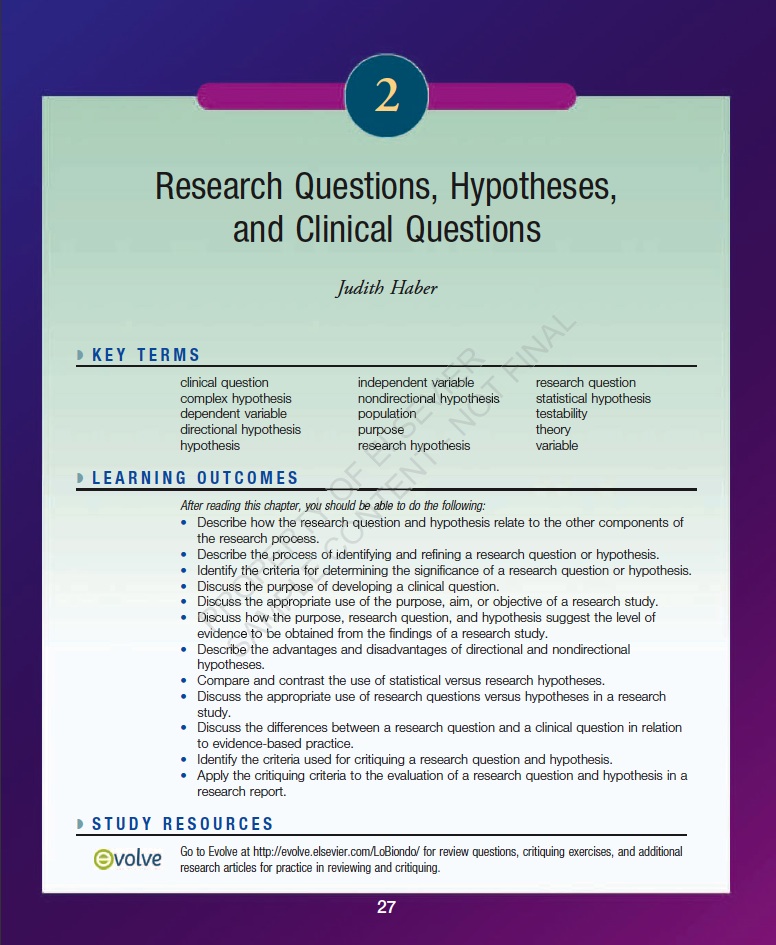
Sarah Eaton blogJudith Haber’s chapter called “Research Questions, Hypotheses and Clinical Questions”

Though marked as “Sample – Not final” with a watermark on the .pdf, this is an incredible 29-page resource that includes flow charts and tables of information. It is easy to understand and written in language that most novice researchers could understand. This one quickly became a favorite because it was colorful and concise. Even though it appears to be written for students and practitioners of health research, there are many elements that may be useful to educators and social science researchers, too. Link for this resource: http://www.us.elsevierhealth.com/media/us/samplechapters/9780323057431/Chapter%2002.pdf

Companion for Undergraduate Research

This is a website (http://www.socscidiss.bham.ac.uk/) that outlines the characteristics of a good research question. Then it talks about each characteristic in detail. It is written in clear language and is very well organized. The page also contains links to other helpful resources on research.

Figuring out how to craft a research question can be tricky. Resources like these help to demystify the process.

______________

Share or Tweet this: What makes a good research question? http://wp.me/pNAh3-1vL

Update – January 2018 – This blog has had over 1.8 million views thanks to readers like you. If you enjoyed this post, please “like” it or share it on social media. Thanks!

Sarah Elaine Eaton is a faculty member in the Werklund School of Education, University of Calgary, Canada.


Is your research biased? Answer: Yes. (Here’s why.)

October 29, 2012

Sarah Eaton blog technology researchThis semester I am teaching a course on Research Methodology in Education. One of the topics that has come up is bias.

Bias is present is bascially every research study. Even though we strive to be objective — and that is part of our work, we nevertheless start with a set of values, beliefs and philosophies that shape our opinions and world view.  It is important for reasearchers to understand the biases they bring to their work and to acknowledge them.

For example, one of my biases is that I hold is that everyone is capable of learning. Not everyone is capable of earning a Ph.D. (for any number of reasons), but everyone is capable of learning something. This is one of my values and beliefs that shapes my work. If I am an honest researcher, I must declare and acknowlege that bias when I do research. It is one thing to have and acknowledge bias. It is an entirely different matter to purposely bias our research in favor of a particular outcome or do research just to prove a point.

There are two ways to approach research:

Approach #1 – Conduct research in a manner that supports your argument

The first is to start with an argument or a position and conduct research and find literature that supports your point of view.

Though some scholars might disagree, I would submit that is an undesirable starting position. The reason is that you are likely to skew either your research or your results so they fit with your argument. Forcing results to fit to a pre-determined argument may be considered unethical. For example, pharmaceutical companies that conduct drug tests in order to prove the drug is safe and refuse to release research that may contradict that starting point are harshly criticized. Such research is not considered believable because it is skewed.

Approach #2 – Start with a research question, hypothesis or topic. Conduct your research in a manner that seeks to answer a question.

The second way to approach you research is to begin with a problem you want to solve or a question you want to answer. Then, you conduct your research in a manner that seeks to answer your research question. Once you have conducted your research, your argument emerges from your data.

The data is the information that you gather that allows you develop a cogent argument to persuade others. You can gather primary data (e.g. interviews) or secondary data (e.g. literature review).

Part of a research study almost always involves a review of previous literature written on the topic you are studying. In your literature review, it is valuable to cite opposing views. Once you have considered your question or problem from a variety of angles, then you can begin to develop an argument, based on your findings. Considering a variety of viewpoints is highly desirable as it demonstrates that you are not attempting to skew your results in favor of a pre-determined outcome.

Be aware that just because you start your research with a particular question or topic, it is unwise to assume that your starting position is the correct one. Be curious, rather than dogmatic. What themes emerge from the literature that you surveyed? What surprised you? What arguments can be made? What conclusions can be drawn?

In my own research, it has happened to me that I start with a research question, problem or hypothesis and as I surveyed the literature, my hypothesis was proven to be incorrect. Be prepared for that to happen. It does not mean you are a bad researcher. Quite the contrary, it means you have allowed your hypothesis or question to be challenged and your research is driven by the data you find.

We may come to our work with a bias. But ultimately, the research needs to speak for itself. That’s what makes it credible.

______________

Share or Tweet this: Is your research biased? Answer: Yes. (Here’s why.) http://wp.me/pNAh3-1vw

Update – January 2018 – This blog has had over 1.8 million views thanks to readers like you. If you enjoyed this post, please “like” it or share it on social media. Thanks!

Sarah Elaine Eaton is a faculty member in the Werklund School of Education, University of Calgary, Canada.


UNESCO’s free advocacy kit for promoting multilingual education

October 24, 2012

UNESCO multilingualism Sarah Elaine Eaton blogUNESCO has a number of initiatives on the go to promote multilingual, bilingual and mother-tongue education. They have come out with a new advocacy kit designed to help raise awareness about the importance of multilingual education. The toolkit is for:

  • education practitioners (teachers)
  • education specialists (learning leaders)
  • policy makers

The kit is a 109-page free, downloadable .pdf. It is very cool. Get yours here.

______________

Share or Tweet this: UNESCO’s free advocacy kit for promoting multilingual education http://wp.me/pNAh3-1vs

Update – January 2018 – This blog has had over 1.8 million views thanks to readers like you. If you enjoyed this post, please “like” it or share it on social media. Thanks!

Sarah Elaine Eaton is a faculty member in the Werklund School of Education, University of Calgary, Canada.


Global Trends in 21st Century Education: Thinking about Technology, Teaching and Learning in the New Millennium – Speaking in Quesnel, BC

October 23, 2012

Last Friday, I was in Quesnel, British Columbia to present at the professional development day for K-12 teachers in School District 28. I was honored to be their keynote speaker, as well as do two workshops afterwards. Here is what I presented:

Keynote address – Global Trends in 21st Century Education: Thinking about Technology, Teaching and Learning in the New Millennium

This talk is based on research I have been doing since 2010 on emerging trends in education across most developed nations and what we might expect over the next 15 to 20 years. I am not a futurist by training, but there are elements of looking down the road and being able to say, “This is where we are today, and it is not impossible that this is where we are heading.”

Workshop #1 – Appreciating Innovation and Incorporating Wisdom Across the Educational Spectrum

This workshop had an educational leadership focus. We looked at how teachers with different approaches to technology can learn to work together for the benefit of students. It was a strength-based approach to working together in the digital age.

Workshop #2 – Learning the Twenty-First Century Way: Making Sense of How to Use Social Media for Classroom Learning and Student Engagement

In this workshop, I shared how I incorporated Twitter into one of my university level classes. Then we had some hands-on time in the lab and teachers got set up with their first Twitter account.

I really enjoyed my time in Quesnel, a small city of 10,000 people where the pulp mill is a major employer and residents are concerned about the land slippage into the Fraser River that is affecting homes and roadways.

I always find that I learn a lot from taxi drivers when I go somewhere to speak and Quesnel was no exception. The cab driver who picked me up at 7:15 a.m. to take me over to the high school told me that his fares so far that morning had included a round-trip drug run and that poverty was a major issue in the community.

Stories like that were countered by the one told to me by Mike Adams, the principal at Correlieu Secondary School, where our PD day was held. He told me that the young man who got the sound system set up for the day had essentially been abandoned by his parents as a teenager. Instead of turning to drugs, he was surrounded by friends, teachers and administrators who wanted to help. As a result, he was on the football team, in the band and part of the school musical. He turned his life around thanks to the strong sense of community and support he found.

Thank you gift from Quesnel, BC - keynote speaker, Sarah Elaine EatonThanks to Lisa Kishkan, who organized the whole PD day for the teachers, including the other workshops that included sessions on intrinsic vs extrinsic motivation; the art of Pysanky (Ukrainian Easter Eggs); and the aboriginal medicine wheel. I really enjoyed my time in Quesnel and as always, I think I learned as much as I shared.

I am excited to try the “birch syrup” that the teachers gave to me as a thank you gift at the end of the day. And I love coffee and I’ll enjoy the new coffee mug that will always remind me of the trip. Thank you to the educators of Quesnel for the great work you do.

______________

Share or Tweet this: Global Trends in 21st Century Education: Thinking about Technology, Teaching and Learning in the New Millennium – Speaking in Quesnel, BC http://wp.me/pNAh3-1vj

Update – January 2018 – This blog has had over 1.8 million views thanks to readers like you. If you enjoyed this post, please “like” it or share it on social media. Thanks!

Sarah Elaine Eaton is a faculty member in the Werklund School of Education, University of Calgary, Canada.