Next week is Academic Integrity Week at the Univeristy of Calgary. This year, I have the honour of moderating a fireside chat with one of my very own Werklund School of Education Doctor of Education (EdD) students, Colleen Fleming.
Join us for a thought-provoking discussion during Academic Integrity Week 2024!
Discover the crucial link between academic integrity and inclusion in higher education with our distinguished speaker, Colleen Fleming, EdD student, Werklund School of Education.
Moderated by Dr. Sarah Elaine Eaton, this conversation will explore:
Defining academic integrity in an inclusive context
Challenges in maintaining integrity across diverse student populations
Practical strategies for educators to promote both integrity and inclusion
Don’t miss this opportunity to gain insights from Colleen’s extensive experience as a K-12 practitioner and her cutting-edge doctoral research. Engage in a live Q&A session and contribute to this important conversation.
A bit about Colleen…
Colleen Fleming (she/her/hers) is a K-12 practitioner at a designated special education school in Calgary. She has a keen interest in developing a culture of integrity among learners through the promotion of equity, diversity, and inclusion. As a Doctor of Education student at Werklund, her research involves proactively educating students about academic integrity in preparation for higher education.
Event details
Date: October 16, 2024
Time: 12:00 – 1:00 p.m.
Location: University of Calgary, Taylor Family Digital Library, Gallery Hall
This blog has had over 3 million views thanks to readers like you. If you enjoyed this post, please “like” it or share it on social media. Thanks!
Sarah Elaine Eaton, PhD, is a Professor and Research Chair in the Werklund School of Education at the University of Calgary, Canada. Opinions are my own and do not represent those of my employer.
Although my role at the University of Calgary’s Office of Equity, Diversity, and Inclusion (OEDI) wrapped up some months ago, there’s an experience that I have been reflecting on that I wanted to share.
While I was working at the OEDI I ran into a colleague at an event. I’d known this person for many years and as we were chatting, they asked, “How does it feel to be a white woman working in an office of equity, diversity, and inclusion? I mean, don’t you feel like you’re taking up space for someone who is more deserving?”
The question was asked with genuine curiosity, and without any judgement or blame that I could ascertain. This person had been engaged in equity work themselves and was genuinely puzzled and curious about why I had taken up a director role in the office.
The question has lingered in my mind and heart for a long time and quite frankly, it’s taken me ages to process, which is why I am just getting around to writing about it now. It is a complex and values-laded question that I have grappled with for what seems like an eon. Although I understand the sentiment behind it, the question itself it oversimplifies the nature of equity, diversity, inclusion, and accessibility (EDIA) work and makes some problematic assumptions.
First, it’s important to recognize that equity work isn’t solely the responsibility of people from marginalized groups. Creating truly inclusive environments requires engagement and effort from people of all backgrounds. I bring my own lived experiences that include both discrimination and privilege. As a woman, I have lived experience of gender-based discrimination. As a white person, I recognize my racial privilege. Being human means that we are infinitely complex and reducing a person down to either a victim of discrimination or a purveyor of privilege is not only reductionist, it can be harmful. In my case, I engage in ongoing reflection that allows me to relate to some challenges faced by marginalized groups, while maintaining awareness of my own privilege.
I am acutely aware of the immense privilege I hold. I continually educate myself, amplify diverse voices, and strive to use my privilege to advocate for systemic changes. I see my role not as speaking for underrepresented groups, but as working to dismantle oppressive structures that perpetuate harm. This includes challenging others to examine their biases and pushing for institutional reforms, and doing so in a way that does not antagonize them, which is quite an art.
The notion that I might be ‘taking up space’ assumes there’s a fixed number of EDIA positions that should be reserved for people of colour. Representation absolutely matters, and EDI work requires a variety of skills, experiences, and perspectives. What matters most, in my humble opinion (and sure to be challenged by some who reads this post, I’m sure…) is a deep commitment to justice, a willingness to continually learn and grow, and the ability to effect change within organizations. These qualities aren’t exclusive to any one demographic.
Moreover, the idea that someone else might be inherently ‘more deserving’ based solely on their identity is problematic. It reduces people to singular aspects of their identity and ignores the complexity of lived experiences. I am about to make another contentious claim here, but here goes… A person of colour is not automatically an expert in all facets of EDIA work simply by virtue of their race, just as being white doesn’t preclude someone from developing expertise in this field.
It is critical — essential — to remember that many forms of marginalization are invisible. Disabilities, neurodivergence, chronic illnesses, socioeconomic background, and LGBTQ2S+* identities are just a few examples of characteristics that may not be immediately apparent. This underscores the importance of resisting the temptation to judge someone’s qualifications or experiences based solely on what we can see or what we think we know about them.
By making assumptions about who ‘deserves’ to be in EDI spaces based on visible characteristics, we risk excluding valuable perspectives, lived experience, and qualifications, while simultaneously reinforcing harmful stereotypes.
Inclusivity means creating environments where all individuals feel empowered to bring their full selves to the work, including aspects of their identity that may not be visible to others.
A key component of my EDI work is the practice of ‘radical acceptance’. This concept goes beyond mere tolerance or surface-level inclusion. Radical acceptance means embracing the full humanity of every individual, including all their complexities, contradictions, and lived experiences. It requires us to set aside our preconceptions and biases, and to approach each person with genuine openness and empathy. In the context of EDIA work, radical acceptance means creating spaces where people feel truly seen, heard, and valued for who they are, not just for how they fit into predefined categories or expectations. Being angry is easy; practising radical acceptance is exhausting, but ultimately more useful than anger.
Being an equity advocate means acknowledging that every person’s journey is unique and valid, even if it doesn’t align with our own experiences or understanding.
Even though I am no longer serving in a formal role related to EDI, I continue to focus on equity, diversity, inclusion, accessibility, and social justice in my work. This includes focusing on dignity, acceptance, and belonging. I strive to approach every interaction with openness and humility, recognizing that each person I encounter may have experiences and insights that I can learn from, regardless of their outward appearance. It also means making a conscious effort to resist the temptation that I might think that I know everything about a person.
There is wisdom to the old adage that “there is more to a person than meets the eye.” What I can say is that every human being is worthy of dignity. This mindset is crucial for creating genuinely inclusive spaces and avoiding the pitfalls of tokenism or superficial diversity.
People whose advocacy focuses on EDIA roles have a special responsibility to practice rigorous self-reflection, actively seek out diverse perspectives, and ensure we keep our privilege and biases in check. We must be humble enough to know when to step back and elevate other voices. I have watched people who believe their position is superior or their experience is more valid lash out at others who are just as deserving of understanding, kindness, and respect. This kind of lateral violence is both jarring and heartbreaking to watch… and even worse when a person has been “cancelled” by a group of loud, virtue-signalling individuals. In some cases, the accusers fail to recognize that in their efforts to be activists and uphold what they believe to be right and true, they may have forgotten that a foundation of equity work is human dignity for all, not just for some.
Those who proclaim to value social justice have a responsibility to be extra cautious before “cancelling” someone.
Practicing radical acceptance has profound implications for how we approach diversity and inclusion. Instead of focusing solely on visible markers of diversity or trying to fill quotas, we work to create environments where every individual feels empowered to bring their whole self to the table. This includes embracing diverse thought processes, communication styles, and ways of problem-solving that might challenge our own assumptions about what ‘professional’ or ‘effective’ looks like.
I work hard to embody this principle of radical acceptance in my interactions. But this is not a linear practice or something that one learns and then does correctly every day. Some days I screw up. Practicing radical acceptance is a constant process of self-reflection, learning, and growth. It means being willing to have my own assumptions challenged and to continually expand my understanding of what diversity and inclusion truly mean. It also means extending grace and forgiveness in moments of conflict with others whose views and lived experiences may lead them to say things or act in ways that I do not understand. What I know for sure is that I will never know the entirety of another person… and they will never know my entirety.
Living and working with others, with an appreciation of who they are, as they are, is part of the daily practice of radical acceptance.
Equity work — as well as integrity work — isn’t about virtue signaling or moral grandstanding. It’s about dismantling oppressive systems and creating genuine, lasting change. That requires participation and commitment from people of all backgrounds, working in solidarity toward a more just and equitable world. I’m driven by a genuine passion for creating more equitable and inclusive environments. I often say that the word ‘integrity’ comes from a Latin word meaning ‘to make whole’. I have said it before and I will say it again (and again… and again…): There can be no integrity without equity.
This blog has had over 3 million views thanks to readers like you. If you enjoyed this post, please “like” it or share it on social media. Thanks!
Sarah Elaine Eaton, PhD, is a Professor and Research Chair in the Werklund School of Education at the University of Calgary, Canada. Opinions are my own and do not represent those of my employer.
On July 1, 2023 I started a new role at the University of Calgary as the Academic Director, Equity, Diversity, and Inclusion (EDI), Education, and Academic Integrity. I have the privilege of working with Dr. Malinda Smith, Vice-Provost, EDI, and an entire team of academic and professional staff whose primary focus is on equity, diversity, inclusion, and accessibility.
In this role, I will:
Continue to build awareness of equity, diversity, inclusion, and accessibility as they relate to academic ethics across the university.
Advise and contribute to the development of resources and supports on academic ethics needed for leaders, academic staff, managers, support staff, students and other university stakeholders.
Develop local, regional, and national partnerships that connect initiatives related to academic ethics as they pertain to equity, diversity, inclusion, and accessibility.
Facilitate campus conversations related to academic ethics through existing networks, committees, and other informal and formal groups.
Develop action-oriented recommendations related to academic ethics from the perspective of equity, diversity, inclusion, and accessibility.
Focus on equity-deserving groups that include, but are not limited to, international students, visiting students, post-doctoral fellows, and early career researchers.
For a few years now, my research and advocacy work as included a more intense focus on social justice, advocacy, and equity. Here is some work I’ve done in the past few years that led to this role that might be helpful if you’re looking for resources on this topic:
Adams, J. D., Turner, K. L., & Eaton, S. E. (2021, March 24). Diversity and equity considerations in academic integrity Association of American Colleges & Universities (AAC&U) 2021 Diversity, Equity, and Student Success Conference, http://hdl.handle.net/1880/113175
Eaton, S. E. (2022). New priorities for academic integrity: equity, diversity, inclusion, decolonization and Indigenization. International Journal for Educational Integrity. https://doi.org/10.1007/s40979-022-00105-0
Eaton, S. E., Stoesz, B. M., Godfrey Anderson, J. R., & LeBlanc-Haley, J. (2022, April 25). Academic integrity through an equity lens: Policy analysis of universities in Atlantic Canada American Educational Research Association (AERA) [online], San Diego, USA. http://hdl.handle.net/1880/114574
Eaton, S. E., Vogt, L., Seeland, J., & Stoesz, B. M. (2023, June 1-2). Academic integrity policy analysis of Alberta and Manitoba colleges Canadian Symposium on Academic Integrity (CSAI), University of Manitoba, Winnipeg, MB, Canada. https://hdl.handle.net/1880/116575
Pagaling, R., Eaton, S. E., & McDermott, B. (2022, April 4). Academic Integrity: Considerations for Accessibility, Equity, and Inclusion. http://hdl.handle.net/1880/114519
Parnther, C., & Eaton, S. E. (2021). Equity, Diversity, Inclusion, and Academic Integrity: Supporting Student Advocacy. http://hdl.handle.net/1880/113143
Parnther, C., & Eaton, S. E. (2021, June 23). Academic integrity and anti-Black aspects of educational surveillance and e-proctoring. Teachers College Record. https://www.tcrecord.org/Content.asp?ContentID=23752
The forthcoming Handbook of Academic Integrity (2nd ed.) has a brand new section on Equity, Diversity, and Inclusion in Academic Integrity. Dr. Ceceilia Parnther serves as the Section Editor. Bringing this topic to light in the handbook will help to centre important conversations about discrimination and advocacy for student success and the student experience.
I am excited to take on this work and look forward to the ways in which we can make progress on these important matters.
This blog has had over 3 million views thanks to readers like you. If you enjoyed this post, please “like” it or share it on social media. Thanks! Sarah Elaine Eaton, PhD, is a faculty member in the Werklund School of Education, and the Educational Leader in Residence, Academic Integrity, University of Calgary, Canada. Opinions are my own and do not represent those of the University of Calgary.
As I write this, the Handbook of Academic Integrity (2nd ed.) is well underway. All the chapters have been submitted and are at various stages of review, revision, and production. Page proofs should start going out to contributing authors this month. This has been a massive project: 150+ authors, 109 chapters, 9 section editors, and me herding all the cool cats who have made it happen.
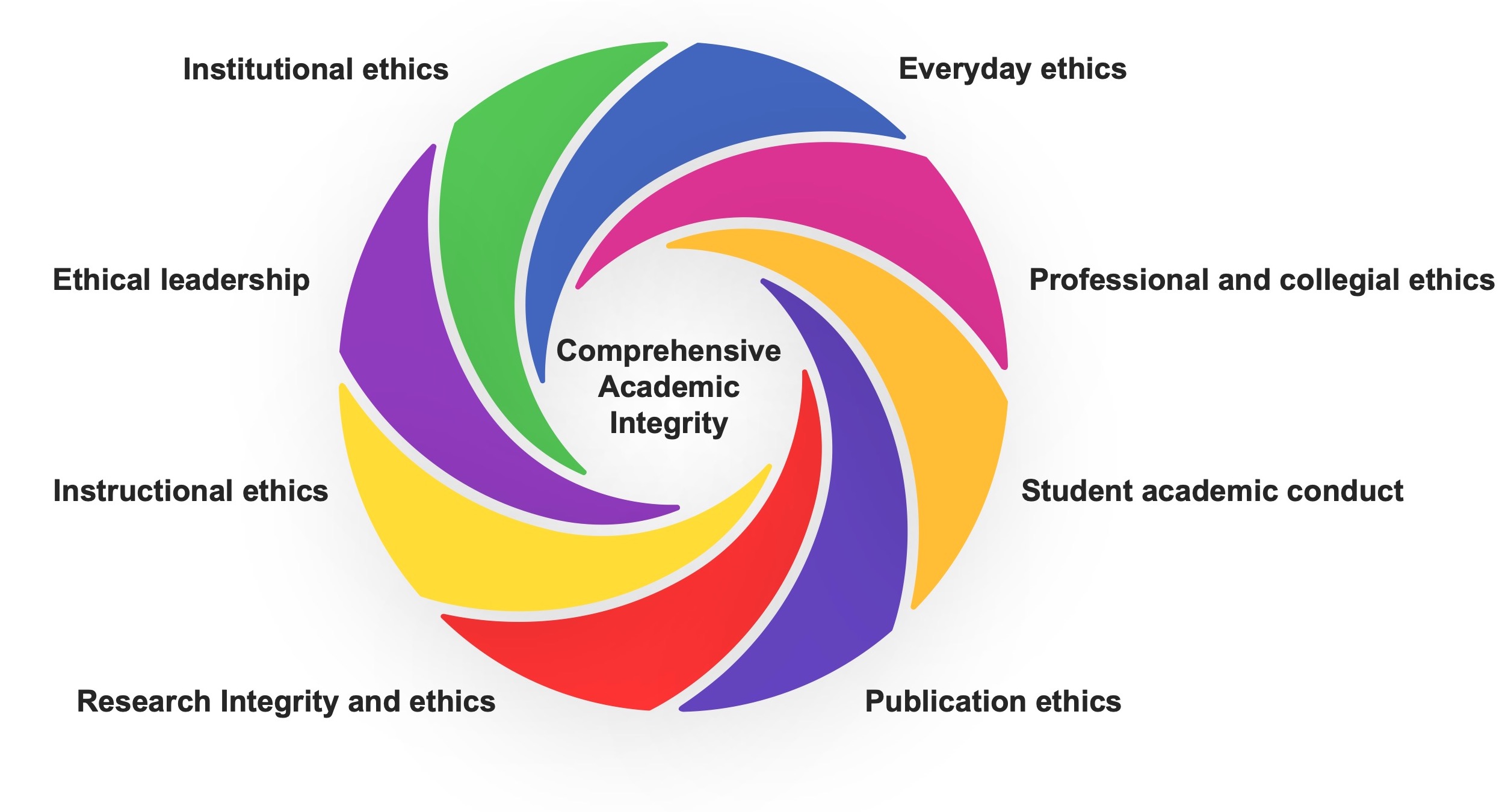
After all the chapters had been submitted, I realized that we had something new and fresh with this edition. We have pushed the boundaries beyond persistently historical ideas about academic integrity only as a matter of student conduct. So, I wrote an introduction for the handbook that synthesizes some its through lines. The common threads of this updated edition are summed up in this Comprehensive Academic Integrity (CAI) framework.
I wrote this intro in two epic writing sessions, fuelled by gallons of coffee, Vegemite on toast, and a pizza that a friend had delivered to my house because he felt sorry for me eating Vegemite on toasted bread crusts. (I am not kidding.) Anyway, first, I drafted the chapter in full. Then I asked a couple of other section editors and contributors to the handbook to provide me with an open peer review of the draft. In the chapter I acknowledge them by name and I re-iterate my gratitude to them here. Thanks are due to Guy Curtis, Brenda M. Stoesz, Rahul Kumar, Beatriz Moya, and Bibek Dahal for their feedback that helped me to improve the chapter. In the second writing session, I incorporated just about all of their suggestions and completely re-vamped the visual image to the one you see below. The CAI Framework is a high-level synthesis of all the chapters in the handbook and as such, every single author who has contributed to the handbook (as well as those they have cited in their respective chapters) all deserve credit.
According to the publisher’s rules around self-archiving and pre-prints, I am not allowed to share the entire chapter with you ahead of publication. But I can share a summary of it, so I’m doing that here. I’ve also self-archived a copy of this overview (minus the background commentary about Vegemite and pizza) in our university’s digital repository. On the off-chance you want to cite the “official” version of the summary, I have included instructions below. You’ll have to wait for the Handbook to be published to read the full chapter, but in the meantime, I hope this overview is useful.
For years scholars and other experts have called for a more holistic approach to academic integrity (e.g., Bertram Gallant, 2008; Boud & Bearman, 2022; Bretag et al, 2014; Carrol & Duggan, 2005; Löfström et al., 2015; Morris & Carrol, 2016; Turner & Beemsterboer, 2003). The CAI framework synthesizes ideas that have been repeated for decades in various iterations.
The central argument behind a wholistic framework is that academic integrity must encompass, but extend beyond, notions of student conduct, and should be considered a foundation of all aspects of education. In this framework, I do not propose a new definition of academic integrity in part, because several useful definitions already exist (see Bretag, 2016; ICAI, 2021; Tauginienė et al., 2018). Instead, this framework can be used with existing definitions.
The Comprehensive Academic Integrity (CAI) framework includes eight (8) essential elements that includes, and extends beyond traditional notions of academic integrity merely as a student responsibility:
Appreciation to Kieran Forde at the University of British Columbia for his most awesome interpretation of the graphic as a “colourful swirly donut”. Who doesn’t love donuts?! Thanks, Kieran!
References
Bertram Gallant, T. (2008). Academic integrity in the twenty-first century: A teaching and learning imperative. Wiley.
Boud, D., & Bearman, M. (2022). The assessment challenge of social and collaborative learning in higher education. Educational philosophy and theory, 1-10. https://doi.org/10.1080/00131857.2022.2114346
Bretag, T. (2016). Educational integrity in Australia. In T. A. Bretag (Ed.), Handbook of Academic Integrity (pp. 1-13). Springer Singapore.https://doi.org/10.1007/978-981-287-079-7_2-1
Bretag, T., Mahmud, S., Wallace, M., Walker, R., McGowan, U., East, J., Green, M., Partridge, L., & James, C. (2014). ‘Teach us how to do it properly!’ An Australian academic integrity student survey. Studies in higher education, 39(7), 1150-1169. https://doi.org/10.1080/03075079.2013.777406
Carroll, J., & Duggan, F. (2005, December 2-5). Institutional change to deter student plagiarism: What seems essential to a holistic approach? 2nd Asia-Pacific Educational Integrity Conference, University of Newcastle, Callaghan, Australia.
Eaton, S. E. (forthcoming). Comprehensive academic integrity (CAI): An ethical framework for educational contexts. In S. E. Eaton (Ed.), Handbook of Academic Integrity (2nd ed.). Springer.
Löfström, E., Trotman, T., Furnari, M., & Shephard, K. (2015). Who teaches academic integrity and how do they teach it? Higher Education, 69(3), 435-448. https://doi.org/10.1007/s10734-014-9784-3
Morris, E. J., & Carroll, J. (2016). Developing a sustainable holistic institutional approach: Dealing with realities “on the ground” when implementing an academic integrity policy. In T. Bretag (Ed.), Handbook of Academic Integrity (pp. 449-462). Springer Singapore. https://doi.org/10.1007/978-981-287-098-8_23
This blog has had over 3 million views thanks to readers like you. If you enjoyed this post, please “like” it or share it on social media. Thanks!
Sarah Elaine Eaton, PhD, is a faculty member in the Werklund School of Education, and the Educational Leader in Residence, Academic Integrity, University of Calgary, Canada. Opinions are my own and do not represent those of the University of Calgary.
I was delighted to take part in three sessions for the International Center for Academic Integrity (ICAI) conference, which was held online this week. With over 1200 registrants, this was the largest ICAI conference ever.
In terms of my own contributions to the conference, this year I focused on collaborative work with others. For me, this means that the work is conceptualized and developed jointly, every step of the way. The end result is stronger, more interesting, and more dynamic than if it had been created by any one individual alone. In an article I co-authored with Rachael Edino a few years ago, we showed that academic integrity research in Canada has mostly been small scale and has lacked collaboration across institutions and across countries. Ever since, I have been on a mission to actively engage in and promote research collaborations that not only include researchers from multiple institutions, but extend to international partnerships, too. I am super excited to say that goal was certainly achieved through collaborative presentations at this year’s ICAI conference, as I had the opportunity to showcase work with 6 colleagues and 1 PhD student, spread out across 7 countries. Here’s a recap:
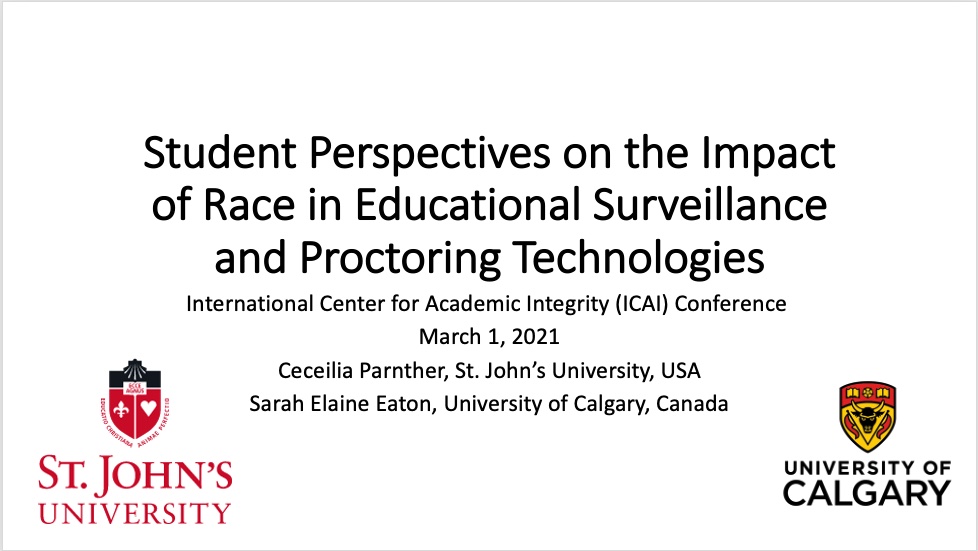
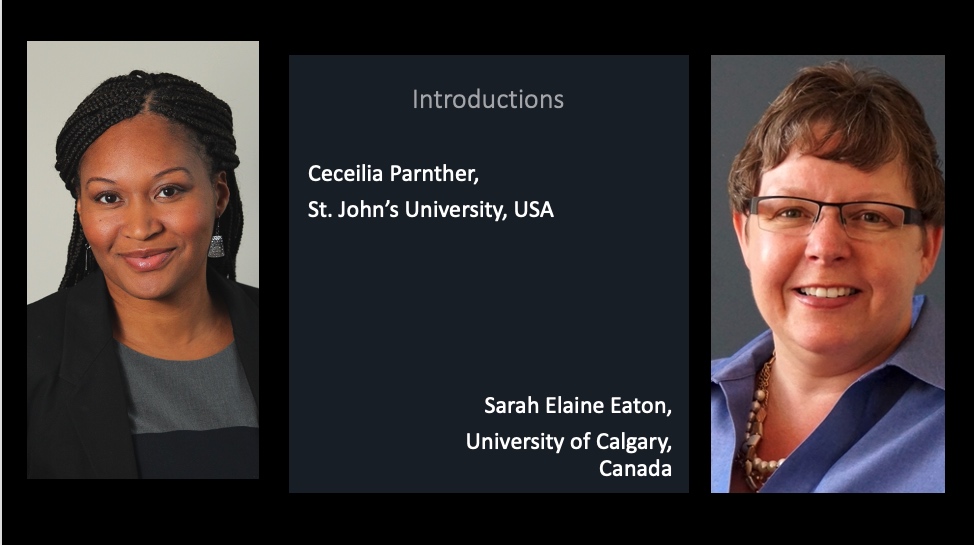
Student Perspectives on the Impact of Race in Educational Surveillance and Proctoring Technologies
Session re-cap: We brought a critical race perspective to electronic and remote proctoring technologies that have become prevalent during COVID-19. E-proctoring is a rapidly growing technology for higher-education institutions. Although this technology is promoted as a method to promote academic integrity by offering faculty control over the remote testing environment, students have expressed concern and anxiety about these monitoring tools. Specifically, students note anxiety and discomfort resulting from the use of these tools. These feelings may be exacerbated for students of colour due to the algorithmic biases that position whiteness as normative. We interrogate the ethical complexities of e-proctoring and other academic integrity technologies through the lens of equity and diversity.
A Chilean Perspective on Academic Integrity During COVID-19: Analyzing Possible Benefits and Challenges of Online Learning Communities
Overview: Beatriz is a new PhD student studying with me at the University of Calgary. This session marked Beatriz’s debut into the international academic integrity community. Due to COVID-19, Beatriz has remained in her home country of Chile throughout the pandemic and has not yet been able to physically come to Canada. She has been getting to know members of the Canadian academic integrity community by joining into our weekly Integrity Hour. This experience of working virtually across several months during Beatriz’s first year as a PhD students served as the basis for this collaborative session.
Session description: The COVID-19 pandemic pushed Chilean universities towards a quick transition into emergency remote teaching. Moreover, faculty identified a rapid increase in academic misconduct cases and the need to promote an academic integrity culture in their institutions. This new scenario called for new strategies to exchange academic integrity practices to help face the pandemic’s obstacles. In this presentation, we analyze the possible benefits and challenges of online learning communities for Chilean higher education institutions inspired by the experience of the Canadian “Integrity hour” online learning community. We also discuss new opportunities as the effects of COVID-19.
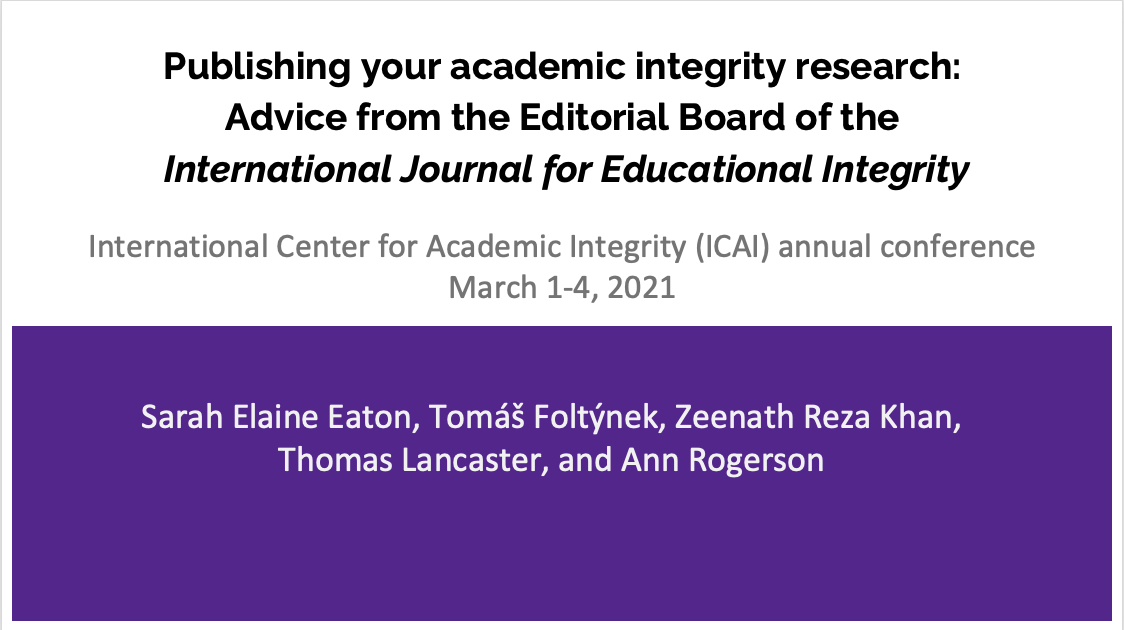
Session recap: We offered an interactive workshop on how to publish your academic integrity research. This session is offered by editorial board members of the International Journal for Educational Integrity.
Learning Outcomes:
Understand what makes excellent quality academic integrity research; what is publishable in a high-quality peer-reviewed journal and what is not; Understand how to prepare a manuscript for submission to a peer-reviewed scholarly journal; Learn how the journals’ scope and submission guidelines are important for prospective authors; Discuss pitfalls of the publication process and how to avoid them; and Gain insights into what double-blind peer review is and how it works. Check out an abbreviated session recording here.
Reflections: This session was the most logistically complex, by far. We had 5 presenters co-presenting in real time from 5 countries across 5 very different time zones. The session was held at 14:00 Eastern, which meant that Ann Rogerson was just rolling out of bed at 06:00 the next day in Wollongong. Needless to say, she arrived with coffee in hand. Meanwhile, Zeenath Reza Khan was looking forward to going to bed after the workshop, as the session was starting at 11:00 p.m. for her over in Dubai. It was noon for me in Calgary, 19:00 for Thomas Lancaster in the UK, and 20:00 for Tomáš Foltýnek in Brno.
This was the first time the five of us had ever co-presented together and our preparations for this session happened entirely asynchronously, using Google slides and also corresponding via e-mail to prepare the entire presentation. We each had slides assigned to us to speak to, but due to the time zones, we did not do a practice run for the session. For me, this was the most incredible presentation as it was truly a privilege to collaborate with so many dedicated colleagues from so many corners of the world. I can’t say for sure, but I think we might have been the most internationally diverse presentation team at this year’s conference.
Concluding Reflections
The conference organizers did a tremendous job of planning and delivering an excellent online event. None of the sessions I took part in either as a co-presenter or as a participant had any technical issues, which really speaks to how much preparation went into this conference prior to the event and “in the background” during the conference itself.
As others with expertise in educational technology will attest, the technology works best when it is invisible. That is to say, when there are technology problems, everyone turns their focus to the tech issues, often at the expense of developing human connections. In this case, the technology itself was very much invisible and the opportunity to connect with fellow collaborators in a very human sense was a highlight of the conference for me.
I think the most remarkable part of co-presenting all of these sessions is that the virtual environment facilitated and provided opportunities to collaborate across countries and time zones. Although I have had the pleasure of meeting Ann Rogerson and Thomas Lancaster in person at previous events, I have yet to meet any of my other fellow collaborators “in real life”. I very much look forward to the day when that happens.
In expect that by the time we get the meet face to face, it will be like meeting old friends and we will slip into conversations and laughter easily. To be able to collaborate with so many international colleagues from across continents was a special and remarkable aspect to this virtual conference.
This blog has had over 2 million views thanks to readers like you. If you enjoyed this post, please “like” it or share it on social media. Thanks!
Sarah Elaine Eaton, PhD, is a faculty member in the Werklund School of Education, and the Educational Leader in Residence, Academic Integrity, University of Calgary, Canada.
Opinions are my own and do not represent those of the University of Calgary or anyone else.




 Posted by Sarah Elaine Eaton, Ph.D.




 Learning, Teaching and Leadership
You must be logged in to post a comment.