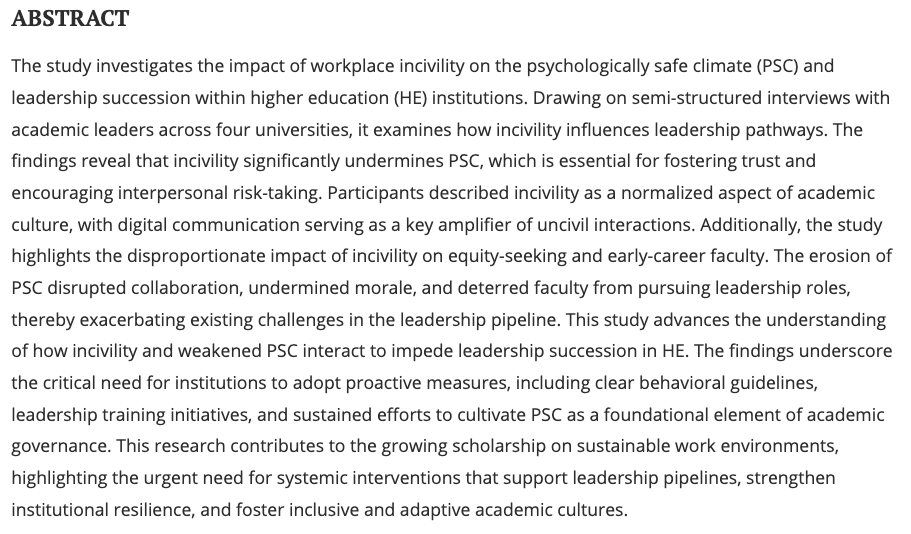
When Leda invited me to join her later for a project on psychological safety and leadership succession in higher education, I accepted right away. This topic is important one and it rarely gets discussed in the literature on academic integrity, but as we know, professional and collegial ethics are part of a comprehensive approach to academic integrity.
As we point out in the abstract and in the main body of the article, there is a disproportionate impact of incivility on equity-seeking and early-career faculty. In other words, those who are already marginalized and experience barriers and discrimination are more likely to be on the receiving end of workplace incivility and hostility.
I’ve said it before and I’ll say it again: There can be no integrity without equity. We need to think more about the way that higher education as a system allows for the perpetuation of discrimination and harm, not only for students, but also for faculty and staff. If the workplace is not a psychologically safe environment, then employees cannot thrive.
I invite you to check out the article, which is open access and free to read and download.
Sarah Elaine Eaton, PhD, is a Professor and Research Chair in the Werklund School of Education at the University of Calgary, Canada. Opinions are my own and do not represent those of my employer.
Gemini Live is Google’s new conversational AI assistant that responds to voice commands in real-time. Unlike text-based interactions, Gemini Live allows for natural, flowing conversations. This voice-first approach opens new possibilities for accessibility in educational settings. It was released last month, and I just got around to trying it today. Here’s how it went:
I was impressed by the tool’s interactivity and speed. In this test I scanned a laptop sticker with the hashtag #UHaveIntegrity, which is from our academic integrity campaign at the University of Calgary. The app correctly identified it and gave me a brief description.
I did a few subsequent tests with other items afterwards. It did not always have 100% accuracy, but with additional prompting, it corrected errors and provided updated information.
I can think of a variety of uses for this kind of app for teaching and learning. In particular, I am excited about the possibilities to enhance accessibility, inclusion, and equity.
Breaking Down Barriers with Voice Interaction
The voice interface of Gemini Live can remove some barriers for students. Students with mobility limitations, visual impairments, or reading difficulties can participate in learning activities through speech. This creates a more level playing field in the classroom.
Imagine a scenario where a teacher uses Gemini Live to help a student with dyslexia engage with research projects. The student could ask questions verbally and receive information without struggling with text. This hypothetical case illustrates how voice interaction might lead to increased confidence and class participation.
Multilingual Support for Diverse Classrooms
Language barriers often create obstacles in education. Gemini Live supports multiple languages and can translate between them. This feature helps:
Non-native English speakers follow lessons in their first language
International students integrate into new learning environments
Teachers communicate with students from different linguistic backgrounds
Parents who speak other languages stay involved in their children’s education
Learning Accommodations Made Simple
Every student learns differently. Gemini Live can adapt content to different learning needs. Here are some examples:
It can explain complex concepts in simpler terms for students who need additional support
It provides alternative explanations when students don’t understand a topic the first time
It offers audio descriptions of visual content for visually impaired students
It can generate study materials in different formats to match learning preferences
Real-Time Assistance in the Classroom
Teachers often struggle to provide individual attention to every student in a classroom. Gemini Live can serve as an additional resource that students can turn to when they need help. This can reduce wait times and frustration.
As a hypothetical example, a high school math teacher could implement Gemini Live as a ‘homework helper’ station in the classroom. Students who get stuck on problems could ask Gemini Live for guidance without waiting for the teacher to become available. This approach would allow more students to receive timely support while waiting for personalized attention from their teacher.
Digital Equity Through Voice Access
Not all students have equal access to technology or equal ability to use traditional interfaces. Voice technology lowers the technical barriers to using digital tools. Students without keyboards, mice, or touchscreens can still access information and complete assignments through voice commands.
Practical Implementation Tips
In thinking about how we could use use Gemini Live and similar tools for accessibility and inclusion, here are some ideas:
Create specific prompts that students can use to get help with different subjects
Set up dedicated stations where students can interact with Gemini Live
Teach students how to ask effective questions
Combine Gemini Live with other AI tools for a comprehensive accessibility solution
Challenges and Considerations
It is important for teachers to be aware that the tool is not perfect (at least as it currently stands). Although Gemini Live offers benefits, it currently has certain limitations.
Voice recognition may struggle with some speech patterns or accents
Private conversations require appropriate spaces to avoid classroom disruption
Students need guidance on when AI assistance is appropriate and when it isn’t
Technology should supplement, not replace, human teaching and interaction
Looking Forward
As AI assistants like Gemini Live continue to evolve, they will provide even more tools for inclusive education. The most successful classrooms will be those that thoughtfully blend technology with human instruction.
By incorporating Gemini Live into teaching practices, educators can create learning environments that accommodate more students. The goal isn’t just to make education accessible but to ensure every student feels valued and included in the learning process. When we remove barriers to education, we unlock potential — and that’s one of the most fun parts of being an educator.
This blog has had over 3.7 million views thanks to readers like you. If you enjoyed this post, please ‘Like’ it using the button below or share it on social media. Thanks!
Sarah Elaine Eaton, PhD, is a Professor and Research Chair in the Werklund School of Education at the University of Calgary, Canada. Opinions are my own and do not represent those of my employer.
Just 26.3% of the European Union’s artificial intelligence (AI) professionals are women, according to a report from LinkedIn.
In my work with of the Women for Ethical AI (W4EAI) UNESCO platform, we had similar findings in our gender outlook study.
There are no easy solutions to this gap, but for those working in this area, some five concrete things you can do to promote gender inclusion (and equity in general) are:
Invite women into leadership roles, strategic planing for artificial intelligence and advanced technology.
Ensure that policies explicitly include women, girls, and other equity-deserving groups.
Invite women (and in particular, early career women and those who are precariously employed) to share and showcase their expertise and knowledge (and compensate them for their contributions).
Create formal sponsorship programs for women and girls who want to develop their knowledge and cp-competencies related to AI, with ongoing opportunities for learning and skill development.
There are a myriad of ethical complexities when it comes to artificial intelligence and gender is only one of them. Acknowledging inequalities and then working to support equity, fairness, and justice will remain ongoing work in the years to come.
United Nations Educational Scientific and Cultural Organization (UNESCO). (2024). UNESCO Women for Ethical AI: Outlook study on artificial intelligence and gender. https://unesdoc.unesco.org/ark:/48223/pf0000391719
This blog has had over 3.7 million views thanks to readers like you. If you enjoyed this post, please ‘Like’ it using the button below or share it on social media. Thanks!
Sarah Elaine Eaton, PhD, is a Professor and Research Chair in the Werklund School of Education at the University of Calgary, Canada. Opinions are my own and do not represent those of my employer.
Here are three things you can do to prioritize human rights and dignity when it comes to policies and procedures to address allegations of academic or research misconduct:
Use a human-rights-by-design approach to developing, revising, and implementing policies by conducting a comprehensive review of existing academic integrity policies. Update policies to explicitly incorporate human rights principles, ensuring they address fair process, privacy, equitable treatment, and respect for human dignity. It is essential to involve individuals from representative groups in this process.
Provide ongoing training, education, and support to faculty, staff, and students about human rights principles and how they apply to misconduct investigations and case management. Create orientation programs that explain expectations for ethical conduct while respecting diverse cultural perspectives. Offer workshops and resources, peer mentoring programs, and support services.
Focus on continuous improvement and quality assurance of ethics and integrity practices by gathering feedback from students, faculty, staff and relevant stakeholders. Regularly review misconduct case management processes and data to ensure equitable treatment across different demographics.
Implementing human rights principles into misconduct investigations and case management helps to create more effective and sustainable learning environments. This approach prioritizes people over punishment, dignity over draconianism, and compassion over callousness.
This blog has had over 3 million views thanks to readers like you. If you enjoyed this post, please “like” it or share it on social media. Thanks!
Sarah Elaine Eaton, PhD, is a Professor and Research Chair in the Werklund School of Education at the University of Calgary, Canada. Opinions are my own and do not represent those of my employer.
Starting the year with a brief reflection inspired by the OECD Social and Emotional Skills for Better Lives report:
How can we, as educators, create systems and circumstances to help students thrive? How do we create opportunities for them? If there are doors that have been closed to them, how do we open those doors?
Or better yet, how do we break down the walls that hold up those doors in the first place?
These are some big questions I am contemplating for this year. How about you?
This blog has had over 3 million views thanks to readers like you. If you enjoyed this post, please “like” it or share it on social media. Thanks!
Sarah Elaine Eaton, PhD, is a Professor and Research Chair in the Werklund School of Education at the University of Calgary, Canada. Opinions are my own and do not represent those of my employer.


 Posted by Sarah Elaine Eaton, Ph.D.



You must be logged in to post a comment.