Coming soon… “Ethics and Integrity in Teacher Education” (Eaton & Khan, eds.)

August 2, 2022
An image with written information about the forthcoming book, "Ethics and Integrity in Teacher Education" edited by Sarah Elaine Eaton and Zeenath Reza Khan

Coming soon… “Ethics and Integrity in Teacher Education” (Eaton & Khan, eds.)

 One of the best things about being on Research and Scholarship Leave (RSL, also known as “sabbatical”) is having time to write and do research. I’m super excited to share that my friend and colleague, Dr. Zeenath Reza Khan, and I have just submitted a manuscript for our edited volume, Ethics and Integrity in Teacher Education.

This book was two years in the making. Zeenath and I are both educators in higher education, but like so many others who work in academic integrity, we often hear that students arrive at post-secondary institutions ill-prepared for what awaits them, including expectations about how to uphold and enact academic integrity. We hear cries of frustration that academic integrity education must start much earlier – and we agree. However, for that to happen, teacher trainees must receive direct and explicit training about how to teach concepts and skills related to academic integrity. If this is not embedded within their pre-service teacher education, the teachers themselves are ill equipped to provide students with this important ethical foundation in K-12 education.

We sought out some of the most highly qualified experts in the world on ethics and integrity for this volume. The result is a specialized team of elite scholars from Canada, the US, the UK, Australia, Mexico, Sweden, and the UAE who have contributed chapters on various topics related to how to teach academic integrity and ethics in teacher training programs and in K-12 education.

Here is a “sneak peek” about what to expect…

  • Table of Contents
  • Acknowledgements
  • Preface
  • Chapter 01: Ethics in Teacher Training: An Overview – Sarah Elaine Eaton (Canada) and Zeenath Reza Khan (UAE)
  • Chapter 02: Embedding principles related to academic integrity in teacher education in Australia – Ann Rogerson (Australia), Claire Rogerson (Australia), and Tiffani Apps (Australia)
  • Chapter 03: Using Codes of Professional Ethics and Conduct in Teacher Education: Pitfalls and Best Practice – Daniella Forster (Australia) and Bruce Maxwell (Canada)
  • Chapter 04: Preparing Preservice Teachers to Teach Academic Integrity and Ethics – Sonja Bjelobaba (Sweden) and Marita Cronqvist (Sweden)
  • Chapter 05: Ethics education in teacher education: a comparative study of teacher education programs embedding ethics education into teacher education curriculum – Afnan Boutid (UAE) and Stephanie Martin (UAE)
  • Chapter 06:  Starting from a Place of Academic Integrity: Building Trust with Online Students – Astrid Kendrick (Canada)
  • Chapter 07: The Role of Compassion in Academic Integrity Management Processes –  Luis I. Guerrero-Martínez (Mexico), Pablo Ayala-Enríquez (Mexico), and Jean Guerrero-Dib (Mexico)
  • Chapter 08: Formalising Preservice Teacher Training to Work with Parents to Promote Academic Integrity in K-12 Education – Brenda M. Stoesz (Canada)
  • Chapter 09:  Proposing a preservice teacher-training module to manage parental involvement in K-12 assessments – Zeenath Reza Khan (UAE) and Veena Mulani (UAE)
  • Chapter 10: Incorporating Ethics into Everyday Classroom in Science Education – Shivadas D. Sivasubramaniam (UK)
  • Chapter 11:  Educational Integrity in Schools: A Framework for Young Learners – Irene Glendinning (UK)

This book will be part of the Ethics and Integrity in Educational Contexts book series, published by Springer.

We do not yet have an exact date of when the book will be published, but we expect it might be in late 2022 or early 2023. We’ll provide updates on this blog and on social media about the progress of the book.

_______________________________

Share or Tweet this: Coming soon… “Ethics and Integrity in Teacher Education” (Eaton & Khan, eds.) https://drsaraheaton.wordpress.com/2022/08/02/coming-soon-ethics-and-integrity-in-teacher-education-eaton-khan-eds/

This blog has had over 3 million views thanks to readers like you. If you enjoyed this post, please “like” it or share it on social media. Thanks!

Sarah Elaine Eaton, PhD, is a faculty member in the Werklund School of Education, and the Educational Leader in Residence, Academic Integrity, University of Calgary, Canada. Opinions are my own and do not represent those of the University of Calgary.


Why Universities and Colleges Need Clear Policies to Deal with Fake COVID-19 Vaccination Records and Test Results

August 17, 2021

Image courtesy of patrisyu at FreeDigitalPhotos.net

Image courtesy of patrisyu at FreeDigitalPhotos.net

With the new academic year just around the corner, universities and colleges are grappling with a return to campus. Some institutions are calling for mandatory vaccine requirements, and the list continues to grow. In Canada, for example, journalists are sharing news of this rapidly changing landscape on a daily basis. Here are just a few examples of news stories from major news outlets:

Just this morning, the President of the University of Calgary sent a campus-wide e-mail stating:

“Starting September 1, the University of Alberta, the University of Calgary, and the University of Lethbridge will require all those coming to campus to undergo regular rapid testing. Those who are fully vaccinated against COVID-19 are exempt from this requirement.

Students, faculty, and staff who are not fully vaccinated, and those who would prefer not to disclose their vaccine status, will need to regularly complete a rapid screening test and receive a negative result before they participate in in-person activities.

Any individual who cannot be tested or vaccinated based on medical or other protected grounds recognized by the Alberta Human Rights Act can request an accommodation.”

The e-mail was signed by all three Alberta university presidents:

  • Bill Flanagan, President and Vice-Chancellor, University of Alberta
  • Ed McCauley, President and Vice-Chancellor, University of Calgary
  • Mike Mahon, President and Vice-Chancellor, University of Lethbridge

I applaud this decision – wholeheartedly and unequivocally.

What was absent from this communication, and most of the communication I have seen about vaccine requirements on campuses, is what the consequences will be for falsifying vaccine documents. On August 9, the Associated Press published an article on how “Fake COVID-19 vaccination cards worry college officials” in the United States.

It is utterly naïve to think that fake COVID-19 test results or vaccination records are limited to the United States or other countries. These are already available for sale for Canadians. I will not include links to these services in this blog post because I do not want to give the impression that I am endorsing any of these services, but you can do a simple Internet search yourself to find out how easy it is to buy these in Canada.

One Canadian news report claimed that fake COVID-19 vaccine passports were available for purchase online for as little as $12. That’s about the same cost as a box of donuts and a couple of coffees from a popular Canadian donut chain restaurant.

A critical question that remains unanswered is: What are the consequences for presenting fake or fraudulent COVID-19 documents on our campuses?

For staff and professors, I expect that human resources departments will be involved. For students, I expect that presenting fake COVID-19 would be a violation of student conduct rules (e.g., academic or non-academic misconduct). What is unclear is how such cases will be dealt with.

Falsifying COVID-10 vaccination status or test results is a willful act of dishonesty and needs to be treated as such.

I contend that such consequences need to be articulated through institution-wide policies and procedures and must be consistent across the institution. For example, it would be ridiculous for a student in arts to receive a warning and a student in science to receive an expulsion for the same offence of presenting a fake COVID-19 vaccination record. Similarly, it would diminish public trust in the institution if contract-based staff were dismissed from their employment for presenting faked COVID-19 documents, but tenured faculty members or administrators received a warning.

Universities and colleges need to take a strong and public stance on the issue of fake COVID-19 documentation.

This is no time to hide behind political-speak such as, “Violations will be addressed on a case-by-case basis” or “We do not expect this to be a problem”. This is a time for universities and colleges to communicate clear and firm expectations that presenting accurate and honest information regarding COVID-19 vaccination status or test results is essential for upholding the academic integrity and ethical standards. In addition, institutions need to develop and communicate clear and firm consequences for presenting fake or falsified COVID-19 documents.

Further, it would be useful for institutions to track and report on misconduct that occurs related to COVID-19, for all campus stakeholders including students, staff, faculty, and administrators and report back to the community on how cases are addressed. This is a not only a matter of public interest, it is a matter of public health. Lives are literally at stake.

Related posts:

______________________

Share or Tweet this: Why Universities and Colleges Need Clear Policies to Deal with Fake COVID-19 Vaccination Records and Test Results – https://drsaraheaton.wordpress.com/2021/08/17/why-universities-and-colleges-need-clear-policies-to-deal-with-fake-covid-19-vaccination-records-and-test-results/

This blog has had over 2 million views thanks to readers like you. If you enjoyed this post, please “like” it or share it on social media. Thanks!

Sarah Elaine Eaton, PhD, is a faculty member in the Werklund School of Education, and the Educational Leader in Residence, Academic Integrity, University of Calgary, Canada.

Opinions are my own and do not represent those of the University of Calgary or anyone else.


New book Series: Ethics and Integrity in Educational Contexts

February 1, 2021

A97796_EIEC_Series_Banner_P2

I am pleased to announce a new book series, Ethics and Integrity in Educational Contexts by Springer.

About this series

The aim of this series is to provide an authoritative series of books on topics relating to ethics and integrity in educational contexts. Its scope includes ethics and integrity, defined in broad and inclusive terms, in educational contexts. It focuses on higher education, but also welcomes contributions that address ethics and integrity in primary and secondary education, non-formal educational contexts, professional education, etc. We welcome books that address traditional academic integrity topics such as plagiarism, exam cheating, and collusion.

In addition, we are particularly interested in topics that extend beyond questions of student conduct, such as

  • Quality assurance in education;
  • Research ethics and integrity;
  • Admissions fraud;
  • Fake and fraudulent credentials;
  • Publication ethics;
  • Educational technology ethics (e.g., surveillance tech, machine learning, and artificial intelligence, as they are used in education);
  • Biomedical ethics in educational contexts;
  • Ethics in varsity and school sports.

This series extends beyond traditional and narrow concepts of academic integrity to broader interpretations of applied ethics in education, including corruption and ethical questions relating to instruction, assessment, and educational leadership. It also seeks to promote social justice, diversity, equity, and inclusion.

The series provides a forum to address emerging, urgent, and even provocative topics related to ethics and integrity at all levels of education, from a variety of disciplinary and geographical perspectives.

Editorial Board

I am delighted to work with an international group scholars and experts as members of the Editorial Board:

Tomáš Foltýnek, Department of Informatics, Faculty of Business and Economics, Mendel University, Brno, Czechia

Irene Glendinning, Coventry University, Coventry, UK

Zeenath Reza Khan, University of Wollongong, Dubai, United Arab Emirates

Rebecca Moore Howard, Syracuse University, New York, USA

Mark Israel, Australasian Human Research Ethics Consultancy Services, Perth, Australia

Ceceilia Parnther, St. Johns’ University, New York, USA

Brenda M. Stoesz, The Center for Advancement of Teaching and Learning, University of Manitoba, Winnipeg, Manitoba, Canada

Forthcoming and New Books

The first book to launch the series will be Academic Integrity in Canada (Eaton & Christensen Hughes, eds., forthcoming). I will share more details about this first book when we are closer to publication, which should be in mid to late 2021.

Proposals for a number of other books to join the series are underway, with authors and editors from a variety of countries.

If you have an idea for a book to be included as part of this series, please contact me.

_____

Share or Tweet this: New book Series: Ethics and Integrity in Educational Contexts https://drsaraheaton.wordpress.com/2021/02/01/new-book-series-ethics-and-integrity-in-educational-contexts/

This blog has had over 2 million views thanks to readers like you. If you enjoyed this post, please “like” it or share it on social media. Thanks!

Sarah Elaine Eaton, PhD, is a faculty member in the Werklund School of Education, and the Educational Leader in Residence, Academic Integrity, University of Calgary, Canada.

Opinions are my own and do not represent those of the University of Calgary or anyone else.


Journal of Educational Thought: Special Issue on Academic Integrity and Ethics

January 14, 2020

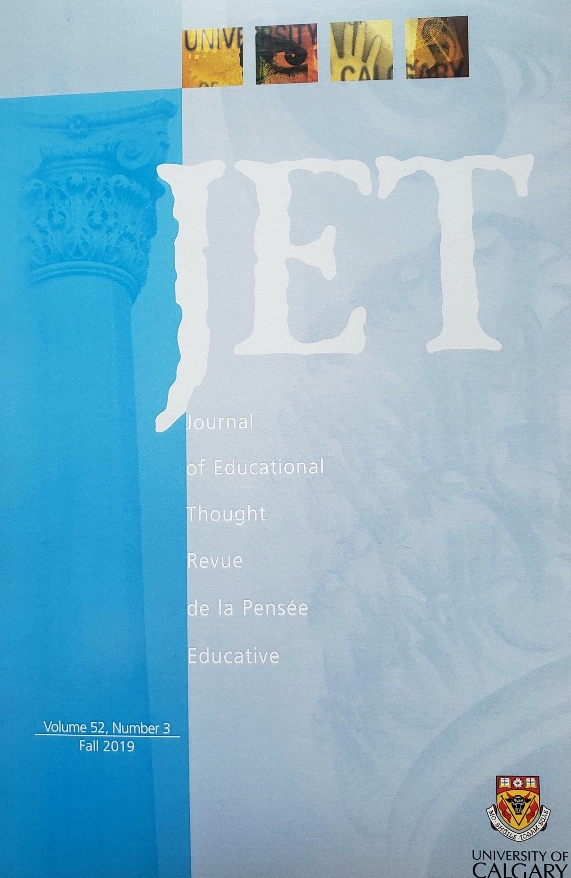
JET Cover 52(3)I am so pleased to share that the special issue of the Journal of Educational Thought dedicated to academic integrity and ethics is now out. I am excited about this work because it adds to the growing body of scholarly and research literature on these important topics, not only in Canada, but globally, too.

I was the guest Co-Editor for this special issue, together with the journal’s editor-in-chief, Ian Winchester.

Here’s an overview of what’s in the issue:

Editorials

Winchester, I. (2019). Academic integrity in the university. Journal of Educational Thought, 52(3), 187-190.

Eaton, S. E. (2019). Considerations of corruption, ethics and integrity in educational contexts: Guest editorial. Journal of Educational Thought, 52(3), 191-192.

Research articles

Lock, J., Schroeder, M., & Eaton, S. E. (2019). Designing and implementing an online academic integrity tutorial: Identifying the challenges within a post-secondary context. Journal of Educational Thought, 52(3), 193-208.

Lancaster, T., Glendinning, I., Foltýnek, T., Dlabolová, D., & Linkeschová, D. (2019). The perceptions of higher education students on contract cheating and educational corruption in South East Europe. Journal of Educational Thought, 52(3), 209-227.

Henry, R., & Gabel, C. (2019). “It’s not just a picture when lives are at stake: Ethical considerations and photovoice methods with Indigenous Peoples engaged in street lifestyles”. Journal of Educational Thought, 52(3), 229-252.

Miron, J. B. (2019). Academic integrity in a student practice environment: An elicitation study. Journal of Educational Thought, 52(3), 253-273.

All of the research articles underwent double-blind peer review.

______________________________________________________

Share or Tweet this: Journal of Educational Thought: Special Issue on Academic Integrity and Ethics

This blog has had over 2 million views thanks to readers like you. If you enjoyed this post, please “like” it or share it on social media. Thanks!

Sarah Elaine Eaton is a faculty member in the Werklund School of Education, and the Educational Leader in Residence, Academic Integrity, University of Calgary, Canada. Opinions are my own and do not represent those of the University of Calgary.


2019 Special Issue: Ethics and Integrity in Educational Contexts – Journal of Educational Thought

August 17, 2018

JET 50(1)Issues around ethics and integrity have become increasingly important in higher educational contexts in a variety of ways including research, teaching and leadership. With increasing expectations of research outputs; interest from students to conduct research involving human subjects; and ethical dilemmas of educational leaders in an age of commodified higher education, issues relating to ethics and integrity permeate every aspect of life in the academy.

We intend for this special issue to encourage dialogic interaction among scholars, elevating the discourse around ethics and integrity across disciplines.

Themes

We invite contributions that speak to the topic of ethics and integrity in higher education in a broad sense. Topics include, but are not limited to:

  • Research ethics
  • Ethical leadership in educational contexts
  • Academic integrity
  • Publication ethics
  • Ethical treatment of Indigenous populations (including ethical considerations for research with Indigenous populations)
  • Ethics and integrity in research partnerships and collaborations
  • Ethics and integrity in higher education
  • Ethics and integrity in K-12 education
  • Medical ethics and related topics (e.g. biomedical ethics)

Types of contributions

Scholarly contributions may include, but are not limited to:

  • Empirical research
  • Critical perspectives
  • Evidence-informed position papers
  • Scholarly essays

All submissions should be substantiated with relevant and current research evidence.

Submissions are welcome in English or French.

October 1, 2018 due date – Expressions of Interest (EOIs)

  • Maximum 500 words, briefly outlining the topic, including a maximum of 5 references of related relevant works (no self-citations).
  • Author(s) bio.
  • APA 6th edition format.

EOIs will be screened for suitability and quality. Invitations to authors to submit full manuscripts will be based on the quality of the EOIs. We anticipate inviting approximately six full manuscripts. We encourage interested parties to contact us with a query e-mail before submitting an EOI.

About the JET: Now in its 51st year of publication, the Journal of Educational Thought is a university-run journal that promotes speculative, critical, and historical research concerning the theory and practice of education in a variety of areas including administration, comparative education, curriculum, educational communication, evaluation, instructional methodology, intercultural education, philosophy, psychology, and sociology. The Journal is international in scope and qualitative in nature. It serves a broad international readership: specialists in the areas mentioned, scholars, and the public in general.

We invite submissions in English or French.

Send your Expression of Interest or queries to:

Dr. Sarah Elaine Eaton, University of Calgary – seaton (at) ucalgary.ca

or

Dr. Ian Winchester, University of Calgary – winchest (at) uncalgary.ca

______________________________________________________

Share or Tweet this: 2019 Special Issue: Ethics and Integrity in Educational Contexts – Journal of Educational Thought https://wp.me/pNAh3-2kQ

This blog has had over 2 million views thanks to readers like you. If you enjoyed this post, please “like” it or share it on social media. Thanks!

Sarah Elaine Eaton is a faculty member in the Werklund School of Education, University of Calgary, Canada.

Opinions are my own and do not represent those of the Werklund School of Education or the University of Calgary.