Future-proofing integrity in the age of artificial intelligence and neurotechnology: Prioritizing human rights, dignity, and equity

November 13, 2024

Once a year I write an editorial for the International Journal for Educational Integrity. I take a big idea, ground it in literature written by some of the best in the world and then call for ways to improve our field even more. In 2023 I wrote about Postplagiarism and in 2022, I focused on equity, diversity, inclusion, accessibility and decolonization as new priorities for academic integrity. Here is this year’s editorial:

Future-proofing integrity in the age of artificial intelligence and neurotechnology: prioritizing human rights, dignity, and equity

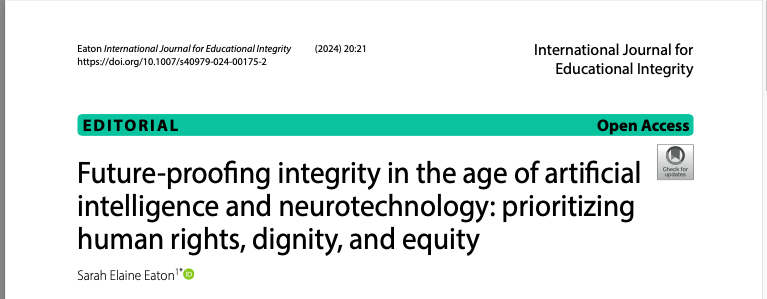
A screenshot of an article title page. There is black text on a white background with a green banner at the top.
Here is a link to the original: https://edintegrity.biomedcentral.com/articles/10.1007/s40979-024-00175-2

Abstract

In this article I argue for the prioritisation of human rights when developing and implementing misconduct policies. Existing approaches may be perpetuate inequities, particularly for individuals from marginalised groups. A human-rights-by-design approach, which centres human rights in policy development, revision, and implementation, ensuring that every individual is treated with dignity and respect.

Recommendations for implementing a human-rights approach to misconduct investigations and case management are offered, covering areas such as procedural fairness, privacy, equity, and the right to education. Additional topics covered are the need to limit surveillance technologies, and the need to recognize that not all use of artificial intelligence tools automatically constitutes misconduct. I disentangle

the differences between equity and equality and explain how both are important when considering ethics and integrity. A central argument of this paper is that a human-rights-by-design approach to integrity does not diminish standards but rather strengthens educational systems by cultivating ethical awareness and respect for personhood. I conclude with a call to action with a seven-point plan for institutions to adopt a human-rights-based approach to ethics and integrity. In the age of artificial intelligence and neurotechnology, insisting on human rights and dignity when we investigate and address misconduct allegations is an ethical imperative that has never been more important.

Keywords Academic misconduct, Academic dishonesty, Plagiarism, Policy, Human rights, Restorative justice, Artificial intelligence, Neurotechnology, Higher education, Education

Commentary

As I reflect on the current state of academic and research integrity, I am struck by a glaring omission in our discussions: the connection between misconduct and human rights. We often treat these as separate entities, failing to recognize the profound impact that misconduct investigations and policies can have on the fundamental rights of individuals. This oversight is particularly concerning in the age of artificial intelligence (AI) and neurotechnology, where the potential for harm is magnified.

Take, for example, the case of a professor in Canada who physically assaulted international students accused of plagiarism. This horrifying example demonstrates how the pursuit of academic integrity can be twisted into a justification for degrading and inhumane treatment, violating the very principles of dignity and respect that should guide our actions. While this is an extreme case, it highlights the need for a fundamental shift in our approach.

In this editorial, I offer a call to action to move beyond simply adhering to legal requirements and embrace a ‘human-rights-by-design’ approach that embeds human rights principles into our policies and practices. This means ensuring procedural fairness throughout investigations, safeguarding the privacy of individuals, and recognizing the right to be presumed innocent until there is proof to the contrary. It also requires us to acknowledge the diverse backgrounds and circumstances of our students and staff, striving for equitable treatment that addresses systemic inequalities and provides the support needed for everyone to succeed.

In the face of rapidly evolving technologies like AI, we must be especially vigilant in upholding human rights. The temptation to rely on unproven AI detection tools or to rush to judgement based on suspicion rather than evidence is strong, but it is a path that leads us away from justice and fairness. We cannot allow fear or expediency to erode our commitment to human dignity.

By centring human rights in our approach to integrity, we can create educational and research environments that are not only ethically sound but also truly just and equitable. This is not about lowering standards; it is about building a culture of integrity that upholds the inherent worth of every individual.

________________________

Share this post: Future-proofing integrity in the age of artificial intelligence and neurotechnology: Prioritizing human rights, dignity, and equity – https://drsaraheaton.com/2024/11/13/future-proofing-integrity-in-the-age-of-artificial-intelligence-and-neurotechnology-prioritizing-human-rights-dignity-and-equity/
This blog has had over 3 million views thanks to readers like you. If you enjoyed this post, please “like” it or share it on social media. Thanks!

Sarah Elaine Eaton, PhD, is a Professor and Research Chair in the Werklund School of Education at the University of Calgary, Canada. Opinions are my own and do not represent those of my employer.


UNESCO Women for Ethical AI: outlook study on artificial intelligence and gender

October 30, 2024

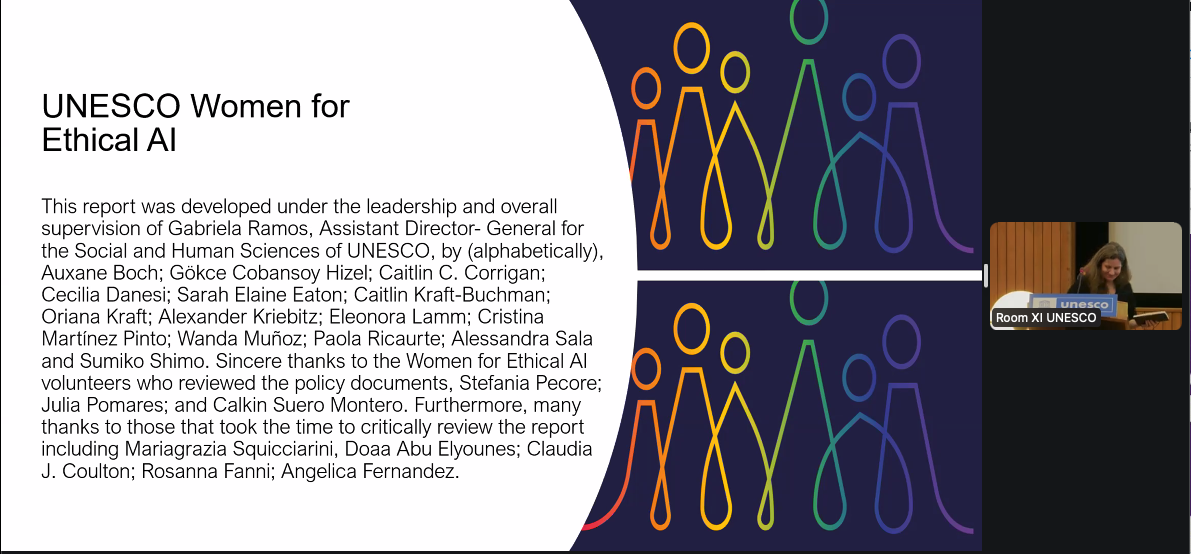
Over the past few months I have had the tremendous opportunity to work with an incredible group of women under the direction of Assistant Director-General (ADG) for Social and Human Sciences of UNESCO. Our collective produced this report that was launched today at a special conference in Paris:

UNESCO Women for Ethical AI: outlook study on artificial intelligence and gender

https://unesdoc.unesco.org/ark:/48223/pf0000391719

Here is our agenda from today’s conference:

I joined today’s conference online. Here are a few pics that I snapped during the presentations:

________________________

Share this post:
UNESCO Women for Ethical AI: outlook study on artificial intelligence and gender – https://drsaraheaton.com/2024/10/30/unesco-women-for-ethical-ai-outlook-study-on-artificial-intelligence-and-gender/

This blog has had over 3 million views thanks to readers like you. If you enjoyed this post, please “like” it or share it on social media. Thanks!

Sarah Elaine Eaton, PhD, is a Professor and Research Chair in the Werklund School of Education at the University of Calgary, Canada. Opinions are my own and do not represent those of my employer.


A Comprehensive Academic Integrity (CAI) Framework: An Overview

April 14, 2023

This post is a reprint of a self-archived document available here: https://prism.ucalgary.ca/handle/1880/116060

Background

As I write this, the Handbook of Academic Integrity (2nd ed.) is well underway. All the chapters have been submitted and are at various stages of review, revision, and production. Page proofs should start going out to contributing authors this month. This has been a massive project: 150+ authors, 109 chapters, 9 section editors, and me herding all the cool cats who have made it happen.

After all the chapters had been submitted, I realized that we had something new and fresh with this edition. We have pushed the boundaries beyond persistently historical ideas about academic integrity only as a matter of student conduct. So, I wrote an introduction for the handbook that synthesizes some its through lines. The common threads of this updated edition are summed up in this Comprehensive Academic Integrity (CAI) framework.

I wrote this intro in two epic writing sessions, fuelled by gallons of coffee, Vegemite on toast, and a pizza that a friend had delivered to my house because he felt sorry for me eating Vegemite on toasted bread crusts. (I am not kidding.) Anyway, first, I drafted the chapter in full. Then I asked a couple of other section editors and contributors to the handbook to provide me with an open peer review of the draft. In the chapter I acknowledge them by name and I re-iterate my gratitude to them here. Thanks are due to Guy Curtis, Brenda M. Stoesz, Rahul Kumar, Beatriz Moya, and Bibek Dahal for their feedback that helped me to improve the chapter. In the second writing session, I incorporated just about all of their suggestions and completely re-vamped the visual image to the one you see below. The CAI Framework is a high-level synthesis of all the chapters in the handbook and as such, every single author who has contributed to the handbook (as well as those they have cited in their respective chapters) all deserve credit.

According to the publisher’s rules around self-archiving and pre-prints, I am not allowed to share the entire chapter with you ahead of publication. But I can share a summary of it, so I’m doing that here. I’ve also self-archived a copy of this overview (minus the background commentary about Vegemite and pizza) in our university’s digital repository. On the off-chance you want to cite the “official” version of the summary, I have included instructions below. You’ll have to wait for the Handbook to be published to read the full chapter, but in the meantime, I hope this overview is useful.

How to cite this overview

Eaton, S.E. (2023). A Comprehensive Academic Integrity (CAI) Framework: An Overview. Calgary, Canada: University of Calgary. https://prism.ucalgary.ca/handle/1880/116060

Overview

For years scholars and other experts have called for a more holistic approach to academic integrity (e.g., Bertram Gallant, 2008; Boud & Bearman, 2022; Bretag et al, 2014; Carrol & Duggan, 2005; Löfström et al., 2015; Morris & Carrol, 2016; Turner & Beemsterboer, 2003). The CAI framework synthesizes ideas that have been repeated for decades in various iterations.

The central argument behind a wholistic framework is that academic integrity must encompass, but extend beyond, notions of student conduct, and should be considered a foundation of all aspects of education. In this framework, I do not propose a new definition of academic integrity in part, because several useful definitions already exist (see Bretag, 2016; ICAI, 2021; Tauginienė et al., 2018). Instead, this framework can be used with existing definitions.

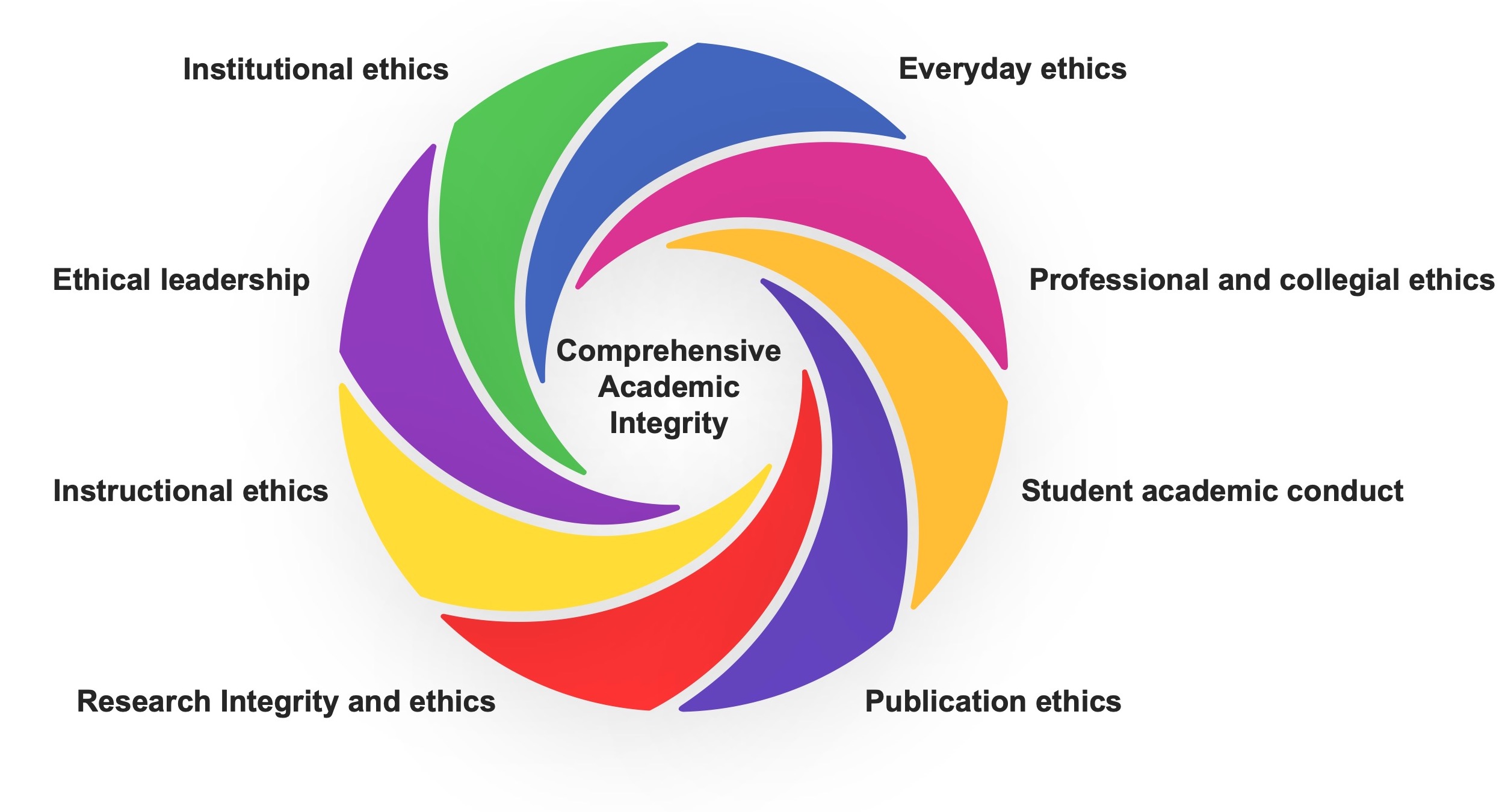
The Comprehensive Academic Integrity (CAI) framework includes eight (8) essential elements that includes, and extends beyond traditional notions of academic integrity merely as a student responsibility:

  • everyday ethics
  • institutional ethics
  • ethical leadership
  • professional and collegial ethics
  • instructional ethics
  • student academic conduct
  • research integrity and ethics
  • publication ethics

Figure 1. Comprehensive Academic Integrity (CAI) Framework

A circle with eight colourful swirls (one each in green, blue, pink, dark yellow, darker purple, red, bright yellow, medium purple, and green). There is black text associated with each swirl. This image is a graphic representation of the Comprehensive Academic Integrity (CAI) framework.

Keywords

academic integrity, student conduct, student affairs, research ethics, research integrity, publication ethics, instructional ethics, pedagogy, everyday ethics, experiential learning, definition, ethical decision-making, morals, values, virtues, leadership, equity, diversity, inclusion, accessibility, justice, decolonization, Indigenization

Postscript

Appreciation to Kieran Forde at the University of British Columbia for his most awesome interpretation of the graphic as a “colourful swirly donut”. Who doesn’t love donuts?! Thanks, Kieran!

References

Bertram Gallant, T. (2008). Academic integrity in the twenty-first century: A teaching and learning imperative. Wiley.

Boud, D., & Bearman, M. (2022). The assessment challenge of social and collaborative learning in higher education. Educational philosophy and theory, 1-10. https://doi.org/10.1080/00131857.2022.2114346   

Bretag, T. (2016). Educational integrity in Australia. In T. A. Bretag (Ed.), Handbook of Academic Integrity (pp. 1-13). Springer Singapore. https://doi.org/10.1007/978-981-287-079-7_2-1 

Bretag, T., Mahmud, S., Wallace, M., Walker, R., McGowan, U., East, J., Green, M., Partridge, L., & James, C. (2014). ‘Teach us how to do it properly!’ An Australian academic integrity student survey. Studies in higher education, 39(7), 1150-1169. https://doi.org/10.1080/03075079.2013.777406

Carroll, J., & Duggan, F. (2005, December 2-5). Institutional change to deter student plagiarism:  What seems essential to a holistic approach? 2nd Asia-Pacific Educational Integrity Conference, University of Newcastle, Callaghan, Australia.

Eaton, S. E. (forthcoming). Comprehensive academic integrity (CAI): An ethical framework for educational contexts. In S. E. Eaton (Ed.), Handbook of Academic Integrity (2nd ed.). Springer. 

International Center for Academic Integrity (ICAI). (2021). The fundamental values of academic integrity (3rd ed.). https://academicintegrity.org/resources/fundamental-values

Löfström, E., Trotman, T., Furnari, M., & Shephard, K. (2015). Who teaches academic integrity and how do they teach it? Higher Education, 69(3), 435-448. https://doi.org/10.1007/s10734-014-9784-3

Morris, E. J., & Carroll, J. (2016). Developing a sustainable holistic institutional approach: Dealing with realities “on the ground” when implementing an academic integrity policy. In T. Bretag (Ed.), Handbook of Academic Integrity (pp. 449-462). Springer Singapore. https://doi.org/10.1007/978-981-287-098-8_23

Tauginienė, L, Gaižauskaitė, I, Glendinning, I, Kravjar, J, Ojsteršek, M, Ribeiro, L, Odiņeca, T, Marino, F, Cosentino, M, Sivasubramaniam, S, Foltýnek, T. Glossary for Academic Integrity. ENAI Report 3G [online]: revised version, October 2018. https://www.academicintegrity.eu/wp/wp-content/uploads/2023/02/EN-Glossary_revised_final_24.02.23.pdf

Turner, S. P., & Beemsterboer, P. L. (2003). Enhancing academic integrity: Formulating effective honor codes. Journal of Dental Education, 67(10), 1122-1129. https://doi.org/10.1002/j.0022-0337.2003.67.10.tb03705.x

_________________________________

Share this post: A Comprehensive Academic Integrity (CAI) Framework: An Overview – https://drsaraheaton.wordpress.com/2023/04/14/a-comprehensive-academic-integrity-cai-framework-an-overview/

This blog has had over 3 million views thanks to readers like you. If you enjoyed this post, please “like” it or share it on
social media. Thanks!

Sarah Elaine Eaton, PhD, is a faculty member in the Werklund School of Education, and the Educational Leader in Residence, Academic Integrity, University of Calgary, Canada. Opinions are my own and do not represent those of the University of Calgary.


Just published! Ethics and Integrity in Teacher Education (Eaton & Khan, eds.)

January 5, 2023

We are pleased to share that our edited volume, Ethics and Integrity in Teacher Education, has just been published. 

Front cover of the edited volume, Ethics and Integrity in Teacher Education

Here is an overview of the book that Zeenath Reza Khan and I edited, with contributions from authors in Canada, Australia, the United Kingdom, UAE, Sweden and Mexico.

Book Description

This book addresses issues related to ethics and integrity in teacher training. Authors pay special attention to the role ethics plays in teaching practice and the importance of establishing expectations for students to learn with integrity from a young age. The book celebrates global perspectives on ethics and integrity for pre-service teachers, acknowledging that although some aspects of ethics are universal, the ways in which these are implemented can vary. Contributors present original research, case studies, and recommendations for practice and teaching.

The book draws on a range of theoretical and conceptual foundations including applied ethics, academic integrity, and moral education.

Table of Contents

Additional Details

Publisher: Springer

Book doi: https://doi.org/10.1007/978-3-031-16922-9

Hardcover ISBN: 978-3-031-16921-2 (Published 02 January, 2023)

Softcover ISBN: 978-3-031-16924-3

eBook ISBN: 978-3-031-16922-9Published: 01 January 2023

Number of Pages: XIII, 178

_________________________________

Share or Tweet this: Just published! Ethics and Integrity in Teacher Education (Eaton & Khan, eds.) – https://wp.me/pNAh3-2RW

This blog has had over 3 million views thanks to readers like you. If you enjoyed this post, please “like” it or share it on social media. Thanks! Sarah Elaine Eaton, PhD, is a faculty member in the Werklund School of Education, and the Educational Leader in Residence, Academic Integrity, University of Calgary, Canada. Opinions are my own and do not represent those of the University of Calgary.


Coming soon… “Ethics and Integrity in Teacher Education” (Eaton & Khan, eds.)

August 2, 2022
An image with written information about the forthcoming book, "Ethics and Integrity in Teacher Education" edited by Sarah Elaine Eaton and Zeenath Reza Khan

Coming soon… “Ethics and Integrity in Teacher Education” (Eaton & Khan, eds.)

 One of the best things about being on Research and Scholarship Leave (RSL, also known as “sabbatical”) is having time to write and do research. I’m super excited to share that my friend and colleague, Dr. Zeenath Reza Khan, and I have just submitted a manuscript for our edited volume, Ethics and Integrity in Teacher Education.

This book was two years in the making. Zeenath and I are both educators in higher education, but like so many others who work in academic integrity, we often hear that students arrive at post-secondary institutions ill-prepared for what awaits them, including expectations about how to uphold and enact academic integrity. We hear cries of frustration that academic integrity education must start much earlier – and we agree. However, for that to happen, teacher trainees must receive direct and explicit training about how to teach concepts and skills related to academic integrity. If this is not embedded within their pre-service teacher education, the teachers themselves are ill equipped to provide students with this important ethical foundation in K-12 education.

We sought out some of the most highly qualified experts in the world on ethics and integrity for this volume. The result is a specialized team of elite scholars from Canada, the US, the UK, Australia, Mexico, Sweden, and the UAE who have contributed chapters on various topics related to how to teach academic integrity and ethics in teacher training programs and in K-12 education.

Here is a “sneak peek” about what to expect…

  • Table of Contents
  • Acknowledgements
  • Preface
  • Chapter 01: Ethics in Teacher Training: An Overview – Sarah Elaine Eaton (Canada) and Zeenath Reza Khan (UAE)
  • Chapter 02: Embedding principles related to academic integrity in teacher education in Australia – Ann Rogerson (Australia), Claire Rogerson (Australia), and Tiffani Apps (Australia)
  • Chapter 03: Using Codes of Professional Ethics and Conduct in Teacher Education: Pitfalls and Best Practice – Daniella Forster (Australia) and Bruce Maxwell (Canada)
  • Chapter 04: Preparing Preservice Teachers to Teach Academic Integrity and Ethics – Sonja Bjelobaba (Sweden) and Marita Cronqvist (Sweden)
  • Chapter 05: Ethics education in teacher education: a comparative study of teacher education programs embedding ethics education into teacher education curriculum – Afnan Boutid (UAE) and Stephanie Martin (UAE)
  • Chapter 06:  Starting from a Place of Academic Integrity: Building Trust with Online Students – Astrid Kendrick (Canada)
  • Chapter 07: The Role of Compassion in Academic Integrity Management Processes –  Luis I. Guerrero-Martínez (Mexico), Pablo Ayala-Enríquez (Mexico), and Jean Guerrero-Dib (Mexico)
  • Chapter 08: Formalising Preservice Teacher Training to Work with Parents to Promote Academic Integrity in K-12 Education – Brenda M. Stoesz (Canada)
  • Chapter 09:  Proposing a preservice teacher-training module to manage parental involvement in K-12 assessments – Zeenath Reza Khan (UAE) and Veena Mulani (UAE)
  • Chapter 10: Incorporating Ethics into Everyday Classroom in Science Education – Shivadas D. Sivasubramaniam (UK)
  • Chapter 11:  Educational Integrity in Schools: A Framework for Young Learners – Irene Glendinning (UK)

This book will be part of the Ethics and Integrity in Educational Contexts book series, published by Springer.

We do not yet have an exact date of when the book will be published, but we expect it might be in late 2022 or early 2023. We’ll provide updates on this blog and on social media about the progress of the book.

_______________________________

Share or Tweet this: Coming soon… “Ethics and Integrity in Teacher Education” (Eaton & Khan, eds.) https://drsaraheaton.wordpress.com/2022/08/02/coming-soon-ethics-and-integrity-in-teacher-education-eaton-khan-eds/

This blog has had over 3 million views thanks to readers like you. If you enjoyed this post, please “like” it or share it on social media. Thanks!

Sarah Elaine Eaton, PhD, is a faculty member in the Werklund School of Education, and the Educational Leader in Residence, Academic Integrity, University of Calgary, Canada. Opinions are my own and do not represent those of the University of Calgary.