 My colleague, Roswita Dressler and I have just had a new paper published. It all started when I was at an academic integrity conference a couple of years back. I was sitting next to a colleague who works in a language other than English (LOTE). The colleague suggested that contract cheating (e.g. essay mills and other forms of outsourced academic work) was a problem of the English-speaking world, asserting that there simply wouldn’t be enough of a market in other languages.
I thought to myself, “Challenge accepted!” I recruited Roswita Dressler to help me undertake a small-scale pilot study. We both have a background in language teaching and between us, we have some level of proficiency in about four languages. We were also curious about the market for academic outsourcing for younger audiences, in elementary, middle and high school.
The questions that guided our project were:
- What evidence exists that online providers offer academic work in languages other than English?
- To what degree are K-12 students targeted by these online providers?
We framed our study specifically within the Canadian context.
Our results showed that not only do commercial contract cheating companies market to specifically to students in Canada, they target children as young as Grade six (approximately 11-12 years old). And yes, we found strong evidence that contract cheating happens in languages other than English (ten of them, in fact).
To the best of our knowledge, this is the first study on contract cheating published in Canada.
The Alberta Teachers Association is the publisher and copyright holder of this article. They have given us permission to post the article in our university’s digital repository. You can access a copy of it free of charge from here:
Eaton, S. E., & Dressler, R. (2019). Multilingual essay mills: Implications for second language teaching and learning. Notos, 14(2), 4-14. Retrieved from http://hdl.handle.net/1880/110695
______________________________________________________
Share or Tweet this: Multilingual essay mills – New article
This blog has had over 2 million views thanks to readers like you. If you enjoyed this post, please “like” it or share it on social media. Thanks!
Sarah Elaine Eaton is a faculty member in the Werklund School of Education, University of Calgary, Canada. Opinions are my own and do not represent those of the Werklund School of Education or the University of Calgary.


 Posted by Sarah Elaine Eaton, Ph.D.
  As many of you know, I’ve been developing a research program on academic integrity over the past few years. Last year I began collaborating with my friend and colleague,
 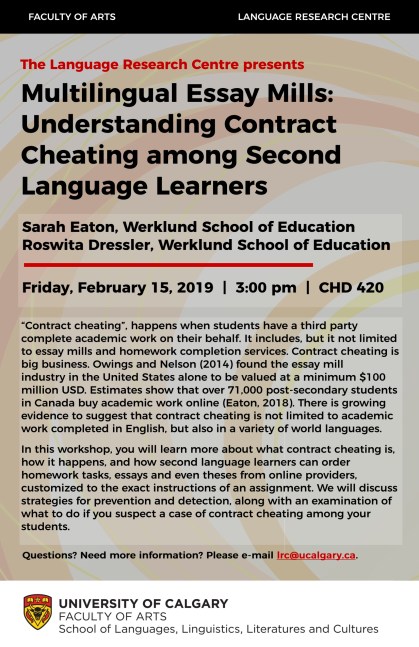 Contract cheating happens when students have a third party complete academic work on their behalf. The term was coined by UK researchers Clarke and Lancaster (2006). It includes, but it not limited to essay mills and homework completion services. Suppliers of this form of “black market” academic work exist mainly online. Students can simply upload a digital copy of their assignment instructions to a website, insert a delivery date and pay for the work by credit card. Contract cheating is big business. Owings and Nelson (2014) found the essay mill industry in the United States alone to be valued at a minimum $100 million USD. Estimates show that over 71,000 post-secondary students in Canada buy academic work online (Eaton, 2018). There is growing evidence to suggest that contract cheating is not limited to academic work completed in English, but also in a variety of world languages.
 ere’s an interesting (and heart wrenching) article about a multilingual Edmonton man who lost all of his languages after a stroke. In the
 Learning, Teaching and Leadership
You must be logged in to post a comment.