New project: Artificial Intelligence and Academic Integrity: The Ethics of Teaching and Learning with Algorithmic Writing Technologies

April 19, 2022

Today the University of Calgary announced the recipients of the 2022 Teaching and Learning Grants. I’m pleased to share that our project was among those awarded funding. Here are the details of our project:

Artificial Intelligence and Academic Integrity: The Ethics of Teaching and Learning with Algorithmic Writing Technologies

Research Team (all from the University of Calgary)

  • Sarah Elaine Eaton, PhD, Werklund School of Education, Principal Investigator
  • Robert Brennan, PhD, Schulich School of Engineering, Co-Investigator
  • Jason Wiens, PhD, Department of English, Faculty of Arts, Co-Investigator
  • Brenda McDermott, PhD, Student Accessibility Services, Co-Investigator
  • Helen Pethrick, MA, Project Manager
  • Beatriz Moya, PhD student, Werklund School of Education, Research Assistant
  • Jonathan Lesage, MSc student, Schulich School of Engineering, Research Assistant

Focus area (as aligned with University of Calgary research priority areas): Innovation and entrepreneurial thinking 

Grant type: Scholarship of Teaching and Learning (SoTL) Grants

Project scope: This project will be conducted at the University of Calgary. Data will be collected from faculty and students, upon successful ethics approval of the project.

Funding amount: $40,000 CAD

Project duration: 2022-2025

Project status

This project just received funding and have submitted documentation to have the project set up in the university systems. We are waiting for that step to be approved. In the meantime, we are preparing our application to the Conjoint Faculties Research Ethics Board (CFREB) at the University of Calgary.

Please note: This is an internal University of Calgary grant. We are not able to include any external collaborators in this particular project.

_________________________________

Share or Tweet this: New project: Artificial Intelligence and Academic Integrity: The Ethics of Teaching and Learning with Algorithmic Writing Technologieshttps://drsaraheaton.wordpress.com/2022/04/19/new-project-artificial-intelligence-and-academic-integrity-the-ethics-of-teaching-and-learning-with-algorithmic-writing-technologies/

This blog has had over 3 million views thanks to readers like you. If you enjoyed this post, please “like” it or share it on social media. Thanks!

Sarah Elaine Eaton, PhD, is a faculty member in the Werklund School of Education, and the Educational Leader in Residence, Academic Integrity, University of Calgary, Canada. Opinions are my own and do not represent those of the University of Calgary.


New Book: Academic Integrity in Canada

March 22, 2022

Cover - Academic Integrity in CanadaI’m pleased to share that Academic Integrity in Canada: An Enduring and Essential Challenge (Eaton & Christensen Hughes, eds.) has been published. This edited volume spans almost 600 pages, including 31 chapters contributed by 40+ authors.

Don’t be misled by the title. Although all the contributors are from Canada, we purposely kept a global audience in mind when crafting the chapters. We wanted this book to be relevant and useful for readers well beyond our own borders.

Tis book is Open Access and freely available to download. Here is the link:  https://link.springer.com/book/10.1007/978-3-030-83255-1

Table of Contents (Overview)

Ch. 01: Academic Integrity in Canada: Historical Perspectives and Current Trends (Sarah Elaine Eaton & Julia Christensen Hughes)

Ch. 02: Academic Integrity Across Time and Place: Higher Education’s Questionable Moral Calling (Julia Christensen Hughes)

Ch. 03: Student Integrity Violations in the Academy: More Than a Decade of Growing Complexity and Concern (Julia Christensen Hughes & Sarah Elaine Eaton)

Ch. 04: Academic Misconduct in Higher Education: Beyond Student Cheating (Julia Christensen Hughes & Sarah Elaine Eaton)

Ch. 05: Re-Defining Academic Integrity: Embracing Indigenous Truths (Yvonne Poitras Pratt & Keeta Gladue)

Ch. 06: Accountability, Relationality and Indigenous Epistemology: Advancing an Indigenous Perspective on Academic Integrity (Gabrielle Lindstrom)

Ch. 07: Understanding Provincial and Territorial Academic Integrity Policies for Elementary and Secondary Education in Canada (Brenda M. Stoesz)

Ch. 08: Contract Cheating in Canada: A Comprehensive Overview (Sarah Elaine Eaton)

Ch. 09: Ethics,  EdTech, and the Rise of Contract Cheating (Brenna Clarke Gray)

Ch. 10: Pay-To-Pass: Evolving Online Systems That Undermine the Integrity of Student Work (Nancy Chibry & Ebba Kurz)

Ch. 11: Education as a Financial Transaction: Contract Employment and Contract Cheating (Katherine (Katie) Crossman)

Ch. 12: Academic Integrity in Work-Integrated Learning (WIL) Settings (Jennifer B. Miron)

Ch. 13: Canadian Open Digital Distance Education Universities and Academic Integrity (Cheryl A. Kier & Jill Hunter)

Ch. 14: Visual Plagiarism: Seeing the Forest and the Trees (John Paul Foxe, Allyson Miller, Glen Farrelly, Vincent Hui, Dianne Nubla, & Colleen Schindler-Lynch)

Ch. 15: Managing Academic Integrity in Canadian Engineering Schools (David deMontigny)

Ch. 16: Teaching the Teachers: To What Extent Do Pre-service Teachers Cheat on Exams and Plagiarise in Their Written Work? (Martine Peters, Sylvie Fontaine, & Eric Frenette)

Ch. 17: The Distinctive Nature of Academic Integrity in Graduate Legal Education (Jonnette Watson Hamilton)

Ch. 18: Student Insight on Academic Integrity (Kelley A. Packalen & Kate Rowbotham)

Ch. 19: Helping Students Resolve the Ambiguous Expectations of Academic Integrity (Susan L. Bens)

Ch. 20: How to Talk About Academic Integrity so Students Will Listen: Addressing Ethical Decision-Making Using Scenarios (Lee-Ann Penaluna & Roxanne Ross)

Ch. 21: Revisioning Paraphrasing Instruction (Silvia Rossi)

Ch. 22: Supporting Academic Integrity in the Writing Centre: Perspectives of Student Consultants (Kim Garwood)

Ch. 23: Beyond the Traditional: Academic Integrity in Canadian Librarianship (Leeanne Morrow)

Ch. 24: The Barriers to Faculty Reporting Incidences of Academic Misconduct at Community Colleges (Melanie Hamilton & Karla Wolsky)

Ch. 25: Changing “Hearts” and Minds: Pedagogical and Institutional Practices to Foster Academic Integrity (Laurie McNeill)

Ch. 26: Promotion of Academic Integrity Through a Marketing Lens for Canadian Post-secondary Institutions (Nazanin Teymouri, Sheryl Boisvert, & Katrina John-West)

Ch. 27: Using Quality Assurance Frameworks to Support an Institutional Culture of Academic Integrity at Canadian Universities (Emma J. Thacker & Amanda McKenzie)

Ch. 28: Student Academic Misconduct Through a Canadian Legal Lens (Melissa Morrison & Philip Zachariah)

Ch. 29: Building a Culture of Restorative Practice and Restorative Responses to Academic Misconduct (Paul Sopcak & Kevin Hood)

Ch. 30: Academic Integrity Through a #SoTL Lens and 4M Framework: An Institutional Self-Study (Natasha Kenny & Sarah Elaine Eaton

Ch. 31: Conclusions and Future Directions for Academic Integrity in Canada (Sarah Elaine Eaton & Julia Christensen Hughes)

_________________________________

Share or Tweet this: New book: Academic Integrity in Canada – https://drsaraheaton.wordpress.com/2022/03/22/10808/

This blog has had over 3 million views thanks to readers like you. If you enjoyed this post, please “like” it or share it on social media. Thanks!

Sarah Elaine Eaton, PhD, is a faculty member in the Werklund School of Education, and the Educational Leader in Residence, Academic Integrity, University of Calgary, Canada. Opinions are my own and do not represent those of the University of Calgary.


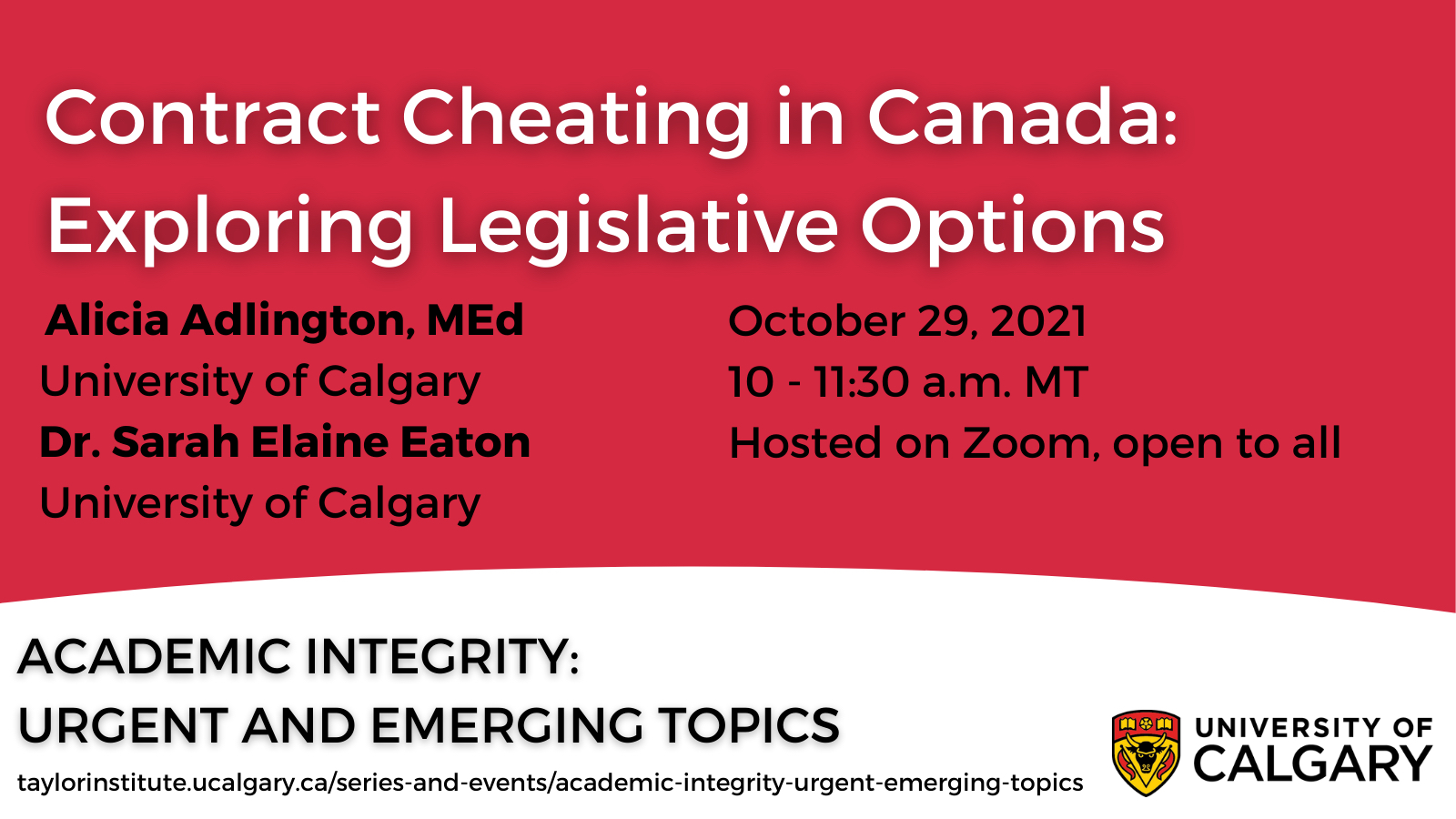
Webinar: Contract Cheating in Canada: Exploring Legislative Options

October 4, 2021

ACADEMIC INTEGRITY: URGENT AND EMERGING TOPICSJoin us for an introductory discussion about the commercial contract cheating industry (e.g., term paper mills, homework completion services, and paid imposters who take exams on behalf of students). One question people often ask is, “Why aren’t these services illegal?” The short answer is: Academic cheating services are not currently illegal in Canada, but they are in other countries. In this session we’ll provide an overview of which countries have successfully enacted legislation against predatory industry that profits from academic misconduct. We will provide an overview of the legal structures in Canada that might facilitate or present barriers to such legislation being enacted in this country. We do not promise answers or solutions to the complex issue of contract cheating, but instead provide an evidence-base for deeper discussion.

The intended audience for this session is primarily for those in Canada interested in contract cheating from the Canadian legal context. Participants from other regions are also welcome.

By the end of this session engaged participants will be able to: 

  • Describe what contract cheating is
  • Understand how legislation against contract cheating has been enacted in other countries
  • Discover legal aspects of contract cheating in Canada and beyond

Facilitators: Alicia Adlington &  Sarah Elaine Eaton, University of Calgary
Date: Friday, October 29, 2021
Time: 10:00 – 11:30 a.m. (Note: This is Mountain Time. Please convert to your local time zone)
Location: Online via Zoom

Please note: Registration will close on Wednesday, October 27, 2021, at 11:59 p.m. (MT) and a Zoom link for the webinar will be sent the morning of the workshop.

Register now

For more information, visit the website: https://taylorinstitute.ucalgary.ca/series-and-events/academic-integrity-urgent-emerging-topics

______________________

Share or Tweet this: Webinar: Contract Cheating in Canada: Exploring Legislative Options https://drsaraheaton.wordpress.com/2021/10/04/webinar-contract-cheating-in-canada-exploring-legislative-options/

This blog has had over 2 million views thanks to readers like you. If you enjoyed this post, please “like” it or share it on social media. Thanks!

Sarah Elaine Eaton, PhD, is a faculty member in the Werklund School of Education, and the Educational Leader in Residence, Academic Integrity, University of Calgary, Canada.

Opinions are my own and do not represent those of the University of Calgary or anyone else.


Ghost Grading: Part 2 – Examining Possible Legal Loopholes in Canada

September 7, 2021

In Part 1 of this series I talked about how contract cheating companies are now targeting professors and teaching assistants (TAs) to offer grading services. Since then, I have done a bit of digging into whether it is legal, or even permissible to outsource one’s grading responsibilities.

I figure if you are hired to for an academic role that includes teaching that would also including taking responsibility for grading and other duties related to assessment. Of course there are provisions to work with a TA in some courses, but TAs are also employees of the university and their work is approved by the institution. In cases like this, working with a TA is a perfectly legitimate activity and there is no deception. Ghost grading is different because it can happen without the knowledge or permission of the employer.

Ghost graders are unauthorized individuals, hired under the table, to perform academic duties that would otherwise be conducted by academic staff or teaching assistants.

Employing ghost graders also deceives students because they have no idea who is assessing their work or who has access to it. Just as educators expect students to complete their assignments themselves, without engaging a third party, so too, should students be able to expect their professors and teaching assistants to assess their work. If a professor or TA hires a ghost grader, the student has no idea what that individual or company might do with their work without their knowledge, such as re-sell it or share it to the contract cheating company or any other additional third party. You can start to see how the practice of using unauthorized ghost graders gets complicated fast. By hiring a ghost grader, educators are breaking trust with their students and their employers.

University faculty members at publicly-funded universities in Canada are often unionized. To my surprise, I found several examples of collective agreements and employment contracts that do not strictly prohibit the outsourcing or sub-contracting of one’s duties. I started with my own university. I searched for the terms “outsource”, “outsourcing”, “subcontract”, and “sub-contract” in our collective agreement for academic staff. I found no matches for these search terms. I reviewed the collective agreement and it was not immediately evident to me that there was any clause that specifically prohibits faculty members from outsourcing their job duties to a third party. (Please note: I am not a lawyer or an expert in contract law.)

I found this puzzling. I am the first to admit that I am not a lawyer, and nor am I an expert on labour laws, collective agreements or contracts. So, I reached out to the University of Calgary Faculty Association (TUCFA) on August 12, 2021 via e-mail to ask for clarification regarding outsourcing in University of Calgary’s collective agreement, but yet to receive a response. To be fair, I am quite sure they remain very busy with matters related to COVID-19 and I will update this blog post if I receive a reply from them.

Out of curiosity, I repeated the search and scan with the collective agreements for academic staff at the University of Alberta (Alberta, Canada), the University of British Columbia (British Columbia, Canada), and Queen’s University (Ontario, Canada) with similar results. As a non-expert, I could find no immediate evidence in any of them that it is prohibited to outsource one’s grading responsibilities, or any other employment duties, for that matter.

I should point out that I have not conducted an in-depth investigation into this. I am situated in Canada and I cannot speak to what happens in any other country. I did not conduct a scan of the collective agreements that cover teaching assistants, but I would not be surprised if the situation was the same.

Following my first blog post on this topic, I received a number of e-mails from individuals telling me stories of professors at their university (in Canada and elsewhere) who regularly outsource their grading duties, paying for services out of their own pocket or under a research grant, classifying them as “professional services”. This is all anecdotal and I cannot substantiate any of it.

What I can say is that it seems there may be a legal loophole, at least in Canada, that would allow contract cheating companies to wiggle into this new line of business of offering grading services to professors and teaching assistants. As with student contract cheating, the companies would not be at fault, particularly since there are no laws in Canada prohibiting these kinds of companies from operating. In other jurisdictions, were laws against contract cheating have been enacted, the focus has been on academic cheating, so there may be loopholes elsewhere that legally allow companies to reach out to faculty and teaching assistants to provide sub-contracting services.

Of course, no collective agreement or employment contract can be exhaustive of all the ways that an employee can engage in misconduct. It could be that there is no clause in these agreements that strictly prohibits outsourcing of work because it falls under a general category of employee misconduct that might be addressed on a case-by-case basis, with investigators considering numerous pieces of evidence and details. It seems bizarre to me that this particular loophole exists, because it has left post-secondary institutions vulnerable to exploitation from commercial third-party providers who profit from various forms of misconduct. And if faculty and teaching assistants do not know that it is unacceptable to outsource their work, then it seems reasonable to expect that some of them might fall prey to companies who promise to ease their stress and relieve them of aspects of their work that they find unrewarding or too time-consuming.

Contract cheating companies are infiltrating higher education faster than ever before; and they may have just found a whole new market for illicit academic outsourcing services with professors and teaching assistants being their target customer base.

Read more:

Ghost Grading: Part 1 – A New Twist on Contract Cheating

Related posts:

______________________

Share or Tweet this: Ghost Grading: Part 2 – Examining Possible Legal Loopholes in Canada – https://drsaraheaton.wordpress.com/2021/09/07/ghost-grading-part-2-examining-possible-legal-loopholes-in-canada/

This blog has had over 2 million views thanks to readers like you. If you enjoyed this post, please “like” it or share it on social media. Thanks!

Sarah Elaine Eaton, PhD, is a faculty member in the Werklund School of Education, and the Educational Leader in Residence, Academic Integrity, University of Calgary, Canada.

Opinions are my own and do not represent those of the University of Calgary or anyone else.


Why Universities and Colleges Need Clear Policies to Deal with Fake COVID-19 Vaccination Records and Test Results

August 17, 2021

Image courtesy of patrisyu at FreeDigitalPhotos.net

Image courtesy of patrisyu at FreeDigitalPhotos.net

With the new academic year just around the corner, universities and colleges are grappling with a return to campus. Some institutions are calling for mandatory vaccine requirements, and the list continues to grow. In Canada, for example, journalists are sharing news of this rapidly changing landscape on a daily basis. Here are just a few examples of news stories from major news outlets:

Just this morning, the President of the University of Calgary sent a campus-wide e-mail stating:

“Starting September 1, the University of Alberta, the University of Calgary, and the University of Lethbridge will require all those coming to campus to undergo regular rapid testing. Those who are fully vaccinated against COVID-19 are exempt from this requirement.

Students, faculty, and staff who are not fully vaccinated, and those who would prefer not to disclose their vaccine status, will need to regularly complete a rapid screening test and receive a negative result before they participate in in-person activities.

Any individual who cannot be tested or vaccinated based on medical or other protected grounds recognized by the Alberta Human Rights Act can request an accommodation.”

The e-mail was signed by all three Alberta university presidents:

  • Bill Flanagan, President and Vice-Chancellor, University of Alberta
  • Ed McCauley, President and Vice-Chancellor, University of Calgary
  • Mike Mahon, President and Vice-Chancellor, University of Lethbridge

I applaud this decision – wholeheartedly and unequivocally.

What was absent from this communication, and most of the communication I have seen about vaccine requirements on campuses, is what the consequences will be for falsifying vaccine documents. On August 9, the Associated Press published an article on how “Fake COVID-19 vaccination cards worry college officials” in the United States.

It is utterly naïve to think that fake COVID-19 test results or vaccination records are limited to the United States or other countries. These are already available for sale for Canadians. I will not include links to these services in this blog post because I do not want to give the impression that I am endorsing any of these services, but you can do a simple Internet search yourself to find out how easy it is to buy these in Canada.

One Canadian news report claimed that fake COVID-19 vaccine passports were available for purchase online for as little as $12. That’s about the same cost as a box of donuts and a couple of coffees from a popular Canadian donut chain restaurant.

A critical question that remains unanswered is: What are the consequences for presenting fake or fraudulent COVID-19 documents on our campuses?

For staff and professors, I expect that human resources departments will be involved. For students, I expect that presenting fake COVID-19 would be a violation of student conduct rules (e.g., academic or non-academic misconduct). What is unclear is how such cases will be dealt with.

Falsifying COVID-10 vaccination status or test results is a willful act of dishonesty and needs to be treated as such.

I contend that such consequences need to be articulated through institution-wide policies and procedures and must be consistent across the institution. For example, it would be ridiculous for a student in arts to receive a warning and a student in science to receive an expulsion for the same offence of presenting a fake COVID-19 vaccination record. Similarly, it would diminish public trust in the institution if contract-based staff were dismissed from their employment for presenting faked COVID-19 documents, but tenured faculty members or administrators received a warning.

Universities and colleges need to take a strong and public stance on the issue of fake COVID-19 documentation.

This is no time to hide behind political-speak such as, “Violations will be addressed on a case-by-case basis” or “We do not expect this to be a problem”. This is a time for universities and colleges to communicate clear and firm expectations that presenting accurate and honest information regarding COVID-19 vaccination status or test results is essential for upholding the academic integrity and ethical standards. In addition, institutions need to develop and communicate clear and firm consequences for presenting fake or falsified COVID-19 documents.

Further, it would be useful for institutions to track and report on misconduct that occurs related to COVID-19, for all campus stakeholders including students, staff, faculty, and administrators and report back to the community on how cases are addressed. This is a not only a matter of public interest, it is a matter of public health. Lives are literally at stake.

Related posts:

______________________

Share or Tweet this: Why Universities and Colleges Need Clear Policies to Deal with Fake COVID-19 Vaccination Records and Test Results – https://drsaraheaton.wordpress.com/2021/08/17/why-universities-and-colleges-need-clear-policies-to-deal-with-fake-covid-19-vaccination-records-and-test-results/

This blog has had over 2 million views thanks to readers like you. If you enjoyed this post, please “like” it or share it on social media. Thanks!

Sarah Elaine Eaton, PhD, is a faculty member in the Werklund School of Education, and the Educational Leader in Residence, Academic Integrity, University of Calgary, Canada.

Opinions are my own and do not represent those of the University of Calgary or anyone else.