Signature pedagogies for e-learning in higher education and beyond

March 6, 2017

http://hdl.handle.net/1880/51848

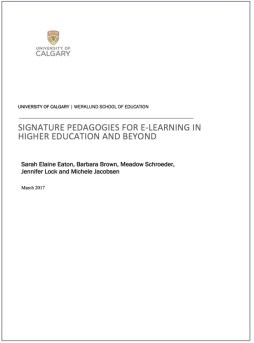
This report explores the notion of signature pedagogies within the field of e-learning for higher education. We build on previous work that examined signature pedagogies in education, linking the concepts of signature pedagogies, the profession of education and e-learning as a means to help educators develop their practice and understanding of the profession.

Background

In November 2016, approximately thirty scholars, practitioners, industry leaders and government officials assembled at The White House for the “Technology in English” event, which was a collaborative effort between The White House Office of Global Engagement and the U.S. Department of State, Bureau of Educational and Cultural Affairs, Office of English Language Programs. The event was part of the inter-agency English for All initiative, announced by President Obama earlier in 2016 (United States Department of State, 2016). The purpose of the event was to gather together individuals with combined expertise in educational technology and English language learning and teaching. Sarah Elaine Eaton, one of the authors of this report, was among those invited to take part in The White House event.

One outcome of the meeting was a commitment to develop a prototype or resource that would serve as an Open Educational Resource (OER), not only for participants of programs sponsored by the U.S Department of State, and educators generally. The project is to be presented at the TESOL 2017 International Convention and English Language Expo in Seattle, Washington State.

In addition, experts were invited to develop and contribute additional resources that would benefit educators in their professional development. This report was prepared as an additional Open Educational Resource for use by those interested in developing their knowledge of signature pedagogies for e-learning in education.

Here is a citation for the report, which you can download for free online:

Eaton, S. E., Brown, B., Schroeder, M., Lock, J. & Jacobsen, M. (2017). Signature pedagogies for e-learning in higher education and beyond. Calgary: University of Calgary. Retrieved from http://hdl.handle.net/1880/51848

____________________________________________________

Share this post: Signature pedagogies for e-learning in higher education and beyond http://wp.me/pNAh3-1MP

This blog has had over 1.8 million views thanks to readers like you. If you enjoyed this post, please “like” it or share it on social media. Thanks!

Sarah Elaine Eaton is a faculty member in the Werklund School of Education, University of Calgary, Canada.


The Administration of English as a Second Language (ESL) Programs: Striking the Balance Between Generating Revenue and Serving Students

December 30, 2012

Critical Perspectives on International Education Sarah EatonI am squealing with joy to share this news with you. Four years ago, Dr. Yvonne Hébert, a professor of Education at the University of Calgary invited me to submit a chapter for a book she was co-editing with her colleague, Dr. Ali Abdi.

I submitted a chapter that focused on the difficulties managers of ESL / EFL programs face when it comes to the pressures they face to generate revenue for their institutions and focussing on students’ learning.

You would think that an administrator’s first priority should be to serve students. Morally and ethically that may be true. In terms of practicalities, the reality can be quite different. Many program administrators face great pressure to “put bums in seats”. This chapter addresses some of those difficulties.

“The Administration of English as a Second Language (ESL) Programs in Higher Education: Striking the Balance Between Generating Revenue and Serving Students” (pages 149-162) is my contribution to the new book called Critical Perspectives on International Education that has just been published by Sense publishers in Rotterdam.

The book is now available in paperback and hardcover:

ISBN Paperback: 9789460919046 ($ 49.00)
ISBN Hardcover: 9789460919053 ($ 99.00)

It may also become available as an e-book in 2013.

There has been so little published about the difficulties that English language program leaders face in terms of the moral, ethical and business decisions they must make every day in their administrative roles. More conversations and dialogue need to happen to help managers and directors make wise decisions.

_________________

If you enjoyed this post, please “like” it or leave a comment. Thanks!

Share or Tweet this: The Administration of English as a Second Language (ESL) Programs: Striking the Balance Between Generating Revenue and Serving Students http://wp.me/pNAh3-1xR

Update – January 2018 – This blog has had over 1.8 million views thanks to readers like you. If you enjoyed this post, please “like” it or share it on social media. Thanks!

Sarah Elaine Eaton is a faculty member in the Werklund School of Education, University of Calgary, Canada.


What makes a good research question?

November 6, 2012

This week I posed a question to my students: What makes a good research question?

As Masters of Education students, they are learning about what it means to be a researcher and building a foundation of knowledge. They came up with some great resources this week. If you are looking for answers to this question, check out these great resources:

Sarah Eaton blog leadershipSonia Ospina’s entry in the Encyclopedia of Leadership on Qualitative Research

This is a 13-page document, available free in .pdf format. Published in 2004, this text shares some of the fundamentals of qualitative research, particularly as it pertains to leadership. It is also very useful for students and researchers working in education and other social sciences. It contains an extensive bibliography that serves as a great point of departure for more exploration. Link for this resource: http://ualr.edu/interdisciplinary/files/2010/03/Qualitative_Research.pdf

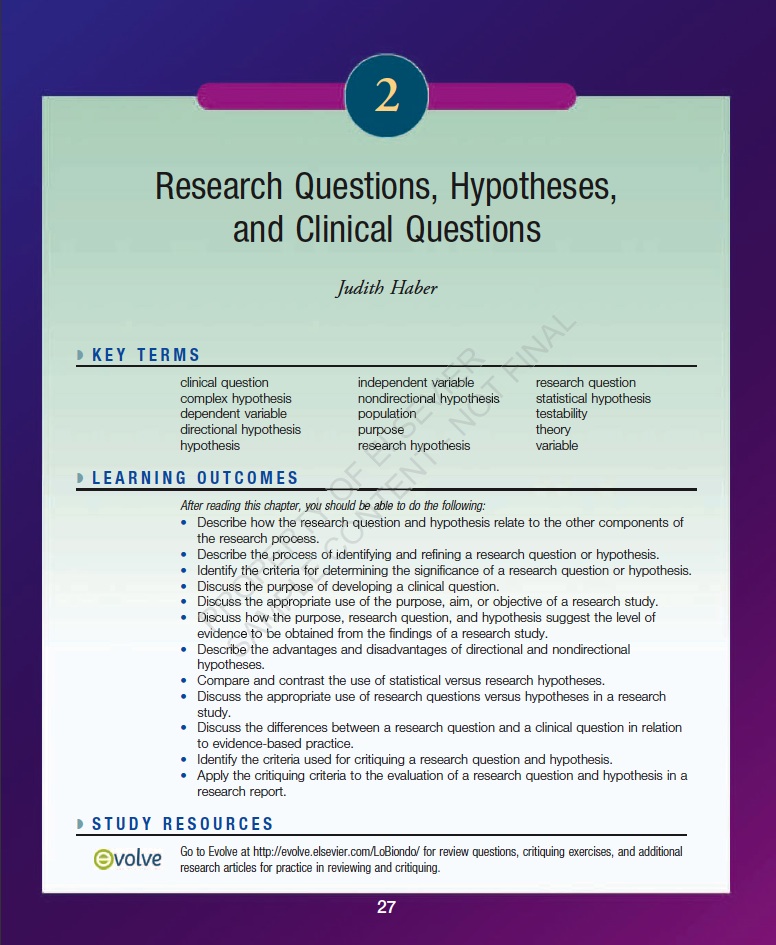
Sarah Eaton blogJudith Haber’s chapter called “Research Questions, Hypotheses and Clinical Questions”

Though marked as “Sample – Not final” with a watermark on the .pdf, this is an incredible 29-page resource that includes flow charts and tables of information. It is easy to understand and written in language that most novice researchers could understand. This one quickly became a favorite because it was colorful and concise. Even though it appears to be written for students and practitioners of health research, there are many elements that may be useful to educators and social science researchers, too. Link for this resource: http://www.us.elsevierhealth.com/media/us/samplechapters/9780323057431/Chapter%2002.pdf

Companion for Undergraduate Research

This is a website (http://www.socscidiss.bham.ac.uk/) that outlines the characteristics of a good research question. Then it talks about each characteristic in detail. It is written in clear language and is very well organized. The page also contains links to other helpful resources on research.

Figuring out how to craft a research question can be tricky. Resources like these help to demystify the process.

______________

Share or Tweet this: What makes a good research question? http://wp.me/pNAh3-1vL

Update – January 2018 – This blog has had over 1.8 million views thanks to readers like you. If you enjoyed this post, please “like” it or share it on social media. Thanks!

Sarah Elaine Eaton is a faculty member in the Werklund School of Education, University of Calgary, Canada.


Business as a creative force that can make the world better

September 9, 2011

The other day I was having a conversation with a colleague about how universities have made drastic changes in how their operational and leadership models in recent years. The change is especially apparent in the Humanities, where scholars are deeply, viscerally offended by the idea of the numbers of “bums in seats” as being an indicator of a faculty’s success.

My friend remarked, “It’s totally a business model!”

I cringed, as I often do, when I hear remarks like that. I’ve worked in post-secondary institutions, with non-profit organizations, with small businesses and entrepreneurs and yes, even with corporations.

I replied, “That’s not a business model. It’s the worst aberration of business. It’s a business model in its most hideous and grotesquely mutated form.”

Don’t get me wrong. There is no doubt in my mind that some businesses exploit their workers, their customers and anyone else they can. There are some businesses who mistreat and abuse their employees. There are some businesses who misreport their numbers and mismanage their money. There’s no denying that.

But not all businesses are that way. In his book Good to Great, Jim Collins looks at the qualities that differentiate good businesses from truly great ones. He describes the characteristics of both and then goes on to give examples from industry. It’s a book that many business people know well. While he talks about profit as being one key indicator of success in business, it is not the only key factor. In fact, as the author points out, companies that are driven purely by profit often never make the leap from good to great.

Collins wrote a subsequent work that is less well known, though equally brilliant. Good to Great in the Social Sectors looks at what makes an organization — any organization — great. He shows what he means by focussing on schools, non-profits and other social sector organizations, demonstrating how we can define success in ways that have nothing to do with generating profit. In fact, he says that business can learn a lot from non-profit organizations.

Business isn’t always the great evil that those who work in education and non-profit think it is. The problem is that they see the worst mutations of business practices being employed as leadership models. When that is the case, how could they think anything else?

David Cooperrider, known to many as the “father” of Appreciative Inquiry wrote an article worth reading. “Business as an Agent of World Benefit: Awe is What Moves Us Forward” (It’s available as a free download. It’s 7 pages and it is worth reading.) In it he talks about trends in the business world relating to ethical business, green business and corporate social responsibility, ultimately arguing that business has the potential to unleash wildly creative, progressive, helpful and powerfully transformative change in the world.

I sometimes challenge my academic colleagues to talk to their spouses and friends who work in corporations about concepts like corporate social responsibility, ethics, green business practices and how their corporations are finding ways to give back to the community. It’s surprising how many people in the corporate world volunteer for community events and are committed to practices such as recycling, pursuing innovation and being creative in their work.

Educational administrations seem to be adopting the worst aberrations of business management models, becoming more self-absorbed, more self-serving and less caring, while business itself is evolving past those models and becoming more responsible, more ethical and pursuing excellence and creativity more diligently than some educational institutions.

Ironic, no?

________________________________________________

Share this article: Business as a creative force that can make the world better http://wp.me/pNAh3-RV

Update – January 2018 – This blog has had over 1.8 million views thanks to readers like you. If you enjoyed this post, please “like” it or share it on social media. Thanks!

Sarah Elaine Eaton is a faculty member in the Werklund School of Education, University of Calgary, Canada.