What makes a good research question?

November 6, 2012

This week I posed a question to my students: What makes a good research question?

As Masters of Education students, they are learning about what it means to be a researcher and building a foundation of knowledge. They came up with some great resources this week. If you are looking for answers to this question, check out these great resources:

Sarah Eaton blog leadershipSonia Ospina’s entry in the Encyclopedia of Leadership on Qualitative Research

This is a 13-page document, available free in .pdf format. Published in 2004, this text shares some of the fundamentals of qualitative research, particularly as it pertains to leadership. It is also very useful for students and researchers working in education and other social sciences. It contains an extensive bibliography that serves as a great point of departure for more exploration. Link for this resource: http://ualr.edu/interdisciplinary/files/2010/03/Qualitative_Research.pdf

Sarah Eaton blogJudith Haber’s chapter called “Research Questions, Hypotheses and Clinical Questions”
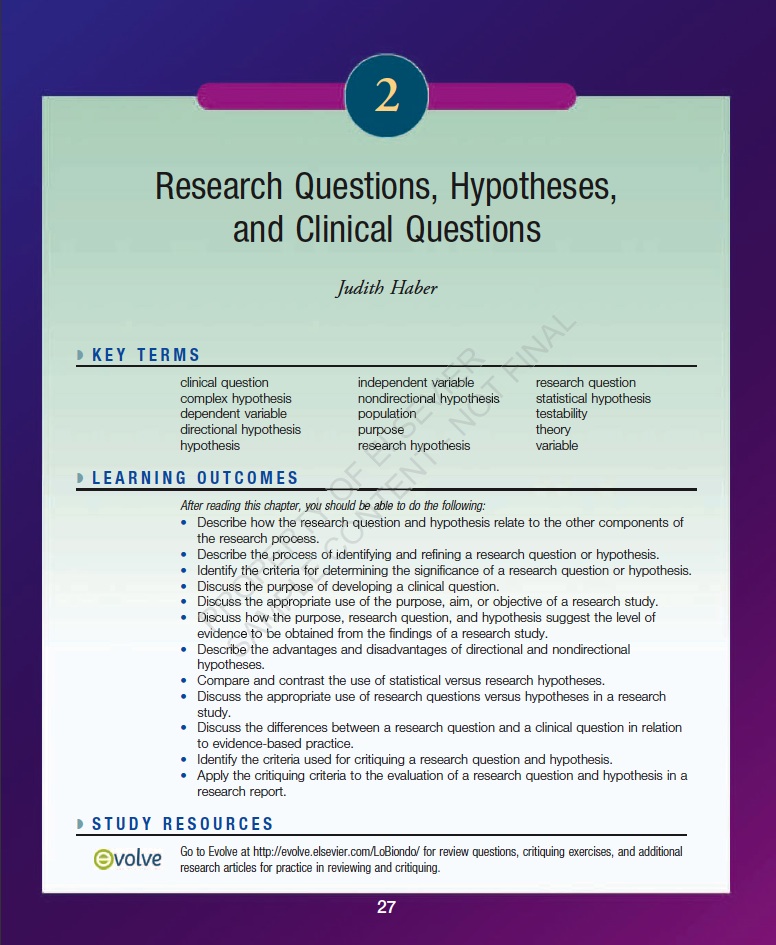
Though marked as “Sample – Not final” with a watermark on the .pdf, this is an incredible 29-page resource that includes flow charts and tables of information. It is easy to understand and written in language that most novice researchers could understand. This one quickly became a favorite because it was colorful and concise. Even though it appears to be written for students and practitioners of health research, there are many elements that may be useful to educators and social science researchers, too. Link for this resource: http://www.us.elsevierhealth.com/media/us/samplechapters/9780323057431/Chapter%2002.pdf

Companion for Undergraduate Research

This is a website (http://www.socscidiss.bham.ac.uk/) that outlines the characteristics of a good research question. Then it talks about each characteristic in detail. It is written in clear language and is very well organized. The page also contains links to other helpful resources on research.

Figuring out how to craft a research question can be tricky. Resources like these help to demystify the process.

______________

Share or Tweet this: What makes a good research question? http://wp.me/pNAh3-1vL

Update – January 2018 – This blog has had over 1.8 million views thanks to readers like you. If you enjoyed this post, please “like” it or share it on social media. Thanks!

Sarah Elaine Eaton is a faculty member in the Werklund School of Education, University of Calgary, Canada.


Is your research biased? Answer: Yes. (Here’s why.)

October 29, 2012

Sarah Eaton blog technology researchThis semester I am teaching a course on Research Methodology in Education. One of the topics that has come up is bias.

Bias is present is bascially every research study. Even though we strive to be objective — and that is part of our work, we nevertheless start with a set of values, beliefs and philosophies that shape our opinions and world view.  It is important for reasearchers to understand the biases they bring to their work and to acknowledge them.

For example, one of my biases is that I hold is that everyone is capable of learning. Not everyone is capable of earning a Ph.D. (for any number of reasons), but everyone is capable of learning something. This is one of my values and beliefs that shapes my work. If I am an honest researcher, I must declare and acknowlege that bias when I do research. It is one thing to have and acknowledge bias. It is an entirely different matter to purposely bias our research in favor of a particular outcome or do research just to prove a point.

There are two ways to approach research:

Approach #1 – Conduct research in a manner that supports your argument

The first is to start with an argument or a position and conduct research and find literature that supports your point of view.

Though some scholars might disagree, I would submit that is an undesirable starting position. The reason is that you are likely to skew either your research or your results so they fit with your argument. Forcing results to fit to a pre-determined argument may be considered unethical. For example, pharmaceutical companies that conduct drug tests in order to prove the drug is safe and refuse to release research that may contradict that starting point are harshly criticized. Such research is not considered believable because it is skewed.

Approach #2 – Start with a research question, hypothesis or topic. Conduct your research in a manner that seeks to answer a question.

The second way to approach you research is to begin with a problem you want to solve or a question you want to answer. Then, you conduct your research in a manner that seeks to answer your research question. Once you have conducted your research, your argument emerges from your data.

The data is the information that you gather that allows you develop a cogent argument to persuade others. You can gather primary data (e.g. interviews) or secondary data (e.g. literature review).

Part of a research study almost always involves a review of previous literature written on the topic you are studying. In your literature review, it is valuable to cite opposing views. Once you have considered your question or problem from a variety of angles, then you can begin to develop an argument, based on your findings. Considering a variety of viewpoints is highly desirable as it demonstrates that you are not attempting to skew your results in favor of a pre-determined outcome.

Be aware that just because you start your research with a particular question or topic, it is unwise to assume that your starting position is the correct one. Be curious, rather than dogmatic. What themes emerge from the literature that you surveyed? What surprised you? What arguments can be made? What conclusions can be drawn?

In my own research, it has happened to me that I start with a research question, problem or hypothesis and as I surveyed the literature, my hypothesis was proven to be incorrect. Be prepared for that to happen. It does not mean you are a bad researcher. Quite the contrary, it means you have allowed your hypothesis or question to be challenged and your research is driven by the data you find.

We may come to our work with a bias. But ultimately, the research needs to speak for itself. That’s what makes it credible.

______________

Share or Tweet this: Is your research biased? Answer: Yes. (Here’s why.) http://wp.me/pNAh3-1vw

Update – January 2018 – This blog has had over 1.8 million views thanks to readers like you. If you enjoyed this post, please “like” it or share it on social media. Thanks!

Sarah Elaine Eaton is a faculty member in the Werklund School of Education, University of Calgary, Canada.


UNESCO’s free advocacy kit for promoting multilingual education

October 24, 2012

UNESCO multilingualism Sarah Elaine Eaton blogUNESCO has a number of initiatives on the go to promote multilingual, bilingual and mother-tongue education. They have come out with a new advocacy kit designed to help raise awareness about the importance of multilingual education. The toolkit is for:

  • education practitioners (teachers)
  • education specialists (learning leaders)
  • policy makers

The kit is a 109-page free, downloadable .pdf. It is very cool. Get yours here.

______________

Share or Tweet this: UNESCO’s free advocacy kit for promoting multilingual education http://wp.me/pNAh3-1vs

Update – January 2018 – This blog has had over 1.8 million views thanks to readers like you. If you enjoyed this post, please “like” it or share it on social media. Thanks!

Sarah Elaine Eaton is a faculty member in the Werklund School of Education, University of Calgary, Canada.


Doing work that matters: Letting values drive how you earn your living… and love your life.

September 27, 2012

Sarah Elaine Eaton leadership speakerAbout a year and a half ago I made a decision that changed my life, both professionally and personally. I made a decision to “do work that matters”; and more specifically, to ONLY “do work that matters”. That is a pretty fuzzy concept and people close to me did not hesitate to let me know.

A good friend with a shrewd business sense who has a high-level position in corporate Calgary put the screws to me by saying, “That’s all well and good, but how do you plan to get ‘work that matters’? Shouldn’t you really define what that means before you decide that you are going to do that and only that? Besides, you are an entrepreneur. Sometimes you have to do work that pays the bills.”

I knew that for too long, I had done work that pays the bills.  Modesty aside, I have a fair number of employable skills, including office skills, technical skills and writing and editing skills. I have also spent almost two decades teaching and facilitating. Then there is the research work… But something shifted. I felt compelled to stop focussing on the skills I have, and start focussing on the values I hold.

I also knew she was right about defining what “work that matters” means. So I asked myself, “What matters?” Here is my answer:

  • Doing work that relates specifically to education, leadership, community and literacy.
  • Working with others to create transformative change for the better.
  • Building capacity in others, helping them grow and realize their potential.
  • Using a strength-based, asset-based approach in all my work.
  • Working with like-minded, highly capable people who share similar values.

The last one turned out to be the most important. Not long after I declared that doing strength-based work matters deeply to me, I was asked to do a project focussed on a Needs Assessment. That is really a fancy term for, “Help us figure out what we need.” The idea is that after the needs have been identified, that you can go about meeting the needs.

A strength-based approach says, “Let’s start by assessing what we already have. Let’s start with the question, what is working well?”

This kind of thinking turns everything on its head. When you insist on examining what is already working well and conducting an inventory all your assets, the result is strangely powerful. The conversation shifts away from what is lacking, what is wrong, what problems there are to be fixed and how terrible things are, to a conversation deeply rooted in strength, resilience and hope.

I started having conversations with friends and colleagues about using strength-based approaches at work, at home and in just about any situation. At first, the conversations were difficult and awkward. I felt like people thought I was naive and out of touch with the real work. I kept reading and educating myself on the notion of asset-based approaches to work, community, leadership and education.

I started partnering with others who were interested in doing similar kinds of work. We began looking at Requests for Proposals (RFPs) for projects that we thought were a precise fit with both our technical skills and our values, in terms of using a strength-based approach to our work.

I can’t give exact details yet because we have not signed the contract yet, but I got word this week that I will get to lead a team of consultants on a major project that fits with all the values that I outlined just over a year ago. The work is amazing. The people we will get to work with are visionaries. The possibility for change is high.

We have all the technical skills we need to do the job. That was not enough though. What ultimately landed us the contract was our clear emphasis on our values. We put a stake in the ground and said, “This is who we are and what we stand for!” Every single one of the values I outlined above come into play for this project.

I think I have finally figured out that a combination of excellent technical skills, solid experience and unapologetic declaration of values is really what allows a person to love the work they do… and do work that matters.

_______________

Share or Tweet this: Doing work that matters: Letting values drive how you earn your living… and love your lifehttp://wp.me/pNAh3-1uE

Update – January 2018 – This blog has had over 1.8 million views thanks to readers like you. If you enjoyed this post, please “like” it or share it on social media. Thanks!

Sarah Elaine Eaton is a faculty member in the Werklund School of Education, University of Calgary, Canada.


Social Media in a Family Literacy Program (Slides)

September 25, 2012

I noticed the other day that I never posted the slides from this presentation that I did last year at the annual conference of the Centre for Family Literacy, so I am posting them now. (Better late than never!)

Social media in a family literacy program from Sarah Eaton
_____________________

Share or Tweet this: Social Media in a Family Literacy Program (Slides) http://wp.me/pNAh3-1uG

Update – January 2018 – This blog has had over 1.8 million views thanks to readers like you. If you enjoyed this post, please “like” it or share it on social media. Thanks!

Sarah Elaine Eaton is a faculty member in the Werklund School of Education, University of Calgary, Canada.