Pastel de Tres Leches – a la canadiense

June 8, 2011

Every semester, I like to close my language classes with a fun activity. Years ago, I used to arrange for a field trip to a local Mexican restaurant. However, times have changed and such field trips now require reams of paperwork and releases… even for adult education classes. So now we have a pot luck in class. This week, my adult education Spanish class wraps up and I decided to make my pastel de tres leches.

If you’ve never had it, then “three milk cake” or “cake soaked in 3 milks” could sound kind of disgusting, I guess. But once your taste buds have experienced the beauty that is pastel de tres leches you never forget it.

There are loads of food blogs out there and don’t worry, this blog is in no danger of becoming one of them. But every now and again, you need to do something different. Since “language” is in the title of the blog, and teaching culture is an important aspect of teaching the language, I’m taking a one-dime detour to include some Latin American culinary culture (with a Canadian twist, just because we’re so obsessed with multiculturalism here.)

This post is dedicated to my adult education Spanish students this semester and to all the language teachers around the globe who are also wrapping up the end of a semester. Many of you, no doubt, will also be making some kind of dish to share with your students. (Feel free to leave a comment and share your dish with us!)

Pastel de Tres Leches

Background and Culture

The first time I heard about pastel de tres leches, it was from an Argentinian friend who raved about it. With eyes rolling back in his head and drool dripping from his mouth as he described it, he said it was famous in Argentina.

Central American friends vehemently deny that claim and assert that it originated much further north.

I’ve worked in Venezuela, Honduras, Cuba and Mexico and personally, I’ve never seen this pastel in any of those places! I’m sure it exists, but I’m not certain who has the real claim to its origin.

Step 1 – Plan ahead

Decadence comes with a price. In this case, the price is time. Ideally, your cake will need to rest for about 24 hours to soak in the goodness of the tres leches.

Step 2 – Prepare and bake the cake

Here is the recipe I use for the cake:

1 1/2 cups (375 ml) all-purpose flour

1 Tbs (15 ml) baking powder

1 Tbs (15 ml) cinnamon

4 eggs, separated

1 1/2 cups (375 ml) sugar

1/2 cup (125 ml) milk

For the topping:

1 12-oz (335 g) can evaporated milk

1 14-oz (390 g) can sweetened condensed milk

2 cups (500 ml) milk

1 cup (250 ml) sugar

1 tsp (5 ml) vanilla extract

Sift the flour with the baking powder.  In large bowl beat the egg whites until frothy.  Add the sugar gradually, beating to form stiff peaks.  Add the yolks one at a time.  Slowly add the flour and milk.

Pour the batter into a grease and floured 13x9x2-inch (33x23x5-cm) baking pan and bake in a preheated 350F (180C) oven until edges are golden brown, about 40 to 45 minutes.  Remove from the oven and let cool on a wire rack.

For the topping, combine the three milks with the other ingredients, stirring until smooth.  Pour the topping over the cake and let sit until all the mixture is absorbed (at least 3 hours, but a full day is better).  Serves 8 to 12.

Pastel de Tres Leches

The recipe calls for a 9 x 13 pan. This is a 9 x 9 pan… and I made a smaller cake with the extra batter.

Step 3 – Add a cranberry compote to make it “a la canadiense”

I was inspired by this recipe. I adapted it this way:

Cranberry Compote

This, for me, is what makes this recipe “a la canadiense”. I remember when I was about 11 years old, growing up in Halifax one cold Saturday in November we went cranberry picking near the beach outside off town. It was one of the coldest, dampest days I ever remember. Our fingers froze. Our buckets seemed to take forever to fill. I’d filled buckets with blueberries loads of times during the summer, but picking cranberries along the beach, with icy wind whipping around you in November is a different experience entirely.

I’m sure my mother and her friends thought it would be a wonderful experience for us kids to know where cranberries came from and to experience picking them ourselves. But even the mothers decided that once was enough and we never repeated the experience.

Now, whenever I buy a cranberries, I always make a mental note to thank whoever picked them. It’s a thankless job, really.

1 bag of frozen or fresh cranberries (about half a kilo or 1 lb.)

1 – 2 tsp of cinnamon

1/2 cup water

1 to 2 cups of sugar (depending how sweet you like it)

rind of 1 orange

1 Tbsp of cornstarch, diluted in about 1/4 cup of warm water

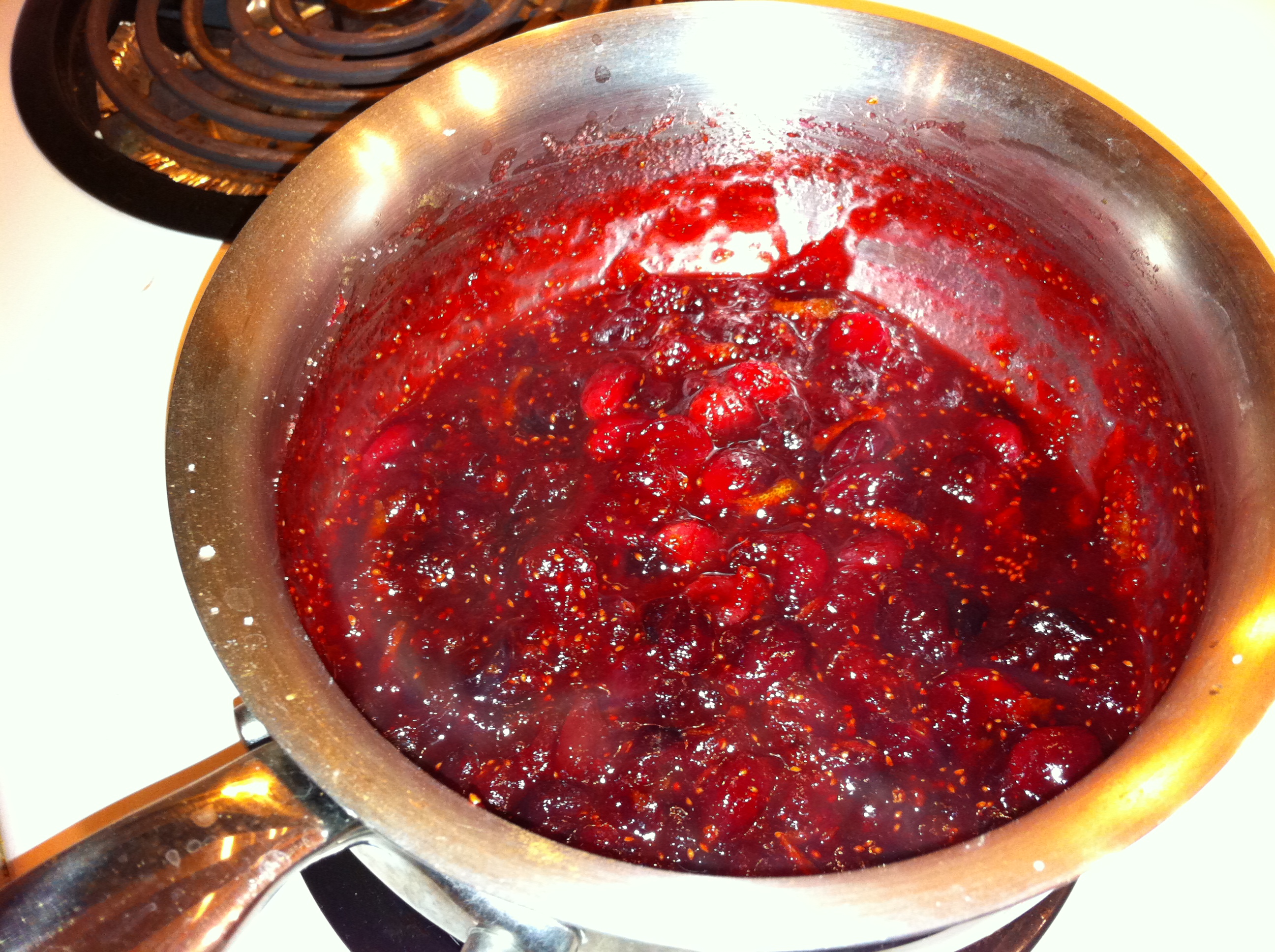
Cook the cranberries, sugar, cinnamon, water and orange rind in a saucepan until it reduces in to a nice compote. Add the cornstarch in water at the end to thicken it up a bit. This is what it looks like as you’re cooking it:

Cranberry compote

And this is the final version:

Cranberry compote - finished

Step 4 – Serve and enjoy

Serve the cake with the compote and enjoy.

Variations on this recipe include serving it with a meringue topping or whipped cream.

_______

Share this post: Pastel de Tres Leches – a la canadiense http://wp.me/pNAh3-Ji

Update – January 2018 – This blog has had over 1.8 million views thanks to readers like you. If you enjoyed this post, please “like” it or share it on social media. Thanks!

Sarah Elaine Eaton is a faculty member in the Werklund School of Education, University of Calgary, Canada.


Job Opportunity: Summer Research Assistant – Specialist in Second Languages

June 2, 2011

June 15, 2011 – Update – This position has been filled. Thanks for the many responses and queries!

_________

I have a project on the go that examines questions around second language education, L2 acquisition and language learning and pedagogy. I’m looking for a part-time research assistant / associate to collaborate on this project over the summer months. Here’s what I’m looking for:

Research Assistant / Associate (Term position)

Summary statement

The Research Assistant / Associate is responsible for assisting the Principal Investigator (PI) in the collection, formatting, analysis and reporting of information on topics relating to second and other language acquisition, language pedagogy and related topics.

Major Responsibilities

  • Plans, organizes and coordinates his or her own schedule to ensure that deliverables are met by due dates.
  • Liaises with the PI for the collection, formatting, analysis and reporting of information.
  • Conducts a literature review using primarily online academic, government and other databases.
  • Data entry of bibliographic information using Endnote.
  • Maintains electronic and hard copy data files and reports.
  • Maintains up-to-date documentation of work completed.
  • Produces written materials for research reports.
  • Proofreads and edits documents generated by the PI.
Meets with the PI on a regular basis to review the work in progress.
  • Deliver work completed on a weekly basis. These deliverables will generally consist of research articles, government reports, applied research articles and professional materials that can contribute to the research report.

Education

Post-secondary degree. Candidates who are currently enrolled in a Master’s or PhD program will be given preference.

A background in second language learning or second language education is highly desirable.

Experience and Skills

  • Experience working with electronic research databases.
  • Previous research experience (e.g. conducting a literature review) is desirable.
  • High levels of personal motivation, self-management and detail-orientation. The incumbent will have the ability to take responsibility to meet deadlines and make progress with minimal supervision.
  • Strong spoken and written communication skills.
  • Rigorous research methods.

Other qualifications

  • You have access to academic research databases through the library of an accredited institution.
  • Strong existing technology skills with MS Word (or Pages), Endnote and general Internet and electronic communications.
  • You are comfortable navigating the Internet to conduct research.
  • You are able to meet face-to-face in the Calgary area on a regular basis or via Skype if you are not located in the Calgary area.
  • You have access to your own computer and the Internet.
  • Must be legally entitled to work in Canada and have a valid Social Insurance Number.

Position Details

Start date: Monday, June 13, 2011
End date: Friday, August 5, 2011

Hours: Generally flexible hours – 5 to 15 hours per week, with a minimum of 5 hours per week.

Wage: $25 / hour, to a maximum of 80 hours ($2000) during the term of the project. Wages are subject to the usual CPP and EI deductions.

Work site: You will work from your own home, on campus or anywhere the work can be completed.

To apply send a brief resume and cover letter via e-mail to:

Dr. Sarah Elaine Eaton
Eaton International Consulting Inc.
sarahelaineeaton (at) gmail.com

Applications are accepted until a suitable candidate is found.

Download a copy of this document for easy printing from:

View this document on Scribd

______________

Share this post: Job Opportunity: Summer Research Assistant – Specialist in Second Languages http://wp.me/pNAh3-HR


You thought Canada was a literate country? Think again

May 26, 2011

In 2003, the International Adult Literacy Skills Survey (IALLS) tested more than 23,000 Canadians in four areas:

  • prose literacy
  • document literacy
  • numeracy
  • problem-solving

Proficiency was rated on the basis of levels one to five, that is, lowest to highest. Level 3 corresponds roughly to high school completion.

In case you’re wondering what this test was all about anyway… IALLS is the Canadian component of the “Adult Literacy and Life Skills” study, which was a joint project of the Government of Canada, the US National Center for Education Statistics and the Organisation for Economic Co-operation and Development (OECD). The larger study was an international undertaking, involving thousands of people from numerous countries. In the literacy world, it’s a big deal. The results are a big deal for all of us Canadians. We have more work to do to raise the bar for all Canadians.

Literacy isn’t a black and white issue. It’s not a matter of “You can read” or “You can’t read”. There’s a continuum. Skills can be built at any time over the life span. They can also decline if we don’t use them.

Sad blonde girl with bookThere is an idea out there at literacy is “an immigrant problem.” Well, folks, it’s a myth. While it’s true that about 60% of new immigrants to Canada scored below Level 3 on the IALSS test, there are tens of thousands of people born right here in Canada who lack sufficient literacy skills.

One shocking result of the test?

2% of Canadian born university-educated individuals scored at the lowest level of prose literacy.

We have to ask ourselves: How are we allowing these people to slip through the cracks, grade after grade and year after year? How is it that someone born in Canada can graduate with an undergraduate degree when they score at the lowest level possible on an international literacy test? Although those results are troubling, some might argue that those people are the exception, that they are the outliers on the bell curve of test results.

Before you write off the stats as being an exception, think about this result:

About 37% of the total Canadian-born population scored below Level 3 in prose literacy.

In other words, about 9 million Canadian-born adult citizens lack sufficient literacy skills to function in the workplace.

Let’s put that into perspective for a minute.

9 Million people…

That’s the entire population of Nova Scotia. Multiplied by 9.

The number of people killed during the Russian Revolution over half a decade from 1917-1922.

The number of people in the UK who are Deaf or Hard of Hearing.

The number of people who follow Justin Bieber on Twitter.

Just under the total number of people in the entire world who suffer from hunger.

However you look at it, 9 million is a lot of people.

What can we do, Canada, to raise the bar for literacy?

References:

http://www.statcan.gc.ca/daily-quotidien/051109/dq051109a-eng.htm

Related posts

Canada’s 9 Literacy and Essential Skills http://wp.me/pNAh3-qi

Literacy and Essential Skills (video) http://wp.me/pNAh3-y

“The Teacher Who Couldn’t Read” http://wp.me/pNAh3-H1

_________________

Share this post: You thought Canada was a literate country? Think again http://wp.me/pNAh3-G7

Update – January 2018 – This blog has had over 1.8 million views thanks to readers like you. If you enjoyed this post, please “like” it or share it on social media. Thanks!

Sarah Elaine Eaton is a faculty member in the Werklund School of Education, University of Calgary, Canada.


How to Get a Spectacular Speaker for Your Next Literacy or Language PD Event

April 26, 2011

Sarah Elaine Eaton - Ontario Literacy Conference speaker 2010I’ve had some conversations recently with colleagues looking for speakers for conferences, professional development (PD) events or workshops. They’ve said that they don’t really know where to start looking and find themselves in that classic quandary… “We need someone good… Really, really good… And we have a limited budget!” Where to start?

In 2010 I was inducted into the Canadian Association of Professional Speakers (CAPS) and I realized that there’s a big gap, a chasm almost, between the world of corporate meeting planners and the non-profit volunteer conference organizing committees. I talk to dozens of professional speakers who are aching to speak at more non-profit and educational events… and volunteer organizers who just don’t know where to find great speakers. There must be a way to get both groups connected!

Here are some tips that may help…

Decide on your budget

Whether you’re working with an entire committee or you’re one person charged with the responsibility of finding an amazing speaker, you’ll want to figure out how much you have to spend. Your budget will generally include two parts:

  • Speaking fee
  • Travel and accommodation

Some speakers have an “all in” fee that includes travel, meals and accommodation. Keynote speeches for non-profit events start at about $500 and go up to $10,000. The fee is often a combination of what the organization can afford and the speaker’s rates. $5000 for a keynote speaking fee is about average, but there is a great deal of variance.

Prospective clients sometimes ask me if I will speak for free. The answer is yes, but there are some rules.

Have a clear idea of what kind of speaker you want

Every event wants someone “good”, but what does that mean to you? Do you want your speaker to entertain, educate or both? Usually, it’s a good idea to get someone who is knowledgeable or an advocate of your subject area. Don’t get in a mechanics expert for a group of literacy practitioners. Make sure your speaker has either worked in the field or is a champion of it.

Beware of the “I need to work” types who will claim to be a supporter of your cause just because they need a gig. A quick Google search can help you figure out who’s really in your corner.

Use your networks to find good speakers

Ask your colleagues, teachers and others for recommendations. Keynoters often get work due to referrals and word of mouth. Don’t be afraid to ask people around you who comes to mind when they think of an engaging presenter. Use professional listservs, Twitter and other social media to get recommendations, too.Auditorum seats

Put out a call for keynotes or plenary speakers

Conferences put out calls for presenters, but don’t often do the same for keynotes or plenaries because they fear that the quality of those who might apply would be lower than if they conducted the search themselves. That’s kind of like saying that a university only accepts students they seek out and they don’t accept applications. Putting out a call for keynotes is a great way to find high quality speakers who are building a reputation – particularly if your budget is very limited. Do an RFP (Request for Proposals) and be clear in your call what fee range you’re looking for, then speakers who are working in that range are likely to apply.

Check out your local professional speaking organization

Really, professional speakers are not as expensive as you may think! There is a stereotype about professional speakers that they have a certain approach (a la Tony Robbins, for example). While it’s true that there are many motivational or inspirational professional speakers, there are also hundreds who specialize in speaking to non-profit and educational audiences.

Professional speaking organizations are usually national organizations. Members must meet a strict set of professional criteria (such as a minimum number of paid speaking engagements per year, letters of reference, etc.) before being inducted into a major national organization. These big organizations are often divided further into state or provincial chapters.

Look for evidence of past success

Good speakers have a track record of success.

In the United States, it is pretty much de rigueur that speakers will have a demo video in the form of a CD, a DVD or a YouTube video. In Canada this may be true for corporate speakers, but has yet to fully catch on for non-profit and philanthropic speakers.

At the very least, a speaker should have testimonials and a list of past clients. Ask for recommendations. Check for a calendar of past or upcoming events. With or without a video, a good indicator of success is a full speaking schedule.

Travel and Accommodation

If there’s one thing that is non-negotiable, it’s travel and accommodation. Your speaker may have traveled all day to get to your event. A hot shower, a clean room and a good meal are a relief after a long day of travel.

Having a greeter at the airport is a nice touch that many non-profit conference organizers overlook.

If you’re trying to save on costs, here’s a tip: Hotel food is often high in calories and not very interesting. Many speakers will appreciate a home cooked meal at the home of a conference organizer. This gives your speaker a chance to get to know you and enjoy some social time.

Allow speaker product sales

I’m baffled by conferences that require speakers to rent a booth in order to sell their products. I suspect that thousands, if not tens of thousands of dollars a year are lost at non-profit events because the conference has a policy against product sales. Unless the speaker travels with an assistant, they likely won’t have the time to set up a booth and sell product.

An experienced speaker will likely be busy reviewing their notes or doing other preparations before the presentation – as they should. Once a speaker factors in the cost of a booth, plus the cost of an assistant to set up that booth and sell the product, most, if not all of the revenue they would have made is gone. So, speakers abide by conference policies and leave their books, workbooks, CDs and DVDs at home.

A better option: Set up a table at the back of the room where the speaker is giving his or her presentation. Have a conference volunteer work at that table in exchange for a percentage of the gross sales (20% to 30% of total sales is common). If a speaker sells $500 in books and splits the revenue 70/30 with the conference, then the conference makes $150. The speaker takes away $350, from which he or she will need to pay the costs of production (book printing), packaging and shipping. In the end, it works out to a pretty fair split.

Develop a relationship with your speaker

Don’t think of this as one-time gig. This is your opportunity to develop an on-going relationship with someone. Your speaker may help to promote your event by posting about it on Twitter, Facebook or other social media. They may mention you on their blog or find other ways to drive traffic to your website and positive attention to your organization. Non-profit speakers usually have a deep emotional attachment to their field. They want to get to know you and those you serve. If you develop a relationship, that same person may join you again for future events. Figure out how you can help each other succeed and I guarantee you that you’ll get quality speakers that your audiences will love.

_____________

Share this post: How to Get a Spectacular Speaker for Your Next Literacy or Language PD Event http://wp.me/pNAh3-Di

Update – January 2018 – This blog has had over 1.8 million views thanks to readers like you. If you enjoyed this post, please “like” it or share it on social media. Thanks!

Sarah Elaine Eaton is a faculty member in the Werklund School of Education, University of Calgary, Canada.


Social Media for Language Programs – Free conference

April 22, 2011

Yup, you read that right. My friend, Evan Rubin, and his colleagues at San Diego State University’s Language Acquisition Resource Centre (LARC) are busy planning the 2011 Social Media Workshop. They invited me to present at the 2010 Social Media conference where I gave a session on Using Skype in the Second and Foreign Language Classroom. I also attended a number of other sessions and their quality was outstanding.

This year, Evan has put together a stellar line-up that includes 5 full days of sessions, August 8-12, 2011. There will be everything from keynotes and presentations to hands-on practice and exchanges of ideas. We’ll be looking at performance-based assessment, e-portfolios, blogging and a whole host of other social media for language education.

The best part? It’s free, all of it! People in San Diego can attend the live sessions and the rest of us can join in via webinar from all around the globe.

This is a fantastic way to get yourself revved up for the new school year, get energized, share and learn. Go. Register now. Tell Evan I sent you. (It’s not like I get a commission or anything… It’s free after all.)

_________

Share this post: Social Media for Language Programs – Free conference http://wp.me/pNAh3-Dc