10 Recommendations for Academic Integrity Action: An AI-Assisted Experiment

January 27, 2025

I worked with a GenAI LLM (Claude) to create an infographic based on this open access article that I wrote:

Eaton, S. E. (2022). New priorities for academic integrity: equity, diversity, inclusion, decolonization and Indigenization. International Journal for Educational Integrity, 1-12. https://doi.org/10.1007/s40979-022-00105-0 

Here’s the result:
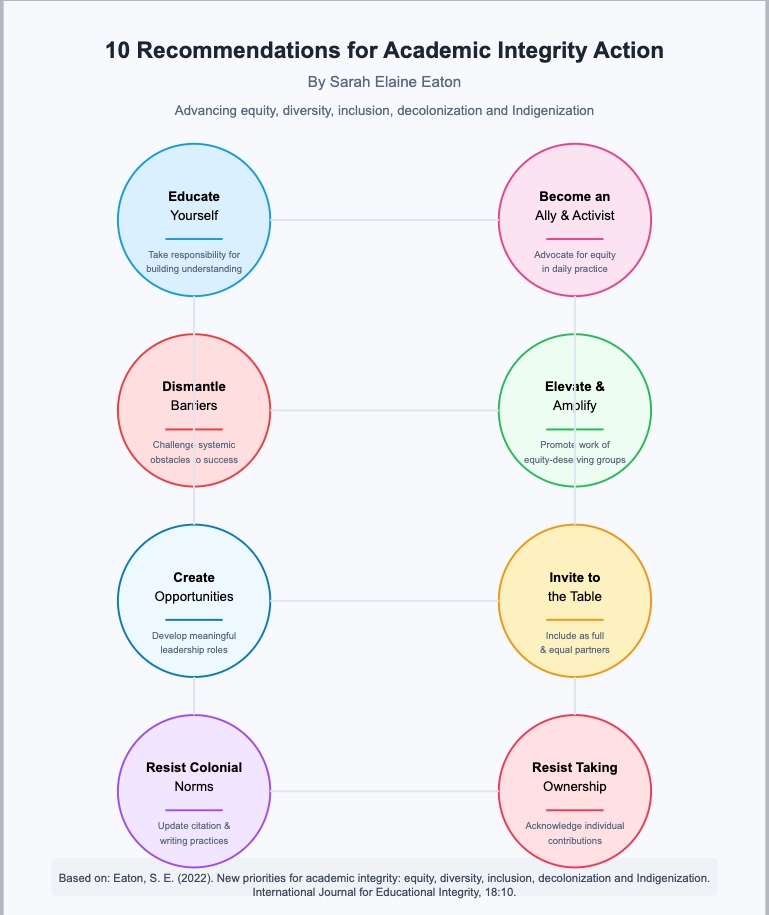
An AI-generated infographic with 10 circles, each of a different colour, with black text inside each of them.
AI-Generated infographic summarizing key ideas in a research article.

I wanted to see how #AI could be used to help with knowledge mobilization and communicating complex research ideas in simple and visually appealing ways. I am not 100% happy with this, but I am also not entirely unhappy. I am curious to see how researchers and scholars can use AI to help make our research more digestible to the general public.

At the end of the experiment, I asked Claude: Based on our interaction just now, what would you say are the benefits and drawbacks of working with AI to create infographics to share findings of research articles?

Claude’s reply:

“I can identify several key benefits and drawbacks of using AI to create infographics for research articles:

Benefits:

  1. Rapid Prototyping and Ideation
  • Quick generation of multiple concept ideas (as shown when I suggested 4 different infographic approaches)
  • Fast iteration based on feedback (like when we added your name and citation)
  • Ability to quickly visualize complex concepts from text
  1. Structured Organization
  • Systematic breakdown of complex research findings into visual elements
  • Logical arrangement of information hierarchies
  • Consistent application of design principles
  1. Customization and Flexibility
  • Ability to modify designs based on specific requests
  • Easy incorporation of branding elements or author attribution
  • Adaptable to different formats and styles
  1. Technical Precision
  • Exact color codes and measurements
  • Consistent spacing and alignment
  • Precise vector graphics that maintain quality at any size

Drawbacks:

  1. Format and Output Limitations
  • Cannot directly generate common file formats like JPG or PowerPoint
  • Unable to provide downloadable files
  • Limited to specific output formats (in our case, SVG)
  1. Technical Barriers
  • Users need to know how to convert or adapt the outputs
  • May require additional tools or software to get desired final format
  • Some technical knowledge needed to implement suggestions
  1. Creative Constraints
  • Limited to certain types of visual representations
  • May not capture nuanced design choices that a human designer would make
  • Restricted by pre-programmed design patterns
  1. Implementation Challenges
  • Gap between AI suggestions and practical implementation
  • Need for manual conversion or recreation in other software
  • Extra steps required to get to final usable format
  1. Quality Control Requirements
  • Need for human oversight and verification
  • May require professional designer input for polishing
  • Could need additional refinement for professional publication

For optimal results, it seems the best approach would be to use AI as a rapid prototyping and ideation tool, then work with a professional designer or use appropriate software to create the final, polished version in the desired format. This combines the efficiency of AI for initial concept development with the precision and format flexibility of professional design tools.”

Note: The numbering issue is a function of formatting in WordPress. I’ll fix that later.

This was an interesting experiment. I’ll be interested to see how AI apps can help us better communicate our research and scholarship to members of the general public.

________________________

Share this post: 10 Recommendations for Academic Integrity Action: An AI-Assisted Experiment – https://drsaraheaton.com/2025/01/27/10-recommendations-for-academic-integrity-action-an-ai-assisted-experiment/

This blog has had over 3.7 million views thanks to readers like you. If you enjoyed this post, please ‘Like’ it using the button below or share it on social media. Thanks!

Sarah Elaine Eaton, PhD, is a Professor and Research Chair in the Werklund School of Education at the University of Calgary, Canada. Opinions are my own and do not represent those of my employer.


Re-Released as a Free Open Access Resource: 101 Ways to Market Your Language Program (2002)

December 6, 2024

In 2002, I published the first edition of 101 Ways to Market Your Language Program. I have just re-released the book as a free open access resource under a Creative Commons (CC BY-NC-ND 4.0). The full book is now available as a free download.

How to cite this work:
Eaton, S. E. (2002/2024). 101 Ways to Market Your Language Program: A Practical Guide for Language Schools and Programs (2024 OA ed.). Eaton International Consulting Inc. https://hdl.handle.net/1880/120145

Abstract

2024 Re-release of the 2002 first edition of this book. The author and copyright holder has released this work under a Creative Commons (CC BY-NC-ND 4.0) license.

This book provides 101 ideas and strategies to empower overall marketing efforts: (1) “Put On Your Thinking Cap” (e.g., define the problem before marketing it, set reasonable goals, and create a niche); (2) “Secrets to Boost Your Marketing Power” (e.g., emphasize the benefits, check out the competition, and sell oneself in as many languages as possible); (3) “Marketing Materials: Tools and Tips to Do the Job Better” (e.g., make a brochure, get mentioned in other brochures, and make it easy to phone for information); (4) “Going Beyond the Basics to Increase Enrollment” (e.g, offer volume discounts and guarantees and give away tuition); (5) “Specialty Tips for Programs at Large Institutions” (e.g., make sure the Web site is easy to find, partner with other educational programs, and get the program mentioned in the calendar); (6) “The Power of People: A Human Touch to Increase Enrollment and Polish Your Image” (e.g., build loyalty with host families, establish win-win relationships, and follow exceptional service standards); (7) “Continue Marketing While Your Students are Enrolled” (e.g., meet students at the airport, partner with local businesses, and create happy memories); and (8) “How to Keep Marketing Once Your Program is Finished” (e.g., create an alumni network, review successes and failures, and plan ahead for next year).

Why Am I Re-Releasing This Work?

I have been invited to deliver the Werklund School of Education 2024-2025 Distinguished Research Lecture.

As part of the lead-up to the lecture, I have decided to make as much of my work as I can available as free, open access resources. This is recognition is a once-in-a-career kind of award and I’m working hard to make sure I can deliver. It is a hybrid public event and you can attend in person or online on March 20, 2025. If you’re interested, you can register here.

Since I am both the author and the copyright holder for this book, I can share it however I want. I am more committed now than ever to make as much of my work as possible freely available to others. Over the coming weeks, I’ll be sharing more links to more freely downloadable resources.

I am super grateful to the University of Calgary digital resources team who are helping me to archive these works.

If you know of someone working in second languages who could use a resource on marketing and recruitment for their program, feel free to share this with them.

________________________

Share this post: Re-released as a Free Open Access Resource: 101 Ways to Market Your Language Program (2002) – https://drsaraheaton.com/2024/12/06/re-released-as-a-free-open-access-resource-101-ways-to-market-your-language-program-2002/

This blog has had over 3 million views thanks to readers like you. If you enjoyed this post, please “like” it or share it on social media. Thanks!

Sarah Elaine Eaton, PhD, is a Professor and Research Chair in the Werklund School of Education at the University of Calgary, Canada. Opinions are my own and do not represent those of my employer.


How to Brand Yourself as a Researcher

February 14, 2018

Recently I was invited by the Werklund School of Education’s Writing Group, which is co-hosted by the Office of Research and the Office of Teaching and Learning, to offer a workshop on branding yourself as a researcher. I’m pretty excited because this gives me a chance to combine my passion for research with my entrepreneurial spirt that led me to have a successful career as an educational consultant before I entered academia full-time.

Branding comes from marketing, but that doesn’t mean academics should feel any disdain towards it. Think of it as learning to share your expertise with people in your field, and beyond, to a wider public audience.

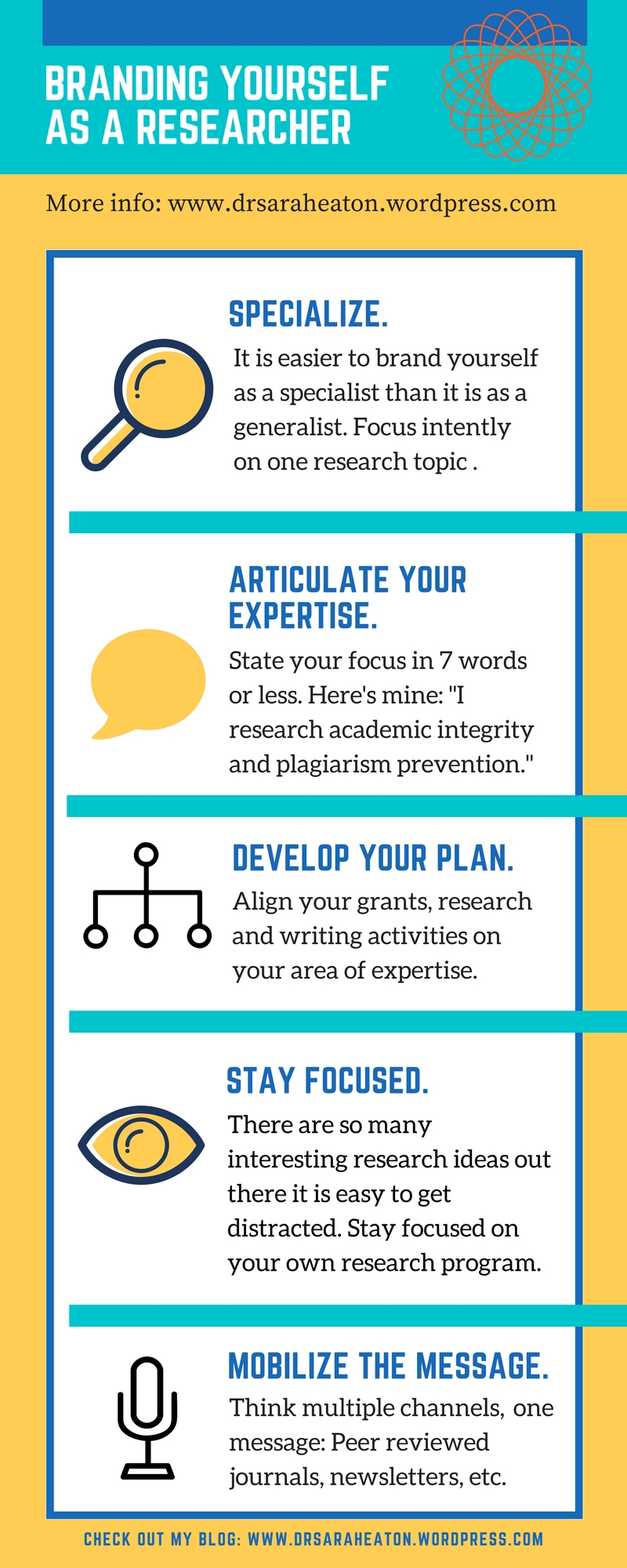
Here are the 5 key points I shared during the workshop:

Specialize.

It is easier to brand yourself as a specialist than it is as a generalist. It is normal for novice and emerging researcher to have multiple areas of interest. This works while you are still figuring out who are you are professionally, but specializing shows you are developing as a researcher. Have a clear research topic that you focus on intently.

Articulate your expertise.

Marketing experts recommend being able to state your focus in 7 words or less.  Here’s mine: “I research academic integrity and plagiarism prevention.” Don’t be that academic that has to ramble on for 38 minutes non-stop to say what it is you are researching. Get to the point and make it easy for others to understand. Practice writing out and saying your research focus until it feels natural.

Develop your plan.

Plan what grants you’ll apply for and when. Develop a writing schedule and target specific journals in your field. Ensure every element of your plan aligns with your area of expertise. Mapping out your research and writing activities will help to ensure you make time for them. Once you execute this plan, you’ll be on your way to having a fully developed research program in your area of expertise.

Stay focused.

There are so many interesting research ideas out there it is easy to get distracted. Stay focused on your own research program. The most successful researchers do not jump on every project that comes along. Choose the projects you want to be involved with carefully and ensure they align with your expertise.

Mobilize your knowledge.

Have multiple channels, but one message. Think about sharing findings in both peer reviewed scholarly journals, as well as plain-language articles targeted to the general public. Think about videos, podcasts and other ways of distributing your knowledge.

The point of all this is to position yourself as an expert in both an academic audience and the public. Ensure others know you are the “go to” person on your topic. Becoming known an expert authority on a key topic not only helps you get noticed in your field, it helps you get hired, and may help you get promoted, too.

Branding yourself as a researcher

References and recommended reading.

Marshall, K. (2017). Branding yourself as an academic. ChronicleVitae. Retrieved from https://chroniclevitae.com/news/1681-branding-yourself-as-an-academic

Mutum, D. S. (n.d.). Social media for researchers and online personal branding.  Retrieved from https://warwick.ac.uk/alumni/services/eportfolios/bsrfbr/dilip_social_media_academics_ebook2.docx

Mizenmacher, M. (2010). Branding your research (and yourself).  Retrieved from http://mybiasedcoin.blogspot.ca/2010/06/branding-your-research-and-yourself.html

Tregoning, J. (2016). Build your academic brand, because being brilliant doesn’t cut it any more. Times Higher Education, (February 24). Retrieved from https://www.timeshighereducation.com/blog/build-your-academic-brand-because-being-brilliant-doesnt-cut-it-any-more

______________________________________________________

Share or Tweet this: How to Brand Yourself as a Researcher https://wp.me/pNAh3-2gR

This blog has had over 1.8 million views thanks to readers like you. If you enjoyed this post, please “like” it or share it on social media. Thanks!

Sarah Elaine Eaton is a faculty member in the Werklund School of Education, University of Calgary, Canada.

Opinions are my own and do not represent those of the Werklund School of Education or the University of Calgary.


New article: Perceptions of ESL Program Management in Canadian Higher Education: A Qualitative Case Study

October 10, 2017

I’m pleased to share my latest article, which has been published in the International Journal of Learning, Teaching and Educational Research.

Abstract

ESL programs at post-secondary institutions must often generate revenue in addition to teaching students English. Institutions often impose explicit expectations on these programs to generate profit, creating unique challenges for those who administer them. This qualitative case study investigated challenges faced by ESL program directors at one university in Canada. Semistructured interviews were used to collect data from program directors (N = 3) on topics relating to administration, marketing, the mandate to generate revenue, and the complexities of ESL program legitimacy and marginalization in higher education contexts. Five key themes emerged from the data: (a) the necessity for directors to be highly qualified and multilingual, as well as have international experience; (b) a general lack of training, support, and resources for program directors; (c) institutional barriers such as working with marketers and recruiters with little knowledge of ESL contexts; (d) program fragmentation and marginalization on campus; and (e) reluctance to share information and program protectionism. Findings point to the need for increased training and support for ESL program directors, along with the need for institutions to elevate the profile of these programs so they are not viewed as having less value than other academic programs on campus.

Keywords: TESOL; TESL, ESL, EFL, language program management; administration; leadership; profit; revenue; marketing

Check out the full article here: https://www.ijlter.org/index.php/ijlter/article/view/980

______________________________________________________

Share or Tweet this: New article: Perceptions of ESL Program Management in Canadian Higher Education: A Qualitative Case Study https://wp.me/pNAh3-1Y8

This blog has had over 1.8 million views thanks to readers like you. If you enjoyed this post, please “like” it or share it on social media. Thanks!

Sarah Elaine Eaton is a faculty member in the Werklund School of Education, University of Calgary, Canada.


Job Posting: Marketing and Recruiting Manager for Prestigious English Language Program

October 29, 2013

When I wrote the first edition of 101 Ways to Market Your Language Program in 2002 one of the language program directors I interviewed for the book expressed disgust at the very idea of the book, saying that the idea of integrating marketing into educational administration was “blasphemous”.

That was at a time when language program managers had no training, no resources and no budgets for marketing. Many of them still don’t.

Since then I have kept my focus on marketing of language programs of all kinds as part of my career. From heritage language programs to TESL to modern world languages, they all have a place in our classrooms, our communities and yes, even the business world. I created www.marketyourlanguageprogram.com where I offer almost all the resources that I have created over the years for free.

In 2009 I wrote my doctoral thesis on marketing of ESL programs at post-secondary institutions. My supervisor liked that I had an innovative topic in an area that had yet to be researched by anyone (anywhere), but warned me that it might not get me a job. (As it turned out, things have worked out just fine.)

Recently, Georgetown University posted a job for

Manager, Marketing for Recruitment.

You can check out the job description here. The position involves recruiting qualified American English teaching professionals for the English Language Fellow and Specialist Programs. The programs, sponsored by the U.S. Department of State, send American teachers around the world to teach English. The jobs are affiliated with and supported by local embassies. What a cool program.

It’s not super clear, but just so it’s forever captured as a graphic, here’s a screen shot of the job posting:

Marketing Manager job posting

Marketing Manager job posting

Slowly, enlightened organizations are beginning to see that marketing our language programs is neither blasphemous nor futile, but rather necessary if we want to endorse, promote and share the importance of learning languages on a global scale. Marketing is serious business. It is unlike any other facet of educational administration or language program management. If we want to get serious about not only saving our language programs, but elevating their importance, we’ve got to go beyond putting up posters in the hallways of our schools to advertise the newest language class, and instead take a professional and strategic approach to recruitment, complete with market research, using metrics to track results and understanding how to demonstrate the concrete impact of language learning to funders, stakeholders and others in our communities.

When prestigious institutions like Georgetown University start creating positions called “Manager, Marketing and Recruitment”  for their language programs (and it’s supported by the U.S. Department of State) other schools are sure to follow.

Does your institution have a marketing manager for its language programs?

If not, what are you waiting for?

_____________________________________________________

If you enjoyed this post, please “like” it or share it on social media. Thanks!

Share or Tweet this: Job Posting: Marketing and Recruiting Manager for Prestigious English Language Program http://wp.me/pNAh3-1Fu

Update – January 2018 – This blog has had over 1.8 million views thanks to readers like you. If you enjoyed this post, please “like” it or share it on social media. Thanks!

Sarah Elaine Eaton is a faculty member in the Werklund School of Education, University of Calgary, Canada.