I’ve been working on a national research project with my colleagues, Jenny Miron and Laura McBrearity, at Humber College to look at what programming and supports Canadian post-secondary institutions provide to students to help them learn about academic integrity. We reviewed the websites of public higher education institutions across the country to better understand how academic integrity information is shared with students and faculty across campuses. We recently presented our findings at the conference of the International Center for Academic Integrity in New Orleans. Here’s a quick overview of our session:
Miron, J. B., Eaton, S. E., & McBrearity, L. (2019). Academic Integrity (AI) Tutorials in Canadian Post-Secondary Institutions: A National Overview. Paper presented at the International Center for Academic Integrity, New Orleans, LA.
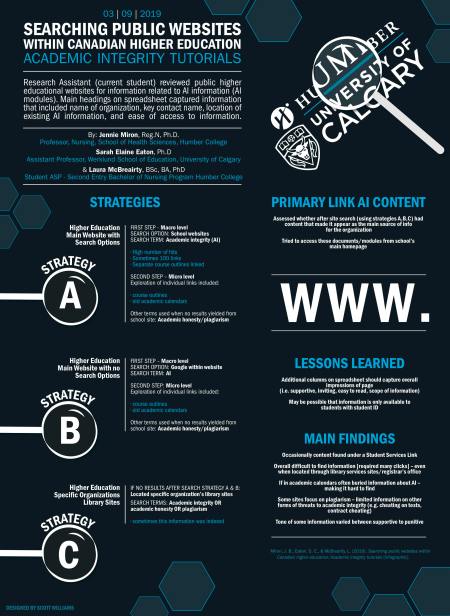
The team at Humber College created this excellent visual infographic highlighting our methods (search strategies), lessons learned and key findings:
We have not published the full findings yet, though we plan to do so soon. Because there is so little research available about what kind of support (e.g. education, tutorials, modules) offer on academic integrity to Canadian post-secondary students, we wanted to make these preliminary results available now.
You can download a high quality version of this infographic here:
Miron, J. B., Eaton, S. E., & McBrearity, L. (2019). Searching Public Websites within Canadian Higher Education: Academic Integrity Tutorials [Infographic]. Retrieved from http://hdl.handle.net/1880/109916
Share or Tweet this: Academic Integrity (AI) Tutorials in Canadian Post-Secondary Institutions: A National Overview
This blog has had over 2 million views thanks to readers like you. If you enjoyed this post, please “like” it or share it on social media. Thanks!
Sarah Elaine Eaton is a faculty member in the Werklund School of Education, University of Calgary, Canada. Opinions are my own and do not represent those of the Werklund School of Education or the University of Calgary.
Issues around ethics and integrity have become increasingly important in higher educational contexts in a variety of ways including research, teaching and leadership. With increasing expectations of research outputs; interest from students to conduct research involving human subjects; and ethical dilemmas of educational leaders in an age of commodified higher education, issues relating to ethics and integrity permeate every aspect of life in the academy.
We intend for this special issue to encourage dialogic interaction among scholars, elevating the discourse around ethics and integrity across disciplines.
Themes
We invite contributions that speak to the topic of ethics and integrity in higher education in a broad sense. Topics include, but are not limited to:
Research ethics
Ethical leadership in educational contexts
Academic integrity
Publication ethics
Ethical treatment of Indigenous populations (including ethical considerations for research with Indigenous populations)
Ethics and integrity in research partnerships and collaborations
Ethics and integrity in higher education
Ethics and integrity in K-12 education
Medical ethics and related topics (e.g. biomedical ethics)
Types of contributions
Scholarly contributions may include, but are not limited to:
Empirical research
Critical perspectives
Evidence-informed position papers
Scholarly essays
All submissions should be substantiated with relevant and current research evidence.
Submissions are welcome in English or French.
October 1, 2018 due date – Expressions of Interest (EOIs)
Maximum 500 words, briefly outlining the topic, including a maximum of 5 references of related relevant works (no self-citations).
Author(s) bio.
APA 6th edition format.
EOIs will be screened for suitability and quality. Invitations to authors to submit full manuscripts will be based on the quality of the EOIs. We anticipate inviting approximately six full manuscripts. We encourage interested parties to contact us with a query e-mail before submitting an EOI.
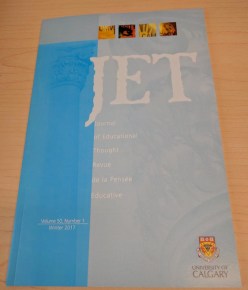
About the JET: Now in its 51st year of publication, theJournal of Educational Thought is a university-run journal that promotes speculative, critical, and historical research concerning the theory and practice of education in a variety of areas including administration, comparative education, curriculum, educational communication, evaluation, instructional methodology, intercultural education, philosophy, psychology, and sociology. The Journal is international in scope and qualitative in nature. It serves a broad international readership: specialists in the areas mentioned, scholars, and the public in general.
We invite submissions in English or French.
Send your Expression of Interest or queries to:
Dr. Sarah Elaine Eaton, University of Calgary – seaton (at) ucalgary.ca
or
Dr. Ian Winchester, University of Calgary – winchest (at) uncalgary.ca
A former student and I were talking recently, and she mentioned the thesis she completed as part of her Master of Education degree at our university.
“I’m going to stop you right there,” I said. “You didn’t do a thesis. You did a capstone project.”
“What’s the difference?” she asked.
It is a common question among students. Students also ask what the difference is between a dissertation and a thesis. Three things they all have in common are:
Completed in partial fulfillment of an academic degree.
Intended to showcase the student’s knowledge on a particular topic.
Approved in some way by the institution that grants the degree.
But that’s about where the commonalities end. The definitions I offer below may vary from one country to another. I am speaking here mainly about Canada, so if you live in a different country, note that the definitions may differ where you are.
Dissertation
This is usually completed as part of a doctoral degree (e.g., PhD, EdD). The work is overseen by a professor, who is often called the ‘advisor’ or the ‘supervisor’. Often, there is a committee that also supports the work. Students are often required to pass a rigorous exam upon completion of their dissertation. This is not true in all jurisdictions, but in Canada, it is normal for examiners to make suggestions for further revisions based on their review of the work and the outcome of the exam. A doctoral dissertation is often a few hundred pages long. When the dissertation is completed and approved in its final version by all the examiners, it may become publicly available through the university library digital repository or another public database. Sometimes the terms “thesis” and “dissertation” are used interchangeably. One possible reason for this could be that the word “thesis” is easier to say.
Thesis
A thesis is usually completed as part of a research-based master’s degree or an undergraduate honours degree. The length may vary, depending on whether it is completed for the undergraduate or master’s level, but often they are about a hundred pages. The work is overseen by a professor, who is often called the advisor or the supervisor. Upon completion of their thesis, students must often pass a rigorous exam. The examiners can make suggestions for further revisions based on their review of the work and the outcome of the exam. When it is completed and approved in its final version by all the examiners, it may become publicly available through the university library or another public database.
Dissertations and theses often have many elements in common such as being supervised by a professor and requiring an exam to pass. Capstone projects, on the other hand, are a bit different.
Capstone Project
This is a project completed as part of a course-based master’s degree. It is often overseen or guided by a course instructor. Sometimes students present their work in some way, but the capstone does not usually require an examination to pass. The length and format of a capstone project can vary and some are presented as multimedia projects instead of a written report. These kinds of projects can go by different names. At our university we call them a “Collaboratory of Practice” project, but the general idea is the same.
Here’s a handy infographic to highlight some of the key ideas.
It is important to remember that these are simplified definitions to help you understand the basic differences only. When you talk about your own academic work, it is important to represent yourself accurately. You want to learn the correct term to talk about the work you have completed as part of your degree.
These explanations may not apply to every institution. If you are not sure, talk to a faculty member from your own university to get more details about how things work at your institution.
One strategy to improve the quality of your writing is to read it aloud. I’ve been doing this for years.
According to the Writing Center at University of California at Chapel Hill, reading out loud means your brain gets information in a different way. You can literally hear your errors! You can find awkward constructions or sentences that are too long, for example. You can also find words that are repeated or just do not sound right.
When I read aloud I will often print out a copy of my work first. That allows me to make quick edits and notes on the page as I go. If something sounds off, I pause, make a note on my paper, then carry on reading the work aloud.
Sometimes when I recommend this strategy to my students, they tell me they feel silly reading their own work out loud. They don’t want others in their work place or household to think they are being pretentious or too eccentric. If this is the case, go find a quiet place where you can be alone.
Another important factor is to give yourself enough time to read aloud, especially if your paper is long. You may find that you prefer to read one section at a time, taking a break in between. It can also be helpful to have a glass of water nearby.
I recommend to each of you that as you revise your term paper, thesis, report or whatever you are writing at the moment that read your own work out loud (just like I did with this blog post). You’ll be surprised how much better the final product is.
Image courtesy of patrisyu at FreeDigitalPhotos.net
One of the things novice and emerging researchers can struggle with is learning how to narrow down their research topic. Here are some resources that I’ve personally collected and curated to help you tackle this complex element of developing your research project. At the time of writing this post, all the links worked and none of these resources had pop-up ads, paywalls or require any kind of payment. These are freely available and should be widely accessible by students in most areas.


 Posted by Sarah Elaine Eaton, Ph.D.
  Issues around ethics and integrity have become increasingly important in higher educational contexts in a variety of ways including research, teaching and leadership. With increasing expectations of research outputs; interest from students to conduct research involving human subjects; and ethical dilemmas of educational leaders in an age of commodified higher education, issues relating to ethics and integrity permeate every aspect of life in the academy.
 One strategy to improve the quality of your writing is to read it aloud. I’ve been doing this for years.

 Learning, Teaching and Leadership
You must be logged in to post a comment.