How to Host a World Cafe: Great Resources to Help You Host a Community Conversation that Matters

March 14, 2013

Creating space for strength in Calgary - Eaton International Consulting Inc.As part of our asset-based community development (ABCD) work with the Creating Space for Strength project in Calgary, we worked together with the Northern Hills Community Association to host a community consultation. We used the “world café” format and method to ignite a powerful conversation with the community. A few people have written to me asking us how we went about it. Here are some of our favorite “how to” resources that will help you host your own world café conversations:

Web resources

Here are some of the great web resources we found and shared with our team, the community and the volunteers who are working on the project:

Carson, L. (2011). Designing a public conversation using the World Café method. Social Alternatives, 30(1), 10-14. Available from http://www.bmartin.cc/pubs/11sa/Carson.html

The World Café. (2008). Café to go: A quick reference guide for putting conversations to work. Available from http://www.theworldcafe.com/pdfs/cafetogo.pdf

Brown, J. (n.d.). A resource guide for the world café. Available from http://meadowlark.co/world_cafe_resource_guide.pdf

Brown, J. (n.d.). Speaking our worlds into being: The world café. Available from http://www.swaraj.org/shikshantar/expressions_brown.pdf

Embedding Enterprise at Newcastle University.  World café creativity exercise. Available from http://www.ncl.ac.uk/quilt/assets/documents/WorldCafeCreativityExercise.pdf

Slocum, N. (2005). Participatory methods toolkit: A practitioner’s manual: The world café: a joint publication of the King Baudouin Foundation and the Flemish Institute for Science and Technology Assessment (viWTA). Available from http://www.kbs-frb.be/uploadedFiles/KBS-FRB/Files/EN/PUB_1540_Toolkit_13_WorldCafe.pdf

Books

Our two favorite books on how to organize and run a community conversation are:

Brown, J. (2005). The world café: Shaping our futures through conversations that matter. San Francisco: Berrett-Koehler Publishers, Inc.

With a Foreward by Margaret Wheatley and an Afterword with Peter Senge, this book is my favorite “go to” resource.

World cafe book cover

Another book to have on your book shelf (and share with others) is:

Born, P. (2008). Community conversations: Mobilizing the ideas, skills and passion of community organizations, governments, businesses and people. Toronto: BPS Books.

Paul Born’s book might be easy to miss, since it does not have the phrase “world café” in its title. It contains great wisdom though and is worth the read.

Paul Born community conversations book cover

____________________________

If you enjoyed this post, please “like” it or leave a comment. Thanks!

Share or Tweet this: How to Host a World Cafe: Great Resources to Help You Host a Community Conversation that Matters http://wp.me/pNAh3-1zO

Update – January 2018 – This blog has had over 1.8 million views thanks to readers like you. If you enjoyed this post, please “like” it or share it on social media. Thanks!

Sarah Elaine Eaton is a faculty member in the Werklund School of Education, University of Calgary, Canada.


How to create a research paper outline: 5 great resources

January 2, 2013

Sarah Elaine Eaton, speaker, presenter, keynote, technology, social media, Calgary, Canada, educator, education, professional developmentOnce again, I am teaching “Writing Educational Research” to Master’s of Education (M.Ed.) students at the University of Calgary this semester. I have found that some students struggle with the process of outlining their final research papers.

Outlining is an invaluable skill that helps you to conceptualize, plan and organize your writing. I learned to outline my essays when I was in school and to this day, I use outlines for research papers and even my books. I find that organizing my ideas in an outline helps me to keep my writing focussed and clear. I even outlined my Master’s and Ph.D. theses. When my Ph.D. thesis had to be modified as I was writing up my project, having an outline helped to decide what to toss, what to keep and how to re-organize the work effectively.

Here are some excellent resources that are useful to university level students, as well as high school students and adult learners who are learning to write essays:

  1. How to write an outline (SUNY) – This is an excellent web page resource produced by the State University of New York (SUNY). The method they demonstrate is the same one I learned in school. It is a classic “tiered” outline. The chart on this web page presents the information in a very clear way that is easy to understand.
  2. How to write an outline (LAVC) – Similar to the SUNY resource, this web page by the Los Angeles Valley College Library explains the difference between a topic outline and a sentence outline, using the tiered format. This web page has some great examples of what a real outline might look like.
  3. Wikihow – How to write an outline – This Wiki breaks down the process of writing an outline into simple, easy-to-follow steps. The wiki also has samples of a research outline, a literature outline and a “compare and contrast” outline.
  4. How to outline a 5-paragraph essay – This YouTube video (4:26) offers tips on how to write a shorter essay. It is great for students who have to write shorter papers or adults who are learning how to write an essay.
  5. Sample qualitative research outline by Rey Ty – This YouTube video moves a bit slowly, but it gives an excellent overview of how to write an outline for a qualitative research project.

Learning to outline is a valuable skill that will serve you in school and in the workplace. A good outline keeps you focussed, organized and on track.

Related posts:

Readings for Writing Educational Research (EDER 603.23) http://wp.me/pNAh3-1OJ

12 Phrases to Avoid in Your Academic Research Papers http://wp.me/pNAh3-1JX

Active vs. passive voice — How to tell the difference http://wp.me/pNAh3-1HX

Why APA formatting matters http://wp.me/pNAh3-1Hc

How many sources do you need in a literature review?  http://wp.me/pNAh3-1Hu

What’s the difference between a citation and a reference? http://wp.me/pNAh3-1F9

Why “as cited in” should be avoided in academic writing  http://wp.me/pNAh3-1BH

10 Great writing resources for grad students – http://wp.me/pNAh3-1Bc

_________________

If you enjoyed this post, please “like” it or leave a comment. Thanks!

Share or Tweet this: How to create a research paper outline: 5 great resources http://wp.me/pNAh3-1y6

Update – January 2018 – This blog has had over 1.8 million views thanks to readers like you. If you enjoyed this post, please “like” it or share it on social media. Thanks!

Sarah Elaine Eaton is a faculty member in the Werklund School of Education, University of Calgary, Canada.


Webinar recording: Creating Space for Strength

November 30, 2012

Our research team is thrilled to share the recording of our webinar “An Introduction to Creating Space for Strength: An Asset-Based Community Development and Research Project Focused on Calgary’s North Central Communities”.

We had over 40 people sign up for the webinar. The program lasted approximately 45 minutes and included chat dialogue from many community participants.

Thank you to everyone who attended and contributed. As promised, here is the recording. Feel free to share it with others.

5 Great resources on asset-based community development (ABCD) http://wp.me/pNAh3-1xJ
______________

Share or Tweet this: Webinar recording: Creating Space for Strength http://wp.me/pNAh3-1wI

Update – January 2018 – This blog has had over 1.8 million views thanks to readers like you. If you enjoyed this post, please “like” it or share it on social media. Thanks!

Sarah Elaine Eaton is a faculty member in the Werklund School of Education, University of Calgary, Canada.


3 Handy Checklists for APA Style and Formatting

November 27, 2012

As my students are getting ready to hand in their final research papers, they are struggling to learn APA (American Psychological Association) standards for formatting, citations and references. Here are three handy checklists I have shared with them. They find them very helpful:

APA Style Checklist – http://www2.indwes.edu/ocls/apa/apastylechecklist.pdf

Checklist for APA Style (from Elmhurst) – http://library.elmhurst.edu/files/2010/02/ChecklistAPA.pdf

APA Format Checklist (from SLU) – http://www.slu.edu/Documents/student_development/student_success_center/APA_Format_Checklist_Handout.pdf

______________

Share or Tweet this: 3 Handy Checklists for APA Style and Formatting  http://wp.me/pNAh3-1wD

Update – January 2018 – This blog has had over 1.8 million views thanks to readers like you. If you enjoyed this post, please “like” it or share it on social media. Thanks!

Sarah Elaine Eaton is a faculty member in the Werklund School of Education, University of Calgary, Canada.


What makes a good research question?

November 6, 2012

This week I posed a question to my students: What makes a good research question?

As Masters of Education students, they are learning about what it means to be a researcher and building a foundation of knowledge. They came up with some great resources this week. If you are looking for answers to this question, check out these great resources:

Sarah Eaton blog leadershipSonia Ospina’s entry in the Encyclopedia of Leadership on Qualitative Research

This is a 13-page document, available free in .pdf format. Published in 2004, this text shares some of the fundamentals of qualitative research, particularly as it pertains to leadership. It is also very useful for students and researchers working in education and other social sciences. It contains an extensive bibliography that serves as a great point of departure for more exploration. Link for this resource: http://ualr.edu/interdisciplinary/files/2010/03/Qualitative_Research.pdf

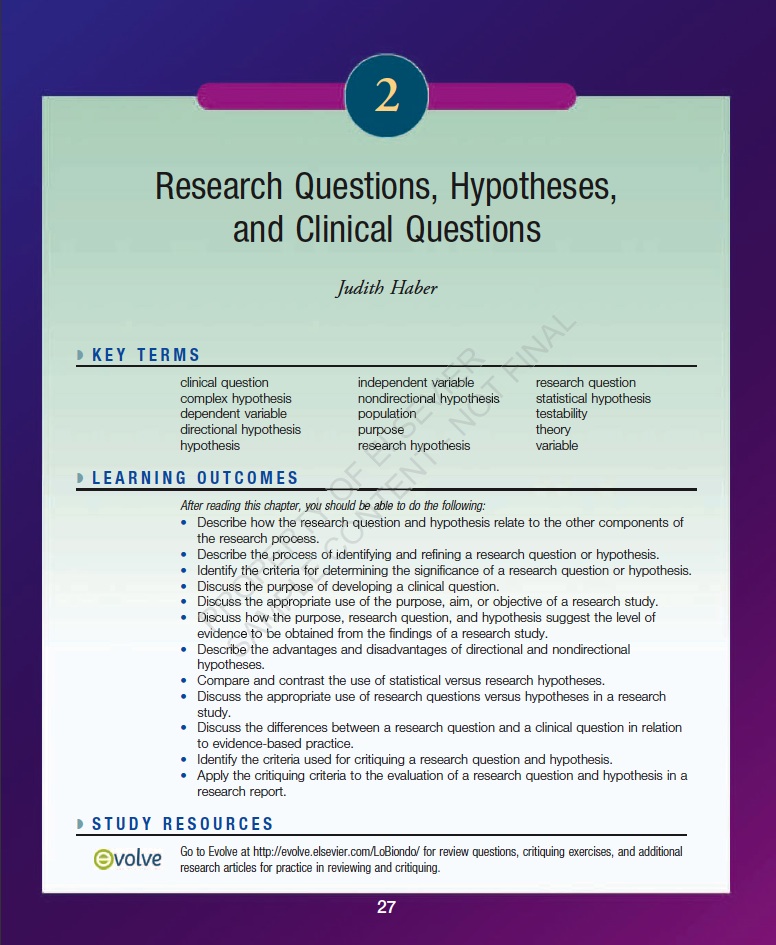
Sarah Eaton blogJudith Haber’s chapter called “Research Questions, Hypotheses and Clinical Questions”

Though marked as “Sample – Not final” with a watermark on the .pdf, this is an incredible 29-page resource that includes flow charts and tables of information. It is easy to understand and written in language that most novice researchers could understand. This one quickly became a favorite because it was colorful and concise. Even though it appears to be written for students and practitioners of health research, there are many elements that may be useful to educators and social science researchers, too. Link for this resource: http://www.us.elsevierhealth.com/media/us/samplechapters/9780323057431/Chapter%2002.pdf

Companion for Undergraduate Research

This is a website (http://www.socscidiss.bham.ac.uk/) that outlines the characteristics of a good research question. Then it talks about each characteristic in detail. It is written in clear language and is very well organized. The page also contains links to other helpful resources on research.

Figuring out how to craft a research question can be tricky. Resources like these help to demystify the process.

______________

Share or Tweet this: What makes a good research question? http://wp.me/pNAh3-1vL

Update – January 2018 – This blog has had over 1.8 million views thanks to readers like you. If you enjoyed this post, please “like” it or share it on social media. Thanks!

Sarah Elaine Eaton is a faculty member in the Werklund School of Education, University of Calgary, Canada.