Understanding Language Register

January 2, 2018

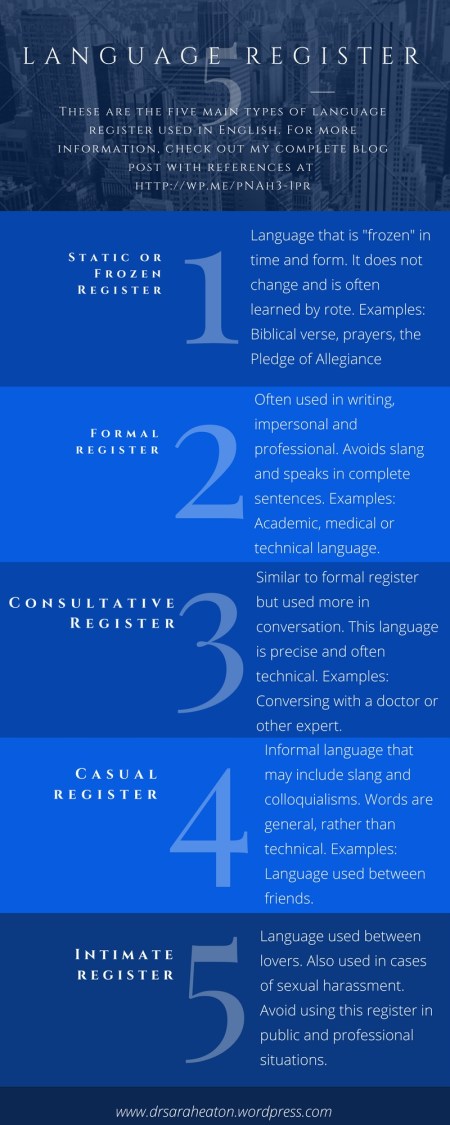
A few years ago I wrote a post on language register. It has become one of the most popular and often viewed posts on my blog. It is a long and fairly involved post, so for those who like their information in bite-sized pieces, here is a quick synopsis for you in the form of an infographic:
Language ReGISTER

It is important to understand the differences between registers so you can use language that is appropriate for a particular situation. If your register is too high, you may come across as being snobby, pretentious or arrogant. If your register is too low, you can come across as being inappropriately informal or too friendly.

It is not only English language learners who need to understand the difference between registers, but native speakers do too. One of the things I have observed in my work as a professor is that students sometimes write in a register that is too casual. Sometimes students do this because they do not want to come across as “stuffy” or pretentious. But casual writing in academic and professional papers can backfire. Writing that is overly casual is often not considered professional or terribly credible by the reader. It is important for students, professionals, scientists and academics to know the formal register for writing papers, theses and reports.

Here’s a free .pdf of this infographic that you can use for your own research or teaching purposes: Language Register (.pdf).

Check out these related posts:

Teaching formal and informal language register to native speakers of English http://wp.me/pNAh3-jV

Language Register and Why It Matters (Or: Why You Can’t Write An Academic Paper in Gangsta Slang) http://wp.me/pNAh3-1pr

______________________________________________________

Share or Tweet this: Understanding Language Register https://wp.me/pNAh3-25U

This blog has had over 1.8 million views thanks to readers like you. If you enjoyed this post, please “like” it or share it on social media. Thanks!

Sarah Elaine Eaton is a faculty member in the Werklund School of Education, University of Calgary, Canada.


New article: “Credit where credit is due”

December 19, 2017

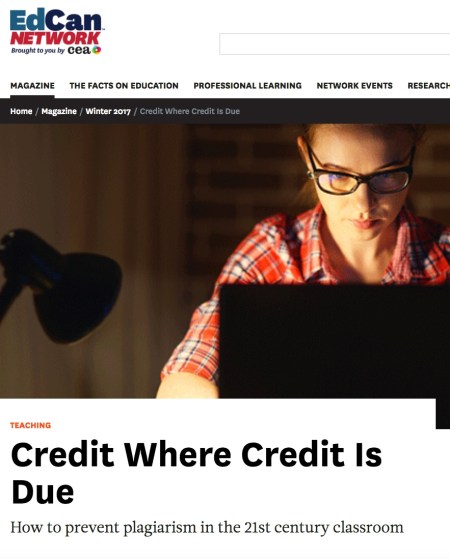
Credit where credit is due - coverIn my latest article, “Credit where credit is due: How to prevent plagiarism in the 21st century classroom” I tackle the tricky question of what it means to plagiarize in the age of copy-and-paste. I also offer K-12 teachers five practical tips on how to prevent plagiarism among school-age children.

Most of my research and writing is focusing more and more on academic integrity and plagiarism prevention in higher education contexts. But it is important for K-12 teachers to be able to talk about these topics to their students, too. That’s what inspired me to write this article.

The full article was published by the EdCan Network and it is a web exclusive in their most recent edition. You can check it out here: https://www.edcan.ca/articles/credit-where-credit-is-due/

______________________________________________________

Share or Tweet this: New article: “Credit where credit is due”

This blog has had over 1.8 million views thanks to readers like you. If you enjoyed this post, please “like” it or share it on social media. Thanks!

Sarah Elaine Eaton is a faculty member in the Werklund School of Education, University of Calgary, Canada.


Understanding academic misconduct: Special event

November 21, 2017

University of Calgary logoIn my role as Interim Associate Dean, Teaching and Learning for the Werklund School of Education at the University of Calgary, I am pleased announce we will welcome Dr. Julia Christensen Hughes to our campus for a special visit on November 24, 2017.

We have two events that are open to the public that I wanted to share with all of you:

Lunchtime Keynote: Understanding academic misconduct: Creating robust cultures of integrity

Time: 12:00 pm – 1:00 pm

Location: University of Calgary, Taylor Institute Forum

This keynote will draw from Christensen Hughes’s research with the late Don McCabe, founder of the International Center for Academic Integrity. Their work was published in 2006 the Canadian Journal of Higher Education (see http://journals.sfu.ca/cjhe/index.php/cjhe/article/view/183537 and http://journals.sfu.ca/cjhe/index.php/cjhe/article/view/183525), and they were awarded with the Sheffield Award from the Canadian Society for Studies in Higher Education (CSSHE) for their contribution.

Afternoon workshop: Strengthening a culture of integrity at the University of Calgary

Time: 3:00 pm – 4:00 pm

Location: University of Calgary, Taylor Institute Forum

This workshop will provide a deeper analysis of why academic misconduct is happening on Canadian university campuses, including from the perspectives of faculty and TAs. Working in groups, participants will discuss their experience at the University of Calgary and generate specific suggestions for what the University might do to strengthen its culture of integrity.

About Dr. Julia Christensen Hughes

jch-colour-photoDr. Julia Christensen Hughes is Dean of the College of Business and Economics (CBE) at the University of Guelph. With a career defined by advocacy, Julia has addressed the United Nations General Assembly on the need for business schools to contribute to advancing the UN’s sustainable development goals, including quality education. Previously, Julia served as President of the Society for Teaching and Learning in Higher Education, a predominantly Canadian organization committed to enhancing the quality of teaching and learning in post-secondary institutions. During this same time, she served as the Director of Teaching Support Services at the University of Guelph.
Julia Christensen Hughes’s scholarly work includes the edited book, Taking Stock: Research on Teaching and Learning in Higher Education (2010), McGill-Queen’s University Press. She has also written on ethics and integrity in the academy, with papers published in the Canadian Journal of Higher Education. Julia has received a number of awards and recognitions, including the Gold “educator” award from the Ontario Hostelry Institute (OHI); the Sheffield Award from the Canadian Society for the Study of Higher Education, for excellence in research; the University of Guelph’s John Bell Award, for distinguished educational leadership; and the “Woman of Distinction Award” from the Guelph YMCA, for outstanding contributions to education and training.

These events are open to all members of the campus community and the public.

______________________________________________________

Share or Tweet this: Understanding academic misconduct: Special event https://wp.me/pNAh3-22q

This blog has had over 1.8 million views thanks to readers like you. If you enjoyed this post, please “like” it or share it on social media. Thanks!

Sarah Elaine Eaton is a faculty member in the Werklund School of Education, University of Calgary, Canada.


Universities unite against the academic black market

October 17, 2017

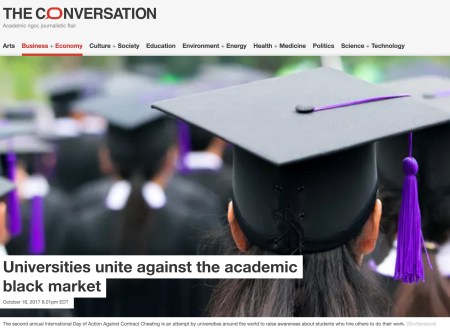
The ConversationOn the TV show Suits, Mike Ross’s character charges a hefty fee to students to take the LSAT (law school admission test) for them. Ross has a stellar memory and a remarkable ability to take tests without getting crushed by stress — he is the perfect “contract cheater.” Later, Ross builds a career as a lawyer based on fake credentials, presumably from Harvard.

Mike Ross may be fictional, but his business is only too real within universities globally. “Contract cheaters” such as Ross complete academic work on a student’s behalf — for a fee. This work includes test taking and homework services. It includes essay-writing and even PhD thesis-writing services, also known as “paper mills.”

In my role as interim associate dean of teaching and learning at the University of Calgary, and as a researcher who specializes in plagiarism prevention and academic integrity, I have been writing about contract cheating since 2010. Since then, it has become rampant at high school and post-secondary levels.

This black market for academic work is vast and little understood. Universities in Canada, and around the world, are having a very hard time trying to police it.

On Oct. 18, 2017, many universities have committed to the second International Day of Action Against Contract Cheating. This aims to tackle the issue head on — by raising awareness and sharing prevention strategies.

Read the whole article in The Conversation (originally published on Oct. 16, 2017).

Check out the radio interview I did on CBC: http://www.cbc.ca/listen/shows/calgary-eyeopener/segment/14438512

Related posts:

______________________________________________________

Share or Tweet this: Universities unite against the academic black market  http://wp.me/pNAh3-1YN

This blog has had over 1.8 million views thanks to readers like you. If you enjoyed this post, please “like” it or share it on social media. Thanks!

Sarah Elaine Eaton is a faculty member in the Werklund School of Education, University of Calgary, Canada.


2nd International Day of Action Against Contract Cheating

October 16, 2017
International Day of Action Against Contract Cheating: Graphic created by University of California at San Diego.

Graphic created by University of California at San Diego.

Contract cheating is an umbrella term used to talk about individuals or businesses that provide academic work for a fee. From imposters who take tests on behalf of others, to professional homework services and paper-writing services or “paper mills”, contract cheating is big business. This black market for academic work is becoming more prevalent, is hard to detect and harder to prove. No one knows exactly how many of these services exist, or how much money they make, but their very existence is troubling. Post-secondary educators, as well as those who aspire to a career in education, need to take action against contract cheating.

U of C logo - 2015In my role as Interim Associate Dean, Teaching and Learning at the Werklund School of Education, I have the chance to organize key events that bring people together over key issues related to teaching and learning in our school. When I heard about the 2nd International Day of Action Against Contract Cheating, I knew we had to join.

We’ll be hosting a Brown Bag Interactive Conversation for faculty and staff about what contract cheating is and what we can do about it. We’ll be sharing the Institutional Toolkit to Combat Contract Cheating and this 3-page handout that gives practical strategies on how to combat it.

More than 40 institutions from more than a dozen countries will be hosting events all over the world on October 18. I am so pleased that the University of Calgary will be among them.

We are using the hashtags #defeatthecheat and #excelwithintegrity on social media. Join the conversation on October 18!

______________________________________________________

Share or Tweet this: 2nd International Day of Action Against Contract Cheating http://wp.me/pNAh3-1Yn

This blog has had over 1.8 million views thanks to readers like you. If you enjoyed this post, please “like” it or share it on social media. Thanks!

Sarah Elaine Eaton is a faculty member in the Werklund School of Education, University of Calgary, Canada.