Neuralink’s Clinical Trials in Canada

January 11, 2025

Last month CBC’s Geoff Leo did a great article on called, ‘No consequences’, for violating human rights in privately funded research in Canada. This was a bit of an eye opener, even for me.

He writes that, “Roughly 85 per cent of clinical trials in Canada are privately funded” and that research undergoes very little scrutiny by anyone.

One of the cases Geoff wrote about involved a research study that ran from 2014-2016 involving Indigenous children in Saskatchewan, aged 12-15, who were research subjects in a study that monitored their brainwaves. Student participants were recruited with the help of a Canadian school board.

The study was led by James Hardt, who runs something called the Biocybernaut Institute, a privately run business. According to Leo, James Hardt claims that “brainwave training can make participants smarter, happier and enable them to overcome trauma. He said it can also allow them to levitate, walk on water and visit angels.”

Geoff Leo digs deep into some of the ethical issues and I recommend reading his article.

So, that was last month. This month, I happened to notice that according to Elon Musk’s Neuralink website, Musk’s product has now been approved by Health Canada to recruit research participants. There’s a bright purple banner at the top of the Neuralink home page showing a Canadian flag that says, “We’ve received approval from Health Canada to begin recruitment for our first clinical trial in Canada”.

A screenshot of the Neuralink.com home page. On the bottom right is a blurred photo of a man wearing a ball cap, who appears to be in a wheelchair and using tubes as medical assistance. There is white text on the right-hand side. At the top is a purple banner with white text and a small Canadian flag.

When you click on the link, you get to another page that shows the flags for the US, Canada, and the UK, where clinical trials are either underway or planned, it seems.
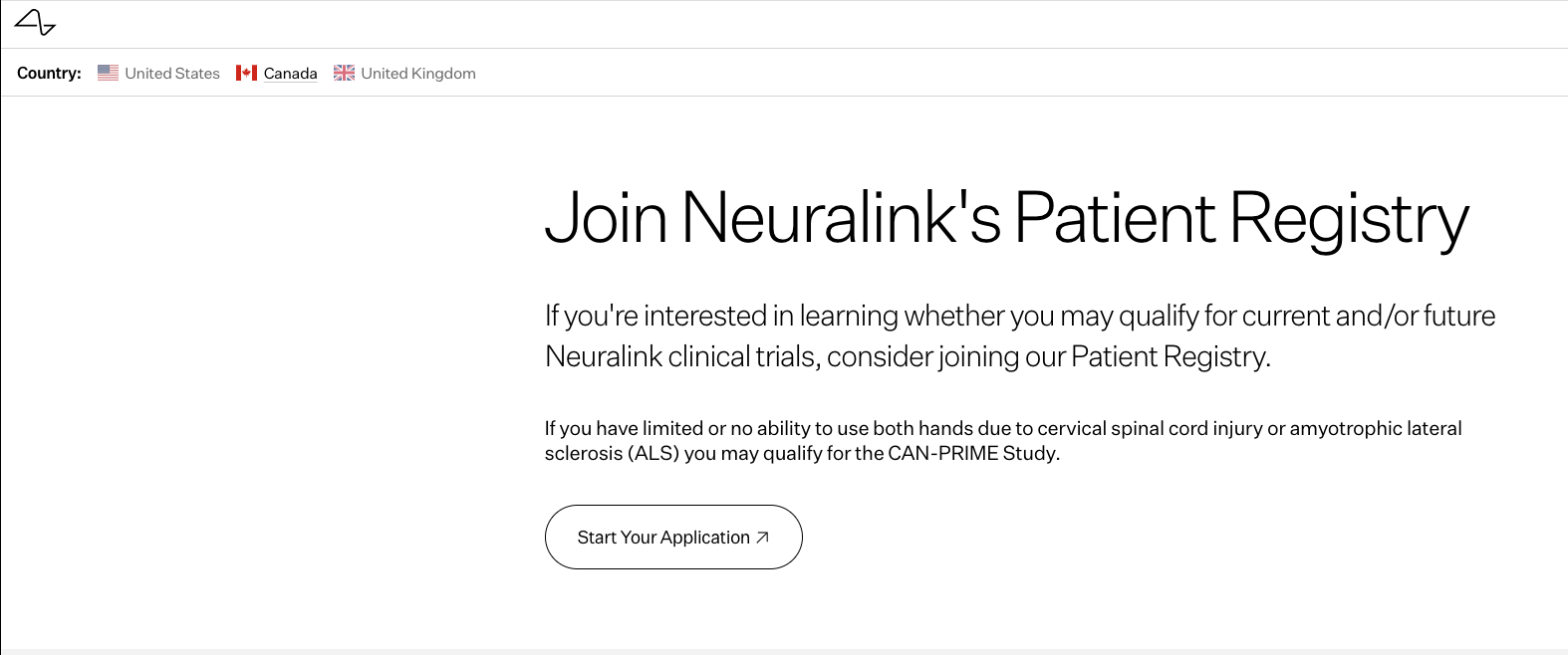
A screenshot of a webpage from the Neuralink web site. It has a white background with black text. In the upper left-hand corner there are three small flags, one each for the USA, Canada, and the UK.

The Canadian version is called CAN-PRIME. There’s a YouTube video promo/recruitment video for patients interested in joining, “this revolutionary journey”.

According to the website, “This study involves placing a small, cosmetically invisible implant in a part of the brain that plans movements. The device is designed to interpret a person’s neural activity, so they can operate a computer or smartphone by simply intending to move – no wires or physical movement are required.”

A screenshot from the Neuralink web page. The background is grey with black text.

So, just to connect the dots here… ten years ago in Canada there was a study involving neurotechnology that “exploited the hell out of” Indigenous kids, according to Janice Parente who leads the Human Research Standards Organization

Now we have Elon Musk’s company actively recruiting people from across Canada, the US, and the UK, for research that would involve implanting experimental technology into people’s brains without, it seems, much research ethics oversight at all.

What could possibly go wrong?

Reference

Leo, G. (2024, December 2). ‘No consequences’ for violating human rights in privately funded research in Canada, says ethics expert. https://www.cbc.ca/news/canada/saskatchewan/ethics-research-canada-privately-funded-1.7393063

________________________

Share this post: Neuralink’s Clinical Trials in Canada – https://drsaraheaton.com/2025/01/11/neuralinks-clinical-trials-in-canada/

This blog has had over 3.7 million views thanks to readers like you. If you enjoyed this post, please ‘Like’ it using the button below or share it on social media. Thanks!

Sarah Elaine Eaton, PhD, is a Professor and Research Chair in the Werklund School of Education at the University of Calgary, Canada. Opinions are my own and do not represent those of my employer. 


Book launch: Critical Perspectives on International Education

March 19, 2013

Launch party - Critical Perspectives in Education

A few weeks ago I was excited to tell you that the book, Critical Perspectives on International Education had been released. My contribution to the book is a chapter called, “The Administration of English as a Second Language (ESL) Programs: Striking the Balance Between Generating Revenue and Serving Students” (pages 149-162).

Tomorrow is the official launch party for the book. I’d like to invite you to join us to celebrate international education!

Wednesday, March 20, 2013

4:00 to 6:00 p.m.

Education Tower, Room 830 (TERA)

University of Calgary

2500 University Dr. N.W., Calgary, Alberta, Canada

Entertainment will be provided by Afo-Danse Troupe

RSVP here: http://fluidsurveys.com/surveys/sarah-khan/book-launch-yvonee-hebert-and-ali-a-abdi/

Critical Perspectives on International Education Sarah Eaton

_________________

If you enjoyed this post, please “like” it or leave a comment. Thanks!

Share or Tweet this: Book launch: Critical Perspectives on International Education http://wp.me/pNAh3-1Ar

Update – January 2018 – This blog has had over 1.8 million views thanks to readers like you. If you enjoyed this post, please “like” it or share it on social media. Thanks!

Sarah Elaine Eaton is a faculty member in the Werklund School of Education, University of Calgary, Canada.


Formal, Non-formal and Informal Learning in the Sciences

August 18, 2010

A few months ago I shared a research report called Formal, non-formal and informal learning: The case of literacy and language learning in Canada. Following that report, I began working with a geophysicist, Heather L. Ainsworth, who also had interest in learning contexts. We collaborated and together we researched, wrote and published a companion report that took the same concepts of formal, non-formal and informal learning and applied them to science and engineering. The result was this companion report, which we co-authored.

View this document on Scribd

Formal, Non-formal and Informal Learning in the Sciences (July, 2010)

ISBN: 978-0-9733594-5-9

Formal abstract: This research report investigates the links between formal, non-formal and informal learning and the differences between them. In particular, the report aims to link these notions of learning to the field of sciences and engineering in Canada and the United States, including professional development of adults working in these fields. It offers practical, concrete examples as well as a conceptual framework for understanding formal, non-formal and informal learning. It offers examples of how all three types of learning are valued in the fields of science and engineering in both educational and professional contexts. It also discusses science literacy, what it is and how popular media is elevating science literacy in general. This is a companion report to “Formal, Non-formal and Informal Learning: The Case of Language Learning and Literacy in Canada” (February, 2010).

Full-text copies of this report may be downloaded from:

National Library of Canada Online Archives (Note: This link works in Explorer and Firefox.)

Related posts:

Formal, Non-formal and Informal Learning (Infographic) https://wp.me/pNAh3-266

Formal, non-formal and informal learning: The case of literacy and language learning in Canada

Formal, non-formal and informal education: What Are the Differences?

Formal, Non-formal and Informal Learning: A podcast

Breathtaking Impact of Volunteers’ Contribution to Non-formal and Informal Literacy Education in Alberta

________________

Tweet or Share this article: Formal, Non-formal and Informal Learning in the Sciences http://wp.me/pNAh3-gX

Update – January 2018 – This blog has had over 1.8 million views thanks to readers like you. If you enjoyed this post, please “like” it or share it on social media. Thanks!

Sarah Elaine Eaton is a faculty member in the Werklund School of Education, University of Calgary, Canada.