Exploring the Contemporary Intersections of Artificial Intelligence and Academic Integrity

May 17, 2022
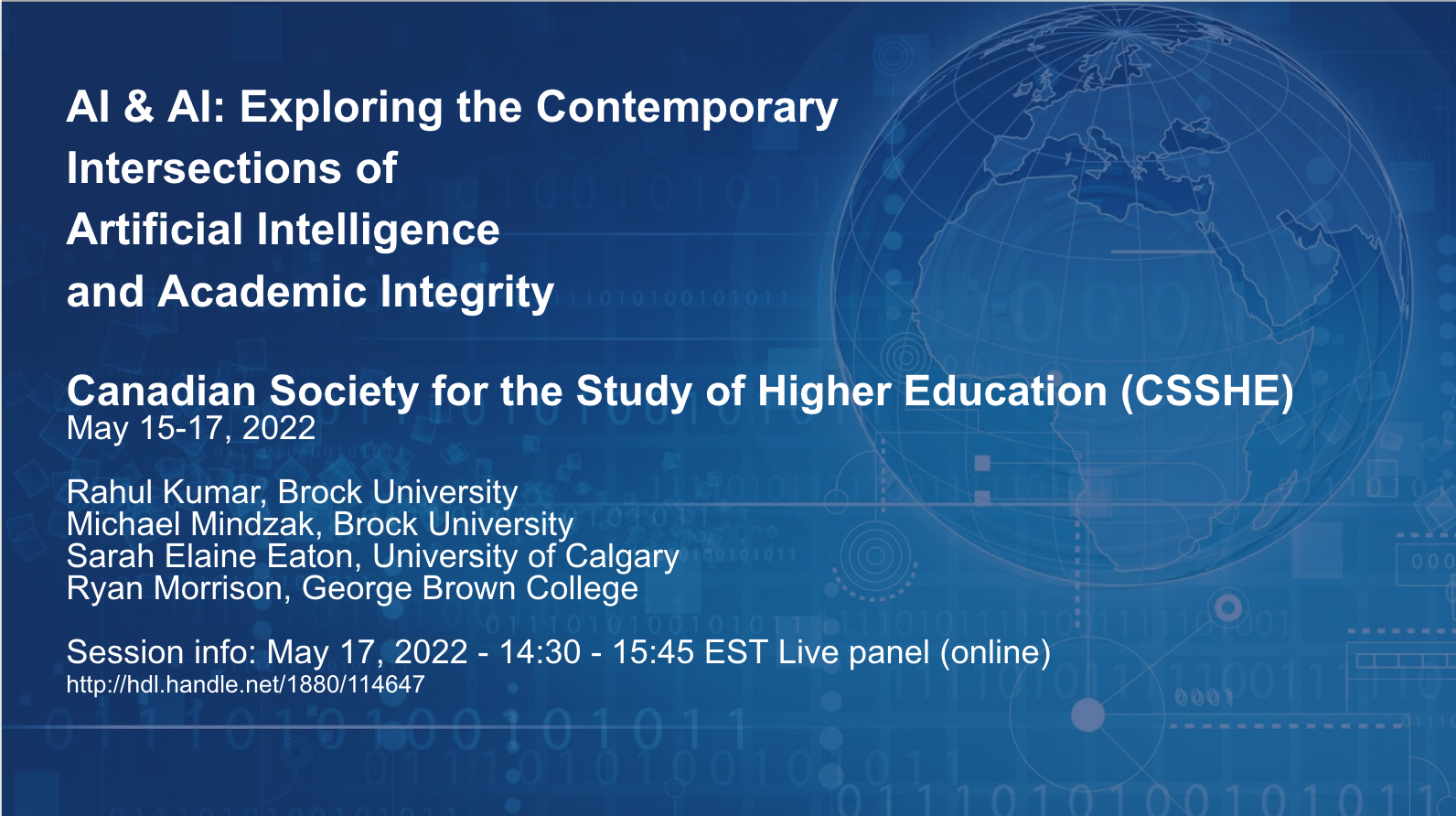
Title slide from CSSHE 2022 panel discussion: AI & AI: Exploring the contemporary intersections of artificial intelligence and academic integrity (Kumar, Mindzak, Eaton & Morrison)

For more than a year there have been small teams of us across Canada studying the impact of artificial intelligence on academic integrity. Today I am pleased to be part of a panel discussion on this topic at the annual conference of the Canadian Society for the Study of Higher Education (CSSHE), which is part of Congress 2022.

Our panel is led by Rahul Kumar (Brock University, Canada), together with Michael Mindzak (Brock University, Canada) and Ryan Morrison (George Brown College, Canada)

Here is the information about our panel:

Session G3: Panel: AI & AI: Exploring the Contemporary Intersections of Artificial Intelligence and Academic Integrity (Live, remote) 

Panel Chair: Rahul Kumar 

  • Rahul Kumar (Brock University): Ethical application with practical examples
  • Michael Mindzak (Brock University): Implications on labour 
  • Ryan Morrison (George Brown College): Large language models: An overview for educators 
  • Sarah Elaine Eaton (University of Calgary): Academic integrity and assessment 

We have developed a combined slide deck for our panel discussion today. You can download the entire slide deck from the link noted in the citation below:

Kumar, R., Mindzak, M., Morrison, R., & Eaton, S. E. (2022, May 17). AI & AI: Exploring the contemporary intersections of artificial intelligence and academic integrity [online]. Paper presented at the Canadian Society for the Study of Higher Education (CSSHE). http://hdl.handle.net/1880/114647

Related posts:

New project: Artificial Intelligence and Academic Integrity: The Ethics of Teaching and Learning with Algorithmic Writing Technologies – https://drsaraheaton.wordpress.com/2022/04/19/new-project-artificial-intelligence-and-academic-integrity-the-ethics-of-teaching-and-learning-with-algorithmic-writing-technologies/

Keywords: artificial intelligence, large language models, GPT-3, academic integrity, academic misconduct, plagiarism, higher education, teaching, learning, assessment

_________________________________

Share or Tweet this: Exploring the Contemporary Intersections of Artificial Intelligence and Academic Integrity https://drsaraheaton.wordpress.com/2022/05/17/exploring-the-contemporary-intersections-of-artificial-intelligence-and-academic-integrity/

This blog has had over 3 million views thanks to readers like you. If you enjoyed this post, please “like” it or share it on social media. Thanks!

Sarah Elaine Eaton, PhD, is a faculty member in the Werklund School of Education, and the Educational Leader in Residence, Academic Integrity, University of Calgary, Canada. Opinions are my own and do not represent those of the University of Calgary.


A Systems Approach to Address Contract Cheating

September 24, 2020

I’m delighted to be giving a presentation today at the the 8th Congress on Academic Integrity organized by the Center for Academic Integrity, University of Monterrey (UDEM), Monterrey, Mexico.

Slide1

Abstract

In this presentation I examine how a systems approach is needed to address contract cheating in its various forms. Using the 4M framework, I demonstrate the role of the individual (micro), the department (meso), the learning organization (macro) and stakeholders beyond the institution (mega).

In this session, I share insights from my forthcoming book, Plagiarism in Higher Education: Tackling Tough Topics in Academic Integrity to be published by ABC Clio/Libraries Unlimited in 2021.

Keywords: academic integrity, academic misconduct, contract cheating, 4M Framework, SoTL

You can find a complete English-language slide deck and the script for the talk archived online here: http://hdl.handle.net/1880/112560

Integridad Académica: Un enfoque de sistemas para enfrentar la compraventa de trabajo académico1
8.° Congreso de Integridad Académica

En esta presentación Eaton examina cómo y por qué se requiere de un enfoque de sistemas para abordar la compraventa de trabajo académico.

Utilizando el marco de referencia de las 4M, Eaton muestra el rol de la persona (micro), el departamento (meso), la institución y la comunidad (mega).

Palabras clave: integridad académica, mala conducta académica, marco de referencia de las 4M, Investigación en Docencia y Aprendizaje (IDA / SoTL)

Se encuentra las diapositivas y todo el contenido de esta presentación aquí:  http://hdl.handle.net/1880/112565

_________________________________

Share or Tweet this:

Academic Integrity: A Systems Approach to Address Contract Cheating 8th Congress on Academic Integrity https://drsaraheaton.wordpress.com/2020/09/24/a-systems-approach-to-address-contract-cheating/(opens in a new tab)

This blog has had over 2 million views thanks to readers like you. If you enjoyed this post, please “like” it or share it on social media. Thanks!

Sarah Elaine Eaton, PhD, is a faculty member in the Werklund School of Education, and the Educational Leader in Residence, Academic Integrity, University of Calgary, Canada. Opinions are my own and do not represent those of the University of Calgary.


Understanding Academic Integrity from a Teaching and Learning Perspective: Engaging with the 4M Framework

August 27, 2020

This post situates academic integrity within the scholarship of teaching and learning (SoTL) discourse. The 4M framework frames integrity through a four interrelated organizational lenses: (a) micro (individual); (b) meso (departmental); (c) macro (institutional); and (d) mega (community).

Keywords: academic integrity, scholarship of teaching and learning (SoTL), pedagogy, 4M framework, systems theory.

Introduction

Using a framework to understand complex issues, such as those relating to academic integrity, can be helpful while avoiding being overly reductionist. For a long time scholars and educators haven calling for more pro-active and pedagogical approaches to academic integrity (Eaton et al., 2017; Howard, 2002; Morris, 2016). One scholar has even called academic integrity a “teaching and learning imperative” (Bertram Gallant, 2008). In addition, the position that academic integrity is solely a student responsibility is now considered outdated, as advocates call for multi-stakeholder approaches that engage various members of the learning community including students, educators, and administrators, in different but interconnected ways (Eaton et al., 2017; Morris, 2016).

To help us understand how all these different stakeholders play a role, a systems approach to academic integrity can be helpful (Bertram Gallant, 2016; Bertram Gallant & Kalichman, 2011; Drinan & Bertram Gallant, 2008).

Systems thinking is not new; it has been around for more than half a century, if not longer (Bronfenbrenner, 1976; 1981; von Bertalanffy, 1968).

The 4M Framework

Systems theory helped to inform the conceptualization of the 4M Framework, which was developed within the Scholarship of Teaching and Learning (SoTL) community to help educators understand teaching and learning inquiry (Friberg 2016; Kalu et al., 2018; Kenny et al., 2016; Poole & Simmons, 2013; Simmons, 2016; Williams et al., 2013). The framework consists of four nested levels: micro, meso, macro, and mega.

The 4M Framework: Micro, Meso, Macro, and Mega Levels

The 4M Framework: Micro, Meso, Macro, and Mega Levels

The Micro Level: Individual

Individual students and educators are at the heart of the 4M framework. Each person’s conceptual understanding of academic integrity, as well as practical skills such as paraphrasing, citing, and referencing, develop at an individual level. But this learning does not happen in isolation. It is impacted by other individuals within the system, as well as the system itself.

Individual educators also operate at the micro level when they are preparing course content, lessons and activities. Research has shown over and over again that students are more likely to care about academic integrity when educators show that it matter to them, too (Bertram Gallant, 2018; McCabe et al., 2012; Eaton et al., 2017). It is at this level that educators can have a direct and lasting impact on teaching students how to engage in ethical decision making and also how to build practical skills such as paraphrasing, citing and referencing.

The Meso Level: Departmental

At this level, academic departments and support units, such as the library or the student affairs office, provide resources and learning opportunities that allow academic integrity to be operationalized. At this level support for academic integrity can be hands-on and pro-active in the form of workshops, tutorials, and practical resources.

The Macro Level: Learning Organization

The learning organization (e.g., college or school) is responsible for setting the institutional direction and culture for academic integrity. This includes having clearly articulated policies and procedures that can be applied fairly and equitably across the institution. Leaders at this level can also act as champions who set the tone for the entire school (McCabe et al, 2012).

The Mega Level: Community

This level includes stakeholders who are connected with the school, but who may not be involved on a day-to-day basis. This includes government bodies, alumni, parents and others who can be engaged to as partners in promoting academic integrity and ethical conduct in a variety of ways.

It is important to engage with colleagues from other institutions to form networks of professional practice (Kenny et al., 2016). This helps us to expand our understanding, push our boundaries and learn with and from one another. When we engage with colleagues outside of our institutions, we are engaging at the mega level. This is essential for those working in academic integrity contexts, where there might be only a handful of individuals directly engaged with this work on a day-to-day basis. Ongoing engagement with a network of like-minded professionals is key to continuing our professional learning in a sustained and sustainable way.

Conclusions

The 4M lens helps us to understand who the various stakeholders are and how they can play a role in upholding and enacting academic integrity in our learning communities. Creating a culture of integrity cannot happen if only certain individuals are engaged (McCabe et al., 2012). Instead, creating a culture of integrity requires intentional and sustained effort across a variety of different stakeholder groups within the institution.

Discussion Questions

  • Who are some of the stakeholders actively engaged in promoting academic integrity at your school?
  • How are you engaging stakeholders at every level of your school to uphold and enact academic integrity?
  • How are you creating a culture of integrity at your school?

References

Bertram Gallant, T. (2008). Academic integrity in the twenty-first century: A teaching and learning imperative. Hoboken, NJ: Wiley.

Bertram Gallant, T. (2016). Systems approach to going forward: Introduction. In T. Bretag (Ed.), Handbook of Academic Integrity (pp. 975-977). Singapore: Springer Singapore.

Bertram Gallant, T., & Kalichman, M. (2011). Academic ethics: A systems approach to understanding misconduct and empowering change in the academy. In T. Bertram Gallant (Ed.), Creating the ethical academy: A systems approach to understanding misconduct and empowering change in higher education (pp. 27-44). New York: Routledge.

Boyer, E. L. (1990). Scholarship reconsidered: Priorities of the professoriate. New York: The Carnegie Foundation for the Advancement of Teaching.

Bronfenbrenner, U. (1976). The Experimental Ecology of Education. Paper presented at the American Educational Research Association (AERA), San Francisco, CA

Bronfenbrenner, U. (1981). The ecology of human development: Experiments by nature and design. Cambridge: Cambridge: Harvard University Press.

Drinan, P. M., & Bertram Gallant, T. (2008). Plagiarism and academic integrity systems. Journal of Library Administration, 47(3-4), 125-140. doi:10.1080/01930820802186472

Eaton, S. E., Guglielmin, M., & Otoo, B. (2017). Plagiarism: Moving from punitive to pro-active approaches. In A. P. Preciado Babb, L. Yeworiew, & S. Sabbaghan (Eds.), Selected Proceedings of the IDEAS Conference 2017: Leading Educational Change Conference (pp. 28-36). Calgary, Canada: Werklund School of Education, University of Calgary. https://prism.ucalgary.ca/handle/1880/52096

Friberg, J. C. (2016). Might the 4M Framework Support SoTL Advocacy? (July 11). Retrieved from https://illinoisstateuniversitysotl.wordpress.com/2016/07/11/might-the-4m-framework-support-sotl-advocacy/

Howard, R. M. (2002). Don’t Police Plagiarism: Just TEACH! The Education Digest, 67(5), 46-49.

Kenny, N., Watson, G. P. L., & Desmarais, S. (2016). Building sustained action: Supporting an institutional practice of SoTL at the University of Guelph. New Directions for Teaching and Learning, 2016(146), 87-94. doi:10.1002/tl.20191

Kalu, F., Dyjur, P., Berenson, C., Grant, K. A., Jeffs, C., Kenny, N., & Mueller, R. (2018). Seven voices, seven developers, seven one things that guide our practice. To Improve the Academy, 37(1), 111-127. doi:10.1002/tia2.20066

McCabe, D. L., Butterfield, K. D., & Treviño, L. K. (2012). Cheating in college: Why students do it and what educators can do about it. Baltimore, MD: Johns Hopkins University Press.

Morris, E. J. (2016). Academic Integrity: A Teaching and Learning Approach. In T. Bretag (Ed.), Handbook of Academic Integrity (pp. 1037-1053). Singapore: Springer Singapore.

Poole, G., & Simmons, N. (2013). Contributions of the scholarship of teaching and learning to quality enhancement in Canada. In R. Land & G. Gordon (Eds.), Enhancing quality in higher education international perspectives (pp. 278-298). London: London: Routledge.

Simmons, N. (2016). Synthesizing SoTL institutional initiatives toward national impact. New Directions for Teaching and Learning, 2016(146), 95-102. doi:10.1002/tl.20192

von Bertalanffy, L. (1968). General system theory: Foundations, development, applications. New York: George Braziller.

Williams, A. L., Verwoord, R., Beery, T. A., Dalton, H., McKinnon, J., Strickland, K., . . . Poole, G. (2013). The Power of social networks: A model for weaving the scholarship of teaching and learning into institutional culture. Teaching & Learning Inquiry: The ISSOTL Journal, 1(2), 49-62. doi:10.2979/teachlearninqu.1.2.4

_____________________

To cite this post in your own work, refer to the original report archived online:

Eaton, S. E. (2020). Understanding Academic Integrity from a Teaching and Learning Perspective: Engaging with the 4M Framework. Calgary: University of Calgary. http://hdl.handle.net/1880/112435

For a deeper dive into this topic, read more in:

Eaton, S. E. (2021). Plagiarism in higher education: Tackling tough topics in academic integrity. Santa Barbara, CA: Libraries Unlimited.

_________________________________

Share or Tweet this: Understanding Academic Integrity from a Teaching and Learning Perspective: Engaging with the 4M Framework https://drsaraheaton.wordpress.com/2020/08/27/understanding-academic-integrity-from-a-teaching-and-learning-perspective/

This blog has had over 2 million views thanks to readers like you. If you enjoyed this post, please “like” it or share it on social media. Thanks!

Sarah Elaine Eaton, PhD, is a faculty member in the Werklund School of Education, and the Educational Leader in Residence, Academic Integrity, University of Calgary, Canada. Opinions are my own and do not represent those of the University of Calgary.

Workshop: Teaching for and with integrity

February 10, 2020

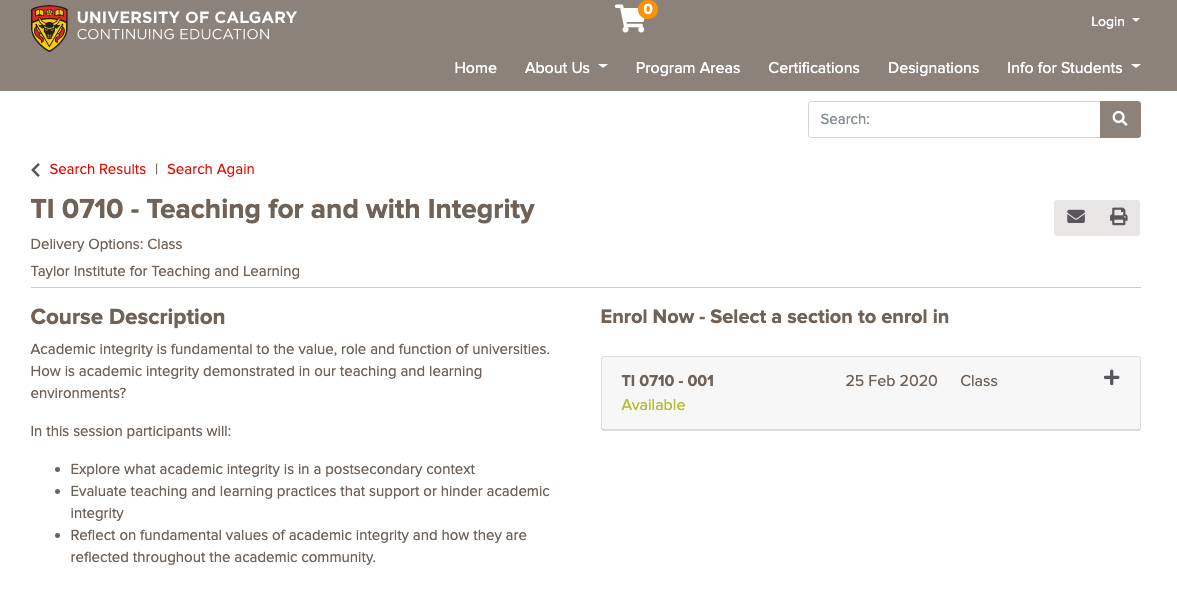
Screen Shot 2020-02-05 at 7.18.28 AMJoin Natasha Kenny and me for this interactive and engaging workshop at the University of Calgary.

Teaching for and with integrity

February 25, 2020

1:00 p.m. – 2:30 p.m.

Click on this link to register. Workshop location (room) is provided in the registration confirmation. No cost to attend. All are welcome.

Workshop Description

Academic integrity is fundamental to the value, role and function of universities. How is academic integrity demonstrated in our teaching and learning environments?

Join us for an interactive and insightful workshop focused on positive aspects of supporting academic integrity from a teaching and learning perspective.

Learning outcomes

In this session participants will:

  • Explore what academic integrity is in a postsecondary context
  • Evaluate teaching and learning practices that support or hinder academic integrity
  • Reflect on fundamental values of academic integrity and how they are reflected throughout the academic community.

We are excited to engage members of our campus community in this work. In the spirit of taking a multi-stakeholder approach to academic integrity, welcome academic staff (of all ranks), teaching assistants, staff, students and others who are interested to join us for this workshop.

This workshop is just one aspect of our ongoing commitment to build a campus culture of academic integrity. We look forward to engaging with you at this event. If you have any questions about academic integrity initiatives at the University of Calgary, contact Sarah Elaine Eaton.

______________________________________________________

Share or Tweet this: Workshop: Teaching for and with integrity

This blog has had over 2 million views thanks to readers like you. If you enjoyed this post, please “like” it or share it on social media. Thanks!

Sarah Elaine Eaton is a faculty member in the Werklund School of Education, and the Educational Leader in Residence, Academic Integrity, University of Calgary, Canada. Opinions are my own and do not represent those of the University of Calgary.


Why you shouldn’t post your teaching dossier online

January 30, 2018

Students and colleagues sometimes ask me if they should post their teaching dossier or portfolio online. My answer is immediate: No!

Those who know me know that I am a big fan of developing a strong online professional presence. I encourage students and colleagues to keep their LinkedIn, Twitter, and other online professional profiles current. But there’s something about a teaching dossier that’s different. I couldn’t put my finger on it until I read an article by White & Conrod (2016) where they tell the story of how their teaching philosophies were plagiarized.

Your teaching philosophy is a key element of your dossier. Developing it is hard work. It involves some deep reflection, brain work and soul-searching. You dig deep into yourself to figure out who you are as an educator, what matters to you and why it matters. Honestly, articulating your teaching philosophy may be the single most difficult element of putting together your teaching dossier. When it’s done, it should be a reflection of who you are and what matters to you as an educator.

Other people may have similar philosophies, but in the end, your statement is about you and your values. It is yours and yours alone.

If you post it online, it becomes easy for others to cut-and-paste what you have shared. These may not be bad people. They may be too afraid or too intimidated to engage in the deep reflection required to develop a philosophy of their own. Who knows? My point is, don’t make it easy for others to steal your teaching philosophy.

Share your dossier selectively, with those who need it, such as employers or those evaluating your teaching. You might also choose to share your dossier with those who would benefit from it, such as students or junior colleagues. That does not mean you have to post it publicly online. You have other options:

Alternatives to posting your teaching dossier publicly online

  1. Share print copies of your work. This may sound old fashioned, but if someone does not require digital access to your dossier and a paper copy works just as well, why not? You might choose to add “Confidential” to the header or footer to make it clear you do not want it to be shared widely.
  2. Save a copy of your work in a digital format that is hard to copy. An protected .pdf isn’t foolproof, but it is an option. Another option is to save your work as a .jpg., but if you choose this route, be sure that the .jpg is high quality and easy to read.
  3. Save your work as a password protected or “read only” online document. Share the password or link with caution.

Again, share selectively and make it clear that your work is not for distribution.

I suspect that some people who are vehement believers in open access or the sharing culture may disagree with my stance on this issue. There are plenty of websites that offer tips about how to post your entire dossier online. Don’t get me wrong. I share lots of my work online, free of charge in an open access format. It may be OK to share parts of your teaching dossier publicly online, such as your previous teaching experience, but not all of it. The key is to think critically about what you want to share and how you choose to do that.

It is important to understand that the more publicly you share, the easier you make it for others to copy-and-paste your deep thoughts, rather than engaging in their own soul-searching journey. If you want to offer others a short-cut and do the hard work for them, that is an option. But if you’d rather not, think twice before posting your entire teaching dossier publicly online.

The point is for you to think critically about who you want to have access to your inner most values about teaching. In my view, your teaching philosophy is a key element of your identity as an educator. Don’t make it easy for others to steal your professional identity.

Reference:

White, M. A., & Conrod, J. D. (2016). Is nothing sacred? Our personal teaching philosophies have been plagiarized. University Affairs. Retrieved from https://www.universityaffairs.ca/opinion/in-my-opinion/is-nothing-sacred-our-personal-teaching-philosophies-have-been-plagiarized/

______________________________________________________

Share or Tweet this: Why you shouldn’t post your teaching dossier online https://wp.me/pNAh3-2gr

This blog has had over 1.8 million views thanks to readers like you. If you enjoyed this post, please “like” it or share it on social media. Thanks!

Sarah Elaine Eaton is a faculty member in the Werklund School of Education, University of Calgary, Canada.

Opinions are my own and do not represent those of the Werklund School of Education or the University of Calgary.