How checking things off your “to do” list is different than solving problems

December 7, 2012

I am in the middle of a small war with the management company of our condo complex. As the board president, I constantly liaise with our property manager about problems that need to be solved on the property. A recent issue is an excellent example of the difference between management and leadership.

There are 110 town homes in our condo complex that are approaching 40 years old. Structural wear and tear is starting to be a problem. This year, one unit had a major ant infestation. We got an exterminator to deal with the problem immediately. He said that the ants were entering through small holes under the kitchen window and in addition to his extermination services, he recommended that we fix the exterior by plugging up the holes that the ants use as entry points to the house.

Since the beginning of August I have been sending in requests to get the holes around the exterior of the windows fixed. I am not an expert in windows or building envelopes or exterior structures, but it was pretty clear where the holes were. I sent in a request to have the caulking around the outside of the window

The property manager has a construction company that they send out on a regular basis to do jobs on the property. I have met them and they are actually great guys. They know what they are doing. They arrive on time, they do a good job, they clean up after themselves, and they are pleasant to all the residents who live here. It doesn’t really get much better than that.

But this ant issue has recently turned into an all out war.

Last month I said, “I have been asking for this to be done for 3 months. Please have the work done.”

His reply, “I have talked to the contractor. He says the work has been done.”

Yesterday I looked at the unit. The entry points for the ants are still visible.

I wrote again, saying “Four months have now passed since I sent in this work request. This work has not yet been completed. Please have the work done.”

The reply came back, “The contractor assures me that he has caulked around the window. Can I give the contractor your phone number and you can deal with him directly?”

I went outside and looked. Indeed, the area around the metal frame had been caulked, but the entry points for the ants were still wide open. I took some pictures. I highlighted the areas where ants were entering:
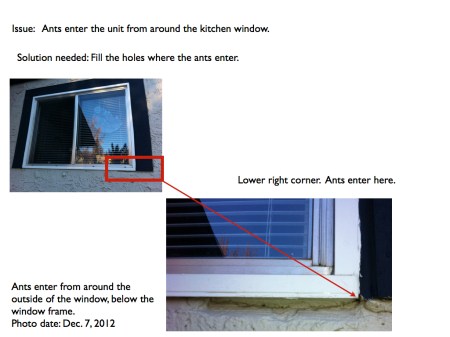
Ant photos.001

Here is the second photo:

Ant photos.002

I sent the photos together with this letter:

Dear John:

I’ve been thinking about this. If you say to a guy, “Go caulk around the window.” He’s going to come over and caulk around the window. The job is done because the job was “to caulk around the window”.

 If you say to the guy, “This place has an ant problem. The kitchen wall is covered with thousands of ants. The exterminator says they are coming in from outside, specifically from around the kitchen window. Go over there and have a look at the outside of the kitchen window. Figure out every possible entry point for the ants to get in around that window. Plug each and every last one of those holes up, so the little buggers can’t get in.”

The job is done when the window is turned into an ant version of Fort Knox. No one — not one little ant — gets in.

That is an entirely different job than, “Go caulk around this window.”

The job we need to have done is the second one — plug up every possible entry point for ants from around that kitchen window.

If you need to give the contractor my number to explain that, then go ahead, but I’m pretty sure you get the idea about what we are after here, which is a solution to the problem of blocking how the ants get into the unit.

Every time you send a guy — or a couple of guys — to our property to do a job, they are not just checking off items from a “to do” list. They are solving problems for the people who live here. In doing that, they are making their life better.

I’m not trying to be melodramatic here, but every time one of your guys comes to our property to fix a problem for a resident, they get a chance to be somebody’s hero. They do that by solving a problem that the owner can not solve by themselves, because they either do not know how or they do not have the skills, expertise, materials, or maybe just the time. That’s one reason people live in condos.

I guarantee you that the single lady who lives in that unit does not have the skills or materials to fix this problem herself — or she would have already.

Your guys have all that — skills, talent, expertise and materials. We rely on you to hire smart guys and you do that. We see it time and time again. They’re smart, they’re capable and they can solve problems. In a small way, they can be somebody’s hero.

So tell your guy that this is his chance to be a hero for Marilyn, the lady who lives there.

Thanks,

Sarah

When it comes to leadership, it is important to give people all the information they need to solve a problem. If you hire smart people, then do not simply give them items to check off their “to do” list. Engage people’s skills, expertise and problem-solving abilities to make them part of the solution. In doing so, you are likely to make their work more meaningful… and both they — and their work — will have a greater impact on those they are helping.

I believe deeply in people’s capacity to solve problems, help others and do meaningful work.

Checking items off a “to do” list does very little to connect the work to the people who may benefit from it. Besides, work that only involves checking items off a “to do” list often lacks meaning, especially when that list is assigned to you by someone else.

Engaging smart people to develop sustainable solutions helps everyone over the long term.

_________________

Share or Tweet this: How checking things off your “to do” list is different than solving problems http://wp.me/pNAh3-1×6

Update – January 2018 – This blog has had over 1.8 million views thanks to readers like you. If you enjoyed this post, please “like” it or share it on social media. Thanks!

Sarah Elaine Eaton is a faculty member in the Werklund School of Education, University of Calgary, Canada.


3 Handy Checklists for APA Style and Formatting

November 27, 2012

As my students are getting ready to hand in their final research papers, they are struggling to learn APA (American Psychological Association) standards for formatting, citations and references. Here are three handy checklists I have shared with them. They find them very helpful:

APA Style Checklist – http://www2.indwes.edu/ocls/apa/apastylechecklist.pdf

Checklist for APA Style (from Elmhurst) – http://library.elmhurst.edu/files/2010/02/ChecklistAPA.pdf

APA Format Checklist (from SLU) – http://www.slu.edu/Documents/student_development/student_success_center/APA_Format_Checklist_Handout.pdf

______________

Share or Tweet this: 3 Handy Checklists for APA Style and Formatting  http://wp.me/pNAh3-1wD

Update – January 2018 – This blog has had over 1.8 million views thanks to readers like you. If you enjoyed this post, please “like” it or share it on social media. Thanks!

Sarah Elaine Eaton is a faculty member in the Werklund School of Education, University of Calgary, Canada.


What makes a good research question?

November 6, 2012

This week I posed a question to my students: What makes a good research question?

As Masters of Education students, they are learning about what it means to be a researcher and building a foundation of knowledge. They came up with some great resources this week. If you are looking for answers to this question, check out these great resources:

Sarah Eaton blog leadershipSonia Ospina’s entry in the Encyclopedia of Leadership on Qualitative Research

This is a 13-page document, available free in .pdf format. Published in 2004, this text shares some of the fundamentals of qualitative research, particularly as it pertains to leadership. It is also very useful for students and researchers working in education and other social sciences. It contains an extensive bibliography that serves as a great point of departure for more exploration. Link for this resource: http://ualr.edu/interdisciplinary/files/2010/03/Qualitative_Research.pdf

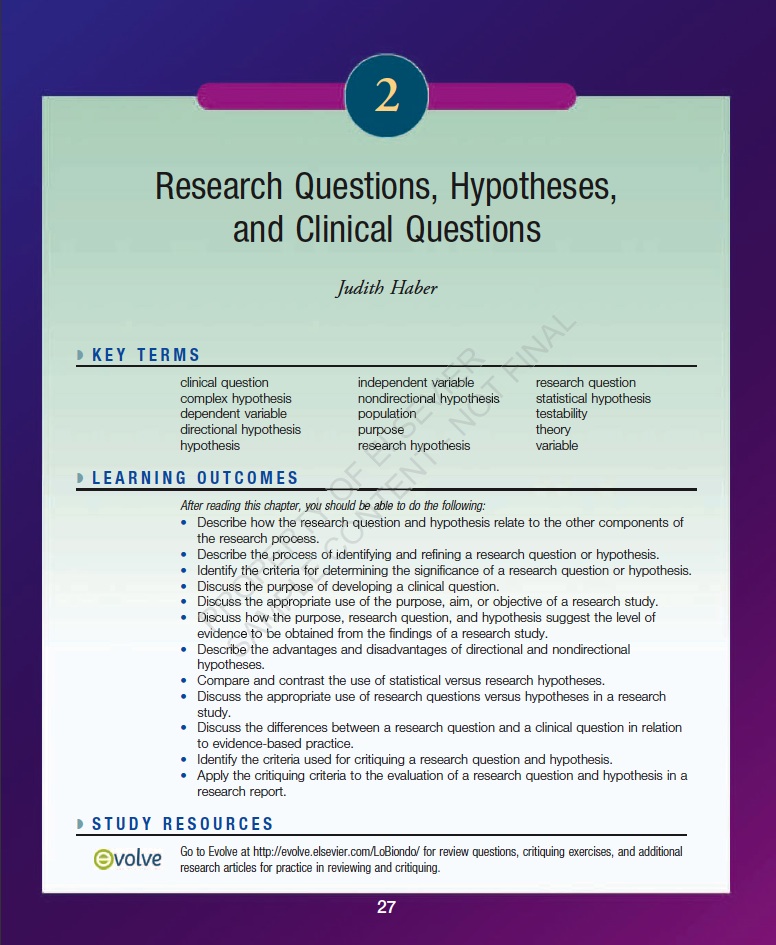
Sarah Eaton blogJudith Haber’s chapter called “Research Questions, Hypotheses and Clinical Questions”

Though marked as “Sample – Not final” with a watermark on the .pdf, this is an incredible 29-page resource that includes flow charts and tables of information. It is easy to understand and written in language that most novice researchers could understand. This one quickly became a favorite because it was colorful and concise. Even though it appears to be written for students and practitioners of health research, there are many elements that may be useful to educators and social science researchers, too. Link for this resource: http://www.us.elsevierhealth.com/media/us/samplechapters/9780323057431/Chapter%2002.pdf

Companion for Undergraduate Research

This is a website (http://www.socscidiss.bham.ac.uk/) that outlines the characteristics of a good research question. Then it talks about each characteristic in detail. It is written in clear language and is very well organized. The page also contains links to other helpful resources on research.

Figuring out how to craft a research question can be tricky. Resources like these help to demystify the process.

______________

Share or Tweet this: What makes a good research question? http://wp.me/pNAh3-1vL

Update – January 2018 – This blog has had over 1.8 million views thanks to readers like you. If you enjoyed this post, please “like” it or share it on social media. Thanks!

Sarah Elaine Eaton is a faculty member in the Werklund School of Education, University of Calgary, Canada.


Is your research biased? Answer: Yes. (Here’s why.)

October 29, 2012

Sarah Eaton blog technology researchThis semester I am teaching a course on Research Methodology in Education. One of the topics that has come up is bias.

Bias is present is bascially every research study. Even though we strive to be objective — and that is part of our work, we nevertheless start with a set of values, beliefs and philosophies that shape our opinions and world view.  It is important for reasearchers to understand the biases they bring to their work and to acknowledge them.

For example, one of my biases is that I hold is that everyone is capable of learning. Not everyone is capable of earning a Ph.D. (for any number of reasons), but everyone is capable of learning something. This is one of my values and beliefs that shapes my work. If I am an honest researcher, I must declare and acknowlege that bias when I do research. It is one thing to have and acknowledge bias. It is an entirely different matter to purposely bias our research in favor of a particular outcome or do research just to prove a point.

There are two ways to approach research:

Approach #1 – Conduct research in a manner that supports your argument

The first is to start with an argument or a position and conduct research and find literature that supports your point of view.

Though some scholars might disagree, I would submit that is an undesirable starting position. The reason is that you are likely to skew either your research or your results so they fit with your argument. Forcing results to fit to a pre-determined argument may be considered unethical. For example, pharmaceutical companies that conduct drug tests in order to prove the drug is safe and refuse to release research that may contradict that starting point are harshly criticized. Such research is not considered believable because it is skewed.

Approach #2 – Start with a research question, hypothesis or topic. Conduct your research in a manner that seeks to answer a question.

The second way to approach you research is to begin with a problem you want to solve or a question you want to answer. Then, you conduct your research in a manner that seeks to answer your research question. Once you have conducted your research, your argument emerges from your data.

The data is the information that you gather that allows you develop a cogent argument to persuade others. You can gather primary data (e.g. interviews) or secondary data (e.g. literature review).

Part of a research study almost always involves a review of previous literature written on the topic you are studying. In your literature review, it is valuable to cite opposing views. Once you have considered your question or problem from a variety of angles, then you can begin to develop an argument, based on your findings. Considering a variety of viewpoints is highly desirable as it demonstrates that you are not attempting to skew your results in favor of a pre-determined outcome.

Be aware that just because you start your research with a particular question or topic, it is unwise to assume that your starting position is the correct one. Be curious, rather than dogmatic. What themes emerge from the literature that you surveyed? What surprised you? What arguments can be made? What conclusions can be drawn?

In my own research, it has happened to me that I start with a research question, problem or hypothesis and as I surveyed the literature, my hypothesis was proven to be incorrect. Be prepared for that to happen. It does not mean you are a bad researcher. Quite the contrary, it means you have allowed your hypothesis or question to be challenged and your research is driven by the data you find.

We may come to our work with a bias. But ultimately, the research needs to speak for itself. That’s what makes it credible.

______________

Share or Tweet this: Is your research biased? Answer: Yes. (Here’s why.) http://wp.me/pNAh3-1vw

Update – January 2018 – This blog has had over 1.8 million views thanks to readers like you. If you enjoyed this post, please “like” it or share it on social media. Thanks!

Sarah Elaine Eaton is a faculty member in the Werklund School of Education, University of Calgary, Canada.


UNESCO’s free advocacy kit for promoting multilingual education

October 24, 2012

UNESCO multilingualism Sarah Elaine Eaton blogUNESCO has a number of initiatives on the go to promote multilingual, bilingual and mother-tongue education. They have come out with a new advocacy kit designed to help raise awareness about the importance of multilingual education. The toolkit is for:

  • education practitioners (teachers)
  • education specialists (learning leaders)
  • policy makers

The kit is a 109-page free, downloadable .pdf. It is very cool. Get yours here.

______________

Share or Tweet this: UNESCO’s free advocacy kit for promoting multilingual education http://wp.me/pNAh3-1vs

Update – January 2018 – This blog has had over 1.8 million views thanks to readers like you. If you enjoyed this post, please “like” it or share it on social media. Thanks!

Sarah Elaine Eaton is a faculty member in the Werklund School of Education, University of Calgary, Canada.