Literacy and Essential Skills: Why Digital Literacy is Crucial

December 6, 2011

The Guardian recently published an article called “No place in class for digital illiterates“. The article talks about how children who lack technology literacy skills are getting left behind. Writer Gavin Dudeney talks about changing definitions of literacy that now include “digital literacy”  or the ability to use the Internet and interact with digital texts.

As I was writing The Need For Increased Integration of Technology and Digital Skills in the Literacy Field in Canada I found research that suggests that Canada’s 9 Literacy and Essential Skills may be just the beginning. One of the 9 Essential Skills is “Computer Use”. Some researchers are suggesting that this term is too narrow. Today, it is not enough for a person to know how to turn on a computer, manipulate a mouse or use a track pad or write a resume on a word processing program. Digital skills are an important part of computer use.

People need to know how to search for everyday information such as bus schedules, tax information and other important information that is part of every day living. Job seekers need to know how to search for and apply for jobs posted on the Internet and submit their resume through an online application system. More and more job application sites require users to create an account and register with a company or a service. If adults do not know how to do these things, they will fall behind.

Children who do not know how to use touch screens or the Internet may find themselves disadvantaged later on, as they try to catch up with digitally savvy peers. There are some groups and individuals who are opposed to the increased use of technology in schools. Waldorf Schools, a system of private schools with an excellent reputation, reportedly does not use any technology in its elementary grades.

As an educator, I worry about such approaches. Clearly, it works for them because they are a hugely successful network of schools. But I openly confess that I have never worked with a Waldorf school, myself. I’d love to be invited to one to see how they teach and engage with their learners. As a bit of a “tech junkie”, I have to acknowledge my bias in favour of using more technology, rather than less. I worried whether children who do not learn how to use touch screens or the Internet in their school years may find themselves disadvantaged later on, as they try to catch up with digitally savvy peers?

Having said that, I do think it is important to incorporate technology in a meaningful way that shows why we are using it, what purpose it serves and ultimately, how it benefits the learner. It is critical to make these links so that we show how digital skills can help children develop cognitively and socially so that when they grow up, their lives as adults have meaning as they find work that makes them feel that they are making a meaningful contribution to their world. It is a world that we can only dream about right now. As an educator, I ask, how do we best prepare our learners for success in five, ten or twenty years’ time? And what will “literacy and essential skills” look like a decade from now?

________________

Like this post? Share or Tweet it: Literacy and Essential Skills: Why Digital Literacy is Crucial http://wp.me/pNAh3-13W

Update – January 2018 – This blog has had over 1.8 million views thanks to readers like you. If you enjoyed this post, please “like” it or share it on social media. Thanks!

Sarah Elaine Eaton is a faculty member in the Werklund School of Education, University of Calgary, Canada.


Best resources of the week (Nov. 20 to 26, 2011)

December 4, 2011

Here are my favorite resources of the week, curated from my Twitter account.

Social Media

Schools would be wise to adopt Granville district’s social media policies – Newark Advocate

How to hide Twitter #hashtag chats from your followers by Dave Larson

The Rise of the Connected Non-Profit from Mashable

10 Things I Learned On My Twitter Journey To 100,000 Followers by John Paul

How 5 Top Brands Crafted Their Social Media Voices by Lauren Indvik

“Don’t do as I say, do as I do” – the role of leadership in promoting the use of social media by Don Ledingham

7 Secrets Of Highly Effective Twitter Power Users  by Lauren Dugan

10 Steps to Kick Start Your Twitter Network from Edte.ch Blog

Proposed social media policy has this school committee in a huff by Sherilynn Macale

Literacy and Essential Skills

Reading to your kid: even more important than you think – The Globe and Mail

How Canadian contemporary authors inspire youth – Imaginaction

Language Learning and Teaching

Chicago Public Schools teacher Kickstarting ESL program through song by Alyssa Vitale

Scaffolding Academic Learning for Second Language Learners by Karen Sue Bradley & Jack Alden Bradley

E-Learning

Activities for online courses: The Beginning by Nicky Hockly

How To Be a Top Learning Organization by Tiffani Murray

7 Things You Should Know about Google Apps from Educause

For some kids, a book is just an iPad that doesn’t work by Ivor Tossell

62 things you can do with Dropbox from MacWorld

Education Resources

Tools for Teaching: Authentic Assessment from the Centre for Teaching and Educational Technologies, Royal Roads University

Flipped Classroom Full Picture: An Example Lesson by Jackie Gerstein

Google Scholar Citations Now Open to All by Ryan Cordell

Education News

Dyslexia may explain my school failure, says Annabel Heseltine by Julie Henry

Ministers of Education Report to Canadians on Official Languages in Education – Canada Newswire

A School System in Maine Gives iPads to Kindergartners from Voice of America

Alberta education minister welcomes input on overhauling system via social media – Metro News

Year-round school: An idea worth exploring – The Windsor Star

Public Speaking and Presentation Skills

Stop Breaking the Basic Rules of Presenting by Ned Potter

App for Speakers: A presentation timer by Takuya Murakami

Secrets from JFK’s Speechwriter by Peter Temple

Writing

How to Write, Launch and Sell Your Informational Ebook by Alexis Grant

Related posts:

Dr. Sarah’s Favorite Resource of the Week (Nov. 13 to 19, 2011)

____________________________

Share this post: Best resources of the week (Nov. 20 to 26, 2011) http://wp.me/pNAh3-12N

Update – January 2018 – This blog has had over 1.8 million views thanks to readers like you. If you enjoyed this post, please “like” it or share it on social media. Thanks!

Sarah Elaine Eaton is a faculty member in the Werklund School of Education, University of Calgary, Canada.


The Need For Increased Integration of Technology and Digital Skills in the Literacy Field in Canada

December 2, 2011

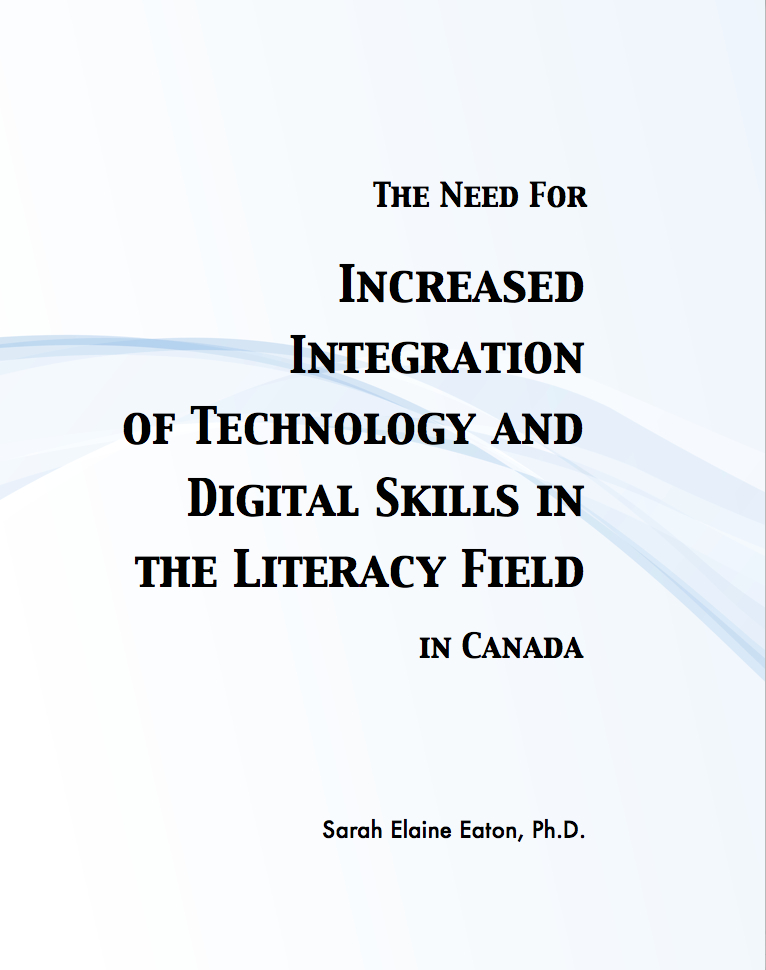
Need for Increased Tech in Literacy by Sarah Elaine Eaton, Calgary, CanadaIt’s here! The Need For Increased Integration of Technology and Digital Skills in the Literacy Field in Canada has just been released.

Technology does not need to be adopted because it is fashionable, but because the face of learning worldwide has changed dramatically over the past several decades at all levels, from early childhood education to workforce training. When literacy professionals integrate technology in meaningful ways, they ultimately help learners prepare for long-term success.

This report highlights the changing landscape of Canadian education and training (though the findings may relate to other regions, too). It offers recommendations for literacy organizations, managers, coordinators, staff, volunteer tutors and other practitioners to incorporate technology into professional practice in an easily accessible manner that focuses on building professional competencies.

Topics covered include:

  • The changing nature of education and training.
  • The current state of literacy instruction.
  • Emerging models of technology integration in the literacy field.
  • The need for continuing professional development.
  • Recommendations.

Bibliography contains 36 references. Get your copy here: http://www.onatepress.com/titles/the-need-for-technology-in-literacy/

This publication is also available through the ERIC database: http://www.eric.ed.gov/PDFS/ED526087.pdf

______________

Like this post? Share or Tweet it: The Need For Increased Integration of Technology and Digital Skills in the Literacy Field in Canada  http://wp.me/pNAh3-12r

Update – January 2018 – This blog has had over 1.8 million views thanks to readers like you. If you enjoyed this post, please “like” it or share it on social media. Thanks!

Sarah Elaine Eaton is a faculty member in the Werklund School of Education, University of Calgary, Canada.


Social Media Challenges in the Workplace – CIRA panel discussion

November 24, 2011
CIRA Dinner Calgary

(Left to Right) John Moreau, Tom Hesse, Sarah Eaton and Andy Robertson debating social media challenges in the workplace

Tonight I took place on a panel discussion in Calgary on the issue of social media challenges in Calgary. The dinner event was hosted by the Southern Alberta chapter of the Canadian Industrial Relations Association (CIRA), and organized by Dr. Kelly Williams-Whitt, who is a professor of Labour Relations at the University of Lethbridge (Calgary Campus) and serves in a leadership role with CIRA.

My fellow panelists were:

  • Andy Robertson, Partner, Macleod Dixon LLP
  • Tom Hesse, United Food and Commercial Workers Canada (UFCW) 401
  • John Moreau, Arbitrator

Dr. Whitt presented us with three Canadian labour cases including:

  1. A female employed in the health care sector who posted photos of patients without their permission on her blog, discussing their conditions and making disparaging remarks about her fellow employees, her workplace and her bosses. (She was later dismissed from her job.)
  2. A male employee with documented mental health issues who blogged about his Neo-Nazi beliefs, his hatred of certain racial groups, the desecration of animal remains that he took part in, the anti-depressants he was on and other assorted topics. He mentioned the name of his employer in his blog. (He was suspended from work and then reinstated.)
  3. A male employee who circulated pornography to his co-workers and was later found to have over 3000 pornographic images and some porn videos in his work e-mail account. (He was suspended from work and then reinstated).

Each panelist gave commentary on the cases, based on their respective experience. My point of view was mainly “pro” social media. My main arguments were:

  • Most companies do not train their employees adequately on how to use social media effectively and responsibly.
  • Organizations need to make their expectations about online behaviour very clear to employees.
  • Everyone who engages in social media leaves a “digital footprint”. Employees and employers need to be aware of what this is and what it can mean over the long term.
  • Digital citizenship is in an important skills to learn in the 21st century.
  • Online reputation management is becoming more important for both employees and employers.

Here’s a clip of my commentary:

It was a lively and invigorating discussion that touched on topics such as personal freedoms, organizational control, common sense and personal responsibility. My fellow panelists were articulate, well-informed and thoughtful in their responses. Being neither a lawyer, nor a union voice, I was honoured to take part in the discussion.

____________

Share this post: Social Media Challenges in the Workplace – CIRA panel discussion http://wp.me/pNAh3-129

Update – January 2018 – This blog has had over 1.8 million views thanks to readers like you. If you enjoyed this post, please “like” it or share it on social media. Thanks!

Sarah Elaine Eaton is a faculty member in the Werklund School of Education, University of Calgary, Canada.


Best resources of the week (Nov. 13 to 19, 2011)

November 20, 2011

Here are my favorite resources of the week, curated from my Twitter account.

Social Media

Social media increasingly used to guage public health – by Christine Moyer, American Medical News

How to Create a Social Media Marketing Schedule – by John D. Leavy

Literacy and Essential Skills

What have you learned about teaching others to read? Share your story – Educational Leadership seeks 200-word stories of wisdom from educators. Add yours.

What You Don’t Know Can Hurt You: Literacy’s Impact on Workplace Health and Safety by Alison Campbell, Conference Board of Canada

Education News

Foreign languages ‘essential for our children’s future’ – Published by The Financial

More Foreign Language Classes Use Online Education – by Catherine Groux, U.S. News

Exam approach fails many – Edmonton Journal

____________________________

Share this post: Best resources of the week (Nov. 13 to 19, 2011) http://wp.me/pNAh3-11B

Update – January 2018 – This blog has had over 1.8 million views thanks to readers like you. If you enjoyed this post, please “like” it or share it on social media. Thanks!

Sarah Elaine Eaton is a faculty member in the Werklund School of Education, University of Calgary, Canada.