Why you shouldn’t post your teaching dossier online

January 30, 2018

Students and colleagues sometimes ask me if they should post their teaching dossier or portfolio online. My answer is immediate: No!

Those who know me know that I am a big fan of developing a strong online professional presence. I encourage students and colleagues to keep their LinkedIn, Twitter, and other online professional profiles current. But there’s something about a teaching dossier that’s different. I couldn’t put my finger on it until I read an article by White & Conrod (2016) where they tell the story of how their teaching philosophies were plagiarized.

Your teaching philosophy is a key element of your dossier. Developing it is hard work. It involves some deep reflection, brain work and soul-searching. You dig deep into yourself to figure out who you are as an educator, what matters to you and why it matters. Honestly, articulating your teaching philosophy may be the single most difficult element of putting together your teaching dossier. When it’s done, it should be a reflection of who you are and what matters to you as an educator.

Other people may have similar philosophies, but in the end, your statement is about you and your values. It is yours and yours alone.

If you post it online, it becomes easy for others to cut-and-paste what you have shared. These may not be bad people. They may be too afraid or too intimidated to engage in the deep reflection required to develop a philosophy of their own. Who knows? My point is, don’t make it easy for others to steal your teaching philosophy.

Share your dossier selectively, with those who need it, such as employers or those evaluating your teaching. You might also choose to share your dossier with those who would benefit from it, such as students or junior colleagues. That does not mean you have to post it publicly online. You have other options:

Alternatives to posting your teaching dossier publicly online

  1. Share print copies of your work. This may sound old fashioned, but if someone does not require digital access to your dossier and a paper copy works just as well, why not? You might choose to add “Confidential” to the header or footer to make it clear you do not want it to be shared widely.
  2. Save a copy of your work in a digital format that is hard to copy. An protected .pdf isn’t foolproof, but it is an option. Another option is to save your work as a .jpg., but if you choose this route, be sure that the .jpg is high quality and easy to read.
  3. Save your work as a password protected or “read only” online document. Share the password or link with caution.

Again, share selectively and make it clear that your work is not for distribution.

I suspect that some people who are vehement believers in open access or the sharing culture may disagree with my stance on this issue. There are plenty of websites that offer tips about how to post your entire dossier online. Don’t get me wrong. I share lots of my work online, free of charge in an open access format. It may be OK to share parts of your teaching dossier publicly online, such as your previous teaching experience, but not all of it. The key is to think critically about what you want to share and how you choose to do that.

It is important to understand that the more publicly you share, the easier you make it for others to copy-and-paste your deep thoughts, rather than engaging in their own soul-searching journey. If you want to offer others a short-cut and do the hard work for them, that is an option. But if you’d rather not, think twice before posting your entire teaching dossier publicly online.

The point is for you to think critically about who you want to have access to your inner most values about teaching. In my view, your teaching philosophy is a key element of your identity as an educator. Don’t make it easy for others to steal your professional identity.

Reference:

White, M. A., & Conrod, J. D. (2016). Is nothing sacred? Our personal teaching philosophies have been plagiarized. University Affairs. Retrieved from https://www.universityaffairs.ca/opinion/in-my-opinion/is-nothing-sacred-our-personal-teaching-philosophies-have-been-plagiarized/

______________________________________________________

Share or Tweet this: Why you shouldn’t post your teaching dossier online https://wp.me/pNAh3-2gr

This blog has had over 1.8 million views thanks to readers like you. If you enjoyed this post, please “like” it or share it on social media. Thanks!

Sarah Elaine Eaton is a faculty member in the Werklund School of Education, University of Calgary, Canada.

Opinions are my own and do not represent those of the Werklund School of Education or the University of Calgary.


21st century definition of plagiarism

January 23, 2018

Not long after I started getting interested in academic integrity, I began wondering how different universities defined plagiarism in their official policy documents. That led me to do an analysis of policy documents from 20 Canadian higher education institutions, and the results were published in the peer-reviewed scholarly journal, Interchange. Basically, what I found was that there was no consistent definition of plagiarism across Canadian post-secondary institutions. In other words, we don’t agree about what actually constitutes plagiarism.

This makes it confusing for students and for professors, especially considering that students might attend one school to do their undergraduate degree and another for their graduate degree, or that professors sometimes change jobs, leaving one institution for another.

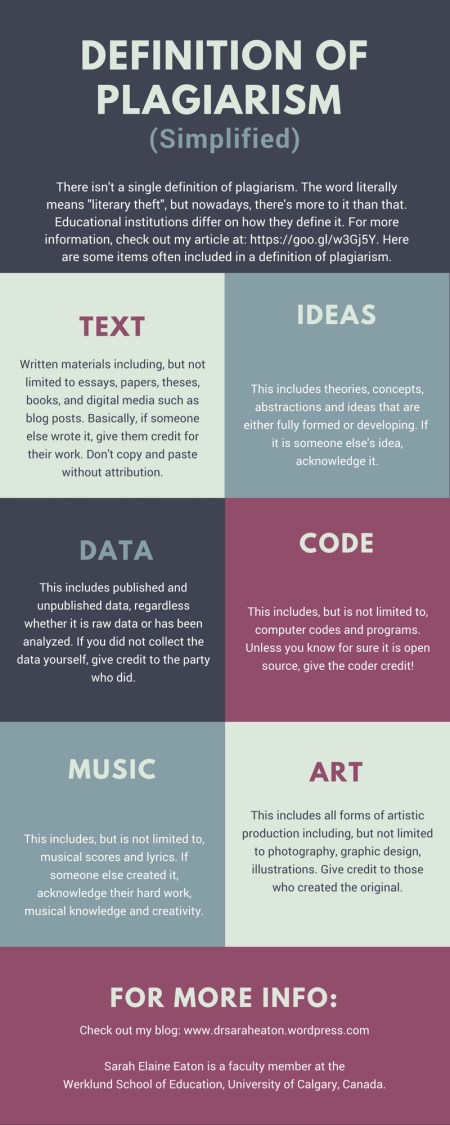
It used to be that the definition of plagiarism was simple: literary theft, but it is a lot more complicated than that in the 21st century, where digital outputs account for as much, if not more than, printed products. Students and professors have asked me, “So, how do you define plagiarism in plain and simple terms?” The answer is actually quite complex and a bit messy. But in the interest of demystifying the issue, here is a straight forward infographic that may help.

Let me say that this resource is simplified — perhaps overly so. My goal here isn’t to be reductionist and I fully acknowledge that not everyone may agree with these simplified explanations. But sometimes it can be easier to wrap your head around something simple to start and then tease out the complexities once you are more comfortable with the basic concepts.  I offer these not as the be-all-and-end-all definition, but rather as a starting point to help educators and students clarify and demystify basic concepts and also to engage in productive conversations about how to cultivate academic integrity and reduce plagiarism.

Definition of plagiarism (jpg)

Here is a free, downloadable .pdf of this infographic that you are welcome to use with your students for teaching purposes. Feel free to use it as a conversation starter to help students understand what plagiarism is and how to prevent it in their own work.

Related post:

Comparative Analysis of Institutional Policy Definitions of Plagiarism: A Pan-Canadian University Study https://wp.me/pNAh3-1LD

______________________________________________________

Share or Tweet this: 21st century definition of plagiarism https://wp.me/pNAh3-2eo

This blog has had over 1.8 million views thanks to readers like you. If you enjoyed this post, please “like” it or share it on social media. Thanks!

Sarah Elaine Eaton is a faculty member in the Werklund School of Education, University of Calgary, Canada.


Avoiding Predatory Journals and Questionable Conferences: A Resource Guide

January 9, 2018
Cover art - Avoiding Predatory Journals and Questionable Conferences

Download a copy of the full report for free from the University of Calgary: https://prism.ucalgary.ca/handle/1880/106227

Not long ago, a graduate student was lured in by a conference in his precise field of study and wrote to me to let me know of his acceptance. I had never heard of the conference. I had never even come across the name of it in passing. I have worked in higher education for almost a quarter of a century and I’ve heard of many legitimate and credible conferences in my field, so I became skeptical.

I asked numerous colleagues, as well as our resident librarian. No one else had heard of the conference either. Kudos to our education librarian at the University of Calgary,  since he went to significant effort to determine if the conference was legitimate. In the end, we decided that it was not a wise use of the student’s money or time.

As a result of that experience, I started investigating the topic of predatory conferences and journals in more depth. I started this guide thinking of other graduate students and junior academics who might be at risk of being seduced into spending valuable resources on taking part, while doing nothing to advance their own learning, professional development, scholarly experience or reputation. The stakes are high for academics and the pressure to produce can be overwhelming at times. This guide is intended to help scholars make wise decisions about how to spend their time, money and resources, while simultaneously protecting and preserving their professional reputation.

The goal of this guide is to provide a clear overview of the topics of predatory journals and questionable conferences and advice on how to avoid them. This guide intentionally adopts a plain language approach to ensure it is accessible to readers with a variety English language proficiency levels.

Download a copy of the full report for free from the University of Calgary: https://prism.ucalgary.ca/handle/1880/106227

______________________________________________________

Share or Tweet this: Avoiding Predatory Journals and Questionable Conferences: A Resource Guide https://wp.me/pNAh3-26x

This blog has had over 1.8 million views thanks to readers like you. If you enjoyed this post, please “like” it or share it on social media. Thanks!

Sarah Elaine Eaton is a faculty member in the Werklund School of Education, University of Calgary, Canada.


Conceptual and Theoretical Frameworks for Educational Research

October 30, 2017

Sarah Eaton blog technology researchIn my experience it is not uncommon for graduate students to struggle to figure out how to develop a conceptual or theoretical framework for their thesis or capstone project.
Here’s a list of resources that may help you do just that. I have developed this list with educational research in mind. Some of the resources are from other fields, but may have strong transferability to educational research contexts. Conversely, researchers from other fields may find the resources in this list helpful.

I have curated resources that are, in my opinion, high quality and relevant to those working in post-secondary research context. I have tried to include resources that are publicly accessible and available free of charge. I have excluded resources that seemed to be (again, in my opinion) overly brief or were being sold for profit.

Remember, if you are looking for sources to cite in your research paper or dissertation, scholarly journal articles and book chapters are often preferable to other kinds of resources because they are considered more credible. If you are just trying to wrap your head around the basics, any of these resources might help you.

Web-based resources

Clarke, R. (2011). Conceptual framework basics.   Retrieved from https://youtu.be/vxA43z4B1ao

Kesterson, T. (2013). Developing Conceptual Framework: Part 1.   Retrieved from https://youtu.be/HrbL508aG4k

Maxwell, J. A. (2005). Conceptual framework: What do you think is going on? Qualitative research design: An interactive approach (3rd. ed., pp. 39-72): Sage. Retrieved from: http://www.sagepub.com/sites/default/files/upm-binaries/48274_ch_3.pdf

Metha, R. S. (2013). Theoretical and Conceptual Framework as Blue Print of a House.   Retrieved from https://www.slideshare.net/rsmehta/conceptual-and-theoretical-framework

Schneider, D. K. (2005). The research plan and conceptual frameworks.   Retrieved from https://tecfa.unige.ch/guides/methodo/edu-tech/slides/res-design-intro.pdf

Sitko, N. J. (2013). Designing a qualitative research project: Conceptual framework and research questions.   Retrieved from http://fsg.afre.msu.edu/zambia/Conceptual_Framework_and_Research_Questions.pdf

Thompson, C. J. (2017). How to use a theory to frame your research study.   Retrieved from https://nursingeducationexpert.com/theory-frame-research/

Scholarly journal articles and book chapters

If you cannot find these articles easily, contact your local librarian. Often librarians can help you access legitimate copies of materials free of charge if you are having difficulty finding them.

Green, H. E. (2014). Use of theoretical and conceptual frameworks in qualitative research. Nurse Researcher, 21(6), 34-38. doi:10.7748/nr.21.6.34.e1252

Imenda, S. (2014). Is There a Conceptual Difference between Theoretical and Conceptual Frameworks? Sosyal Bilimler Dergisi/Journal of Social Sciences, 38(2), 185-195.

Jabareen, Y. (2009). Building a conceptual framework: Philosophy, definitions, and procedure International Journal of Qualitative Methods, 8(4), 49-62. Retrieved from https://journals.library.ualberta.ca/ijqm/index.php/IJQM/article/viewFile/6118/5892

Pearson Casanave, C., & Li, Y. (2013). Novices’ struggles with conceptual and theoretical framing in writing dissertations and papers for publication. Publications, 3(2), 104-119. Retrieved from https://doaj.org/article/227a9233d0d54cfeb08379902fbc0827 doi:10.3390/publications3020104

Saunders, M., N.K., Gray, D. E., Tosey, P., & Sadler-Smith, E. (2015). Concepts and theory building. In L. Anderson, J. Gold, J. Stewart, & R. Thorpe (Eds.), A Guide to Professional Doctorates in Business and Management (pp. 35-56). London: Sage.

Related posts:

How to narrow down your research topic http://wp.me/pNAh3-1Xf

Developing a Work Plan for Your Thesis https://wp.me/pNAh3-1X3

What if you’re wrong? A question for researchers http://wp.me/pNAh3-1Vq

______________________________________________________

Share or Tweet this: Conceptual and Theoretical Frameworks for Educational Research https://wp.me/pNAh3-1Za

Update – January, 2018 – This blog has had over 1.8 million views thanks to readers like you. If you enjoyed this post, please “like” it or share it on social media. Thanks!

Sarah Elaine Eaton is a faculty member in the Werklund School of Education, University of Calgary, Canada.


Universities unite against the academic black market

October 17, 2017

The ConversationOn the TV show Suits, Mike Ross’s character charges a hefty fee to students to take the LSAT (law school admission test) for them. Ross has a stellar memory and a remarkable ability to take tests without getting crushed by stress — he is the perfect “contract cheater.” Later, Ross builds a career as a lawyer based on fake credentials, presumably from Harvard.

Mike Ross may be fictional, but his business is only too real within universities globally. “Contract cheaters” such as Ross complete academic work on a student’s behalf — for a fee. This work includes test taking and homework services. It includes essay-writing and even PhD thesis-writing services, also known as “paper mills.”

In my role as interim associate dean of teaching and learning at the University of Calgary, and as a researcher who specializes in plagiarism prevention and academic integrity, I have been writing about contract cheating since 2010. Since then, it has become rampant at high school and post-secondary levels.

This black market for academic work is vast and little understood. Universities in Canada, and around the world, are having a very hard time trying to police it.

On Oct. 18, 2017, many universities have committed to the second International Day of Action Against Contract Cheating. This aims to tackle the issue head on — by raising awareness and sharing prevention strategies.

Read the whole article in The Conversation (originally published on Oct. 16, 2017).

Check out the radio interview I did on CBC: http://www.cbc.ca/listen/shows/calgary-eyeopener/segment/14438512

Related posts:

______________________________________________________

Share or Tweet this: Universities unite against the academic black market  http://wp.me/pNAh3-1YN

This blog has had over 1.8 million views thanks to readers like you. If you enjoyed this post, please “like” it or share it on social media. Thanks!

Sarah Elaine Eaton is a faculty member in the Werklund School of Education, University of Calgary, Canada.