Website Hijacking by Contract Cheating Companies

April 17, 2018

For a while now I’ve been working on projects related to preventing and addressing violations of academic integrity such as plagiarism and contract cheating. Contract cheating is a complex form of cheating, but it basically boils down to someone else doing the work on behalf of a student. The term “contract cheating” was coined more than a decade ago, in 2006, by Clarke and Lancaster in the U.K.

There are companies whose entire business model is focused on helping students cheat. They can go by different names depending on the services they offer. They have been called “essay mills”, “paper mills” or “homework completion services”. The companies make their money in different ways. They might charge by the page or charge a flat fee for an entire assignment.

To the surprise of many teachers and educational administrators, contract cheating is big business. Studies have found that this industry is likely worth a minimum of $100 Million USD in the United States (Owings and Nelson, 2014). Studies in the UK and New Zealand also estimate the contract cheating industry to be worth millions in those countries, too (Draper & Newton, 2017; Yorke, 2017).

These companies lure in students with offers of “help” and promises of making their lives easier. Their rhetoric is that of persuasion and manipulation. They try to trick students into believing that there is nothing wrong with paying a company to do academic work on their behalf when nothing could be further from the truth. The language contract cheating companies use in their advertising seems benevolent, but the primary focus is for them to make money, not to help students. These companies are driven by profit first and foremost. They have sophisticated marketing methods that can be both aggressive, insidious, and sometimes, even illegal.

I had heard anecdotally that contract cheating companies sometimes hijack other websites, putting their own ads on the site. Presumably, it is cheaper for them to hire a hacker to get into a less secure site than to pay to have their ads posted legitimately online. Last week, I accidentally found one such website. The website seemed to belong to a small, well-meaning community organization in the United States.

I have redacted the information to avoid the possibility of legal action, but here is a screen shot showing what it looked like:

Contract cheating website hack

Figure 1: Screen shot of redacted webpage compromised by a contract cheating company.

Upon analyzing the situation more deeply, it looked like the hijackers had gone into the organization’s web site and created several sub-pages. The original pages of the organization such as the home page and sub-pages created by the legitimate website owner were completely intact and untouched. It looked to me as if the hijackers had gone into the background of the site and created additional, publicly available sub-pages where they then posted ads for a contract cheating company, complete with links that re-directed to the contract cheating company’s website. Upon inspecting the website further, I found that the metadata of the page had been populated hidden keywords such as “essay writing”, “plagiarism-free” and “thesis assistance”. This means that students searching for those terms might be led to the advertisement on the newly-created sub-pages, which they would then click on to be re-directed to the contract cheating website. If that was the case, then this an unsuspecting community organization might not have found the newly-created sub-pages for some time.

Small non-profits and community organizations often lack awareness and resources about how companies like this can compromise their websites. In an excellent article on nonprofit cybersecurity, Sheela Nimishakavi (2018) notes “all nonprofits need to implement appropriate security measures”. Julie Campbell (2018) offers some excellent tips on how nonprofits can fight cyber-attacks. Here are a couple of Campbell’s recommendations:

  1. Upgrade your computers and software.
  2. Train and inform employees and volunteers.
  3. Focus on passwords.

A website owner, whether they are an individual or an organization, may be completely unaware when a contract cheating company compromises their site. If you see an ad for a contract cheating company, look at the website address. If it looks like it might belong to a person or an organization who is not at all affiliated with exploiting students, contact the website owner to let them know. In this case, I found the contact information for the website owner and e-mailed them to let them know their site had been compromised.

References

Campbell, J. (2018). 8 ways nonprofits can fight cyber attacks. The Balance. Retrieved from https://www.thebalance.com/better-nonprofit-cyber-security-2502537

Clarke, R., & Lancaster, T. (2006, June). Eliminating the successor to plagiarism: Identifying the usage of contract cheating sites. Paper presented at the Second International Plagiarism Conference, Gateshead, United Kingdom.

Draper, M. J., & Newton, P. M. (2017). A legal approach to tackling contract cheating? International Journal for Educational Integrity, 13(1), 1-16. doi:10.1007/s40979-017-0022-5

Nimishakavi, S. (2018). It’s 2018: Do you know where your nonprofit’s cybersecurity is? Nonprofit Quarterly. Retrieved from https://nonprofitquarterly.org/2018/01/26/2018-know-nonprofits-cybersecurity/

Owings, S., & Nelson, J. (2014). The essay industry. Mountain Plains Journal of Business and Economics, 15, 1-21. Retrieved from http://www.mountainplains.org/articles/2014/General%20Research/Mountain_Plains_Journal_of_Business_and_Economics_Volume_15_2014_1-21_General_Research_Owings.pdf

Yorke, H. (2017, January 13). More than 20,000 university students buying essays and dissertations as Lords call for ban on ‘contract cheating.’ The Telegraph. Retrieved from https://www.telegraph.co.uk/education/2017/01/13/20000-university-students-buying-essays-dissertations-lords/

Note: This blog post is a reprint of a full report that is archived in the University of Calgary digital repository. Here is the citation for the original:

Eaton, S.E. (2018). Website Hijacking by Contract Cheating Companies. Calgary: University of Calgary. Retrieved from http://hdl.handle.net/1880/106494

______________________________________________________

Share or Tweet this: Website Hijacking by Contract Cheating Companies https://wp.me/pNAh3-2i6

This blog has had over 1.8 million views thanks to readers like you. If you enjoyed this post, please “like” it or share it on social media. Thanks!

Sarah Elaine Eaton is a faculty member in the Werklund School of Education, University of Calgary, Canada.

Opinions are my own and do not represent those of the Werklund School of Education or the University of Calgary.


How to Prepare a Teaching Dossier

April 10, 2018

The first time I was asked by my department head to prepare a teaching portfolio was back in the 1990s. At the time, I had no idea what one was or how to go about preparing it. We’ve come a long way since then and now there are some terrific resources out there to help teachers, graduate students and professors prepare a teaching dossier (also known as a portfolio).

Here are some things to think about when preparing your dossier:

Elements of a Teaching Dossier.jpg

If you work at a university with Teaching and Learning Centre, check out the resources they have available. Often, these centres will host workshops or provide individual assistance to members of the university community working on their dossiers.

It takes time to develop a teaching dossier. It’s part thinking, part writing and part figuring out how to present the information to a reader who may or may not be familiar with your professional experience. Give yourself plenty of time to develop your dossier. Ask a colleague or two to look over a draft and get some feedback.

Here are some resources that I think are tremendous and will help you understand what a dossier is and how to prepare one.

Printable online resources

Canadian Association of University Teachers. (2007). Teaching Dossier  Retrieved from http://sfufa.caut.ca/wp-content/uploads/2012/11/Sample-Teaching-Dossier-.pdf

Centre for Leadership in Learning at McMaster University. (n.d.). Preparing a Teaching Dossier. Retrieved from http://cll.mcmaster.ca/resources/pdf/DossierPackage_Web.pdf

Dalhousie University. (n.d.). The Step-by-Step Creation of a Teaching Dossier.   Retrieved from https://cdn.dal.ca/content/dam/dalhousie/pdf/dept/clt/Resources/Step-by-step%20Guide.pdf

Korpan, C. (2015). Guide to Preparing Teaching Statements and Dossiers. Retrieved from https://www.uvic.ca/learningandteaching/assets/docs/instructors/for-review/TA%20Professional%20Development%20and%20Information/Guide%20to%20Preparing%20Teaching%20Statements%20and%20Dossiers.pdf

Memorial University of Newfoundland. (2016). Suggested Framework for a Teaching Dossier.   Retrieved from https://citl.mun.ca/TeachingSupport/consultation/Framework_Dossier_March_2016.pdf

University of Toronto CUPE 3902. (n.d.). Ten Tips for Preparing a Teaching Dossier.   Retrieved from http://www.cupe3902.org/wp-content/uploads/2017/06/Ten-Tips-for-Preparing-a-Teaching-Dossier.pdf

Websites

University of Toronto Teaching Assistants’ Training Program. Preparing the Teaching Dossier: Guidelines. Retrieved from http://tatp.utoronto.ca/teaching-toolkit/teaching-dossier/preparing-teaching-dossier-guidelines/

Vanderbilt University. (n.d.). Teaching Statements.   Retrieved from https://cft.vanderbilt.edu//cft/guides-sub-pages/teaching-statements/

Western University. Preparing Your Teaching Dossier.   Retrieved from https://www.uwo.ca/tsc/resources/selected_teaching_topics/teaching_dossiers/guide_to_constructing/preparing_teaching_dossier.html

Check out this related post:

Why you shouldn’t post your teaching dossier online https://wp.me/pNAh3-2gr

______________________________________________________

Share or Tweet this: How to prepare a teaching dossier https://wp.me/pNAh3-2hu

This blog has had over 1.8 million views thanks to readers like you. If you enjoyed this post, please “like” it or share it on social media. Thanks!

Sarah Elaine Eaton is a faculty member in the Werklund School of Education, University of Calgary, Canada.

Opinions are my own and do not represent those of the Werklund School of Education or the University of Calgary.


How parents help their kids cheat in school

March 6, 2018

I recently heard an acquaintance complain about how tired they were at work one morning. The reason? “I was up all night working on my kid’s science project.”

The parent was adamant that their child had to “do well” on the science project. To that parent, “doing well” meant getting a good grade and receiving praise (and possibly a prize) from the judges. It wasn’t about if or how much their child learned during the process.

That got me thinking about the various ways I’ve observed parents helping their kids cheat in school. Here are a few:

Doing the work for them

When parents do their kids’ homework for them, students don’t learn.

Fixing all the mistakes

When parents fix all the mistakes so their child can hand in a perfect assignment, it doesn’t show the teacher how the student needs to improve.

Re-writing it

When parents re-write a student’s work to make it sound better, the end product does not reflect the student’s current writing ability.

Re-designing it

When parents re-work the slide deck or improve the design of a project, the end product shows what the parent can do, not the child.

Doing all the research

Parents are not helping their kids learn when they do all the background research for a project.

5 Ways parents help their kids cheat in school.jpg

Parents need to stop equating doing their children’s school work as an act of service that shows their children how much they love them. Doing a child’s school work does not send the message, “I love you!” Instead, it enables the child to avoid learning things for themselves.

When parents to school work on behalf of their children, it is a form of cheating. In fact, it is part of special kind of academic dishonesty called “contract cheating”. This is when a student has someone else do their work on their behalf. Contract cheating can happen when students buy their school work off the internet for money, or when they agree to have anyone else do their work for them, even if no money is exchanged. There is still an implicit contract in place: Someone else is doing the work on behalf of the student.

Parents can be active partners in their child’s success when they focus on learning as a process, not as an end product. That is why it is important for parents to help children learn skills like writing, designing and researching and to improve their skills over time. Learning isn’t about being perfect; it is a lifelong process that keeps going long after students leave school.

I am not saying this is easy. The temptation to “help” a child succeed can be strong. It is important for parents to understand that helping does not mean doing the student’s work for them.

______________________________________________________

Share or Tweet this: How parents help their kids cheat in school https://wp.me/pNAh3-2hd

This blog has had over 1.8 million views thanks to readers like you. If you enjoyed this post, please “like” it or share it on social media. Thanks!

Sarah Elaine Eaton is a faculty member in the Werklund School of Education, University of Calgary, Canada.

Opinions are my own and do not represent those of the Werklund School of Education or the University of Calgary.


What kind of sources to include in your literature review

February 27, 2018

Graduate students who are unfamiliar with what is expected of them in terms of higher-level research writing can easily get overwhelmed when it comes to their literature review. A literature review can form part of a larger project, such as a chapter in a thesis or dissertation, and it can also be a standalone project. Regardless of whether it is part of a project or a standalone work, we (your professors) expect certain kinds of sources.

We learned what kinds of sources to include in literature reviews when we were students, but we are not always so good at articulating what those expectations are. The result can be frustration for both students and professors. In this post, I have curated tips and information that I have been sharing with graduate students over the past several years.

These tips are intended to be a guideline, not a prescription. They are based on my experience and include a healthy dose of my own opinion. For example, I am adamant that students should avoid citing Wikipedia in their research writing. I am also unapologetically opposed to quotation websites where students have been known to cut and paste quotations from great thinkers such as Aristotle or Plato. In my view, quotations for research writing ought to come from original works (or in a pinch, a translation of an ancient text).

Your professors or research supervisors will have their own ideas about what kind of sources to include in your literature review, so be sure to consult with them. Here’s what I tell my students:

Most respected sources

Books, peer-reviewed scholarly or scientific journals from reputable publishers. Avoid predatory journals. At least 80% of the total number of sources in your literature review should be sources from this category.

Sources that are OK to use in moderation

Credible edited journals that may not be peer-reviewed, but are highly respected in a professional field; edited conference proceedings; papers from well-respected research institutes or think tanks. Usually, not more than 20% of your sources should come from this category.

Sources that should be used sparingly

Materials from highly reputable news agencies such as the BBC or the Washington Post or highly respected websites, such as the Mayo Clinic. It is not that these sources are not credible, but that you want your research literature review to be strongly focused on research materials. For that reason, I recommend that not more than 5% of sources come from this category.

Sources to avoid

I mentioned two of the big ones above: Wikipedia and online quotation sites. Also avoid predatory journals and any sites (including popular media) that is less reputable.

Here’s an infographic to help you make wise choices about what kind of material to include in your literature review.

Hierarchy of Sources for Educational Research (1)

If your topic has limited sources available in the research, find and analyze what you can, but avoid “padding” your literature review with non-scholarly sources.

When you are learning how to write a literature review, it can be tricky to figure out what kinds of sources to include. Remember, you want to focus on producing a review that is evidence-informed and research-based. The quantity of sources you consult may be important, but quality is definitely important.

Talk with your supervisor about their expectations and get guidance as you go along. The more you work with scholarly or scientific sources, the better you will get at writing literature reviews.

Here’s a longer essay I wrote on this topic if you are interested in reading more:

Eaton, S. E. (2018). Educational Research Literature Reviews: Understanding the Hierarchy of Sources. Calgary: University of Calgary. Retrieved from http://hdl.handle.net/1880/106406

Related posts:

How many sources do you need in a literature review?  http://wp.me/pNAh3-1Hu

5 Websites to avoid referencing in your research papers  http://wp.me/pNAh3-1IA

What’s the difference between a manuscript and an article? http://wp.me/pNAh3-1SV

How to provide peer review feedback http://wp.me/pNAh3-1qH

Template for a 10-page graduate research paper in social sciences http://wp.me/pNAh3-1s2

How to narrow down your research topic http://wp.me/pNAh3-1Xf

Dear students, It is not O.K. to cite Wikipedia as a source for scholarly articles. Sincerely, your prof. http://wp.me/pNAh3-1qx

______________________________________________________

Share or Tweet this: What kind of sources to include in your literature review – https://drsaraheaton.com/2018/02/27/what-kind-of-sources-to-include-in-your-literature-review/

This blog has had over 3.7 million views thanks to readers like you. If you enjoyed this post, please “like” it or share it on social media. Thanks!

Sarah Elaine Eaton is a faculty member in the Werklund School of Education, University of Calgary, Canada.

Opinions are my own and do not represent those of the Werklund School of Education or the University of Calgary.


How to Brand Yourself as a Researcher

February 14, 2018

Recently I was invited by the Werklund School of Education’s Writing Group, which is co-hosted by the Office of Research and the Office of Teaching and Learning, to offer a workshop on branding yourself as a researcher. I’m pretty excited because this gives me a chance to combine my passion for research with my entrepreneurial spirt that led me to have a successful career as an educational consultant before I entered academia full-time.

Branding comes from marketing, but that doesn’t mean academics should feel any disdain towards it. Think of it as learning to share your expertise with people in your field, and beyond, to a wider public audience.

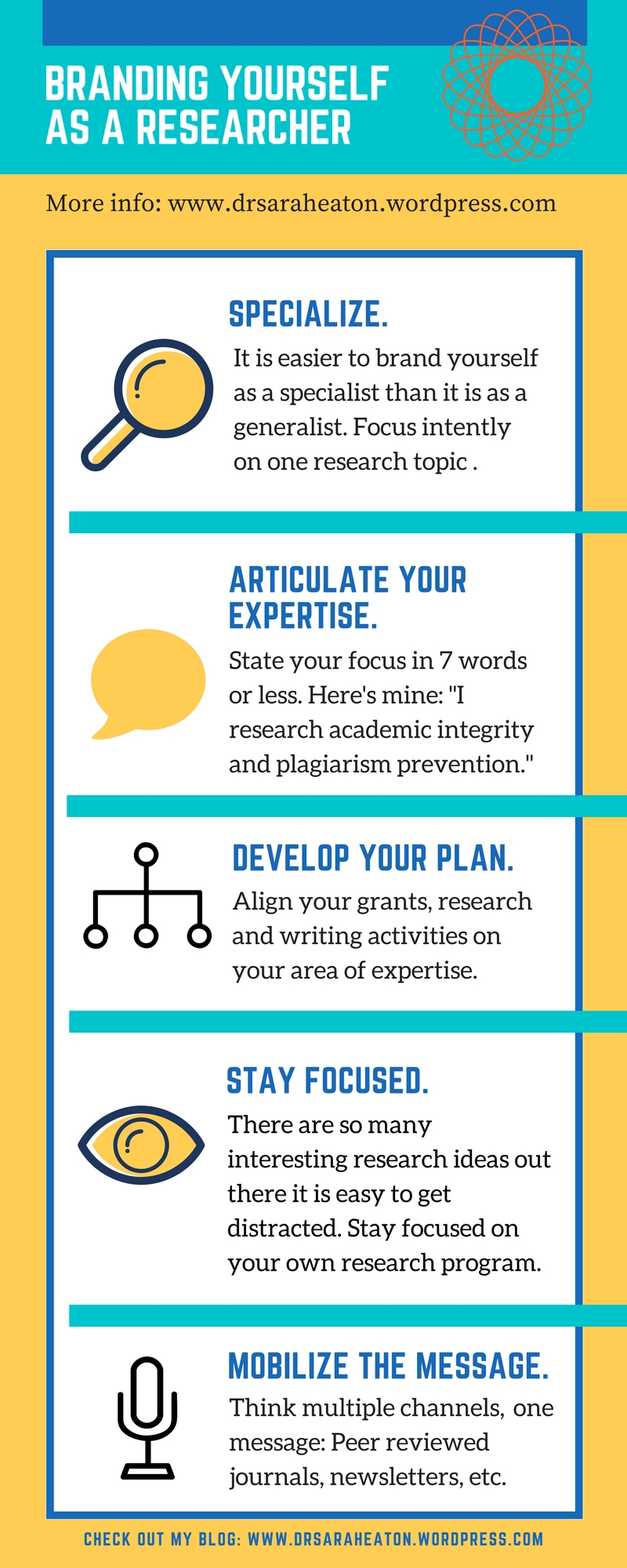
Here are the 5 key points I shared during the workshop:

Specialize.

It is easier to brand yourself as a specialist than it is as a generalist. It is normal for novice and emerging researcher to have multiple areas of interest. This works while you are still figuring out who are you are professionally, but specializing shows you are developing as a researcher. Have a clear research topic that you focus on intently.

Articulate your expertise.

Marketing experts recommend being able to state your focus in 7 words or less.  Here’s mine: “I research academic integrity and plagiarism prevention.” Don’t be that academic that has to ramble on for 38 minutes non-stop to say what it is you are researching. Get to the point and make it easy for others to understand. Practice writing out and saying your research focus until it feels natural.

Develop your plan.

Plan what grants you’ll apply for and when. Develop a writing schedule and target specific journals in your field. Ensure every element of your plan aligns with your area of expertise. Mapping out your research and writing activities will help to ensure you make time for them. Once you execute this plan, you’ll be on your way to having a fully developed research program in your area of expertise.

Stay focused.

There are so many interesting research ideas out there it is easy to get distracted. Stay focused on your own research program. The most successful researchers do not jump on every project that comes along. Choose the projects you want to be involved with carefully and ensure they align with your expertise.

Mobilize your knowledge.

Have multiple channels, but one message. Think about sharing findings in both peer reviewed scholarly journals, as well as plain-language articles targeted to the general public. Think about videos, podcasts and other ways of distributing your knowledge.

The point of all this is to position yourself as an expert in both an academic audience and the public. Ensure others know you are the “go to” person on your topic. Becoming known an expert authority on a key topic not only helps you get noticed in your field, it helps you get hired, and may help you get promoted, too.

Branding yourself as a researcher

References and recommended reading.

Marshall, K. (2017). Branding yourself as an academic. ChronicleVitae. Retrieved from https://chroniclevitae.com/news/1681-branding-yourself-as-an-academic

Mutum, D. S. (n.d.). Social media for researchers and online personal branding.  Retrieved from https://warwick.ac.uk/alumni/services/eportfolios/bsrfbr/dilip_social_media_academics_ebook2.docx

Mizenmacher, M. (2010). Branding your research (and yourself).  Retrieved from http://mybiasedcoin.blogspot.ca/2010/06/branding-your-research-and-yourself.html

Tregoning, J. (2016). Build your academic brand, because being brilliant doesn’t cut it any more. Times Higher Education, (February 24). Retrieved from https://www.timeshighereducation.com/blog/build-your-academic-brand-because-being-brilliant-doesnt-cut-it-any-more

______________________________________________________

Share or Tweet this: How to Brand Yourself as a Researcher https://wp.me/pNAh3-2gR

This blog has had over 1.8 million views thanks to readers like you. If you enjoyed this post, please “like” it or share it on social media. Thanks!

Sarah Elaine Eaton is a faculty member in the Werklund School of Education, University of Calgary, Canada.

Opinions are my own and do not represent those of the Werklund School of Education or the University of Calgary.