Our team has been busy since we launched our research in April, 2022. I haven’t done an update in a while, so I wanted to let you know what we’ve been up to. Check out our project website (https://osf.io/4cnvp/) for links to our peer-reviewed publications and other information about our work.
We are still collecting data for our survey and you’re welcome to participate! To take the survey, click here.
Expansion of our research
In April 2022, we received funding from the Social Science and Humanities Research Council of Canada (SSHRC) in the form of a Connection Grant to host a public research forum. We included partners from the University of Saskatchewan, Brock University, Toronto Metropolitan University, and Deakin University (Australia). We hosted our research symposium on June 7-8, 2023 at the University of Calgary.
In case you missed this SSHRC-funded research symposium on the impact of artificial intelligence on higher education and academic integrity, you can catch up with the slides here:
Eaton, S. E., Dawson, P., McDermott, B., Brennan, R., Wiens, J., Moya, B., Dahal, B., Hamilton, M., Kumar, R., Mindzak, M., Miller, A., & Milne, N. (2023). Understanding the Impact of Artificial Intelligence on Higher Education. Calgary, Canada. https://hdl.handle.net/1880/116624
Also, you can catch Phill Dawson’s keynote from the event which is now archived on YouTube:
Phill Dawson’s keynote: Don’t Fear the Robot, University of Calgary, June 8, 2023
We are excited about next steps for this work and I’m happy to answer any questions you have about academic integrity and artificial intelligence.
Acknowledgements
We are grateful to the sponsors of this research:
Social Sciences and Humanities Research Council (SSHRC)
University of Calgary Teaching and Learning Grant
University of Calgary International Research Partnership Workshop Grant
Werklund School of Education, University of Calgary
Brock University
Deakin University
Toronto Metropolitan Univeristy
University of Saskatchewan
Related posts:
Invitation to Participate: Research Study on Artificial Intelligence and Academic Integrity: The Ethics of Teaching and Learning with Algorithmic Writing Technologies – https://wp.me/pNAh3-2U3
This blog has had over 3 million views thanks to readers like you. If you enjoyed this post, please “like” it or share it on social media. Thanks! Sarah Elaine Eaton, PhD, is a faculty member in the Werklund School of Education, and the Educational Leader in Residence, Academic Integrity, University of Calgary, Canada. Opinions are my own and do not represent those of the University of Calgary.
People have been asking if they should be using detection tools to identify text written by ChatGPT or other artificial intelligence writing apps. Just this week I was a panelist in a session on “AI and You: Ethics, Equity, and Accessibility”, part of ETMOOC 2.0. Alec Couros asked what I was seeing across Canada in terms of universities using artificial intelligence detection in misconduct cases.
The first thing I shared was the University of British Columbia web page stating that the university was not enabling Turnitin’s AI-detection feature. UBC is one of the few universities in Canada that subscribes to Turnitin.
Key message: Tools to detect text written by artificial intelligence aren’t really reliable or effective. It would be wise to be skeptical of any marketing claims to the contrary.
There are news reports about students being falsely accused of misconduct when the results of AI writing detection tools were used as evidence. See news stories here and here, for example.
There have been few studies done on the impact of a false accusation of student academic misconduct, but if we turn to the literature on false accusations in criminal offences, there is evidence showing that false accusations can result in reputation damage, self-stigma, depression, anxiety, PTSD, sleep problems, social isolation, and strained relationships, among other outcomes. Falsely accusing students of academic misconduct can be devastating, including dying by suicide as a result. You can read some stories about students dying by suicide after false allegations of academic cheating in the United States and in India. Of course, stories about student suicide are rarely discussed in the media, for a variety of reasons. The point here is that false accusations of students for academic cheating can have a negative impact on their mental and physical health.
Key message: False accusations of academic misconduct can be devastating for students.
Although reporting allegations of misconduct remains a responsibility of educators, having fully developed (and mandatory) case management and investigation systems is imperative. Decisions about whether misconduct has occurred should be made carefully and thoughtfully, using due process that follows established policies.
It is worth noting that AI-generated text can be revised and edited such that the end product is neither fully written by AI, nor fully written by a human. At our university, the use of technology to detect possible misconduct may not be used deceptively or covertly. For example, we do not have an institutional license to any text-matching software. Individual professors can get a subscription if they wish, but the use of detection tools should be declared in the course syllabus. If detection tools are used post facto, it can be considered a deception on the part of the professor because the students were not made aware of the technology prior to handing in their assessment.
Key message: Students can appeal any misconduct case brought forward with the use of deceptive or undisclosed assessment tools or technology (and quite frankly, they would probably win the appeal).
If we expect students to be transparent about their use of tools, then it is up to educators and administrators also to be transparent about their use of technology prior to assessment and not afterwards. A technology arms race in the name of integrity is antithetical to teaching and learning ethically and can perpetuate antagonistic and adversarial relationships between educators and students.
Ethical Principles for Detecting AI-Generated Text in Student Work
Let me be perfectly clear: I am not at all a fan of using detection tools to identify possible cases of academic misconduct. But, if you insist on using detection tools, for heaven’s sake, be transparent and open about your use of them.
Here is an infographic you are welcome to use and share: Infographic: “Ethical Principles for Detecting AI-Generated Text in Student Work” (Creative Commons License: Attribution-NonCommercial-ShareAlike 4.0 International). The text inside the infographic is written out in full with some additional details below.
Here is some basic guidance:
Check your Institutional Policies First
Before you use any detection tools on student work, ensure that the use of such tools is permitted according to your school’s academic integrity policy. If your school does not have such a policy or if the use of detection tools is not mentioned in the policy, that does not automatically mean that you have the right to use such tools covertly. Checking the institutional policies and regulations is a first step, but it is not the only step in applying the use of technology ethically in assessment of student work.
Check with Your Department Head
Whether the person’s title is department head, chair, headmaster/headmistress, principal, or something else, there is likely someone in your department, faculty or school whose job it is to oversee the curriculum and/or matters relating to student conduct. Before you go rogue using detection tools to catch students cheating, ask the person to whom you report if they object to the use of such tools. If they object, then do not go behind their back and use detection tools anyway. Even if they agree, then it is still important to use such tools in a transparent and open way, as outlined in the next two recommendations.
Include a Statement about the Use of Detection Tools in Your Course Syllabus
Include a clear written statement in your course syllabus that outlines in plain language exactly which tools will be used in the assessment of student work. A failure to inform students in writing about the use of detection tools before they are used could constitute unethical assessment or even entrapment. Detection tools should not be used covertly. Their use should be openly and transparently declared to students in writing before any assessment or grading begins.
Of course, having a written statement in a course syllabus does not absolve educators of their responsibility to have open and honest conversations with students, which is why the next point is included.
Talk to Students about Your Use of Tools or Apps You will Use as Part of Your Assessment
Have open and honest conversations with students about how you plan to use detection tools. Point out that there is a written statement in the course outline and that you have the support of your department head and the institution to use these tools. Be upfront and clear with students.
It is also important to engage students in evidence-based conversations about the limitations tools to detect artificial intelligence writing, including the current lack of empirical evidence about how well they work.
Conclusion
Again, I emphasize that I am not at all promoting the use of any AI detection technology whatsoever. In fact, I am opposed to the use of surveillance and detection technology that is used punitively against students, especially when it is done in the name of teaching and learning. However, if you are going to insist on using technology to detect possible breaches of academic integrity, then at least do so in an open and transparent way — and acknowledge that the tools themselves are imperfect.
Key message: Under no circumstances should the results from an AI-writing detection tool be used as the only evidence in a student academic misconduct allegation.
I am fully anticipating some backlash to this post. There will be some of you who will object to the use detection tools on principle and counter that any blog post talking about how they can be used is in itself unethical. You might be right, but the reality remains that thousands of educators are currently using detection tools for the sole purpose of catching cheating students. As much as I rally against a “search and destroy” approach, there will be some people who insist on taking this position. This blog post is to offer some guidelines to avoid deceptive assessment and covert use of technology in student assessment.
Key message: Deceptive assessment is a breach of academic integrity on the part of the educator. If we want students to act with integrity, then it is up to educators to model ethical behaviour themselves.
References
Sadasivan, V. S., Kumar, A., Balasubramanian, S., Wang, W., & Feizi, S. (2023). Can AI-Generated Text be Reliably Detected? ArXiv. https://doi.org/10.48550/arXiv.2303.11156
This blog has had over 3 million views thanks to readers like you. If you enjoyed this post, please “like” it or share it on social media. Thanks! Sarah Elaine Eaton, PhD, is a faculty member in the Werklund School of Education, and the Educational Leader in Residence, Academic Integrity, University of Calgary, Canada. Opinions are my own and do not represent those of the University of Calgary.
I am beyond excited to share that all of the chapters for the Handbook of Academic Integrity (2nd ed.) are fully approved and in production!
This is a massive volume, with 112 chapters, 109 of which are brand new. There are 3 chapters carried forward from the first edition into the new one.
I wanted to share an explanation about how the Handbook will be available online.
The electronic version of the Handbook of Academic Integrity is — and will continue to be — available in two (2) formats. One format is the dynamic online version and the other is the static online version.
Dynamic Online Version
The Dynamic Online Version of the Handbook is also called the “living” version. As and when an author decides to update a previous edition contribution, the updated version will replace the previous version on Springerlink (while the previous version is still accessible). In this “living” format, the Table of Contents is not organized section-wise, instead the chapters are added alphabetically as and when the online-first publication is completed for a chapter.
Springer has assured me that the first edition link will never expire and will remain online in perpetuity.
The static online version for the second edition will be available when the entire edition is ready to go to print. That may not be for several months yet because this is a massive project and also it is detail-oriented work that must be completed to exacting standards.
In the meantime, chapters from the new edition will be added to the living version in an “online first format” as they ready.
The First Chapter of the Second Edition Has Been Published
I confess that I do not know the inner workings of the publisher in terms of all of the production details. This means that I do not know the order in which chapters will become available online and nor do I have specific dates for when chapters will be available online.
Having said that, I am happy to share that one chapter from the new edition is now available online. Here are the details:
Stoesz, B.M. (2023). Academic integrity through ethical teaching and assessment: Overview and current trends. In: Eaton, S.E. (eds) Handbook of Academic Integrity. Springer, Singapore. https://doi.org/10.1007/978-981-287-079-7_89-1
This is the first of over 100 new chapters that will all be published over the next several months. Keep your eye on the website for the living edition for more chapters coming soon!
This blog has had over 3 million views thanks to readers like you. If you enjoyed this post, please “like” it or share it on social media. Thanks! Sarah Elaine Eaton, PhD, is a faculty member in the Werklund School of Education, and the Educational Leader in Residence, Academic Integrity, University of Calgary, Canada. Opinions are my own and do not represent those of the University of Calgary.
Academic misconduct has taken various forms in present-day educational systems. One method that is on the rise is the use of artificially generated software compositions. The capabilities and sophistication of these new technologies are improving steadily. We are conducting a study to gauge the sophistication of the current artificial intelligence (AI) software-generated text. To that end, we are recruiting participants to evaluate the level of writing level of small compositions (260 words in length at most).
Your participation in this study would be to evaluate two small pieces of text presented in a survey and optionally make comments on your observation. We appreciate your consideration in this matter. This research provides an opportunity for the participants to contribute to the state of AI software used for various educational purposes. Participation in this study is voluntary, and you are free to terminate the survey and withdraw at any time and for any reason without censor. There are no known physical, psychological, or social risks associated with participation in the study.
All demographic data collected will be kept strictly confidential. Only the researchers listed in this letter will have access to the raw data. The data (in electronic format) will be retained indefinitely. Participation in the study will be asked for some basic demographic information and then presented with a 260- word length composition. After reading, the participants will be asked to evaluate the level, assign a mark to the composition, and note any pertinent observations. The second piece of composition, also of the same length, will be followed by the same set of questions. The total anticipated time for completing the survey is about 9-12 minutes, but it can vary based on reading speed and consideration afforded to the assigned grade.
If you have any questions or concerns about your participation in this study, you can contact the Principal Investigator, Dr. Sarah Elaine Eaton, seaton (at) ucalgary.ca
This study is funded by a University of Calgary Teaching and Learning Grant. This study has been approved by the Conjoint Faculties Research Ethics Board at the University of Calgary: REB22-0137.
Share this post: Invitation to Participate: Research Study on Artificial Intelligence and Academic Integrity: The Ethics of Teaching and Learning with Algorithmic Writing Technologies – https://wp.me/pNAh3-2U3
This blog has had over 3 million views thanks to readers like you. If you enjoyed this post, please “like” it or share it on social media. Thanks! Sarah Elaine Eaton, PhD, is a faculty member in the Werklund School of Education, and the Educational Leader in Residence, Academic Integrity, University of Calgary, Canada. Opinions are my own and do not represent those of the University of Calgary.
As I write this, the Handbook of Academic Integrity (2nd ed.) is well underway. All the chapters have been submitted and are at various stages of review, revision, and production. Page proofs should start going out to contributing authors this month. This has been a massive project: 150+ authors, 109 chapters, 9 section editors, and me herding all the cool cats who have made it happen.
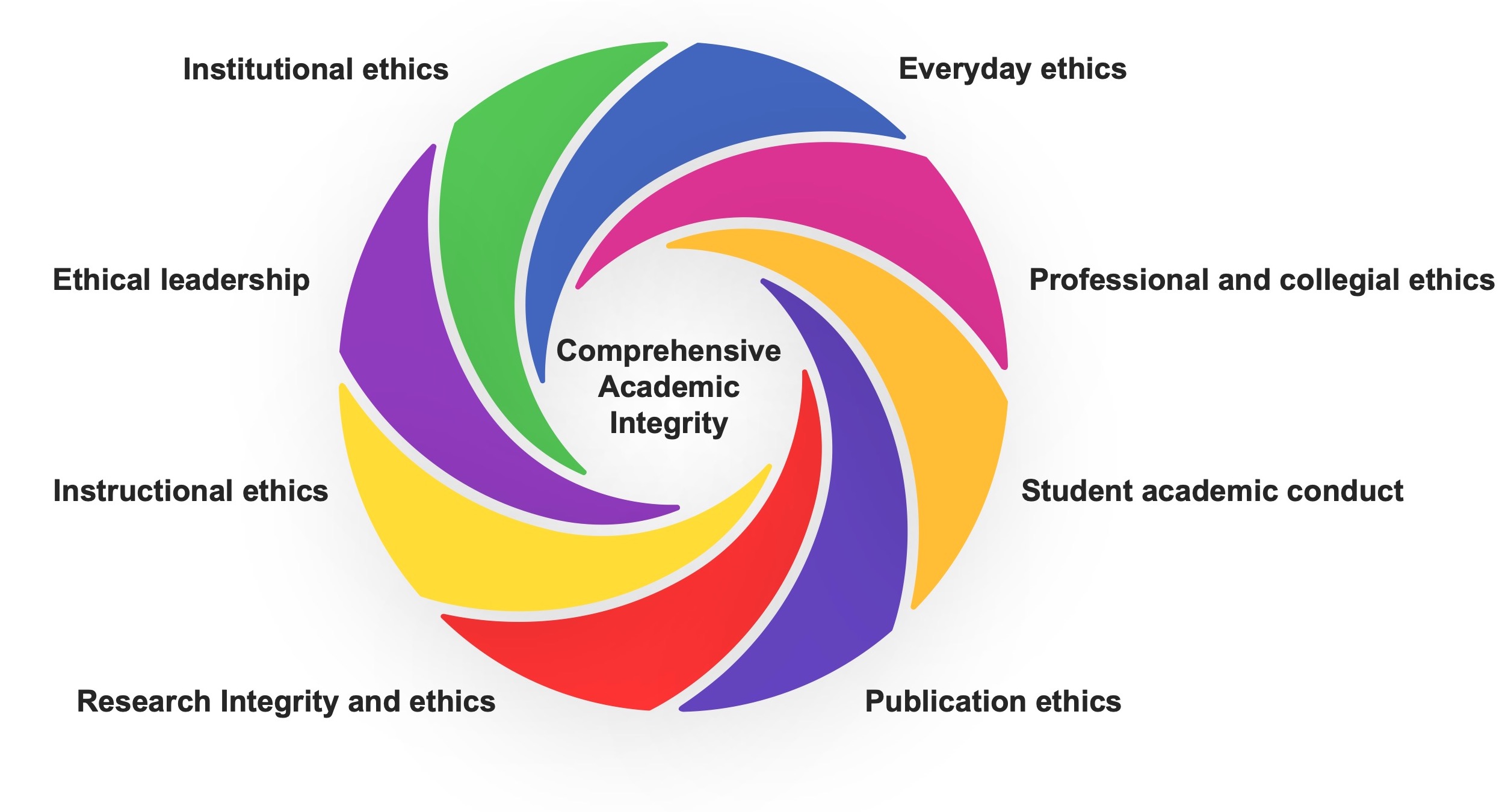
After all the chapters had been submitted, I realized that we had something new and fresh with this edition. We have pushed the boundaries beyond persistently historical ideas about academic integrity only as a matter of student conduct. So, I wrote an introduction for the handbook that synthesizes some its through lines. The common threads of this updated edition are summed up in this Comprehensive Academic Integrity (CAI) framework.
I wrote this intro in two epic writing sessions, fuelled by gallons of coffee, Vegemite on toast, and a pizza that a friend had delivered to my house because he felt sorry for me eating Vegemite on toasted bread crusts. (I am not kidding.) Anyway, first, I drafted the chapter in full. Then I asked a couple of other section editors and contributors to the handbook to provide me with an open peer review of the draft. In the chapter I acknowledge them by name and I re-iterate my gratitude to them here. Thanks are due to Guy Curtis, Brenda M. Stoesz, Rahul Kumar, Beatriz Moya, and Bibek Dahal for their feedback that helped me to improve the chapter. In the second writing session, I incorporated just about all of their suggestions and completely re-vamped the visual image to the one you see below. The CAI Framework is a high-level synthesis of all the chapters in the handbook and as such, every single author who has contributed to the handbook (as well as those they have cited in their respective chapters) all deserve credit.
According to the publisher’s rules around self-archiving and pre-prints, I am not allowed to share the entire chapter with you ahead of publication. But I can share a summary of it, so I’m doing that here. I’ve also self-archived a copy of this overview (minus the background commentary about Vegemite and pizza) in our university’s digital repository. On the off-chance you want to cite the “official” version of the summary, I have included instructions below. You’ll have to wait for the Handbook to be published to read the full chapter, but in the meantime, I hope this overview is useful.
For years scholars and other experts have called for a more holistic approach to academic integrity (e.g., Bertram Gallant, 2008; Boud & Bearman, 2022; Bretag et al, 2014; Carrol & Duggan, 2005; Löfström et al., 2015; Morris & Carrol, 2016; Turner & Beemsterboer, 2003). The CAI framework synthesizes ideas that have been repeated for decades in various iterations.
The central argument behind a wholistic framework is that academic integrity must encompass, but extend beyond, notions of student conduct, and should be considered a foundation of all aspects of education. In this framework, I do not propose a new definition of academic integrity in part, because several useful definitions already exist (see Bretag, 2016; ICAI, 2021; Tauginienė et al., 2018). Instead, this framework can be used with existing definitions.
The Comprehensive Academic Integrity (CAI) framework includes eight (8) essential elements that includes, and extends beyond traditional notions of academic integrity merely as a student responsibility:
Appreciation to Kieran Forde at the University of British Columbia for his most awesome interpretation of the graphic as a “colourful swirly donut”. Who doesn’t love donuts?! Thanks, Kieran!
References
Bertram Gallant, T. (2008). Academic integrity in the twenty-first century: A teaching and learning imperative. Wiley.
Boud, D., & Bearman, M. (2022). The assessment challenge of social and collaborative learning in higher education. Educational philosophy and theory, 1-10. https://doi.org/10.1080/00131857.2022.2114346
Bretag, T. (2016). Educational integrity in Australia. In T. A. Bretag (Ed.), Handbook of Academic Integrity (pp. 1-13). Springer Singapore.https://doi.org/10.1007/978-981-287-079-7_2-1
Bretag, T., Mahmud, S., Wallace, M., Walker, R., McGowan, U., East, J., Green, M., Partridge, L., & James, C. (2014). ‘Teach us how to do it properly!’ An Australian academic integrity student survey. Studies in higher education, 39(7), 1150-1169. https://doi.org/10.1080/03075079.2013.777406
Carroll, J., & Duggan, F. (2005, December 2-5). Institutional change to deter student plagiarism: What seems essential to a holistic approach? 2nd Asia-Pacific Educational Integrity Conference, University of Newcastle, Callaghan, Australia.
Eaton, S. E. (forthcoming). Comprehensive academic integrity (CAI): An ethical framework for educational contexts. In S. E. Eaton (Ed.), Handbook of Academic Integrity (2nd ed.). Springer.
Löfström, E., Trotman, T., Furnari, M., & Shephard, K. (2015). Who teaches academic integrity and how do they teach it? Higher Education, 69(3), 435-448. https://doi.org/10.1007/s10734-014-9784-3
Morris, E. J., & Carroll, J. (2016). Developing a sustainable holistic institutional approach: Dealing with realities “on the ground” when implementing an academic integrity policy. In T. Bretag (Ed.), Handbook of Academic Integrity (pp. 449-462). Springer Singapore. https://doi.org/10.1007/978-981-287-098-8_23
This blog has had over 3 million views thanks to readers like you. If you enjoyed this post, please “like” it or share it on social media. Thanks!
Sarah Elaine Eaton, PhD, is a faculty member in the Werklund School of Education, and the Educational Leader in Residence, Academic Integrity, University of Calgary, Canada. Opinions are my own and do not represent those of the University of Calgary.


 Posted by Sarah Elaine Eaton, Ph.D.





You must be logged in to post a comment.