Unveiling the Handbook of Academic Integrity (2nd ed.) in Dubai

December 28, 2023
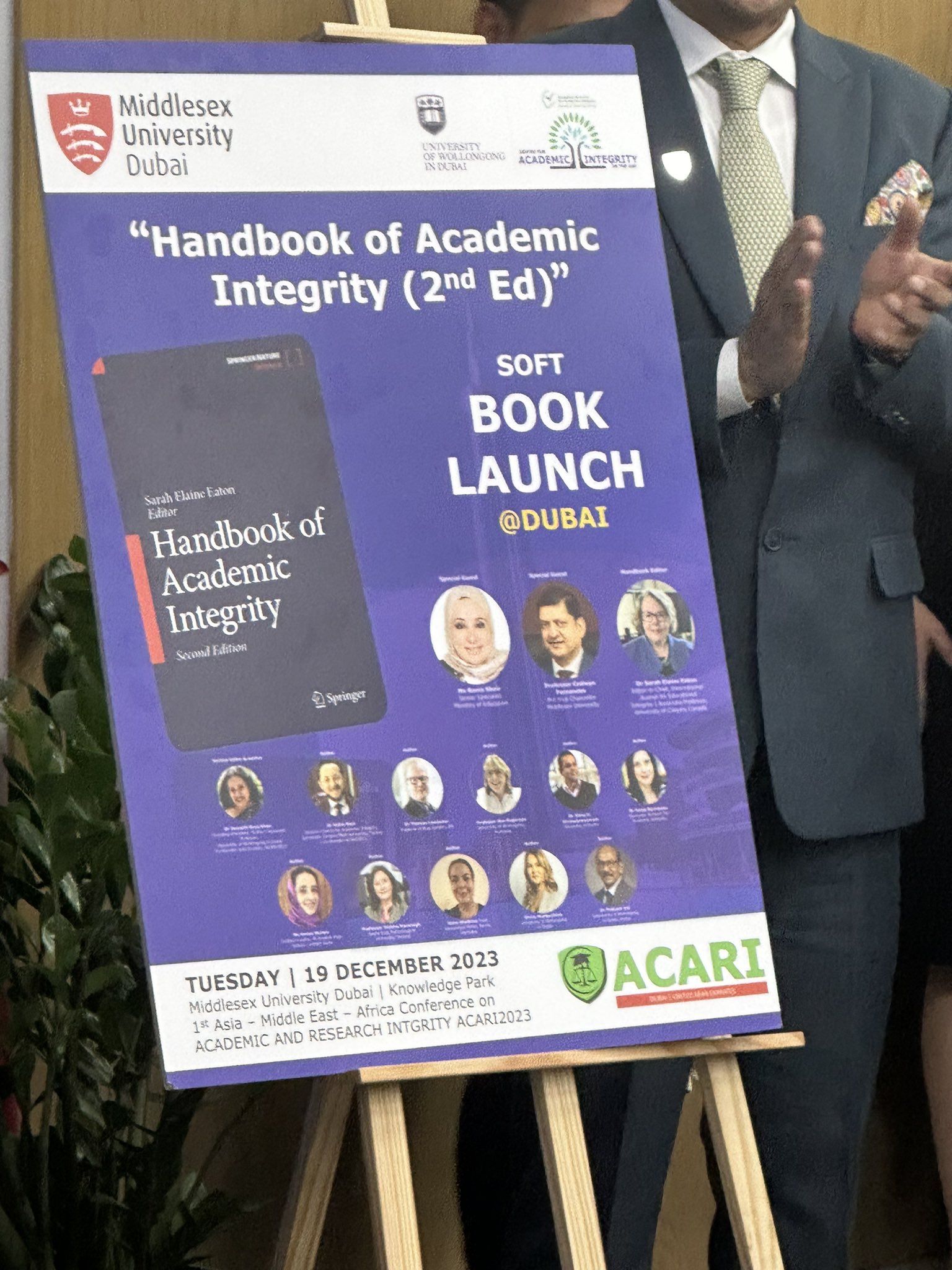
A poster with a blue background. There is a white banner at the top with university logos. The poster contains an image of a book cover and faces of individuals associated with the book.

The 1st Asia -Middle East – Africa Conference on Academic and Research Integrity (ACARI) 2023, 17-19 December at Middlesex University Dubai. It was against this backdrop that the highly anticipated Handbook of Academic Integrity (2nd ed.), published by Springer, was unveiled at a dazzling soft launch, marking a milestone in the book’s journey and the evolution of academic integrity knowledge-sharing and community-building.

The handbook is now in its final stages of production, and the standalone second edition will be released in hard copy in January, 2024. To celebrate, Dr. Zeenath Reza Khan, who serves as one of the handbook’s section editors and contributors, and was a co-chair of the 1st Asia -Middle East – Africa Conference on Academic and Research Integrity (ACARI) 2023, 17-19 December led the organization of the soft launch for the handbook during the conference.

The launch was held during the closing ceremony of the conference on the final day in an auditorium at the prestigious Middlesex University Dubai, was both festive and scholarly, as it brought together educators, researchers, and advocates for academic integrity. In addition to conference delegates, a number of esteemed dignitaries attended including, His Excellency, Jamal Hossain, Consul General of Bangladesh to UAE; Dr. Mohammad Ali Reza Khan, Award-winning Expert Wildlife Specialist, Dubai Municipality, along with Professor Cedwyn Fernandes, Pro Vice Chancellor of Middlesex University and Director of Middlesex University Dubai. Special thanks to Ms. Rania Sheir, Senior Specialist, Entrepreneurship and Innovation, Ministry of Education, UAE, who not only attended the launch, but also posted about it on LinkedIn.

 A screenshot of a LinkedIn post.

The Handbook, meticulously curated by leading experts in the field, is a compendium of insights, strategies, and best practices aimed at upholding the ethical practices in academia and research. It covers a diverse range of topics, from plagiarism to artificial intelligence, to the promotion of ethical behaviour in academic research, and much more. The multidimensional approach of the Handbook of Academic Integrity  ensures that it caters to the needs of educators, administrators, and students alike.

A number of contributing authors were in attendance, including:

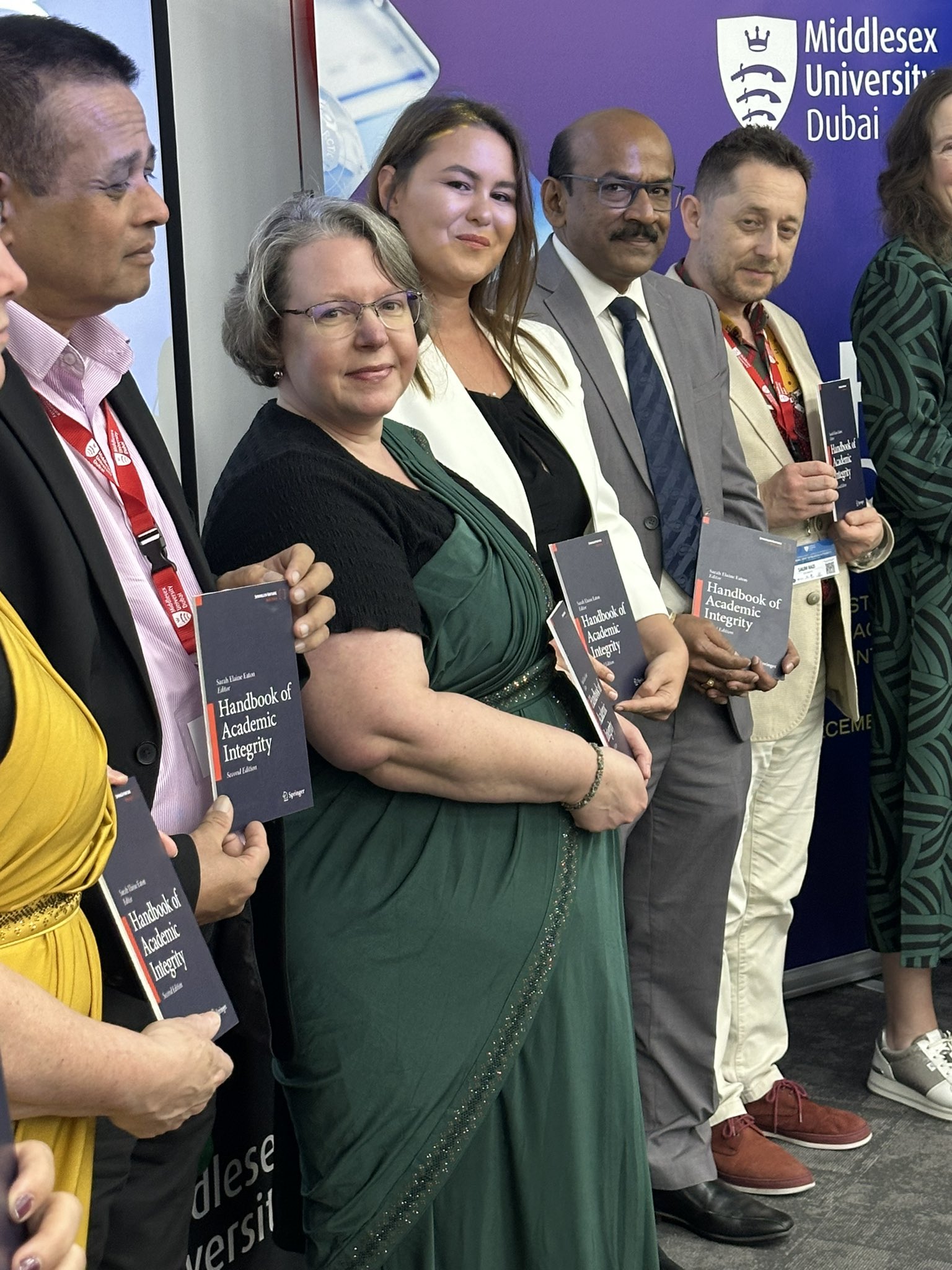
Dr. Zeenath generously gifted two colleagues and me with authentic saris that we wore during the closing ceremony and the launch. As you can see from the photo below, I was given one in dark green and I just love it! I had an opportunity to say a few words about the book and its importance in the field, and to thank the organizers and authors. Each contributor was gifted a symbolic souvenir cut-out of the front cover of the handbook and following the formalities, we signed the back of one another’s covers.

The book launch culminated in a celebratory atmosphere, with attendees leaving inspired. The Handbook of Academic Integrity (2nd ed.), now poised to be a cornerstone in the field, builds on the first edition and stands as a testament to the collective commitment to nurturing a culture of integrity throughout every level of education and research.

Photo gallery:
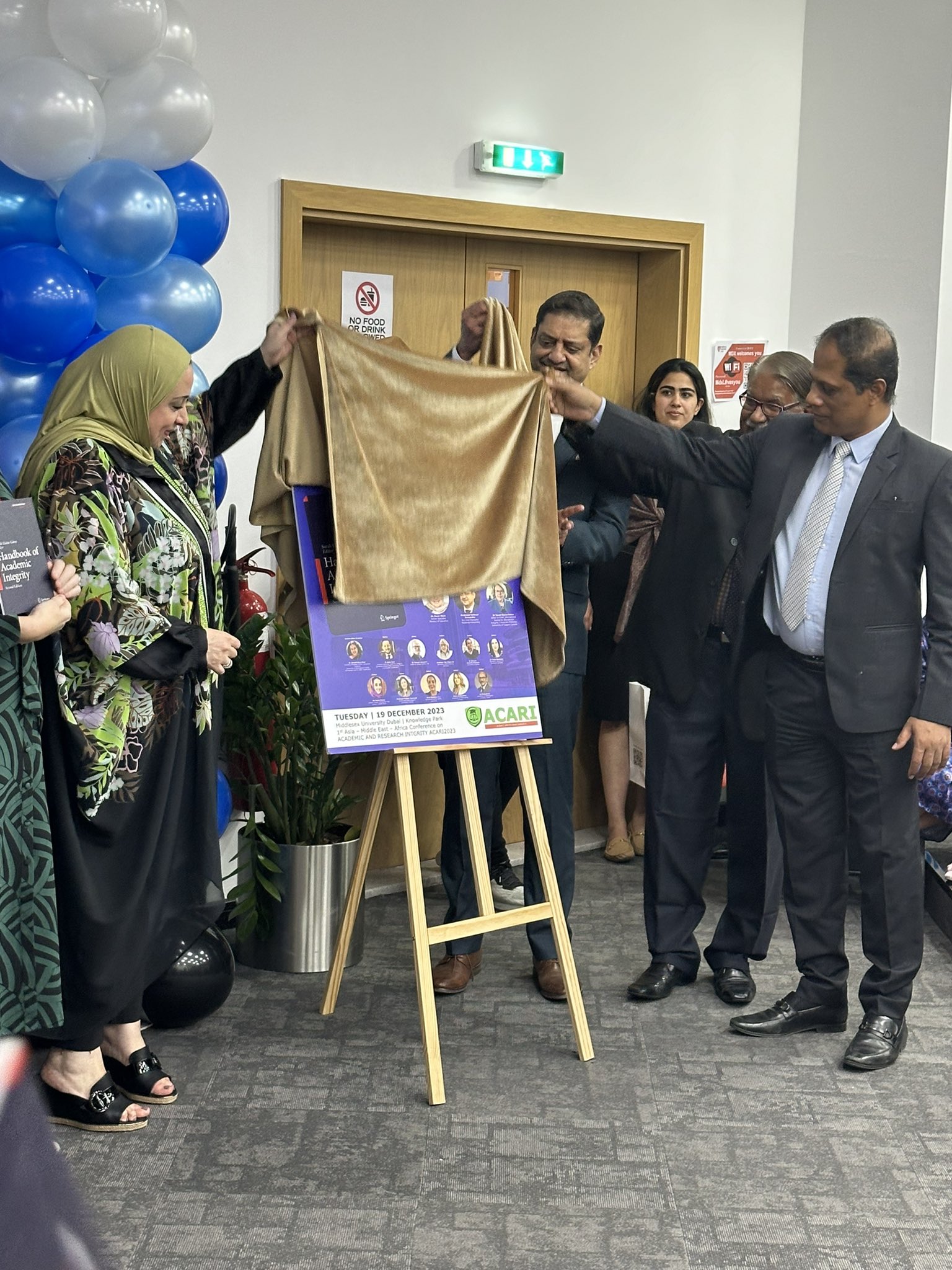
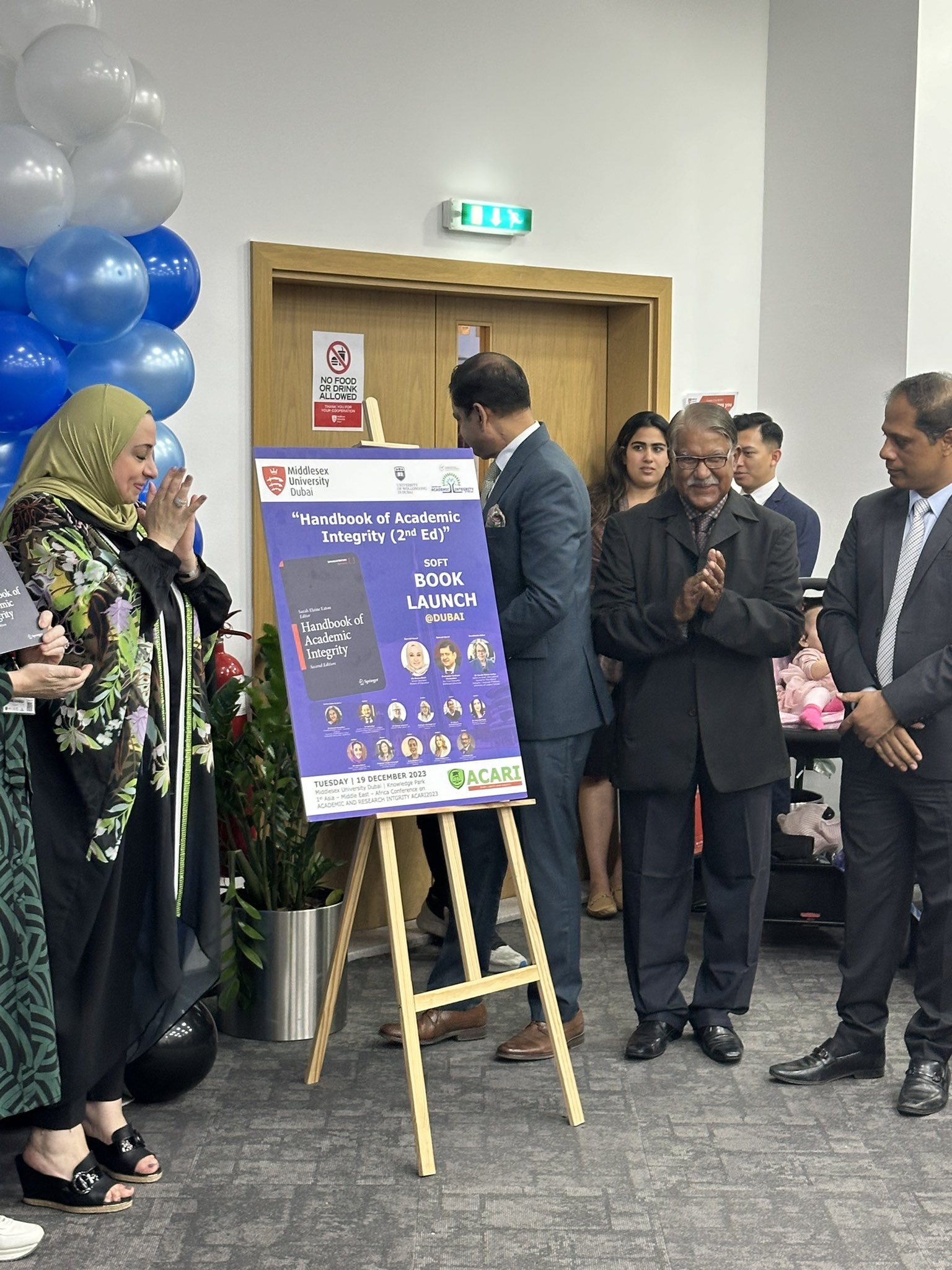
Unveiling of the Handbook of Academic Integrity (2nd ed.) Two people are removing a gold-coloured cover from a poster featuring the book cover. People are standing in the background. There are blue and white balloons on the left edge of the frame.
A group of people standing around a large easel. On the easel is a poster.
An easel showing a large poster.
A photo with a group of people. Each person is holding a cardboard cutout of a book cover.
A photo of a group of people. There is an easel with a poster in the centre.
A photo of a group of people. Each person is holding a cardboard cutout of a book cover.

____________________________

Share this post: Unveiling the Handbook of Academic Integrity (2nd ed.) in Dubai – https://drsaraheaton.wordpress.com/2023/12/28/unveiling-the-handbook-of-academic-integrity-2nd-ed-in-dubai/

This blog has had over 3 million views thanks to readers like you. If you enjoyed this post, please “like” it or share it on social media. Thanks!

Sarah Elaine Eaton, PhD, is a faculty member in the Werklund School of Education at the University of Calgary, Canada. Opinions are my own and do not represent those of my employer.


Invitation to Participate: Research Study on Artificial Intelligence and Academic Integrity: 

April 19, 2023

The Ethics of Teaching and Learning with Algorithmic Writing Technologies 

On the right there is a black robotic hand and forearm. On the left there is a human hand and forearm. The forearm is tatooed. One finger from each hand is touching the other.
Photo by cottonbro studio on Pexels.com

Academic misconduct has taken various forms in present-day educational systems. One method that is on the rise is the use of artificially generated software compositions. The capabilities and sophistication of these new technologies are improving steadily. We are conducting a study to gauge the sophistication of the current artificial intelligence (AI) software-generated text. To that end, we are recruiting participants to evaluate the level of writing level of small compositions (260 words in length at most).

Your participation in this study would be to evaluate two small pieces of text presented in a survey and optionally make comments on your observation. We appreciate your consideration in this matter. This research provides an opportunity for the participants to contribute to the state of AI software used for various educational purposes. Participation in this study is voluntary, and you are free to terminate the survey and withdraw at any time and for any reason without censor. There are no known physical, psychological, or social risks associated with participation in the study.

All demographic data collected will be kept strictly confidential. Only the researchers listed in this letter will have access to the raw data. The data (in electronic format) will be retained indefinitely. Participation in the study will be asked for some basic demographic information and then presented with a 260- word length composition. After reading, the participants will be asked to evaluate the level, assign a mark to the composition, and note any pertinent observations. The second piece of composition, also of the same length, will be followed by the same set of questions. The total anticipated time for completing the survey is about 9-12 minutes, but it can vary based on reading speed and consideration afforded to the assigned grade.

If you have any questions or concerns about your participation in this study, you can contact the Principal Investigator, Dr. Sarah Elaine Eaton, seaton (at) ucalgary.ca

This study is funded by a University of Calgary Teaching and Learning Grant. This study has been approved by the Conjoint Faculties Research Ethics Board at the University of Calgary: REB22-0137.

To take the survey, click here.

_________________________________

Share this post: Invitation to Participate: Research Study on Artificial Intelligence and Academic Integrity: The Ethics of Teaching and Learning with Algorithmic Writing Technologies – https://wp.me/pNAh3-2U3

This blog has had over 3 million views thanks to readers like you. If you enjoyed this post, please “like” it or share it on social media. Thanks! Sarah Elaine Eaton, PhD, is a faculty member in the Werklund School of Education, and the Educational Leader in Residence, Academic Integrity, University of Calgary, Canada. Opinions are my own and do not represent those of the University of Calgary.


6 Tenets of Postplagiarism: Writing in the Age of Artificial Intelligence

February 25, 2023
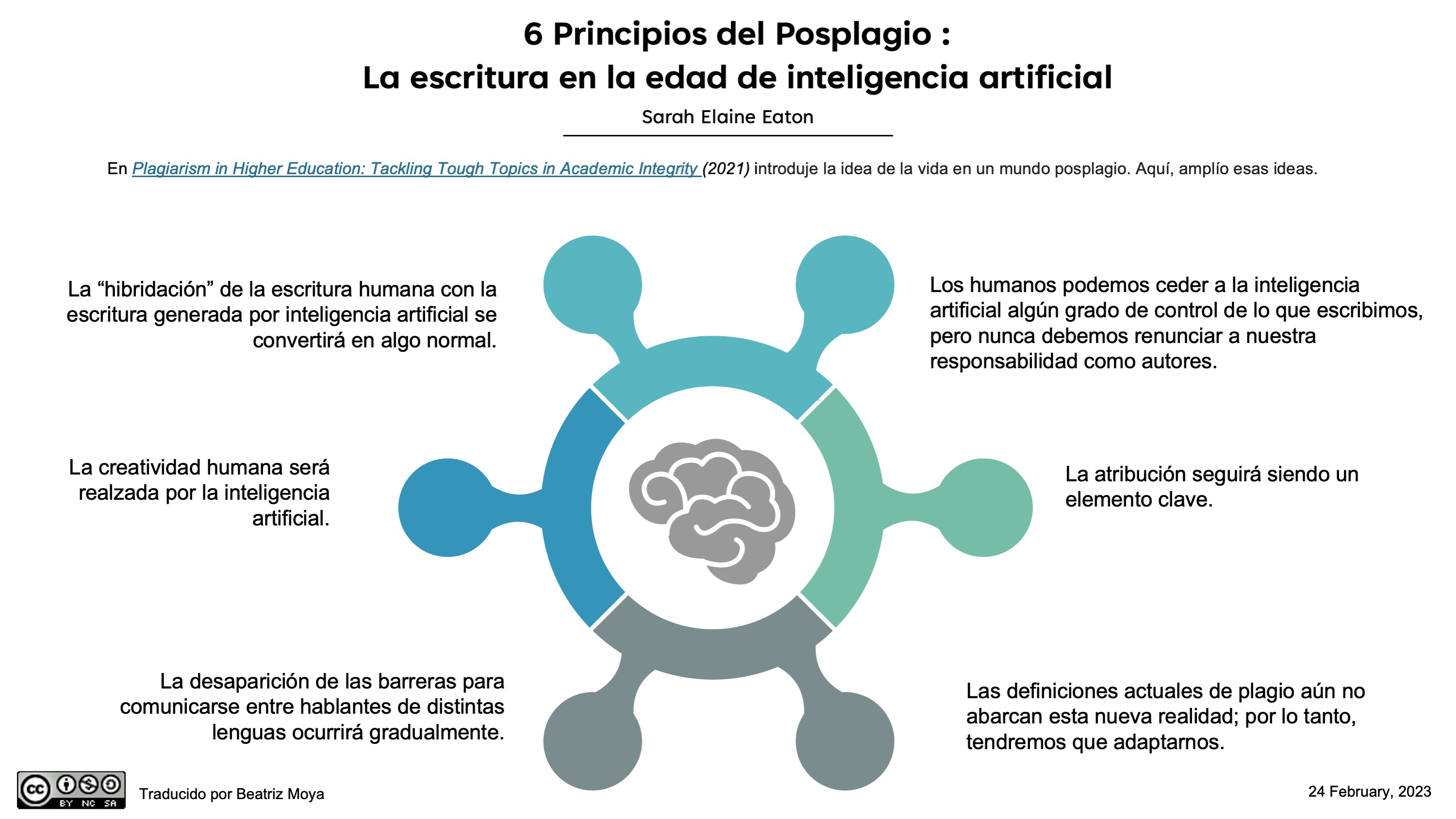
An infographic showing the 6 tenets of the post-plagiarism age. There is a circle with six points extending from it. There is an icon of a brain at the centre. These ideas were developed from the book, Plagiarism in Higher Education: Tackling Tough Topics in Academic Integrity (2021) by S. E. Eaton.

In the final chapter of Plagiarism in Higher Education: Tackling Tough Topics in Academic Integrity (2021) I contemplate the future of plagiarism and academic integrity. I introduced the idea of life in a postplagiarism world; thinking about the impact of artificial intelligence on writing. Here, I expand on those ideas. These 6 tenets characterize the post-plagiarism age:

Hybrid Human-AI Writing Will Become Normal

Hybrid writing, co-created by human and artificial intelligence together is becoming prevalent. Soon it will be the norm. Trying to determine where the human ends and where the artificial intelligence begins is pointless and futile.

Human Creativity is Enhanced

Human creativity is enhanced, not threatened by artificial intelligence. Humans can be inspired and inspire others. Humans may even be inspired by artificial intelligence, but our ability to imagine, inspire, and create remains boundless and inexhaustible.

Language Barriers Disappear

One’s first language will begin to matter less and less as tools become available for humans to understand each other in countless languages.

Humans can Relinquish Control, but not Responsibility

Humans can retain control over what they write, but they can also relinquish control to artificial intelligence tools if they choose. Although humans can relinquish control, they do not relinquish responsibility for what is written. Humans can – and must – remain accountable for fact-checking, verification procedures, and truth-telling. Humans are also responsible for how AI-tools are developed.

Attribution Remains Important

It always has been, and always will be, appropriate and desirable to appreciate, admire, and respect our teachers, mentors, and guides. Humans learn in community with one another, even when they are learning alone. Citing, referencing, and attribution remain important skills.

Historical Definitions of Plagiarism No Longer Apply

Historical definitions of plagiarism will not be rewritten because of artificial intelligence; they will be transcended. Policy definitions can – and must – adapt.

Translations of the Six Tenets of Postplagiarism

Since I first shared the Six Tenets of Postplagiarism, the infographic has been translated into French and Spanish. I am very grateful to the translators, who put in time and effort to go through the points in detail. Here are the translated versions:

Les 6 Principes du Postplagiat (French)

This translation was done by Dr. Elaine Beaulieu at the University of Ottawa, Canada.

Colleagues at the Université du Québec à Montréal (Canada), also wrote a web article in French. It is available here: https://collimateur.uqam.ca/collimateur/6-principes-de-lapres-plagiat-a-lere-de-lia/

6 Principios del Posplagio (Spanish)

The Spanish translation was done by Beatriz Moya, PhD candidate at the University of Calgary.

More Resources on PostPlagiarism

Check out my video on this topic on YouTube: https://youtu.be/NxFMMw1QZX0

Check out my article in University World News on this topic: “Artificial intelligence and academic integrity, post-plagiarism”

_________________________________

Share this:  6 Tenets of Postplagiarism: Writing in the Age of Artificial Intelligence https://drsaraheaton.wordpress.com/2023/02/25/6-tenets-of-postplagiarism-writing-in-the-age-of-artificial-intelligence/

This blog has had over 3 million views thanks to readers like you. If you enjoyed this post, please “like” it or share it on social media. Thanks!

Sarah Elaine Eaton, PhD, is a faculty member in the Werklund School of Education, and the Educational Leader in Residence, Academic Integrity, University of Calgary, Canada. Opinions are my own and do not represent those of the University of Calgary.


Now Published: Contract Cheating in Higher Education

August 11, 2022
Eaton, Curtis, Clare, Stoesz, Seeland & Rundle cover

Now published: Contract Cheating in Higher Education: Global Perspectives on Theory, Practice, and Policy (Eaton, Curtis, Stoesz, Clare, Rundle, & Seeland, 2022). This volume, published by Palgrave MacMillan, includes twenty chapters from contributors across Australia, North America, and Europe:

  1. Introduction: Contract cheating and introduction to the problem. – Curtis, G. J., Clare, J., Rundle, K., Eaton, S. E., Stoesz, B. M., & Seeland, J.
  2. What can we learn from measuring crime when looking to quantify the prevalence and incidence of contract cheating? – Clare, J., & Rundle, K.
  3. Limitations of contract cheating research. –  Krásničan, V., Foltýnek, T., & Dlabolová, D. H.
  4. Essay mills and contract cheating from a legal point of view. – Draper, M.
  5. Leveraging college copyright ownership against file-sharing and contract cheating websites. – Seeland, J., Eaton, S. E., & Stoesz, B. M.
  6. The encouragement of file sharing behaviours through technology and social media: Impacts on student cheating behaviours and academic piracy. – Rogerson, A. M.
  7. Higher education assessment design. – Sutherland-Smith, W., & Dawson, P.
  8. Critical thinking as an antidote to contract cheating. – Stoesz, B. M., Eaton, S. E., & Seeland, J.
  9. Contract cheating and the Dark Triad traits. – Baran, L., & Jonason, P. K.
  10. Contract cheating: The influence of attitudes and emotions. – Curtis, G. J., & Tindall, I. K.
  11. Applying situational crime prevention techniques to contract cheating. – Clare, J.
  12. Presentation, Properties and Provenance: the three Ps of identifying evidence of contract-cheating in student assignments. – Crockett, R.
  13. “(Im)possible to prove”: Formalising academic judgement evidence in contract cheating cases using bibliographic forensics. – Ellis, C., Rogerson, A. M., House, D., & Murdoch, K.
  14. Aligning academic quality and standards with academic integrity – Glendinning, I.
  15. Addressing contract cheating through staff-student partnerships. – Lancaster, T.
  16. The extortionate cost of contract cheating. – Veeran-Colton, T., Sefcik, L., & Yorke, J.
  17. The rise of contract cheating in graduate education. –  Parnther, C.
  18. Listening to ghosts: A qualitative study of narratives from contract cheating writers from the 1930s onwards. – Eaton, S. E., Stoesz, B. M., & Seeland, J.
  19. Assessment brokering and collaboration: Ghostwriter and student academic literacies. – Thacker, E. J.
  20. Conclusion – Eaton, S. E., Stoesz, B. M., Seeland, J. Curtis, G. J., Clare, J., & Rundle, K. 

Updates:

October 4, 2022 – The final proofs have been submitted to the publisher. The book now moves into production and should be available very soon!

October 28, 2022 – The book has now been published!

_______________________________

Share or Tweet this: New Book Coming Soon: Contract Cheating in Higher Education – https://drsaraheaton.wordpress.com/2022/08/11/new-book-coming-soon-contract-cheating-in-higher-education/

This blog has had over 3 million views thanks to readers like you. If you enjoyed this post, please “like” it or share it on social media. Thanks!

Sarah Elaine Eaton, PhD, is a faculty member in the Werklund School of Education, and the Educational Leader in Residence, Academic Integrity, University of Calgary, Canada. Opinions are my own and do not represent those of the University of Calgary.


Blogs as Public Scholarship: An Academic Integrity Example

June 30, 2021

It’s that time of year again… performance reporting for academic staff at our university happens every two years, with reports due on June 30. There was an official communication that came out a few months back saying we would not have to submit our reports in the usual way, using the online portal system. (Thank God for that… Even with the new system we got a couple of years ago, it still takes hours and hours to fill to enter one’s activities. It’s maddening). But we still had to do a report.

In my case, I had to do two, because over the past two years I have spent half of my time in my home faculty, the Werklund School of Education, and the other half of my time as the inaugural Educational Leader in Residence, Academic Integrity, at the Taylor Institute for Teaching and Learning.

Earlier this year, the University of Calgary signed the San Francisco Declaration on Research Assessment (DORA), which I was pretty excited about. It is part of an overall commitment to assess and value research and scholarly activity in a variety of ways, beyond the traditional peer-reviewed journal articles. Indeed, much of my work I share through public scholarship, including blog posts. Now, as long as I can show some impact from that work, it can be considered as part of my scholarship. That was not always the case.

I am not going to rattle off a whole bunch of numbers about how much I did of this or that (though let me tell you, I was exhausted after reading my own report). Instead, I’m going to focus on one blog post that a senior leader and mentor said in a personal communication “arguably may have been your most important public impact that you have made”. It was the blog post I did on April 3, 2021: Analysis of plagiarism in the draft Alberta K-6 curriculum.

Let’s look at the impact of this one blog post:

Total views: 36,000+

This single blog post resulted in more than 36,000 views (see Figure 1).

Figure 1.

Viewer statistics (n = 36,147) for “Analysis of Plagiarism in the Draft Alberta K-6 Curriculum. (Screenshot date: June 30, 2021)

That’s pretty good for a blog post — at least for me. I mean, I’m a professor who researches ethics and integrity. It’s not like my blog shows off the latest fashion or offers delicious recipes. This post was was — let’s be honest – as close to viral as I’m probably ever going to get.

Media attention

This analysis of plagiarism in the draft AB curriculum caught the attention of the media worldwide, with more than 60 news outlets globally reporting on it. (See details here: https://docs.google.com/document/d/1GuyeKP26wnpFT3i0FD2ztoQOoitKbwHv6OdRVUkGLZE/edit?usp=sharing)

You can see my CTV news interview about it here: https://calgary.ctvnews.ca/examples-of-plagiarism-found-throughout-draft-curriculum-1.5378232

Political action

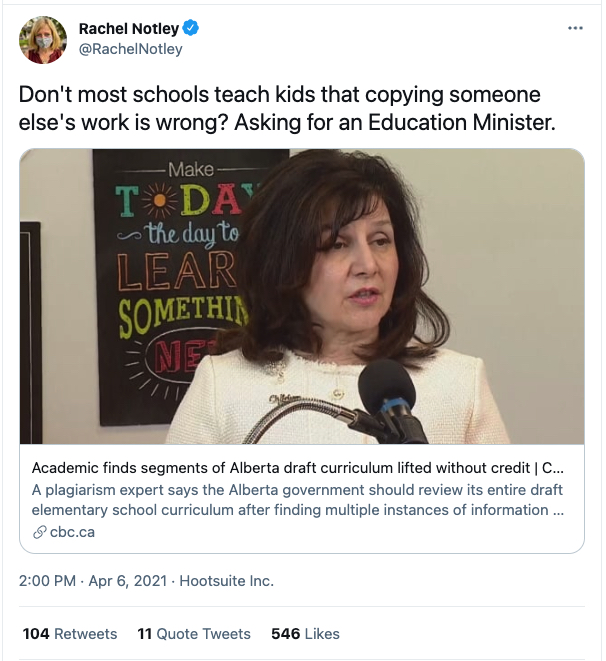
In addition, this work caught the attention of elected officials in Alberta, who shared news of the plagiarism in the draft curriculum on their social media platforms, such as this Tweet from the Hon. Rachel Notley, Leader of the Opposition. (see Figure 1).

Figure 1

Tweet from Rachel Notley, April 6, 2021.

In case you missed it, I was the “academic” quoted in the media article that the leader of opposition Tweeted out.

On April 6, 2021, the Hon. Rachel Notley, leader of the opposition, questioned the Minister of Education, the Hon. Adriana LaGrange, about the plagiarism in the draft curriculum during the official question period in the Alberta provincial legislature, as documented in the official legislative Hansard.

Although dozens and dozens of teachers and other members of the public commented on social media about the plagiarized passages in the draft curriculum, it is fair to say that my analysis of the plagiarism had an impact on all of that. It is not an impact that is easily quantified, but it is reasonable to conclude that the analysis helped to inform a broader public dialogue about the (deeply flawed) draft curriculum, plagiarism, and the need to pay attention to ethics and integrity in K-12 education.

Collaboration Resulting from the Work

This work led to a collaboration with Carla Peck, Angela Grace and others, supported by our respective Deans of Education, called the Alberta Curriculum Analysis project. Through this project, we are documenting numerous analyses of the draft curriculum, from a variety of contributors with different academic and disciplinary backgrounds. This project has become an important public artefact and act of scholarly advocacy to help hold our government accountable, as well as to inform the public.

Completely non-academic (and a little cheeky) impact

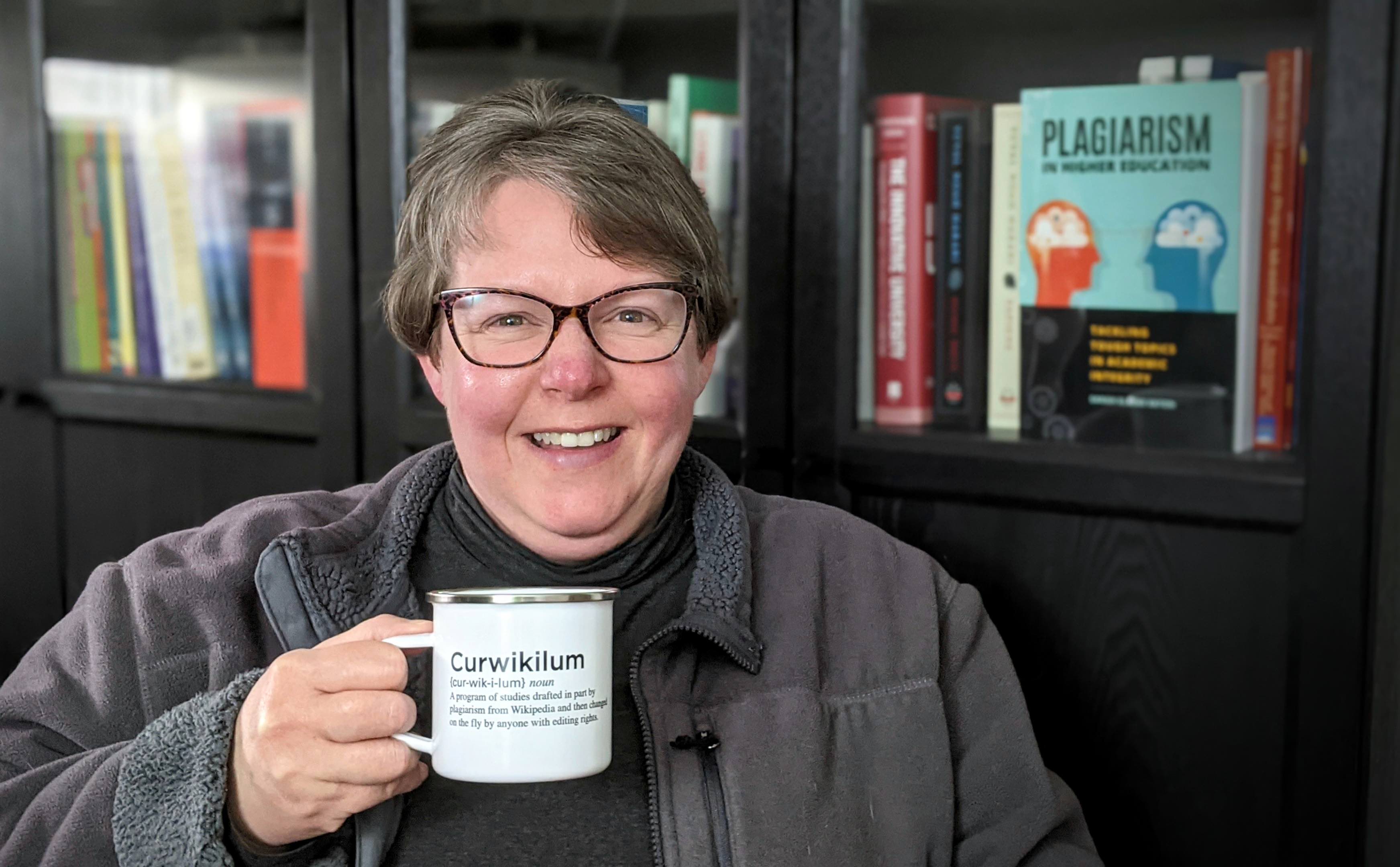
There’s a small business in Edmonton, Canada, called Fehr Play Creative that creates all kinds of custom and novelty products. Not long after I did my analysis of plagiarism in the draft curriculum, they came out with their “Curwikilum” novelty mug. A senior leader at the university bought me one as a gift and it quickly became my favourite, as you can see in this photo:

Figure 2.

Curwikilum mug produced by Fehr Play Creative in Edmonton, AB.

I didn’t ask the good folks at Fehr Play Creative to make this mug. It was entirely their idea. They did a play on words with “curriculum” and “Wikipedia”, coming up with “Curiwikilum” and defined it as: “(noun) A program of study drafted in part by plagiarism from Wikipedia and then changed on the fly by anyone with editing rights”.

It’s the perfect social commentary about what was happening with the draft curriculum… Passages lifted straight from Wikipedia and then slightly altered on the official government website in real time. This “on the fly editing” not only happened with plagiarized passages, but also other passages that members of the public and experts flagged as incorrect or objectionable.

One mug literally said it all. And in terms of impact, what can I say? I mean, man alive – Merch! How many academics can say their work has resulted (directly or indirectly) in novelty merchandise?! I honestly don’t think I’ve seen any kind of mug prior to this that talked about plagiarism. I mean — come on!! This is the area I research — and someone made a frikkin’ novelty mug about it! How utterly cool is that?! It’ll probably never happen again for the rest of my career, so I enjoyed the moment while it lasted.

Was any of this published in a peer-reviewed journal? Nope.

Was any of it reviewed by a peer in any way before I published it? Nope.

Did peers review it afterwards (voluntarily) and offer their comments on it in public forums such as Facebook and Twitter? You bet they did. (And they were very nice about it, I might add.)

Can I prove “cause and effect” with any of this?

Nope – and nor do I want to. Public scholarship isn’t about taking individual credit for work as a sole author and saying, “Hey funders (or whoever), see this causal link between my work and this great discovery?!” I don’t know of anyone who engages in public scholarship who would do that because the very idea is ludicrous.

It is imperative to push back on the notion that “impact” must equate to “cause and effect”. It doesn’t. In some cases the very idea is so reductionist it is nonsensical.

It’s not about “if A (i.e., my research) then B (i.e., some great result)”. Public scholarship is about contributing to a broad public discourse in an informed way through scientific and scholarly inquiry. It is one contribution to a great big important conversation over which few individuals (if any) have direct control, but together, we can collectively make a difference. If I can make a difference with my work that puts the focus of education squarely on ethics and integrity, then it’s all worth it.

This is the kind of scholarship I am interested in now: the kind that makes a difference. Of course, I know I still have to do the peer-reviewed journal articles. That’s part of the job. But more and more I am realizing that peer-reviewed journal articles are, ironically, the kind of work that has the least impact.

So my advice to my fellow academic integrity and ethics scholars — and academics in general — is this: Do what you need to do because your job requires it, but keep doing your public advocacy work, your blog posts, and your public scholarship because it can – and does – make a difference.

____

Share or Tweet this: Blogs as Public Scholarship: An Academic Integrity Example – https://drsaraheaton.wordpress.com/2021/06/30/blogs-as-public-scholarship-an-academic-integrity-example/

This blog has had over 2 million views thanks to readers like you. If you enjoyed this post, please “like” it or share it on social media. Thanks!

Sarah Elaine Eaton, PhD, is a faculty member in the Werklund School of Education, and the Educational Leader in Residence, Academic Integrity, University of Calgary, Canada.

Opinions are my own and do not represent those of the University of Calgary or anyone else.

Follow me on Twitter.