A Comprehensive Academic Integrity (CAI) Framework: An Overview

April 14, 2023

This post is a reprint of a self-archived document available here: https://prism.ucalgary.ca/handle/1880/116060

Background

As I write this, the Handbook of Academic Integrity (2nd ed.) is well underway. All the chapters have been submitted and are at various stages of review, revision, and production. Page proofs should start going out to contributing authors this month. This has been a massive project: 150+ authors, 109 chapters, 9 section editors, and me herding all the cool cats who have made it happen.

After all the chapters had been submitted, I realized that we had something new and fresh with this edition. We have pushed the boundaries beyond persistently historical ideas about academic integrity only as a matter of student conduct. So, I wrote an introduction for the handbook that synthesizes some its through lines. The common threads of this updated edition are summed up in this Comprehensive Academic Integrity (CAI) framework.

I wrote this intro in two epic writing sessions, fuelled by gallons of coffee, Vegemite on toast, and a pizza that a friend had delivered to my house because he felt sorry for me eating Vegemite on toasted bread crusts. (I am not kidding.) Anyway, first, I drafted the chapter in full. Then I asked a couple of other section editors and contributors to the handbook to provide me with an open peer review of the draft. In the chapter I acknowledge them by name and I re-iterate my gratitude to them here. Thanks are due to Guy Curtis, Brenda M. Stoesz, Rahul Kumar, Beatriz Moya, and Bibek Dahal for their feedback that helped me to improve the chapter. In the second writing session, I incorporated just about all of their suggestions and completely re-vamped the visual image to the one you see below. The CAI Framework is a high-level synthesis of all the chapters in the handbook and as such, every single author who has contributed to the handbook (as well as those they have cited in their respective chapters) all deserve credit.

According to the publisher’s rules around self-archiving and pre-prints, I am not allowed to share the entire chapter with you ahead of publication. But I can share a summary of it, so I’m doing that here. I’ve also self-archived a copy of this overview (minus the background commentary about Vegemite and pizza) in our university’s digital repository. On the off-chance you want to cite the “official” version of the summary, I have included instructions below. You’ll have to wait for the Handbook to be published to read the full chapter, but in the meantime, I hope this overview is useful.

How to cite this overview

Eaton, S.E. (2023). A Comprehensive Academic Integrity (CAI) Framework: An Overview. Calgary, Canada: University of Calgary. https://prism.ucalgary.ca/handle/1880/116060

Overview

For years scholars and other experts have called for a more holistic approach to academic integrity (e.g., Bertram Gallant, 2008; Boud & Bearman, 2022; Bretag et al, 2014; Carrol & Duggan, 2005; Löfström et al., 2015; Morris & Carrol, 2016; Turner & Beemsterboer, 2003). The CAI framework synthesizes ideas that have been repeated for decades in various iterations.

The central argument behind a wholistic framework is that academic integrity must encompass, but extend beyond, notions of student conduct, and should be considered a foundation of all aspects of education. In this framework, I do not propose a new definition of academic integrity in part, because several useful definitions already exist (see Bretag, 2016; ICAI, 2021; Tauginienė et al., 2018). Instead, this framework can be used with existing definitions.

The Comprehensive Academic Integrity (CAI) framework includes eight (8) essential elements that includes, and extends beyond traditional notions of academic integrity merely as a student responsibility:

  • everyday ethics
  • institutional ethics
  • ethical leadership
  • professional and collegial ethics
  • instructional ethics
  • student academic conduct
  • research integrity and ethics
  • publication ethics

Figure 1. Comprehensive Academic Integrity (CAI) Framework
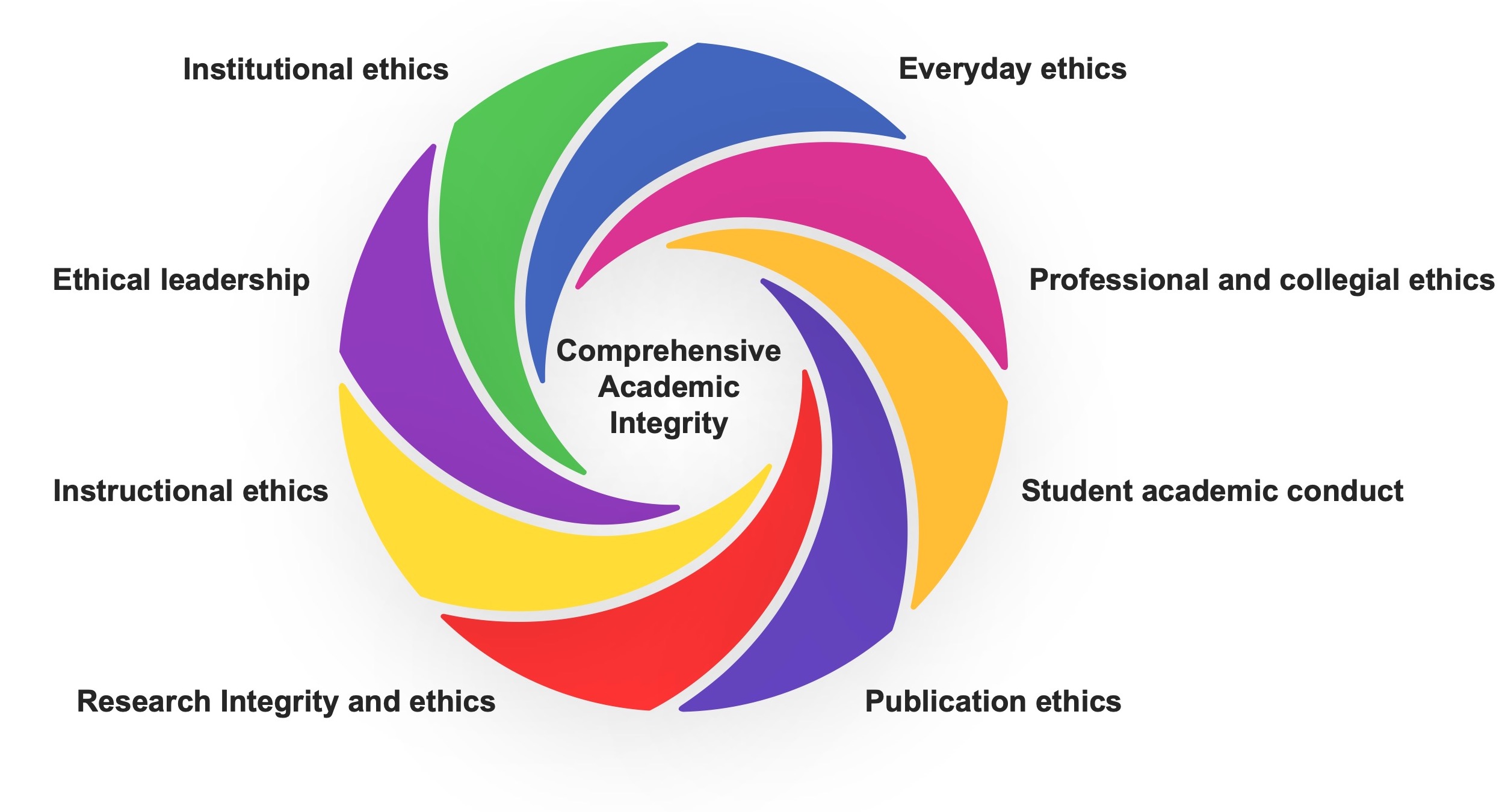
A circle with eight colourful swirls (one each in green, blue, pink, dark yellow, darker purple, red, bright yellow, medium purple, and green). There is black text associated with each swirl. This image is a graphic representation of the Comprehensive Academic Integrity (CAI) framework.

Keywords

academic integrity, student conduct, student affairs, research ethics, research integrity, publication ethics, instructional ethics, pedagogy, everyday ethics, experiential learning, definition, ethical decision-making, morals, values, virtues, leadership, equity, diversity, inclusion, accessibility, justice, decolonization, Indigenization

Postscript

Appreciation to Kieran Forde at the University of British Columbia for his most awesome interpretation of the graphic as a “colourful swirly donut”. Who doesn’t love donuts?! Thanks, Kieran!

References

Bertram Gallant, T. (2008). Academic integrity in the twenty-first century: A teaching and learning imperative. Wiley.

Boud, D., & Bearman, M. (2022). The assessment challenge of social and collaborative learning in higher education. Educational philosophy and theory, 1-10. https://doi.org/10.1080/00131857.2022.2114346   

Bretag, T. (2016). Educational integrity in Australia. In T. A. Bretag (Ed.), Handbook of Academic Integrity (pp. 1-13). Springer Singapore. https://doi.org/10.1007/978-981-287-079-7_2-1 

Bretag, T., Mahmud, S., Wallace, M., Walker, R., McGowan, U., East, J., Green, M., Partridge, L., & James, C. (2014). ‘Teach us how to do it properly!’ An Australian academic integrity student survey. Studies in higher education, 39(7), 1150-1169. https://doi.org/10.1080/03075079.2013.777406

Carroll, J., & Duggan, F. (2005, December 2-5). Institutional change to deter student plagiarism:  What seems essential to a holistic approach? 2nd Asia-Pacific Educational Integrity Conference, University of Newcastle, Callaghan, Australia.

Eaton, S. E. (forthcoming). Comprehensive academic integrity (CAI): An ethical framework for educational contexts. In S. E. Eaton (Ed.), Handbook of Academic Integrity (2nd ed.). Springer. 

International Center for Academic Integrity (ICAI). (2021). The fundamental values of academic integrity (3rd ed.). https://academicintegrity.org/resources/fundamental-values

Löfström, E., Trotman, T., Furnari, M., & Shephard, K. (2015). Who teaches academic integrity and how do they teach it? Higher Education, 69(3), 435-448. https://doi.org/10.1007/s10734-014-9784-3

Morris, E. J., & Carroll, J. (2016). Developing a sustainable holistic institutional approach: Dealing with realities “on the ground” when implementing an academic integrity policy. In T. Bretag (Ed.), Handbook of Academic Integrity (pp. 449-462). Springer Singapore. https://doi.org/10.1007/978-981-287-098-8_23

Tauginienė, L, Gaižauskaitė, I, Glendinning, I, Kravjar, J, Ojsteršek, M, Ribeiro, L, Odiņeca, T, Marino, F, Cosentino, M, Sivasubramaniam, S, Foltýnek, T. Glossary for Academic Integrity. ENAI Report 3G [online]: revised version, October 2018. https://www.academicintegrity.eu/wp/wp-content/uploads/2023/02/EN-Glossary_revised_final_24.02.23.pdf

Turner, S. P., & Beemsterboer, P. L. (2003). Enhancing academic integrity: Formulating effective honor codes. Journal of Dental Education, 67(10), 1122-1129. https://doi.org/10.1002/j.0022-0337.2003.67.10.tb03705.x

_________________________________

Share this post: A Comprehensive Academic Integrity (CAI) Framework: An Overview – https://drsaraheaton.wordpress.com/2023/04/14/a-comprehensive-academic-integrity-cai-framework-an-overview/

This blog has had over 3 million views thanks to readers like you. If you enjoyed this post, please “like” it or share it on
social media. Thanks!

Sarah Elaine Eaton, PhD, is a faculty member in the Werklund School of Education, and the Educational Leader in Residence, Academic Integrity, University of Calgary, Canada. Opinions are my own and do not represent those of the University of Calgary.


How to Talk to Your Students about ChatGPT: A Lesson Plan for High School and College Students

April 7, 2023
bionic hand and human hand finger pointing

Photo by cottonbro studio on Pexels.com

This article by Ben Edwards in ArtsTechnica (April 6, 2023) is worth a read, “Why ChatGPT and Bing Chat are so good at making things up”.

Edwards explains in clear language, with lots of details and examples, how and why large language models (LLMs) such as ChatGPT make up content. As I read this article, it occurred to me that it could serve as a really great way to have pro-active and generative conversations with students about the impact of artificial intelligence for teaching, learning, assessment, and academic integrity. So, here is a quick lesson plan about how to use this article in class:

Education level

Secondary school and post-secondary (e.g., community college, polytechnic, undergraduate or graduate university courses)

Lesson Plan Title: Understanding ChatGPT: Benefits and Limitations

Learning Objectives

By the end of this lesson students will be able to:

  • Understand how and why AI-writing apps make up content.
  • Explain the term “confabulation”.
  • Discuss the implications of fabricated content on academic integrity
  • Generate ideas about how to fact-check AI-generated content to ensure its accuracy

Lesson Preparation

Prior to the class, students should read this article: “Why ChatGPT and Bing Chat are so good at making things up by Ben Edwards, published in ArtsTechnica (April 6, 2023)

Come to class prepared to discuss the article.

Learning Activity

Class discussion (large group format if the class is small or small group format with a large group debrief at the end):

Possible guiding questions:

  • What is your experience with ChatGPT and other AI writing apps?
  • What were the main points in this article? (Alternate phrasing: What were your key takeaways from this article?)
  • What are some of the risks when AI apps engage in confabulation (i.e., fabrication)?
  • Discuss this quotation from the article, “ChatGPT as it is currently designed, is not a reliable source of factual information and cannot be trusted as such.”
  • Fabrication and falsification are commonly included in academic misconduct policies. What do you think the implications are for students and researchers when they write with AI apps?
  • What are some strategies or tips we can use to fact-check text generated by AI apps?
  • What is the importance of prompt-writing when working with AI writing apps?

Duration

The time commitment for the pre-reading will vary from one student to the next. The duration of the learning activity can be adjusted to suit the needs of your class.
  • Students’ pre-reading of the article: 60-minutes or less
  • Learning activity: 45-60 minutes

Lesson closure

Thank students for engaging actively in the discussion and sharing their ideas.

Possible Follow-up Activities

  • Tips for fact-checking. Have students in the class generate their own list of tips to fact-check AI-generated content (e.g., in a shared Google doc or by sharing ideas orally in class that one person inputs into a document on behalf of the class.)
  • Prompt-writing activity. Have students use different prompts to generate content from AI writing apps. Ask them to document each prompt and write down their observations about what worked and what didn’t. Discuss the results as a class.
  • Academic Integrity Policy Treasure Hunt and Discussion. Have students locate the school’s academic misconduct / academic integrity policy. Compare the definitions and categories for academic misconduct in the school’s policies with concepts presented in this article such as confabulation. Have students generate their own ideas about how to uphold the school’s academic integrity policies when using AI apps.

Creative Commons License

This lesson plan is licensed under a Creative Commons Attribution-NonCommercial 4.0 International License (CC BY-NC 4.0). This license applies only to the lesson plan, not to the original article by Ben Edwards.

Additional Notes

This is a generic (and imperfect) lesson plan. It can (and probably should) be adapted or personalized depending on the needs of the learners.

Acknowledgements

Thanks to Dr. Rahul Kumar, Brock University for providing an open peer review of this lesson plan.

 _________________________________

Share or Tweet this: How to Talk to Your Students about ChatGPT: A Lesson Plan for High School and College Students – https://drsaraheaton.wordpress.com/2023/04/07/how-to-talk-to-your-students-about-chatgpt-a-lesson-plan-for-high-school-and-college-students This blog has had over 3 million views thanks to readers like you. If you enjoyed this post, please “like” it or share it on social media. Thanks! Sarah Elaine Eaton, PhD, is a faculty member in the Werklund School of Education, and the Educational Leader in Residence, Academic Integrity, University of Calgary, Canada. Opinions are my own and do not represent those of the University of Calgary.

Academic Integrity and Academic Labour: One Faculty Association’s Position

March 17, 2023

by Sarah Elaine Eaton

The Alberta Colleges and Institutes Faculties Association (ACIFA) (Alberta, Canada) has released a brand new report on academic integrity. ACIFA’s Position on Academic Integrity, was prepared by Brooklin Schnieder, ACIFA Vice President, Professional Affairs.

Front cover of the report, ACIFA position on Academic Integrity. The title of the report is written in white text on a grey banner. There is a photo graph of a woman leaning over a desk to help a student who is sitting down. The student is holding a pen and has paper and binders in front of her.

This report covers important topics for faculty associations and academic unions and their members, related to academic integrity:

  • Faculty members’ role in promoting academic integrity
  • Academic integrity and workload
  • Emotional labour and burnout
  • Institutional policies and practices
  • Curriculum and assessment practices
  • Text-matching software and other technology solutions
  • Academic file-sharing and copyright
  • Contract cheating
  • Artificial intelligence
  • Equity, Diversity and Inclusion
  • Decolonization and Indigenization

The report concludes with a dozen recommendations, framed through the lens of social justice and advocacy, “Faculty are deeply committed to these values, but such a commitment should not come with a corresponding cost of additional unremunerated hours, emotional labour, and burnout. And with technological change, the opportunities for students and faculty to find themselves mired in academic integrity issues will only continue to increase.” (p. 9)

To my knowledge, this is the first report on academic integrity by a faculty association or union anywhere. It is a fabulous document that brings important issues into focus. The report is available to download from the ACIFA website: https://www.acifa.ca/_files/ugd/16fcf0_c98c6fb9f9bc4e4880a9f875d754eb4e.pdf

I acknowledge that I may be biassed in my assessment of this work because I’ve been cheering Booklin on in the background as she meticulously prepared this report. So, in the interest of transparency, I wish to disclose that I know Brooklin personally, as she has also been an active contributor to the Alberta Council on Academic Integrity (ACAI) Contract Cheating Working Group, which I co-chaired with Sheryl Boisvert from 2020 to 2023. Brooklin invited me to review a draft of this report I gladly volunteered my time to do so. Now I am happy to share her work publicly and add a further call to action:

Academic labour unions everywhere have a role to play in ensuring that work relating to academic integrity is fair and equitable for faculty members and in particular, those who are precariously employed. I call on other academic and teachers’ unions to produce their own reports to support their members in their efforts to uphold integrity in educational institutions. 

Please share this report widely within your networks.

_________________________________

Share or Tweet this: Academic Integrity and Academic Labour: One Faculty Association’s Position – https://drsaraheaton.wordpress.com/2023/03/17/academic-integrity-and-academic-labour-one-faculty-associations-position/

This blog has had over 3 million views thanks to readers like you. If you enjoyed this post, please “like” it or share it on social media. Thanks!

Sarah Elaine Eaton, PhD, is a faculty member in the Werklund School of Education, and the Educational Leader in Residence, Academic Integrity, University of Calgary, Canada. Opinions are my own and do not represent those of the University of Calgary.


Book launch: Fake Degrees and Fraudulent Credentials in Higher Education

March 7, 2023

Carleton University Innovation Hub is pleased to host this public event.

Fake Degrees and Fraudulent Credentials in Higher Education

Join editors/authors Sarah Elaine Eaton, Jamie J. Carmichael, and Helen Pethrick in the Innovation Hub on Friday March 24, 2023 for the launch of their new book Fake Degrees and Fraudulent Credentials in Higher Education. This hybrid event will feature reading from the book and continue an important conversation facing many people in the world today.

Event Date: March 24th, 11:00 am – 12:00 (Eastern Standard Time)  

Event Location: Innovation Hub, 2020 Nicol Building, Carleton University or online

Hybrid Option:  A zoom Link will be provided via email to event registrants.

For more information or to register – https://carleton.ca/innovationhub/book-launch/

Related posts

_________________________________

Share or Tweet this: Book launch: Fake Degrees and Fraudulent Credentials in Higher Education https://wp.me/pNAh3-2SD

This blog has had over 3 million views thanks to readers like you. If you enjoyed this post, please “like” it or share it on social media. Thanks!

Sarah Elaine Eaton, PhD, is a faculty member in the Werklund School of Education, and the Educational Leader in Residence, Academic Integrity, University of Calgary, Canada. Opinions are my own and do not represent those of the University of Calgary.


6 Tenets of Postplagiarism: Writing in the Age of Artificial Intelligence

February 25, 2023
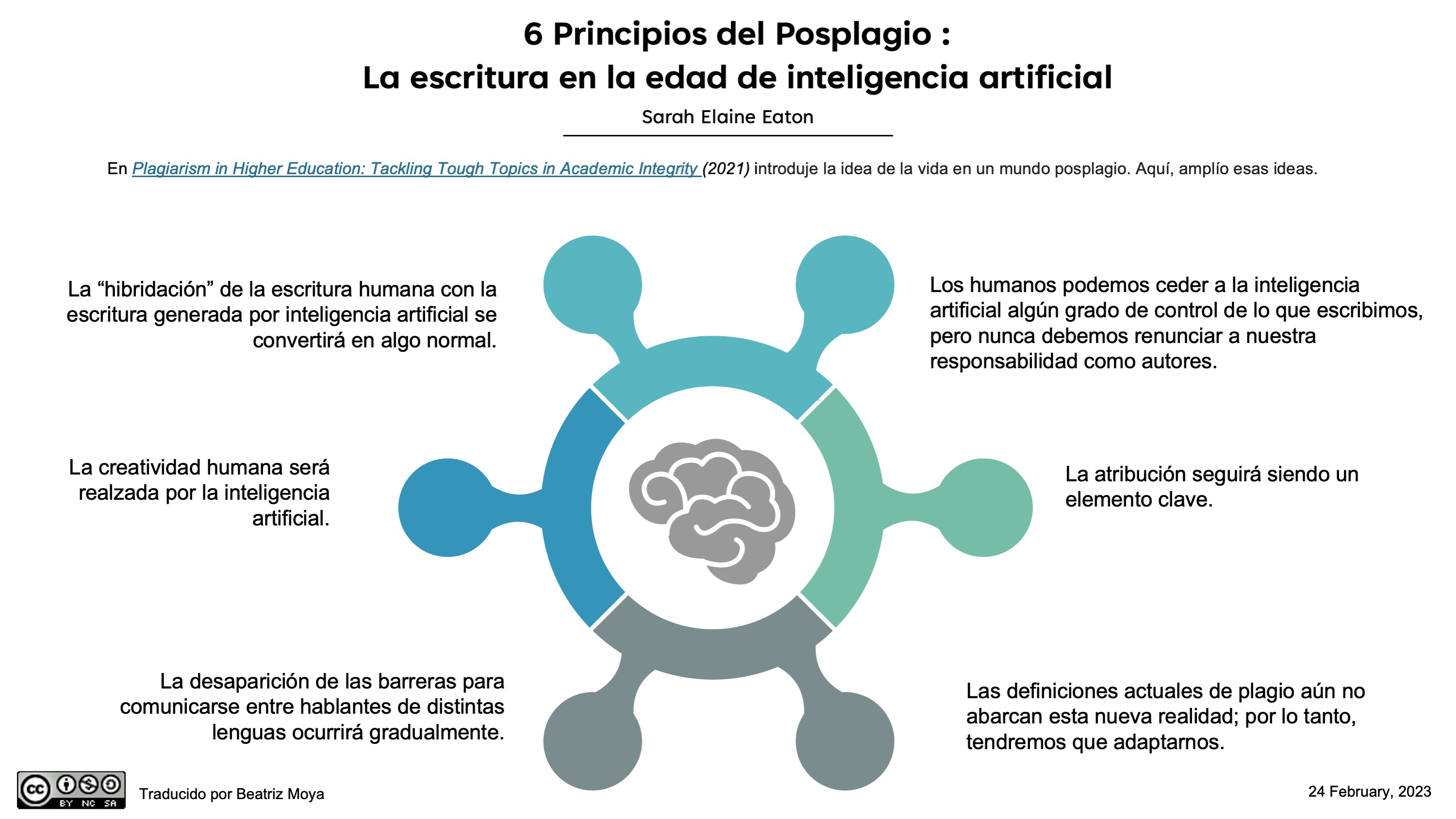
An infographic showing the 6 tenets of the post-plagiarism age. There is a circle with six points extending from it. There is an icon of a brain at the centre. These ideas were developed from the book, Plagiarism in Higher Education: Tackling Tough Topics in Academic Integrity (2021) by S. E. Eaton.

In the final chapter of Plagiarism in Higher Education: Tackling Tough Topics in Academic Integrity (2021) I contemplate the future of plagiarism and academic integrity. I introduced the idea of life in a postplagiarism world; thinking about the impact of artificial intelligence on writing. Here, I expand on those ideas. These 6 tenets characterize the post-plagiarism age:

Hybrid Human-AI Writing Will Become Normal

Hybrid writing, co-created by human and artificial intelligence together is becoming prevalent. Soon it will be the norm. Trying to determine where the human ends and where the artificial intelligence begins is pointless and futile.

Human Creativity is Enhanced

Human creativity is enhanced, not threatened by artificial intelligence. Humans can be inspired and inspire others. Humans may even be inspired by artificial intelligence, but our ability to imagine, inspire, and create remains boundless and inexhaustible.

Language Barriers Disappear

One’s first language will begin to matter less and less as tools become available for humans to understand each other in countless languages.

Humans can Relinquish Control, but not Responsibility

Humans can retain control over what they write, but they can also relinquish control to artificial intelligence tools if they choose. Although humans can relinquish control, they do not relinquish responsibility for what is written. Humans can – and must – remain accountable for fact-checking, verification procedures, and truth-telling. Humans are also responsible for how AI-tools are developed.

Attribution Remains Important

It always has been, and always will be, appropriate and desirable to appreciate, admire, and respect our teachers, mentors, and guides. Humans learn in community with one another, even when they are learning alone. Citing, referencing, and attribution remain important skills.

Historical Definitions of Plagiarism No Longer Apply

Historical definitions of plagiarism will not be rewritten because of artificial intelligence; they will be transcended. Policy definitions can – and must – adapt.

Translations of the Six Tenets of Postplagiarism

Since I first shared the Six Tenets of Postplagiarism, the infographic has been translated into French and Spanish. I am very grateful to the translators, who put in time and effort to go through the points in detail. Here are the translated versions:

Les 6 Principes du Postplagiat (French)

This translation was done by Dr. Elaine Beaulieu at the University of Ottawa, Canada.

Colleagues at the Université du Québec à Montréal (Canada), also wrote a web article in French. It is available here: https://collimateur.uqam.ca/collimateur/6-principes-de-lapres-plagiat-a-lere-de-lia/

6 Principios del Posplagio (Spanish)

The Spanish translation was done by Beatriz Moya, PhD candidate at the University of Calgary.

More Resources on PostPlagiarism

Check out my video on this topic on YouTube: https://youtu.be/NxFMMw1QZX0

Check out my article in University World News on this topic: “Artificial intelligence and academic integrity, post-plagiarism”

_________________________________

Share this:  6 Tenets of Postplagiarism: Writing in the Age of Artificial Intelligence https://drsaraheaton.wordpress.com/2023/02/25/6-tenets-of-postplagiarism-writing-in-the-age-of-artificial-intelligence/

This blog has had over 3 million views thanks to readers like you. If you enjoyed this post, please “like” it or share it on social media. Thanks!

Sarah Elaine Eaton, PhD, is a faculty member in the Werklund School of Education, and the Educational Leader in Residence, Academic Integrity, University of Calgary, Canada. Opinions are my own and do not represent those of the University of Calgary.