A Scholar’s Thoughts About Social Media and Blogging

March 2, 2024

Over the years I have received well-meaning, but ultimately inaccurate — or even harmful — advice from superiors or colleagues at work and friends about how to “do” social media and blogging. I have been reflecting on this topic a lot lately. Here are some things I have been told (which are totally bogus) and my responses to them.

“Facebook should be for personal stuff. Keep work posts to LinkedIn or Twitter/X.”

This is bullshit. Your social media accounts are for whatever you want them to be for. I have had people unfriend or unfollow me on Facebook because they only want to see photos of my personal life. I share some posts about personal things occasionally, but not often… and that’s my choice.

I share stuff on social media channels, in part, to connect with people who have similar interests to me. If those things don’t interest you, I respect that, but don’t preach to me about how to use my own social media accounts.

“Blogging about work-related topics isn’t a hobby. You need non-work-related hobbies.”

Photo by Pixabay on Pexels.com

I remember a senior administrator telling me this. They were criticizing me when I said that I like to blog as a hobby. They opined that hobbies should not have anything to do with work. Your hobbies — what you do outside of work to relax, blow off steam, or decompress — is your own business. If it happens to relate to work, that is also your own business.

I like blogging about things I am interested in. I happen to be interested in topics that relate to my job — ethics, integrity, higher education, etc. No one pays me to blog, so it is not technically work. It’s my blog and I’ll write about whatever I damn well please.

For the record, I have some hobbies that do not relate to my profession, but I may not post about them online. I don’t post photos of every meal I cook, even though cooking is one of my hobbies. What I share on social channels does not represent the entirety of my life.

Well-Meaning but Misplaced Advice About Online Activity

I have found wonderful online communities and individuals whom I would not have connected with any other way, if it were not for social media. In some cases, there are individuals whom I have never met in person, but yet I feel an affinity for, because we share similar interests and have meaningful conversations and interactions about things that are mutually important to us. Over the years, I have found that when I have met someone in real life for the first time that I have had a connection with online about a topic of mutual interest, the real-life encounter is easy, authentic, and often fun.

Conversely, there are people in my social media circles whom I originally met in person that I am not all that close to, or haven’t seen in years or decades. Some of these individuals seem to think it is OK to offer unsolicited advice about how to use my own social media accounts when the reality is that they don’t genuinely care much about me. If they did, they would know that I would find it more supportive if they just appreciated me for who I am, rather than who they want me to be.

Concluding Comments

I am really lucky that I enjoy my work — a lot. I have a great job that happens to align brilliantly with my strengths, expertise, and interests. I recognize this is a privilege and even a luxury. Not everyone has such luxury. Someone said to me recently, “When your interests, passion, and expertise line up with your job, you have hit the proverbial jackpot.”

That comment caused me to reflect on these criticisms in a new way. Before the neoliberalization of higher education, being a scholar was as much a lifestyle as it was a job. Being a scholar is part of my identity. It is part of who I am and I recognize that this a tremendous privilege. There are many things wrong with higher education and the system, as a whole, does not afford most of us the luxury of being scholars. There are many things that I am not good at, and some of them I am downright lousy at. But when it comes to things I am passionate about (e.g., academic integrity), I’m full on — all the time. And you know what? That. Is. Perfectly. OK.

For what it is worth, it has taken me years, no… decades, to get to a place where I can just say that.

Photo by Stanley Morales on Pexels.com

So, I’m just going to own it. I have worked hard — exceptionally hard — for the life that I have, which is that of a scholar. It is not perfect, by any stretch. I dreamed of being a professor from the time I was little. I may not sit around sipping brandy while sitting in a leather chair in a library with shelves lined from floor to ceiling with books. That reality does not exist — at least not for me. My version of being a scholar includes having a messy desk, half-read books strewn all over my untidy house, and active engagement with my online communities, my social media, and my blog.

I am in a stage of my career now, as a tenured associate professor, that I can say things that I felt too vulnerable to say as a precariously-employed or untenured academic. This blog post is for anyone out there who has been chastised or criticized by administrators, colleagues, or anyone else who has made you feel “less than” for being yourself in online spaces and communities. If you want to blog or post about topics that matter to you, I’m right there with you. If those topics relate to your work, that’s cool with me – and this should also be OK to others. If your employer does not oblige you or expect these things from you and you are engaging in these activities because they feel meaningful and important to you, then all the power to you. You may be giving of yourself, your expertise, and your wisdom in ways that extend beyond the requirements of your job – and that can actually be a pretty special and generous thing to do.

What I ask of my colleagues and superiors is that you accept me for who I am. The same goes for colleagues and others who also may be similar to me, colleagues who engage in online and social media activities about stuff that is important to them – especially when it might relate to advocacy, activism, and improving the lives of other people (in my case, students). Reserve your judgements about who a person should be and appreciate them for who they actually are. In my opinion, that is a more genuine form of acceptance, support, and even friendship. In the meantime, I am just going to sit here on a Saturday morning and keep blogging about stuff that matters to me…

Related posts

Finding your Flair: Clothing Choice in School and Work

Radical Acceptance: A Framing for Advocacy and Equity, Diversity, Inclusion, Accessibility and Integrity Work

____________________________

Share this post: A Scholar’s Thoughts About Social Media and Blogging – https://drsaraheaton.wordpress.com/2024/03/02/a-scholars-thoughts-about-social-media-and-blogging/

This blog has had over 3.6 million views thanks to readers like you. If you enjoyed this post, please “like” it or share it on social media. Thanks!

Sarah Elaine Eaton, PhD, is a faculty member in the Werklund School of Education at the University of Calgary, Canada. Opinions are my own and do not represent those of my employer.

Sarah Elaine Eaton, PhD, Editor-in-Chief, International Journal for Educational Integrity


Lessons learned from 2 Million blog views

June 5, 2018

8 years.

614 posts.

5126 followers

2,014,851 views.

According to the blog stats, I’ve recently topped two million all-time blog views, with over 1.2 million visitors (some of whom have viewed more than one post, obviously):

All time views - posts

Here are some things I’ve learned about blogging as a result of this experience:

Keep on blogging

I know so many people who have started blogs, only to abandon them because they got too busy, got frustrated when they didn’t get a massive following instantly or just got bored.

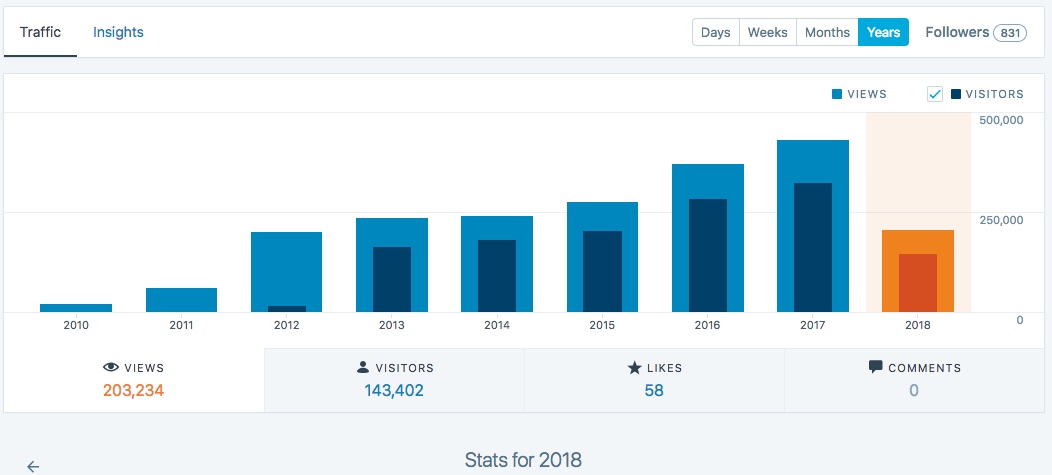
Here’s a high-level graph that shows a steady increase in blog views and visitors over the years:

Year-over-year.jpg

Of course, the stats for 2018 are lower because year isn’t half over yet. But if you look at 2010 through 2017, you can see that the number of individual views, as well as the number of visitors, has increased steadily over time.

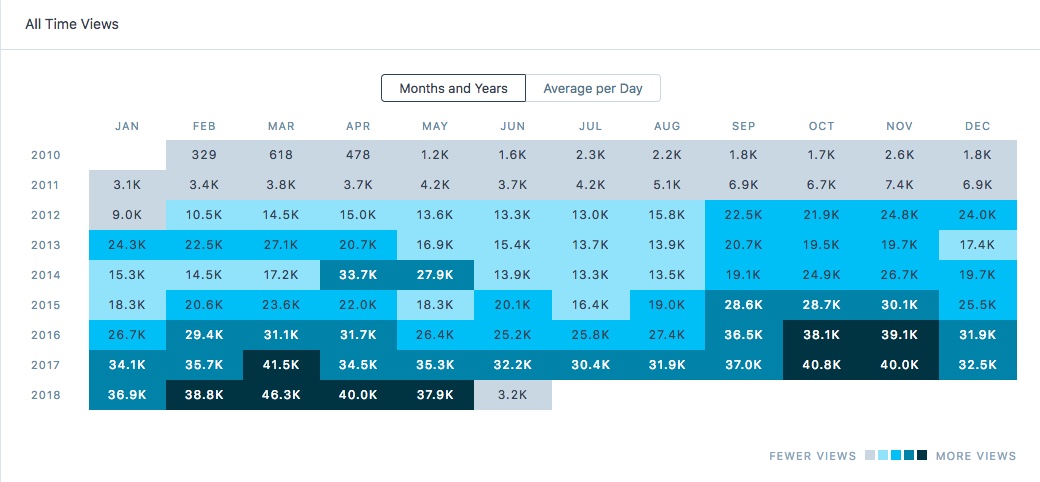
The graph below breaks it down a bit more. It shows how many views my blog has had over the months and years since I started it in February, 2010. Darker colours represent more views.

All time views - Months and years.jpg

In 2018, my monthly average has been about 39.9 thousand views per month, from January through May. (Given that I’m writing this post in early June, 2018, the numbers for this month don’t look very impressive, but that block will be dark blue by the end of the month.)

The number of views has increased consistently over time. The average number of views per month in 2010 was under 1400. What I had as a monthly average number of views in my first year of blogging is now almost my daily average!

When I tell people that my blog now gets over 1000 views per day, they look at me in disbelief, but here are the stats:

Average per day.jpg

Again, the numbers for June 2018 look low because that’s a monthly total and we’re still at the beginning of the month and that number is the average for the entire month. That number will increase throughout the month.

Look at all the light grey in the first two years of my blog. The real increases started to show in year 3 (2012). If I had given up blogging, I would never have seen those increases. My lesson learned here is: Keep on blogging, even when you think no one is reading. More readers will stop by as your blog gets populated with content.

Your progress is relative

There are some superstar bloggers out there who get millions of views every week. Some bloggers make money from their blogs, and others even blog for a living. But that was never my intention. My goal with my blog has been consistent: to share and archive content, document my own professional and learning experiences and offer tips to students and educators. The number of views and visitors is relative to the industry you work in, your purpose for blogging and how much content you share.

Sometimes you don’t know the reason for the stats

My best day for blog views was April 7, 2014:

All time views - posts

What happened that day? Nothing special, as far as I can tell. I didn’t even post that day. It was a complete fluke. I have no idea why that day in 2014 was my all-time daily maximum for blog views.

My learning from this is to not get too hung up on trying to achieve every day. Progress happens over time. Blips and flukes happen, too. The important thing is to not give up and stick with it.

Try different things

I have tried all kinds of different things over the years. I’ve written features about educators who inspired me (like this post about Deaf educator, Brent Novodvorski, for example). In 2012, I did a weekly series where I posted my favourite resources of the week. I have also used my blog as a space to archive material that I wanted to share online with readers, like this APA Checklist for Term Papers.

I have tried all kinds of different things over the years. My learning from this is that experimenting helped me to figure out what works. It also helped me to figure out what kind of blogger I want to be.

Develop your blogging identity

I have worked as an educator since 1994. It’s no secret that I love teaching! I love interacting with students, whether they are in a classroom or online. While I may have been experimental with my posts at times, I’ve been consistent that my blog has always been focused on learning in one way or another. I don’t post recipes or tips to improve your health or fitness. I post about education. My followers have come to expect posts about learning, teaching, leadership or a related topic.

My learning from this is to develop an identity as a blogger. I have grown and developed as both an educator and a blogger since I started my blog. I engage in regular reflection about what I have learned and what I still want to learn. For me, my professional growth and my development as a blogger have gone hand-in-hand over the past eight years.

Followers come from different places

Apparently, my blog has over 5000 followers:

Followers.jpg

Some folks follow along on WordPress, others get an e-mail every time a post is published and still others follow along on social media. WordPress doesn’t give me much information about who these followers are, but all I can say is, “Thank you!” I appreciate that you have read, liked and commented (or even just lurked) over the years. It makes me feel that my blog with worthwhile to you. What better reward could there be?

Approach comments with caution

Regular followers will know that I shut down the comments section on my blog a few years ago. For a long time, I was really excited to get comments on my blog. But then, things took a dark turn once the blog started to really gain views. The nature of some of the comments sometimes became rude, aggressive or abusive.

I expect that anyone who has spent a lot of time blogging has encountered something similar. I understand there are different thoughts on how to approach this. Some people believe that there’s no such thing as bad publicity and the more flaming comments, the better. Me, not so much. Ultimately, I decided to shut down the comments function. I still really appreciate it when people hit the “Like” button at the end of a post, but I’m not sure I’ll ever re-open the comments again.

Your blog can be an incubator for ideas

One highlight about developing my identity as a blogger and as a professional is that in 2010, the first year of my blog I wrote a post called, “Are your students plagiarizing? Here’s how you find out”. I wrote a few other posts about plagiarism over the next year. Several years later, academic integrity has developed into a major research area for me. In 2017, I published my first peer-reviewed research article on plagiarism.

My learning from this is that your blog can be a place where your ideas germinate and incubate. I think those early posts in plagiarism in 2010 planted a seed that grew over the years.

People sometimes steal your content

I am sorry to say that some of my best content has been replicated on other people’s blogs or sites without attribution to me. Of course this makes me sad and angry. I sometimes wonder if that experience was part of the reason my interest in plagiarism as a research interest developed? Not sure.

I have learned the hard way that there are some people who feel entitled to lift whatever they want off the Internet and claim it as their own.

At one point, I was so upset this by this, I took a long hiatus from blogging. I almost abandoned my blog altogether. Instead, I learned a few tips and tricks. I’ll share these in a future post. (Wink, wink!)

My advice for bloggers

My key piece of advice for bloggers is: Stick with it. Your blog is an expression of you and your ideas over time. Share whatever you want. Some people will love it and others won’t. That’s OK.

If people leave you hurtful comments, turn off the comments. Your blog is about you and those who appreciate the effort you put into it. Experiment. Try different things. No blog is perfect, so don’t aim for perfection. Aim to be yourself and share whatever inspires you. Over time, I bet you’ll be surprised to see how you grow as a result.

Blog on, my friends!

______________________________________________________

Share or Tweet this: Lessons learned from 2 Million blog views https://wp.me/pNAh3-2iZ

This blog has had over 2 million views thanks to readers like you. If you enjoyed this post, please “like” it or share it on social media. Thanks!

Sarah Elaine Eaton is a faculty member in the Werklund School of Education, University of Calgary, Canada.

Opinions are my own and do not represent those of the Werklund School of Education or the University of Calgary.


2013 in review

December 31, 2013

I am so grateful to the long-term and new readers who stopped by my blog this year. I always enjoy reading the year-end report that WordPress sends out to its writers. I thought I’d share this with you and tell you how much I appreciate you being part of this experience. Sometimes I blog for myself, to archive resources or materials, but mostly, I blog to share those resources, ideas and materials with you. This year, the blog had almost a quarter of a million visits. If that isn’t inspiration to keep blogging, then I don’t know what is!

Thank you for being here with me, along this journey of learning, leading and living. Wishing you a fulfilling 2014, full of challenges that make us want to be just a little bit more than we were in 2013, stopping just short of exasperation or frustration… and enough to remind us that every day offers an opportunity.

Here’s an excerpt:

The Louvre Museum has 8.5 million visitors per year. This blog was viewed about 230,000 times in 2013. If it were an exhibit at the Louvre Museum, it would take about 10 days for that many people to see it.

Click here to see the complete report.

___________________________

Update – January 2018 – This blog has had over 1.8 million views thanks to readers like you. If you enjoyed this post, please “like” it or share it on social media. Thanks!

Sarah Elaine Eaton is a faculty member in the Werklund School of Education, University of Calgary, Canada.


10 Tips for Creating Successful and Sustainable Online Communities

August 7, 2013

NingI have set up a number of online communities throughout my career. Here are my top 10 lessons learned over the years:

  1. An initial time investment of 25 hours to get your online community set up is not unreasonable. It’s easy and fast to sign up, but there’s more to it than setting up an account and a profile. In the beginning, you need to build a foundation for ongoing and sustainable social interaction between your members. You need to create a community that provides value, resources and a sense that time there will be well spent.
  2. You also need to collect and add some quality content to populate the site from the very beginning. Do not wait until you have a critical mass of members, assuming that high quality content will simply appear. Set the example for what type of content you expect by populating the site with some initial contributions yourself.
  3. Most popular content includes “how to” information, tips, lesson plans and very practical hands-on type information. Avoid lengthy diatribes, theory or “heavy” philosophical material. Multi-media content is also popular.
  4. It’ll work best if you “seed” the community with at least half a dozen (or more, if you can get them) key individuals who are well-known in the social group. These “founding members” should be hand-picked by the administrator. They are folks who will be seen as trusted authorities or influencers. Get at least half a dozen founding members fully signed up (including their profiles and photos) before sending out a mass public invite. You may have to follow up with them once or twice to nudge them, but it’s worth it. Seeding your site with a few key influencers can help build the online community quickly and effectively.
  5. People will have a look to see who else is part of the online community before they sign up themselves. If they see people they know, trust and like on the list of virtual community members, they are more likely to sign up themselves.
  6. Ask each of your “founding members” to contribute one piece of content — an article, a blog post or something that will bring value to the community. Part of the success of your Ning will depend on having quality contributions from a variety of members.
  7. Plan on updating your online community at least once a week. One of the biggest downfalls of online communities is that they stagnate because no one contributes.
  8. Approve new members. Human spammers or spam bots may try to sign up for your online community. Some services that offer online communities give you the option to require that new members be approved. If your service offers that option, I recommend accepting it. It’s a little more work upfront, but it keeps the quality of your online community high… which will keep your members happy.
  9. If you do get spammers in the community, eject them immediately. No apologies and no questions asked. If necessary, you may need to apologize to community members for spammer activity and let them know that you have taken steps to ensure that it doesn’t happen again.
  10. Invite contributions from members on an ongoing basis. Send out periodic and personalized e-mails to members letting them know that you have showcased their work or you’d like to invite them to contribute. Avoid sending form letters or messages that are not personalized. Sending occasional personal e-mail communications will be more effective than mass mailouts or “blasts”. By the way, this goes beyond a form letter that simply has the person’s first name in the salutation. That no longer counts as genuinely personalized communication. Add a comment about the person as human being. Ask about their spouse, kids, pets or latest project or vacation, using specific details that lets the sender know it is not really just another form letter.

Over the past few years, I have noticed a curious trend. Five years ago, fewer people knew what online communities were all about. Those who knew signed up without much resistance and contributed generously. Now, more people know what online communities are and understand how to participate in one, but at the same time, people are getting pickier about what they sign up for. Even though more people have higher technology literacy levels when it comes to understanding both the concept and the “nuts and bolts” of online communities, that does not necessarily correlate to a willingness to sign up for one.

The trick to creating a sustainable and successful online community is continually providing value to members, without overwhelming them. You must respect their time, their privacy and their willingness to engage. Time and energy are valuable personal resources. If you want someone to spend time and energy in your online community, make it worthwhile for them.

An online community is not a sales platform and nor is it a space for one person to broadcast their ideas or opinions. A community — whether it is online or in real life — must be interactive, engaging and supportive for everyone.

Ning is my favorite online platform for online communities, especially for education and non-profit. There is a cost, but it is minimal. The Ning name is also trusted and well-known. I don’t think you need to budget tens of thousands of dollars to have a custom-built platform.

(Note: I have no affiliation to Ning and receives no financial or other benefits from promoting them. I just think they are a good service that’s worth recommending.)

__________________________

If you enjoyed this post, please “like” it or share it on social media. Thanks!

Share or Tweet this: 10 Tips for Creating Successful and Sustainable Online Communities http://wp.me/pNAh3-1Do

Update – January 2018 – This blog has had over 1.8 million views thanks to readers like you. If you enjoyed this post, please “like” it or share it on social media. Thanks!

Sarah Elaine Eaton is a faculty member in the Werklund School of Education, University of Calgary, Canada.


De-grouping to be a more effective leader

August 2, 2013

LinkedIn logoYou are probably familiar with the term “re-grouping”. It means taking a breath and a step back from a situation in order to re-assess the current state of it.

Lately, I have been “de-grouping”, mostly on LinkedIn. For a number of years, I have been a member of the maximum number of groups allowed, which is 50. I signed up for groups related to topics I was interested in professionally including leadership, literacy, languages, marketing, education and other topics. I tried to read discussion posts and contribute. I thought it was a good way to keep my pulse on sectors and industries that I felt were important to my career.

What I found was quite the opposite. Instead of staying on top of news and trends, I was inundated with messages, many of which did not help me learn, grow or provide many insights.

On the flip side, I was also unable to contribute much of value to many of the discussions.

I have pared down my membership to 10 LinkedIn groups. Here are the three criteria I used to decide which groups to stay in:

  1.  I personally know some or all of the members. I’ve seen the whites of their eyes and I can easily remember their smile.
  2. I learn something from the discussions.
  3. I can contribute something of value to the discussions from time to time.

For me, cutting back on the number of groups I am a member of on LinkedIn has helped free up time and energy for other activities such as tending to my clients, teaching students and preparing upcoming presentations and workshops for the fall. All in all, being more selective about how I spend my time and energy online has helped me to cultivate my professional and leadership skills overall. I’m still online… just more selectively than ever before.

I have increased energy as I am using laser-focus to determine which activities bring value to my profession and where I can also make a meaningful contribution.

Related post: How to delete LinkedIn contacts who spam you (and why you should) http://wp.me/pNAh3-1CO

 __________________________

If you enjoyed this post, please “like” it or share it on social media. Thanks!

Share or Tweet this: De-grouping to be a more effective leader http://wp.me/pNAh3-1De

Update – January 2018 – This blog has had over 1.8 million views thanks to readers like you. If you enjoyed this post, please “like” it or share it on social media. Thanks!

Sarah Elaine Eaton is a faculty member in the Werklund School of Education, University of Calgary, Canada.