How to Publish your Amazon Kindle e-book (It’s easier than you think!)

March 15, 2012

Are you an author or a writer? Do you have a book in you that is ready to be shared with the world?

I published my first book in 2002. Last year, everything changed. I published 4 of my own e-books as Amazon Kindle books.

In Feburary, I had the privilege of presenting the nuts and bolts of the “how to” at the National Speakers Association 2012 Winter Conference in Dallas, TX on February 4.

A few weeks later, I did the same presentation for the my home chapter of the Canadian Association of Professional Speakers. We taped the Calgary session and I have the highlights here for you. This video details the exact method for you, step-by-step.

My prediction is that teachers, students and writers of all types are soon going to be publishing and sharing their work on line in a variety of formats. Amazon e-books are just one way to do that. It is easier now to be a published writer than it has ever been in history. If you are a writer, this is your time!

___________________________

Share or Tweet this post: How to Publish your Amazon Kindle e-book (It’s easier than you think!) http://wp.me/pNAh3-1jm

Update – January 2018 – This blog has had over 1.8 million views thanks to readers like you. If you enjoyed this post, please “like” it or share it on social media. Thanks!

Sarah Elaine Eaton is a faculty member in the Werklund School of Education, University of Calgary, Canada.


101 Ways to Market Your Language Program (10 Free webinars)

March 14, 2012

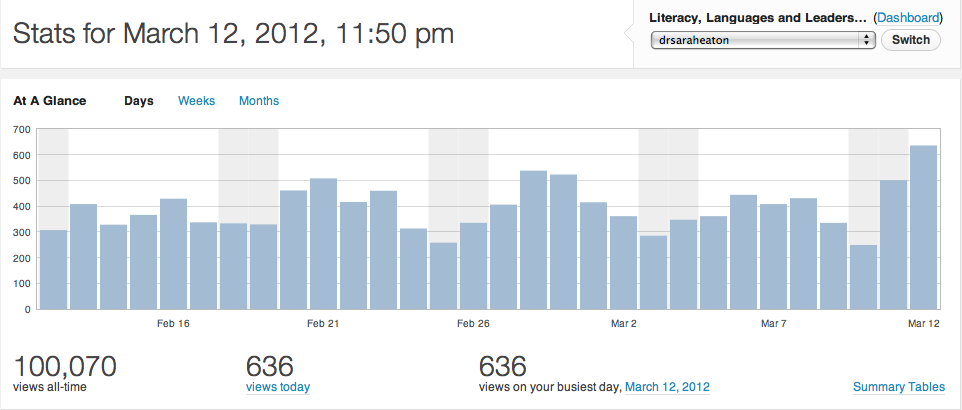
What an amazing week! My blog is just over 2 years old and this week, we topped 100,000 all-time views and 200 subscribers.

It’s definitely time to celebrate.

10 Free Webinars on How to Market and Promote Your Language or Literacy Program

Over the next 10 weeks, I’m going to host a free webinar every week. Each one will highlight different ideas from 101 Ways to Market Your Language Program. Every week you’ll get practical, low-cost ideas to help you promote any language or literacy program. Best of all, you’ll get to connect with others on line who are also interested in the same topic, ask questions and interact.

The webinars will be 30 to 60 minutes in length. Bring a pen and paper. I’m going to give you lots of ideas you can implement right away.

We’ll do the webinars for the next ten Wednesdays: March 21 to May 23, 2012

There are some time zone changes coming up around the world, so double-check these times against your local area:

Point of origin – 14:00 (2:00 p.m.) Mountain Time, March 21, 2012 – Calgary / Edmonton

16:00 (4:00 p.m.) – Eastern Time – Toronto / New York

20:00 (8:00 p.m.) – Greenwich Time – London, England

22:00 (10:00 p.m.) – Eastern European Time – Athens / Istanbul

05:00 (5:00 a.m.) – following day – Japan Standard Time – Tokyo

To join the webinar, click here: http://meet11548754.adobeconnect.com/saraheaton/ — There is no need to register. These webinars are free and open to everyone. Seating is limited though, so sign on early.

I’ll record each webinar and post it so you can view it later, too.

This is essentially a 10-week course designed to take you through the entire book from beginning to end. I’ll include some marketing “best practices” and show you how to start thinking about promoting your programs to ensure they are sustainable over the long term. I’ll share some case studies and stories, along with lots of practical “how to” information that you can use right away.

Here’s what we’ll cover

Week #1 – How to develop your marketing strategy and plan

Week #2 – Setting marketing goals, target markets, budgets

Week #3 – Focus on benefits, writing marketing materials

Week #4 – Business cards, newsletters, signs and other communications

Week #5 – What makes people care about you. How to stand out from the crowd.

Week #6 – Specialty tips for programs at large institutions

Week #7 – Relationship marketing. The power of connections.

Week #8 – It’s how you make them feel. Adding personal touches that make all the difference

Week #9 – Effective follow up with your marketing and not giving up too soon.

Week #10 – Social media for marketing

All you have to do is block off the next 10 Wednesdays in your calendar at your corresponding local time and then log in using the link above. It’s that easy. And it’s my way of showing my appreciation to you.

Thank you to everyone who has viewed the blog, left a comment or subscribed. I really love the work I do and being able to share with you, learn from you and engage with you inspires me every single day.

___________________________

Share or Tweet this post: 101 Ways to Market Your Language Program (10 Free webinars) http://wp.me/pNAh3-1j6

Update – January 2018 – This blog has had over 1.8 million views thanks to readers like you. If you enjoyed this post, please “like” it or share it on social media. Thanks!

Sarah Elaine Eaton is a faculty member in the Werklund School of Education, University of Calgary, Canada.


Is being a language teacher dangerous to your health?

March 13, 2012

Do you work in poor, run-down conditions? Or an old building that’s falling apart?

Amelia’s story

Amelia Labbe Sarah Eaton University of CalgaryWhen I started my Master’s degree in Spanish at the University of Calgary, I heard staff and professors complaining about the air quality and run down conditions in Craigie Hall, the building where the modern language departments are housed. I never really thought about it much, since I head my head buried in my books and I was learning to live in a new city and adjust to the pressures of being a young graduate student.

One of the first people to welcome me into the department was Amelia Labbé. A native of Bolivia, Amelia ran the university’s Centro de Tertulia (Spanish Centre). Officially, Amelia’s job was to provide opportunities for conversation with a native speaker. Unofficially, the Centro de Tertulia became a place where students would gather, socialize in Spanish, help one another with their homework, listen to music in Spanish and sometimes even watch telenovelas.  There was only one rule: When you crossed the threshold in to the Centro, it was Spanish only. No English. No French. Solamente español. It was her one rule and she stuck to it.

Amelia also became a mentor and unofficial advisor to many students who sought her council and words of wisdom, even though it was not part of her job. Officially, the university has designated student advisors and anyone who is not a designated advisor is not supposed to offer guidance to students. But that didn’t stop students from asking her what she thought and seeking her advice. Students trusted her. They could tell that she cared deeply about them… In fact, she cared more about the students than she did about regulations or rules. Over the course of her career, she touched the lives of thousands of students who studied Spanish at the University of Calgary, including mine.

Last fall, Amelia fell ill. She blamed it on the building where she worked, which was known to have asbestos in it. On November 8, 2011, Amelia passed away from pulmonary fibrosis. Along with many of my friends and colleagues, I attended the celebration of her life on November 19.

Faculty and staff complaints about poor air quality are blown off

Since then, twenty years of complaints about the state of the building and questions about its air quality have erupted into a full-scale war. I have gone from being a Master’s student to working in the Language Research Centre, where I now have the privilege of being a Research Associate and an Adjunct Assistant Professor, after finishing my Ph.D.

An informal investigation was held a few years ago when it was determined that an extraordinarily high percentage of the faculty and staff had been diagnosed with cancer. Many of them pointed to their physical working conditions as a factor in their illness. Tests were done. Faculty and staff were told that everything was fine. Sadly, the incidence of cancer diagnosis among language faculty continued. Others were diagnosed with asthma and unknown allergies. No one could prove any correlation between the physical environment and the incidence of illness.

Following Amelia’s passing, some faculty members and staff insisted that a full investigation be conducted. Today, the CBC published, “Teacher’s lung disease death prompts U of C building worries: But officials say Craigie Hall air quality not compromised by asbestos“. The story documents reactions to Amelia’s health issues and subsequent passing, and speculations that her physical work environment were the root cause of her death. Amelia’s husband and my colleague and mentor, Dr. Rachel Schmidt, publicly offered commentary to reports.The university released a statement declaring that “air quality and environment are within the acceptable guidelines“.

Language programs: Between a rock and a hard place

In my Ph.D. research I found that it is not uncommon for language programs at large institutions to be marginalized both politically and in terms of their physical placement on a campus.

Here’s an excerpt from my Ph.D. thesis:

Language programs, because they are not necessarily seen as academic in nature, do not always have a prominent place on campus. While it would be logical for ESL programs to be physically positioned in places that are easily accessible by foreign students who struggle with the language, “many … programs are housed in temporary bungalows, in basements, or on the periphery of our campuses” (Stoller, 1997, p. 40).

This assertion is echoed more recently by Quay Connection (2000, p. 14) whose research shows that “Many providers say their facilities are too run down, too small, impermanent, unattractive.” This speaks to the question of the legitimacy of such programs, which is discussed later on. For now it is enough to note that the physical placement of such programs on a campus is one indicator of how they are viewed by administration (Stoller, 1997). Program managers must often advocate for improved space and facilities for their programs. (Eaton, 2009, pp. 66-67).

My thesis dealt specifically with ESL programs. In the case of one of the programs I studied, it had just recently been relocated to the main floor of the building. Previous to that, it was located on the 14th floor of the building. The very odd thing about that particular building was that the 14th floor was accessible only by taking the elevator to the 13th floor and then taking the stairs up one more floor. So, non-native speakers of English were required to navigate a complex procedure in order to get to the program offices. Even native speakers had trouble figuring out how to get to their offices.

Even though the Department of French, Italian and Spanish has been renovated now, the Department of Germanic, Slavic and East Asian languages is still in need of renovations. Both language departments remain in an unattractive and outdated building with an elevator that is often broken down. The building is known to have asbestos.

A jumping off point

It seems that there is some evidence that shows that language programs are located in physical spaces that are far from ideal. In the work I have done with language programs at high schools, colleges and universities, this seems to be a common complaint… but with little to no research to identify whether or not this is indeed a problem in the field of language teaching. My guess is that large scale studies about the physical marginalization of language programs at institutions have never been done. (If you know of any such studies, please leave a comment!)

Language programs should not be relegated to old, run down buildings or pushed into basements. Language program administration and management includes advocating for programs and courses. As faculty and staff, it is our responsibility to advocate for one another, too. Some recommendations to consider:

  1. Have conversations with colleagues about the physical conditions in which you work. Are they adequate? Does your physical space promote health and well-being?
  2. Advocate for an improved location on your campus. Particularly in the case of ESL programs, students need to be able to find your offices.
  3. Engage in conversations and dialogue with faculty committees and administrators.
  4. If you suspect health issues that are due to your physical environment, keep detailed records and write it all down. Without documentation, it is more difficult to make a case for further investigation.
  5. Draw on support from your faculty association or union, if you have one. These bodies exist to protect workers’ rights, including their health.
  6. Take care of yourself. If  you are suffering ill effects and you believe that your work environment may be a contributing factor, do what you need to do to keep yourself healthy. I have colleagues in Craigie Hall who work as much as possible from home, one now works in another building and another brought in her own air filtration machine for her office. None of these is a perfect solution, but they may help. If nothing else, they give the employees a sense of empowerment, which is essential when you’re fighting cancer, or another life-threatening illness.

I’ve now watched a friend and colleague die and an alarming number of other friends have been diagnosed with cancer or asthma. No one knows for sure what the cause is. They’re all pretty convinced that the building where they work is a factor.

How’s the physical space where your language program is located?

References:

Eaton, S.E. (2009). Marketing of Revenue-generating ESL Programs at the University of Calgary: A qualitative study. Thesis. University of Calgary, Canada.

Quay-Connection. (2000). Marketing ACE in Victoria. Annadale (Australia): Adult, Community and Further Education Board, Melbourne (Australia).

Stoller, F. L. (1997). The catalyst for change and innovation. In M. A. Christison & F. L. Stoller (Eds.), A handbook for language program administrators (pp. 33-48). Burlingame, CA: Alta Book Center Publishers.

Update on this story: On March 21, I was quoted in the Calgary Herald’s article, “Craigie Hall Asbestos Level Normal: Review“. The article was written after the university released a report stating that everything was fine with the air quality in the building. Still though… it is puzzling why so many staff complain of health concerns?

____________

Share or Tweet this post: Is being a language teacher dangerous to your health? http://wp.me/pNAh3-1iJ

Update – January 2018 – This blog has had over 1.8 million views thanks to readers like you. If you enjoyed this post, please “like” it or share it on social media. Thanks!

Sarah Elaine Eaton is a faculty member in the Werklund School of Education, University of Calgary, Canada.


What to do when a student hates technology (A year of inspired insights #7)

March 6, 2012

Gabriel sat there with his arms crossed on the first day of class. A third-year undergraduate student, he had not enrolled in my Effective Learning course by choice. The course was mandatory for students on academic probation. Enrolling and passing the course were among the conditions students had to meet in order to be allowed to stay at the university for one more semester.

Every student had their own story and their own reasons for being on academic probation. While their stories were unique, they shared a common sense of resentment and distain at the idea of being forced to take a class on effective learning. My job was show them strategies and tools they could use to improve their success at university and ultimately, to help them get off probation.

Rather than starting with the idea that the students were somehow deficient and needed “fixing”, I used a strength-based approach to learning and study skills. I started with the assumption that they were all talented, smart and capable. We were going to uncover their strengths and then leverage them to help them succeed.

A rebel without a cell phone

Like his classmates, Gabriel did not particularly want to be there. Unlike his classmates, he was reluctant to explore the idea that he had strengths. He was quietly rebellious. He had hobbies outside school that inspired and energized him, but he could not make the mental connection between the skills he used in his hobbies and the skills he would need to succeed in school and in life. Though his outward appearance did not scream anarchy, it was clear that part of him rejected mainstream culture. He secretly enjoyed the idea of not being part of the status quo.

As part of his desire to express his individualism, he renounced technology. In fact, he started the semester by declaring, “I hate technology. I hate computers. I don’t own a cell phone. I don’t text. I barely check my e-mail. And I especially hate social media! We should learn with books and pens and pencils!”

Being the techno-geek that I am, his words were like fingernails down a chalkboard for me.  I thought to myself, “Great. Just great… I have the only 19-year old Luddite on the entire university campus in my class.”

A strength-based approach to learning

I challenged him, but not on technology. I challenged him to re-examine himself and his skills not in terms of what he didn’t like or felt he was not good at, but rather in terms of his strengths. “So, tell me what you’re good at,” I said.

“What I’m good at?” He looked perplexed.

“Yes. You’ve just said that you’re not a fan of technology. So what are you a fan of? What are you good at?”

“Well…” He thought for a few seconds. “I’m good at public speaking. The art of rhetoric and oratory dates back to the Ancient Greeks. That, to me, education. The Greeks had it right. I think we need more face-to-face communication, not more technology. We need more contact with each other as human beings.”

Gabriel couldn’t help but turn his thinking back to what he didn’t like.

“OK, so forget about technology for a minute,” I said. “Tell me more about public speaking. What makes you good at it?”

He went on to talk about how he loved to stand in front of a crowd and give a speech. Gabe certainly did have “the gift of gab”. He could pontificate on any subject with no preparation. He rambled in a stream-of-consciousness manner and his speech craft needed work, but he was articulate and not at all nervous about speaking up.

I challenged him to explore the art and science of persuasive speaking and to refine his presentation skills. He seemed pleased that I had not pushed the technology issue. He agreed to explore the idea of deepening his public speaking skills.

Assignments using technology and social media: a pedagogical rationale

Throughout the semester, students had a number of assignments that involved technology including learning how to post to a class discussion board and an assignment that involved them using Twitter. This meant opening a social media account, learning how to post, use hashtags and interact with their peers in a meaningful manner.

Gabriel was not happy about these assignments. “Why do we have to use social media?” He growled. “It’s evil.”

“Hhhmm, I’m not sure evil is a word I’d use, but I get that you are not a fan of it. We are using it in a short assignment because learning how to interact effectively with others is an important skill that will serve you both inside and outside the classroom. When you are looking for a job after university, having a sense of what effective digital citizenship is may be helpful.”

He still didn’t like it, but since the assignment was required, he did it.

A strength-based approach to assessment – With digital and analog options

Instead of a final exam, I arranged for the students to do a strength-based assessment of their learning. Their learning portfolio was carefully explained and students were given a grading rubric so that they would clearly understand what constituted a highly successful – or not-so-successful – learning portfolio.

Students were given the option of choosing their own format for their portfolio. A traditional binder with pages inside divided into sections was one option. An e-portfolio was another option.

The archangel of surprises

To my amazement, only one student developed an e-portfolio: Gabriel.

While the other students were keen to use technology to text their friends or check in on Facebook, when it came to using technology for learning, they opted not to.

It was Gabriel who chose to develop his own website using Google sites, and add pages and entries to create a digital learning portfolio. He also used his digital camera to document the entire process of the creation and wrote reflective journal posts about the process of constructing his e-portfolio.

In his reflective online journal posts, he discussed the method he used to create his site, the process he went through to conceptualize what his e-portfolio should look like and how it should be organized and how he went about curating and including entries.

As a tech geek, it thrilled me to bits that my self-proclaimed technology hater was the only student in the class to choose the digital option for his final assignment.

As a teacher, what impressed me the most was the depth of his metacognitive and self-reflective process as a learner that he invested into the project. It was evident that he did not do it as a slap in the face or some kind of bizarre act of defiance. It was not a case of, “See? Any idiot can do tech!” Instead, he demonstrated a sincere willingness to step out of his comfort zone and try something new.

He engaged deeply with the assignment and used self-reflection and analytical thinking to drive his learning process.

I reflected for some time on why Gabriel may have chosen a digital option for his final assignment. While it was true that over the course of the semester we’d had some good conversations and he was doing much better in his studies, I was not convinced that alone was enough of a reason to make him to a technology-based project. He was not just using technology to consume information — searching web sites and reference articles on line, he was using technology to create something that was entirely his own.

I was so happy I wanted to cry, precisely because I knew that this was a really, really big deal for him. He was willing to go out on a limb and try something that three months earlier he had been dead-set against.

Here’s what I learned:

7 Tips to deal with a student who is resistant to technology

1. Allow critics the right to their opinion

This creates a mental and social space for dialogue to occur. Aristotle said, “It is the mark of an educated mind to entertain a thought without accepting it.” If you are a tech supporter, are you really ready to entertain the thought that technology is a turn off for some people?

2. Be an advocate, not an antagonist

If someone really, really hates technology then you saying, “You MUST do it this way!” does little to inspire them. Instead, try engaging the learner in an open dialogue about why they feel that the way they do. The point is not to try and change their mind (antagonistic), but to allow the other person to be heard, and ensure that you are heard, too (advocate).

3. Provide logical reasons for what you are doing

If you incorporate technology into your classes, be very clear about you are doing do. Do not go high tech simply because it is fashionable. Ensure there are sound pedagogical (or at least logical) reasons for doing so. Be able to articulate those reasons to your learners. Even if they do not agree, they are more likely to respect you as a professional for being able to explain why you are using technology in a particular way.

4. Focus on learners’ strengths

Just because a learner may not like technology does not mean that they lack talents, skills and abilities. If tech is not their strength, find out what is. Help them identify and cultivate what they are really, really good at. Make it about them and their learning journey, not about prescriptive course content or worse, about using technology simply because you say they have to. Students do not have to be “fixed” and they will not suddenly become complete and whole human beings as soon as we stuff them with the right knowledge. Start with the idea that they are strong, capably and perfectly OK they way they are. Build on what they are already good at.

5. Earn, then develop learners’ trust

When you help learners shine in a way that makes them feel comfortable and safe, they are more likely to trust you. When students trust you, they are more likely to allow themselves to be vulnerable when they are around you. When they allow themselves to be vulnerable, the are more likely to engage in new acivities or tasks in which they have lower levels of confidence or engagement.

6. Let learners adopt technology at their own pace

Sarah Elaine Eaton, speaker, presenter, keynote, technology, social media, Calgary, Canada, educator, education, professional developmentNot everyone is an innovator or an early adopter. That is not only OK, it is a scientifically proven phenomenon, as evidenced by Everett Rogers in his 1962 Diffusion of Innovation theory. People adopt new innovations at a variety of rates. Some people lag behind others. There is nothing wrong with that. Let them be a little reluctant. It’s who they are. Gentle guidance is more effective than pushy insistence.

7. Give learners options

Acknowledge that while technology is an important aspect of twenty-first century learning, it is not the only way. As human beings, we were perfectly capable of learning before the the personal computer was popularized in the 1980s. We can train our brain to be curious even if there is no technology around. We can also develop critical and analytical thinking skills without sitting in front of a computer. By giving learners options in terms of how high-tech they want to go, we keep the learning focussed on the student and their lifelong journey as learners.

Inspired insight: As an educator, I have biases too

Every now and then, a student with a completely different way of thinking and looking at the world may open themselves up to try something new. We lead by example when we  as teachers, allow ourselves to look at the world differently, too — even when it makes us uncomfortable to do so.

While I remain a huge advocate of technology and a techno-geek, I also realize that this  is a bias in my own personality and teaching. As teachers, we all have biases. I am openly biased in favour of using technology for learning. There are those who are biased against it.

There is value in recognizing and questioning our own biases as educators and as human beings. When it is helpful for our students, being able to set aside our biases and focus on what helps them learn in a way that makes sense for them is one of the most difficult — and most productive — skills we can learn as teachers.

Related posts:

A year of inspired insights #6: You can raise me up: The lasting impact of a teacher’s words

A year of inspired insights #5: When reason falls on deaf ears

A year of inspired insights #3: Servant leadership in the scullery

A year of inspired insights #2: Conversations change everything

A year of inspired insights #1: There’s a silver lining in every ambulance

My 2012 resolution project: A year of inspired insights

_____________

Share or Tweet this post: What to do when a student hates technology http://wp.me/pNAh3-1it

Update – January 2018 – This blog has had over 1.8 million views thanks to readers like you. If you enjoyed this post, please “like” it or share it on social media. Thanks!

Sarah Elaine Eaton is a faculty member in the Werklund School of Education, University of Calgary, Canada.


Teaching Non-Profits How to Use Webinars Effectively

March 4, 2012

Tomorrow is an exciting day for me. I start teaching another “Build Your Own Webinar” course. This will be the third time I am teaching the program and I’m pretty excited. In the past, we’ve had participants from literacy and other non-profit organizations who run educational programs, as well as entrepreneurs, and people working in small to medium-size businesses.

The course basically teaches people how to build a webinar step-by-step, taking it from concept to delivery. The idea is that by the end of the program, participants have a webinar that is ready to go live.

Here is the course outline:

View this document on Scribd

Here’s what some participants of the webinar programs have said:

“I have nothing but gratitude and thanks for such a well planned and meaningful learning experience. This webinar was pivotal to a new career direction for me.” – Pat Minor, Canadian Parents for French, High River, Alberta, Canada

“Sarah is definitely an expert in her field. The breadth and depth of her information is excellent and she is very willing to share her time and expertise. I have attended several of her webinars. I highly recommend any webinar that she’s presenting in.” – Jeff Hough, Idaho State University, ISU Workforce Training, Pocatello, ID, USA

“Sarah is hugely knowledgeable in e-learning design to ensure that the audience is kept engaged. She also has a keen sense of what works and a broad knowledge of what tools are out there in the marketplace. I’d recommend this webinar to anyone contemplating developing their own programs!” – Peter Temple, Past President, Canadian Association of Professional Speakers, Calgary Chapter, Calgary, Alberta, Canada

“Great practical information for anyone who is looking at venturing into the world of webinar production. Sarah provided practical information and questions to ask when you are looking for a provider that will meet your needs.” – Laura Godfrey, LearningLinks Resource Centre, Calgary, Alberta, Canada

I am excited to meet the participants who will be joining us for this new course. Love working with adult learners who are dedicated to lifelong learning, professional development and using technology to advance the good work they do.

________________

Share or Tweet this post: Teaching Non-Profits How to Use Webinars Effectively http://wp.me/pNAh3-1ia

Update – January 2018 – This blog has had over 1.8 million views thanks to readers like you. If you enjoyed this post, please “like” it or share it on social media. Thanks!

Sarah Elaine Eaton is a faculty member in the Werklund School of Education, University of Calgary, Canada.